After I issued a luddite complaint lamenting the arrival in ham radio of appliance-like “remote heads”, Ed KC8BSV pointed out that at least one guy — Joe VE1BWV — is HOMEBREWING his own remote head. (You must admit, this sounds really weird.) I still haven’t completely got my head around this, but Joe’s video (above) is really impressive.
We’re living in the future my friends!
Remote your heads! With 3D printers!
Category: Canada
The Radio Doctor of Montreal
So much radio wisdom in the words of the Radio Doctor of Montreal.
Radio Astronomy Knack!
This video has so much of the kind of stuff that interests us: roadkill antennas. 3D printers. Arduinos. Raspberry Pi, And of course, RADIO ASTRONOMY.
And the Thought Emporium guys have a lot of other great project videos on their YouTube site:
https://www.youtube.com/channel/UCV5vCi3jPJdURZwAOO_FNfQ
I feel myself being pulled back into SPACE. First there was Farhan’s new satellite, now this. Last weekend I finished a 3 element quad for 146 MHz. In a fit of nostalgia I used the same copper tube elements that I used to communicate with the MIR space station from the Dominican Republic in 1995. They have good JuJu. And Mojo. TRGHS. More on this later. Tune UP!
The CHIME Radio Telescope and Fast Radio Bursts
The new Canadian radio telescope is very interesting. It has a great name for a radio telescope: CHIME
And it it always nice to come across a reference to the Parkes Radio Telescope.
More info here:
https://www.theregister.co.uk/2018/08/03/fast_radio_burst/
And here:
https://en.wikipedia.org/wiki/Fast_radio_burst
Good luck on getting a QSL from the FRB station.
Wow. Mr. Carlson’s New Old-Time Radio and Test Gear Lab. VE7ZWZ — Homebrew Hero
It has been a while since we last visited Mr. Carlson’s lab. As always, we found it amazing. The awesomeness just keeps increasing. Previous visits: https://soldersmoke.blogspot.com/search?q=Carlson
As was the case before, this is really almost too much. THREE DX-100s in the shelves. A massive collection of tubes, some sorted, some un-sorted. But don’t worry — Paul has a good memory and remembers where everything is. I believe him.
For his amazing shack and workshop(s) and for his willingness to repair old-time test gear, Paul VE7ZWZ clearly deserves homebrew hero status.
Thanks Paul.
On-Board your Arduino Board with an HCC Board
Nice, but the toaster oven is kind of scary.
BITX Night on 7277: First N6ORS and then Canadian BITX Builders
I was about an hour late for the Eastern time zone meet-up at 7 pm local on 7277 kHz Sunday night (my wife and I watch 60 Minutes at that hour). but I figured I could work some guys if I got on at 8 pm. Sure enough, I was called by Keith N6ORS on his MIN-X rig. I was on my QRO DIGI-TIA. It was great to catch up with Keith.
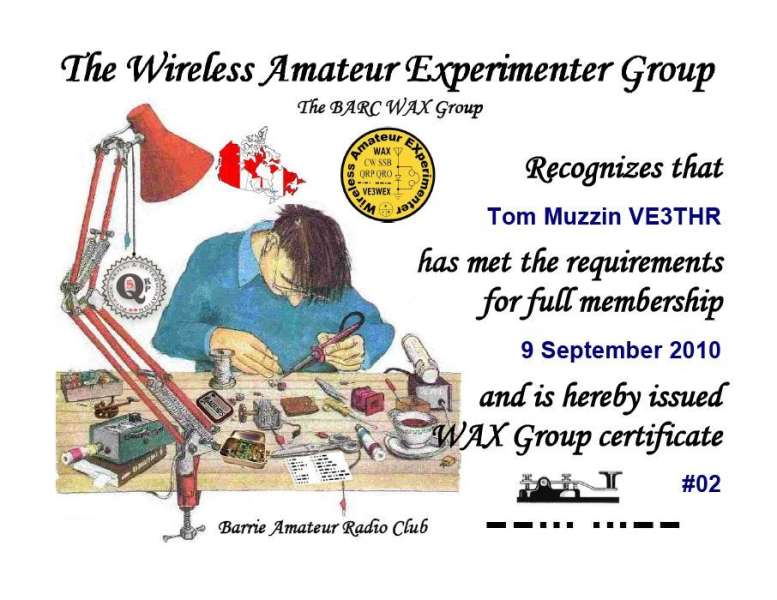
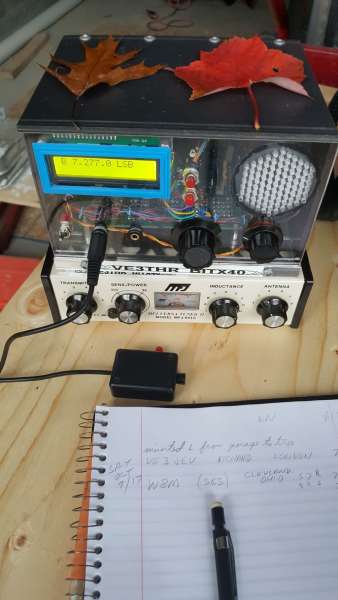
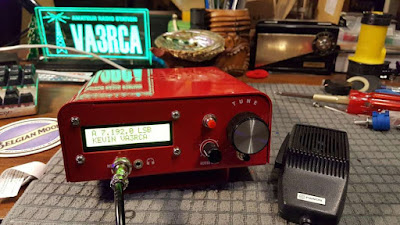
Then I got a call from VE3THR. Last year I’d talked to Tom when he was using his BITX40. This time he was on with his uBITX. FB. Tom’s club in Barrie, Ontario is obviously melting a lot of solder and having a lot of fun. Here are some pictures of their rigs.
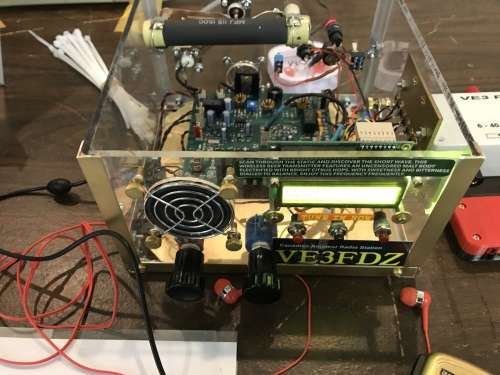
VE1LEB’s Ergonomic BITX Enclosure (in Juliano Blue)
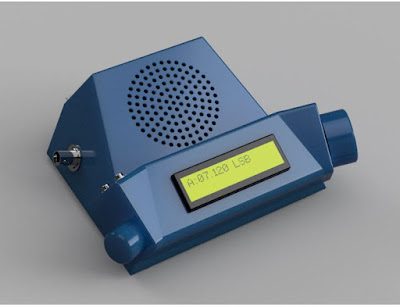
Wow, Michael’s amazingly cool BITX enclosure looks like you could use it to ask Scottie to beam you up.
Put an end to those freakish contortions — 3D print yourself an Ergonomic BITX box! Very FB Michael. Thanks.
Hi Bill and Pete:
I thought you’d be interested to see my ergonomic enclosure for the BITX40. While operating homebrewed regen radios, I noticed that my hands/arms/shoulders were becoming uncomfortable after a while. After thinking about this for a few days, I realized that the dials on the front of these small radios were forcing my hands into freakish contortions—and having both hands on the dials at all times while tuning made matters worster faster! So I did some homework and determined that our arms and hands most naturally hold things toward each other, as though they are holding a small cylinder by the ends. But the conventional “dials-and-speaker-facing-
My enclosure design for the BITX40 re-orients the volume and tuning knobs toward the sides of the radio, making their operation much more natural—and pleasant. Although it’s not retro, it does have an unconventional appearance and should fit in quite naturally with all the other homebrewed solutions featured on SolderSmoke.
You can visit my post at http://blog.
By the way, I also have a 3D printable mic for the BITX40: https://www.
73, Michael VE1LEB
An Old but Cool DiFX: The Epiphyte
I’ve been hearing about this rig for many years. It first appeared in the September 1994 issue of QRPp, the journal of the NORCAL QRP club. A condensed version of that article appeared in SPRAT 81 (Winter 94-95). The designer is Derry Spittle VE7QK from Vancouver, British Columbia.
The name always puzzled me. Here is the explanation: It started with the Neophyte: A very simple direct conversion receiver that many of us built. The Neophyte was mostly an NE602 and an LM386. In the Epiphyte, a crystal filter and a second NE602 were added, turning the Neophytes into a superhet receiver and — with some additional circuitry — an SSB transceiver. The Oxford English Dictionary reportedly defines an Epiphyte as “a plant that grows on another plant”(see picture below). The Epiphyte grew out of the Neophyte.
And this plant grew in British Columbia, which seems — like Australia and New Zealand — to be fertile ground for simple phone rigs. I’m pretty sure the “Wee Willy” DSB rig also came out of BC, and it may have had a similar purpose: allowing for portable contact with the BC Public Service Net on 75 Meters.
There are many features of the Epiphyte that I like: There is a simple 455 kHz filter and a ceramic resonator BFO/Carrier oscillator. The original design featured a VXO-like circuit using a ceramic resonator at 4.19 MHz. And it ran off AA batteries (as did the NE602 DSB rig I took to the Dominican Republic).
Unlike my NE602 rig, the Epiphyte made an artful use of the fact that NE602’s can be set up to have TWO inputs and TWO outputs. Where I used DPDT relays to switch inputs and outputs from both NE602s, OM Spittle left all the inputs and outputs connected, and simply switched the VFO and BFO signals. Ingenious.
There were updates and improvements. The Epiphyte 2 and 3 featured increased power out (5 watts vs. 1 Watt). Version 3 has an IRF-510 in the final, driven by a CA3020A chip. That chip is capable of 70 db gain. Wow.
In 1996 NORCAL and G-QRP donated 50 EP-2 kits to radio amateurs in third world countries. Very nice.
In 2000 NORCAL did a kit of the EP-3 — it sold out in 24 hours. Here is a nice article on the EP-3:
http://www.norcalqrp.org/files/Epiphyte3Mnl.pdf
And above we have a video from Japan of an EP-3 in action.
Video (Audio) of N2CQR (me) on 40 Meters with BITX DIGI-TIA
This was the icing on the cake. Ruben AC2RJ up in New York was monitoring as I called CQ with my BITX Digi-Tia last night on 40 meters. He recorded the contacts that ensued. I was really glad that he recorded VE3XBO describing his experiences with a BITX 40 Module at his local radio club — The WAX Group of the Barrie Radio Club in Ontario.
Farhan’s module is really starting to show up more often on the band. On the 19th of April I talked to Bruce KC1FSZ — he was on his Peppermint Bark BITX 40. And on March 30 I talked to Josh KE8CPD on his BITX 40.
Click on the arrow (above) to listen to Ruben’s recording. Ruben has a nice YouTube channel here:
https://www.youtube.com/channel/UCXClX_GBzFQIiqTwgnt8qxA
Stepping Inside an AM Transmitter (video)
Very cool video. We have visited VE7ZWZ’s amazing shack before. This time he takes us inside a BIG commercial AM transmitter that he has modified for use on the amateur bands.
I know that he had the plate voltage turned off, but I still felt myself cringing when he reached up to touch the plate connectors on those enormous thermatrons. The filaments were on, adding to my unease. Dude, don’t do that! And if you are standing INSIDE the transmitter, keeping one hand behind your back might not be as beneficial as it normally would be.
His comments on his VFO were interesting. I was kind of disappointed that he went with a varactor circuit. A varactor? Amidst all those bread slicer variable caps? It just doesn’t seem right. (And BTW they are bread slicers, NOT “potato slicers.”) But I kind of liked the heater–thermistor–insulation set up that keeps the VFO at constant temperature.
I thought it was interesting that these transmitters were kept on, with the tubes glowing for years at a time.
Thanks Mr. Carlson, for another great video!
VE7SL and THE POWER OF THE GREEN GLOW
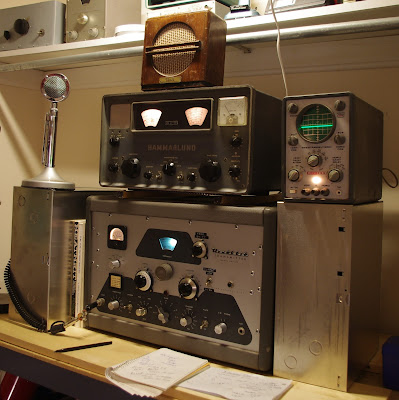
Steve VE7SL recently discussed Heathkit’s wise use of the color green in the VF-1 and DX-100 frequency readouts. The power of green is visible in the above photo of the N2CQR AM station. (I used this gear to check into the Old Military Radio Net and the Lonely Guys’ Net on 75 meters on Saturday). Note the VF-1 on the shelf in the upper left, and the awesome green oscilloscope trace. Juliano Blue is all well and good, but let’s not deny THE POWER OF GREEN.
Steve’s discussion (and cool Knack story):
http://ve7sl.blogspot.com/2017/01/the-green-glow.html
VE3KCL Balloon makes “several loops around Greenland”
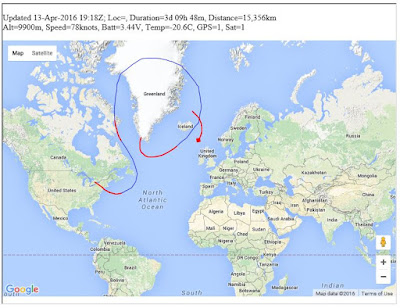
Oh, I really want to do this. We had a bunch of balloons for my daughter’s birthday and I found myself trying to guestimate how much they could lift. There is a balloon store that sells the metalized party balloons used here. They have a helium tank. I hate to be a party pooper (!) but wouldn’t the antenna represent a bit of a hazard? If it came down in power lines, that wouldn’t be good right?
In any case, three cheers for Dave VE3KCL and for Hans, G0UPL, the wizard who makes the QRSS/WSPR transmitter that is currently flying over Iceland.
Hi all
Some of you must have seen this already – but the rest of you may find it interesting. Dave VE3KCL launched his S-9 balloon 4 days ago (2 standard party-balloons, hydrogen-filled) with modified QRP Labs Ultimate3S QRSS/WSPR transmitter onboard.
We are using WSPR messages for tracking – one normal WSPR message and one with a special data protocol to provide altitude, speed, Maidenhead 5/6th characters, battery voltage, temperature and GPS/satellite status. The transmitter has about 16mW power output, on 30m band. It is sending CW and JT9 as well. Altitude is a little over 10,000m. So far it has traveled in several loops around Greenland and the North Atlantic. Currently it is near the Faroe islands. See live tracking at QRP Labs website http://qrp-labs.com/ultimate3/ve3kcl-balloons/ve3kcl-s9.html
G-landers, don’t get too excited that it appears to be heading your way – the wind prediction shows it likely to head back West almost as far as Newfoundland, before turning back East towards Spain!
73 Hans G0UPL
VA2NM’s Michigan Mighty Mite (with Tuna Tin LPF!) (video)
Bill,
Here is my contribution… After managing to somehow get my hand wound transformer to melt a pill container, I used my Dad’s hand made, circa 1950 transformer and got it working on a 1.4 MHz xtal and also on 3.58 MHz with a colour burst xtal. A re wound coil on the remaining unmelted pill container worked on 40 meters. I succeeded in getting my Mighty Mite working on three bands. My father would have been pleased, as this was kept aside all this time and now has been put to use. He had built the coil while working part time in post World War II England at the GEC labs in U.K.
Thanks for the motivation! I’m going to move forward and clean up the 80 meter signal and see how far it goes on the reverse beacon website.
The coil form was about 80 turns on a 1 inch diameter with a 20 turn secondary that I used for the center tap portion by joining both bottom ends. Then I wound an 10 trim secondary, loaded up with a 50 ohm resistor to tune up (capacitor fully opened up) on 3.58 MHz in the video, and the audio coming from my receiver tuned to the 3.58 MHz signal.
Regards,
Nigel Maund
Nigel Maund
Saskatchewan Mighty Mite (Video)
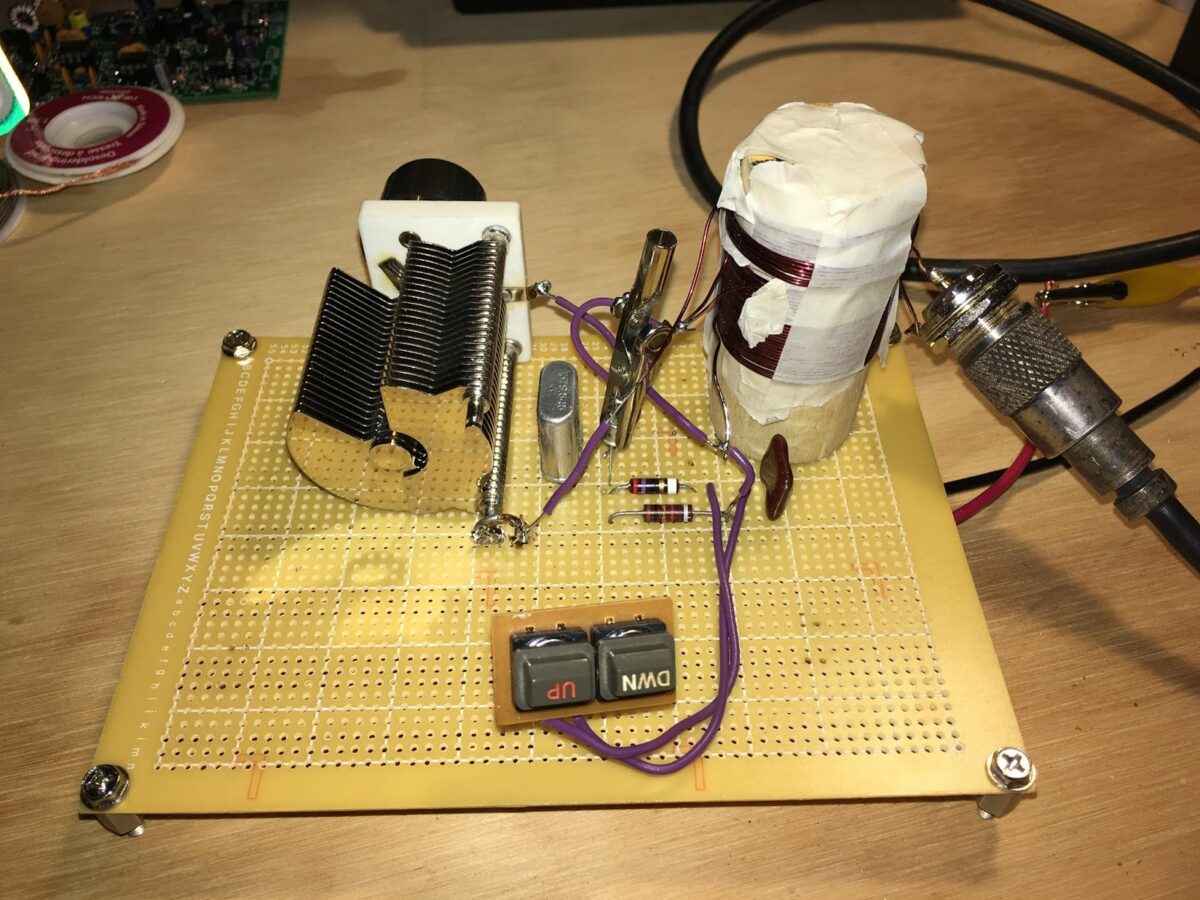
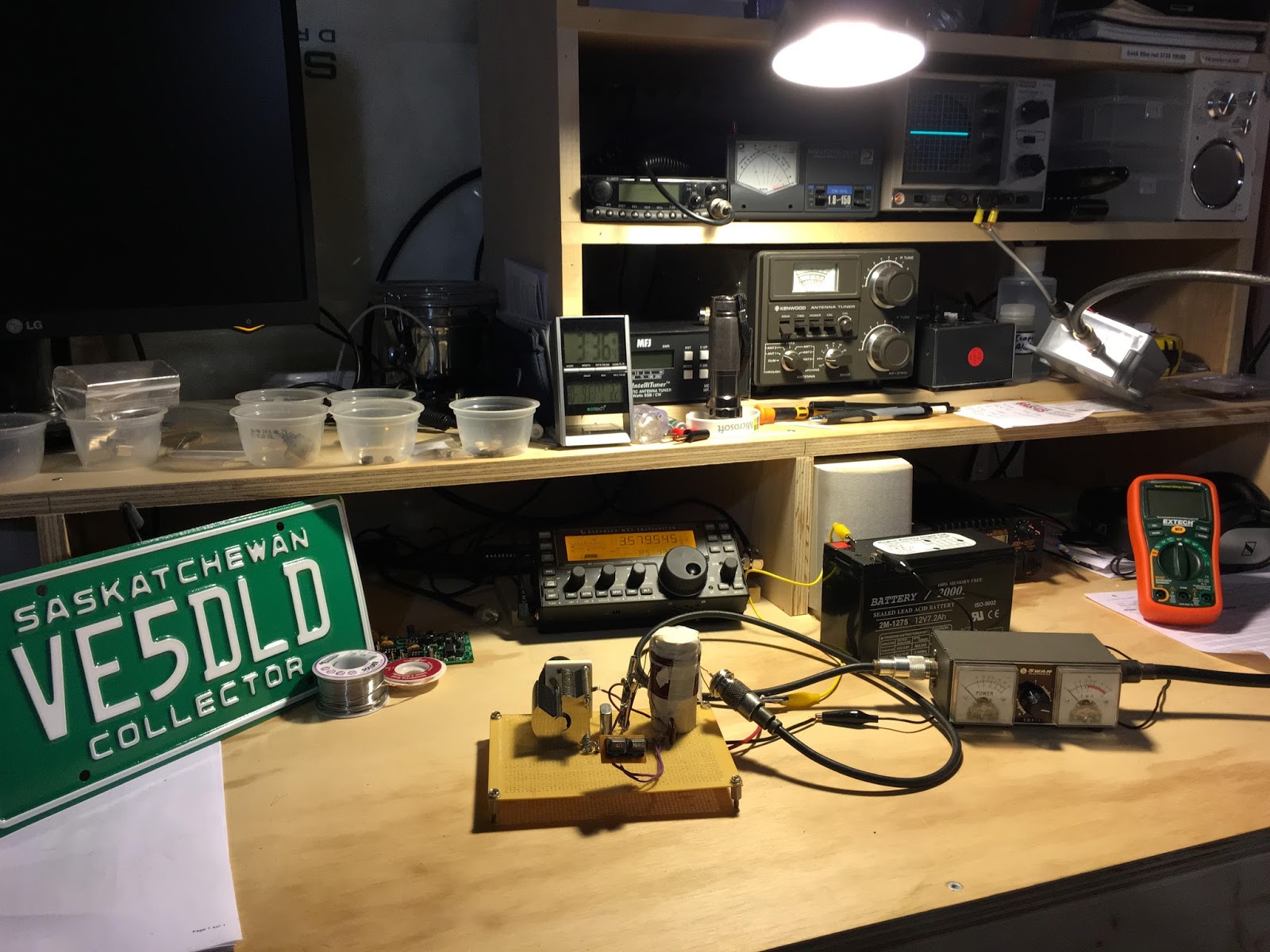
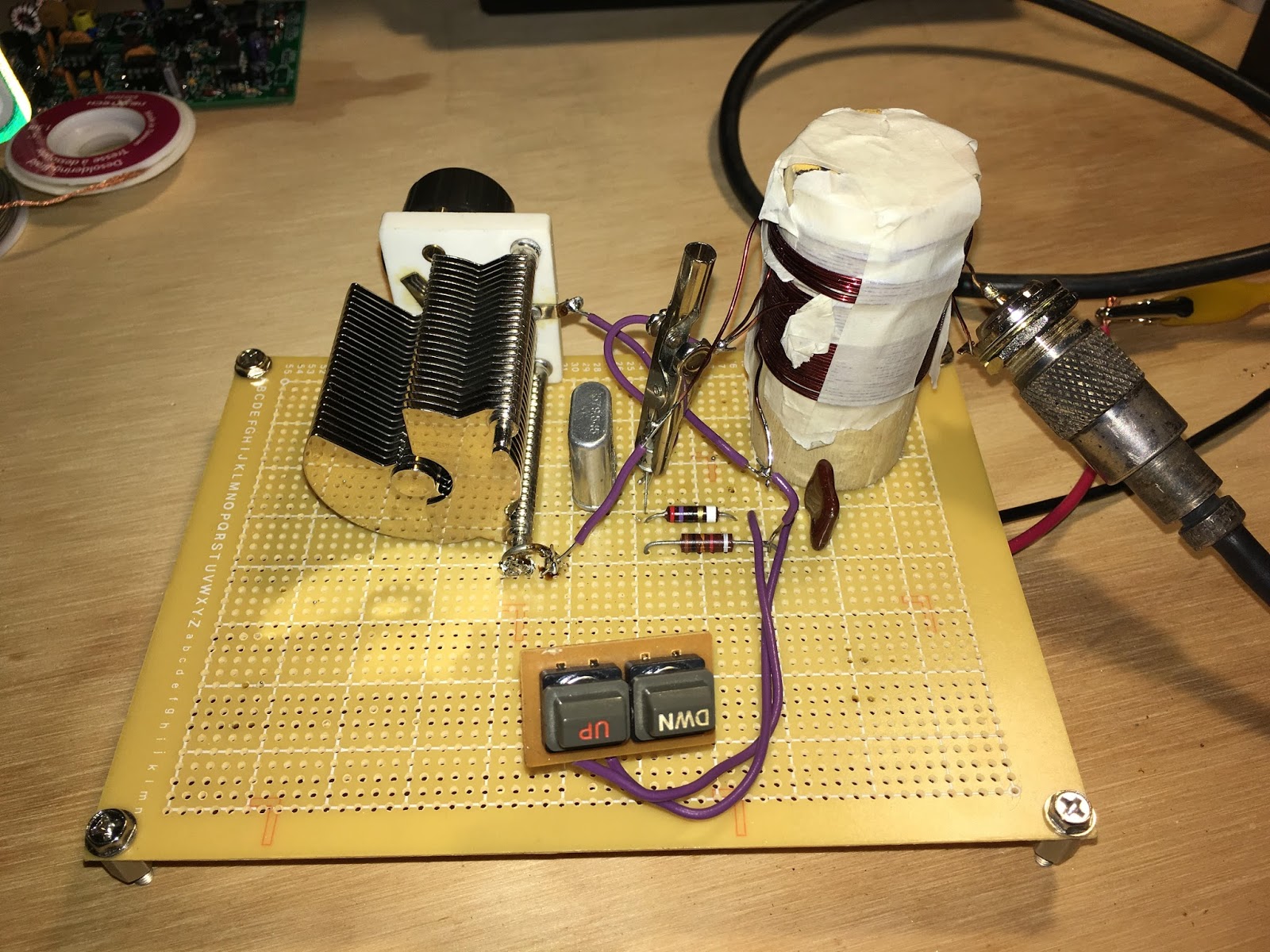
Bill and Pete,
Tonight I have had my first experience with the joy of oscillation! I’m so happy to have my M3 oscillating! This was a great first project and look forward to seeing if I can’t build a lowpass filter to go with it. As you recommended Bill, I reconfigured my initial board to make things much more compact thus keeping the lead length short. For the coil, i used a 1.25in wooden dowel and it worked great! Here are a few photos. Thanks a lot for the crystal! Video will be coming soon.
Looking forward to Pete’s 40m transceiver project. Keep up the great podcast!
Daniel
VE5DLD
The Truly Amazing Workbench and Shack of VE7ZWZ (Video)
Brace yourselves. This is almost too much. Prepare for sensory overload and possible palpitations.
Wow. This is really amazing. Note the very casual way Paul manages to mix Eico 430 oscilloscopes with the latest Tek touch-screen ‘scope. Heck, the doesn’t even mention the SP-600s! He does briefly note “a very large transmitter.” Indeed. And he has a microscope on the bench.
This video is part of an excellent YouTube channel called “Mr. Carlson’s Lab.” Great stuff in there. Paul works on everything from old tube type receivers to modern Yaesus and Icoms.
It took me a little digging to find his ham radio call sign. There are many Paul Carlsons on QRZ.com, but Paul’s pronunciation of “solder” gave him away. It seems our Canadian friends also (like the Brits) pronounce the “L.” VE7ZWZ.
Check out his channel. Lots to learn there:
https://www.youtube.com/watch?v=qqmegXoB7lA
Our book: “SolderSmoke — Global Adventures in Wireless Electronics” http://soldersmoke.com/book.htm Our coffee mugs, T-Shirts, bumper stickers: http://www.cafepress.com/SolderSmoke Our Book Store: http://astore.amazon.com/contracross-20
Teensy SDR Update (video)
I know this will have some of you thinking that I have been kidnapped or drugged or brain-washed (by N6QW!) or something, but the truth is I’m just being drawn in by that fascinating little color screen. This is the beautiful work of Rich, VE3MKC. He has also updated his blog and provided a very nice diagram and written description of all the I and Q action: http://rheslip.blogspot.ca/ Thanks Rich!
Our book: “SolderSmoke — Global Adventures in Wireless Electronics” http://soldersmoke.com/book.htm Our coffee mugs, T-Shirts, bumper stickers: http://www.cafepress.com/SolderSmoke Our Book Store: http://astore.amazon.com/contracross-20
VE3MKC’s Teensy Si5351 SDR Receiver with a Tiny Color Screen (video)
From: Rich
To: “soldersmoke@yahoo.com”
Sent: Thursday, January 22, 2015 9:22 AM
Subject: Cheap, open source Arduino SDR project
Sent: Thursday, January 22, 2015 9:22 AM
Subject: Cheap, open source Arduino SDR project
Bill
First, thanks for Soldersmoke and all you do for us QRP hackers around the world. I’m a big fan!
I’ve detected you are getting sucked into the world of microcontrollers of late. I know you are not really that excited about SDR but this is a radio that combines Arduino, the currently popular SI5351 and a Softrock to make a very functional SDR. I started this project last year which uses the fabulous Teensy 3.1 and companion audio shield. I recently packaged it all up and it looks like a QRP radio now. Still doesn’t transmit but as I like to say thats “just a small matter of software”.
There are several posts about it on my blog. The most recent:
There’s a link to a video and a link to the code in that post.
Rock on Bill!
73, Rich Heslip
VE3MKC
From: solder smoke
Sent: Friday, January 23, 2015 4:09 AM
To:
Subject: Re: Cheap, open source Arduino SDR project
Wow Rich that is really beautiful. Amazing! I am also sending this to Pete Juliano, but I was at first hesitant about this because I feared that your combination of Si5351 and TFT display might be TOO exciting for him. Deep breaths Pete…
73 and Thanks, Bill
From: jessystems@verizon.net
To: soldersmoke@yahoo.com;
Subject: Re: Cheap, open source Arduino SDR project
Date: Fri, 23 Jan 2015 06:03:40 -0800
To: soldersmoke@yahoo.com;
Subject: Re: Cheap, open source Arduino SDR project
Date: Fri, 23 Jan 2015 06:03:40 -0800
Hi Rich & Bill,
Wow –really exciting project Rich! Congratulations and Bravo!
This is so exciting, for all hams, as this just shows the power of the available low cost technology that is now on the market. Your project is really tempting as I have a V6.2 15M softrock sitting in a box (somewhere). I was somewhat put off with the Power SDR as the opposite sideband rejection is not too good –it is clear you have cracked that nut.
Thanks for sharing Rich and yes Bill I am taking very deep breaths.
73’s
Pete N6QW
Thanks guys! When I saw the Teensy 3.1 with the companion audio codec board the first thing that came to mind was a portable SDR. Since its Arduino compatible I am able to leverage the SI5351 library, encoder library etc so its mostly just putting software blocks together. The digital filter design is a bit tricky but Loftur VE2LJX did quite a bit of work on that and now it works really well.
I hope to add CW decoding and PSK31 at some point. I’ve used less than half the flash on the Teensy so lots of room for new features. I’m hoping if the word gets out I won’t have to do this all myself!
Pete – too bad you missed the Black Friday sale – Teensy 3.1 and the audio shield for $18. Deep breaths…
: )
73, Rich
VE3MKC
Our book: “SolderSmoke — Global Adventures in Wireless Electronics” http://soldersmoke.com/book.htm Our coffee mugs, T-Shirts, bumper stickers: http://www.cafepress.com/SolderSmoke Our Book Store: http://astore.amazon.com/contracross-20
VE7BPO’s QRP POPS IS BACK!
We were all understandably concerned when Todd VE7BPO announced this Fall that he was taking down his beloved QRP POPS web site. I’m pleased to report that Todd has transitioned from Web Site to blog. The spirit of QRP POPS lives on here:
http://qrp-popcorn.blogspot.com/
There are also links on this blog to all the great stuff that was on Todd’s site:
Three cheers for Todd! Hip-hip…
Our book: “SolderSmoke — Global Adventures in Wireless Electronics” http://soldersmoke.com/book.htm Our coffee mugs, T-Shirts, bumper stickers: http://www.cafepress.com/SolderSmoke Our Book Store: http://astore.amazon.com/contracross-20
Another Great Blog from Canada
Earlier we wrote about QRP POP’s reemergence in blog form.
Here’s another great blog from Canada, this one from Steve VE7SL:
http://ve7sl.blogspot.com/
Our book: “SolderSmoke — Global Adventures in Wireless Electronics” http://soldersmoke.com/book.htm Our coffee mugs, T-Shirts, bumper stickers: http://www.cafepress.com/SolderSmoke Our Book Store: http://astore.amazon.com/contracross-20