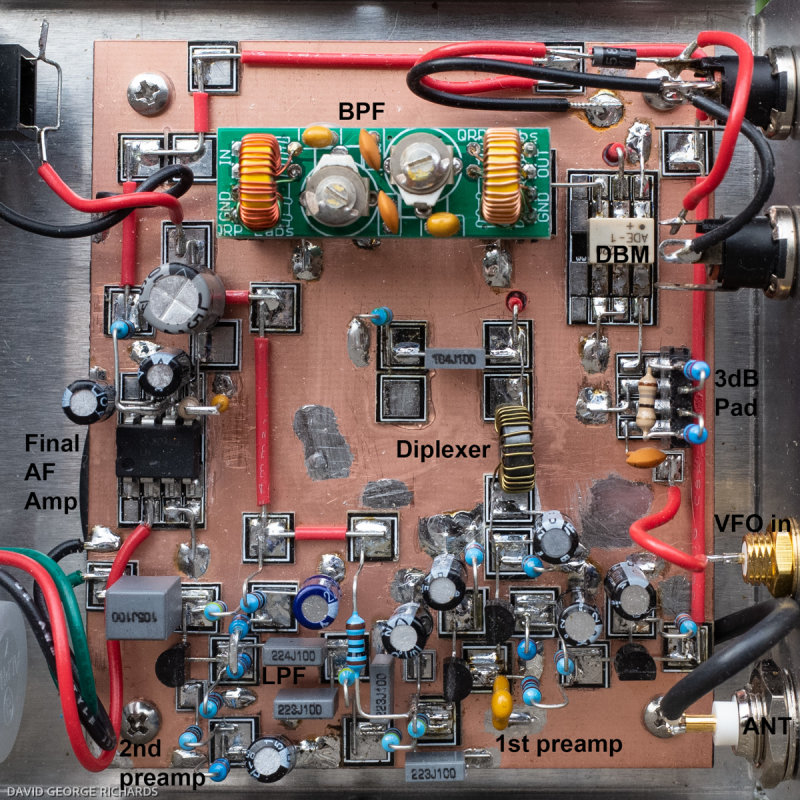
John KN6FVK’s FB Homebrew SolderSmoke Direct Conversion Receiver — Crickets Killed with Barkhausen-Be-Gone Spray!

I went to bed worrying about this one. John KN6FVK had been having a lot of problems. He had repeatedly reported hearing nothing (crickets!) when he fired up the receiver. Members of the Discord group had provided a lot of coaching, but still, CRICKETS! John had a good sense of humor. When I pointed out that oscillations in the AF amp are caused by a feedback path that meets “the Barkhausen criteria” John said he went to Lowes and bought a spray can of Barkhausen-Be-Gone. It seems to have worked. Actually I think John put some additional capacitance on the DC rail of the AF amp. In any case, he was going to wait for the evening for test out the fixed receiver. The time difference with California meant that I went to bed with fingers crossed. Happily the BBG spray and (more likely) the extra capacitance worked. John sent us some really nice videos of his receiver in action. I really like the inscriptions on his pine board. This should become “a thing.”

John writes:

I‘m very ok now…. — sigh / smile — THANK YOU ALL for your help and patience. As painful as this was, it was a lot of fun and I learned a lot. After I build an actual work bench, I might try this again (looks are important). But I’m definitely going to start playing with it and learning from it. On to Mods and Upgrades! Need to learn-up on this “Barkhausen” silliness too. -73
Here is John’s receiver pulling in CW (WB6CGJ):

Congratulations John, Welcome to the Hall of Fame.

——————————–

Join the discussion – SolderSmoke Discord Server:

https://discord.gg/Fu6B7yGxx2

Documentation on Hackaday:

https://hackaday.io/project/190327-high-schoolers-build-a-radio-receiver

SolderSmoke YouTube channel:
Monitoring Maritime Radio Messages with YADD

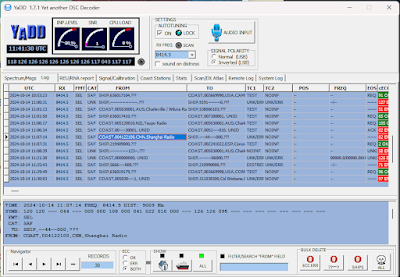
Click on the image for a clearer view
This is really cool and very easy. Easy nerd thrills.

On Friday, Steve VE7SL, put up a blog post on how we can relive the glories of our youth by monitoring HF long-distance maritime traffic. In the old days the ships were on CW and many report that it was great fun to listen to the various “fists” in action from coastal stations, and from ships on the high seas. While the CW is long gone, this maritime traffic is still on the air. Today they are using a SEL call system called Digital Selective Calling or DSC.

Happily, it is very easy to decode these transmissions. Steve recommends a program called YADD (Yet Another DSC Decoder). I downloaded it in seconds and had it installed on my computer in minutes. Next I had to find a general coverage receiver. I thought about pressing my old HQ-100 into service, or maybe even the S-38E, but a cooler head prevailed. I remembered that Farhan had given us a general coverage receiver in his uBITX transceiver. So it came off the shelf and got powered up. Around dawn on October 14, 2024 I put the receiver on 8.415 MHz LSB. I didn’t even have to do a real connection to the computer — I just put the speaker close to the mic and that was sufficient.

Boom. Soon I was getting signals from ships afloat and from coastal stations. I heard Shanghai, New Zealand, and Australia. See above. From the U.S., I heard Miami, but the most emotional for me was hearing the station at Pt. Reyes, in California. This is the station that Dick Dilman W6AWO has volunteered at for many years. FB.

Back in 2017, Steve had another post on DSC and YADD:
Thanks Steve!

This site explains very well what DSC is. From this I think we can see that there is nothing illegal about using YADD to monitor the DSC alerts (that are all emergency-related): https://infoshipping.tripod.com/gmdss_dsc.html

Ham Radio in the 1970s (and earlier, with some cool Jazz). What favorite rigs do you see?

Rogier PA1ZZ sent me this today. I think I may have seen pieces of it before, but this restoration
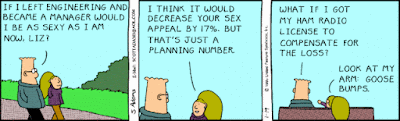
is really nice. But ham radio seems to have been a lot cooler in California. I don’t remember it being so socially advantageous on the East Coast. See Dilbert cartoon below.

So many memories:

— The video opens with someone working on a QF-1 Q multipliers. We have destroyed so many of these relics, in pursuit of the variable capacitors (which turn out to be not so good).

— A Drake 2-B on Field Day.

— An HT-37 in a shack.

–What looks like an HW-32a in a mobile rig.

— Maybe an HW-101.

— A BC-348.

— The ATV station with lots of homebrew gear was very cool.

— I also liked the single THERMATRON homebrew CW rig made from an old TV. FB.

— The CW used in the video was all pretty good. There was a lot of chirp. This, of course, adds character to a signal. FB.

After the video, they take a walk down memory lane, looking at ham radio magazines with some cool jazz playing in the background. I saw a Swan 240 and a D-104. The debauchery of the 1970s was evident on the magazine covers. Even QST seemed to be caught up in this. Check out the August 1975 cover of QST.

Anyway, this video was a lot of fun. Thanks Rogier!

What favorite rigs do you see? Make note of them in the comments.

This video and the Dilbert cartoon reminded me of a discussion we had many years ago about THE KNACK:

Who can tell us more about Lovelock’s homebrew shortwave radio?

Three years earlier, Lovelock had listened on his homemade shortwave radio in Finchley to the ‘beep, beep, beep’ transmission of the USSR’s Sputnik, the first satellite that humanity had put into orbit. Now he was playing with the super powers.”


A bit of a soap opera, but the radio question is, I think, interesting.

Pete Juliano’s Amazing Videos — 318 of Them!

Blogs come and go, but (hopefully) YouTube is more permanent and accessible. This morning I re-found Pete N6QW’s YouTube channel. When you use it, I suggest you click on “oldest” first. This will take you back 14 years, to Pete’s time in the Pacific Northwest. The video above (him playing guitar) was shot just before he and his XYL moved back to California.

Here is Pete’s YouTube channel:
This is a tremendous resource for ham radio homebrewers. It should be preserved and protected.
Subscribe!

Thanks Pete!


Eric Schwartz WA6HHQ of Elecraft — FDIM Interview #4 by Bob Crane W8SX (audio)

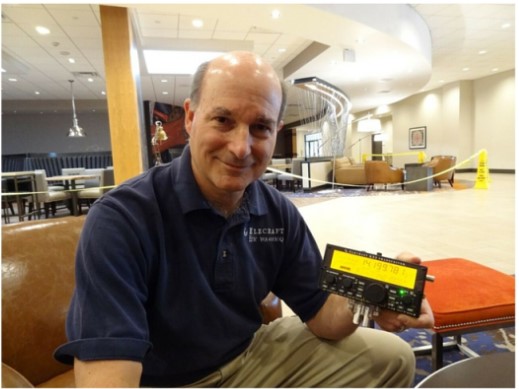
It was really cool that our correspondent at FDIM caught up with Eric Schwartz WA6HHQ of Elecraft. Some highlights from the interview:

— Eric met Wayne Burdick through the NORCAL 40 (Wayne had designed it, and Eric was writing articles about it). That was a very influential rig — it was the basis for a book and a CALTECH course by David Rutledge.

— Elecraft has a strong QRP element in its DNA.

— The K2 is “Heathkit style” and offers the builder the opportunity to understand the rig at the component level.

— Eric says that using something you built yourself is worth at least 10db.

Here is Bob’s interview with Eric:

http://soldersmoke.com/WA6HHQ23.mp3

Thanks Eric and thanks Bob.

A Surprisingly Good Movie from the Late 1960s: “The Ham’s Wide World” (Video)

I found this movie to be surprisingly good. Narrated by Arthur Godfrey, it features Barry Goldwater, and a lot of other hams. There is a homebrewer too! Lots of old rigs we know and love: a Drake 2-B, a couple of Galaxy Vs, a Benton Harbor lunchbox, Heathkit SB-series rigs, many Swans, and was that an HQ-170 that I saw in there? There are also many cool antennas, including a 15 meter quad set up by a bunch of Southern California teenagers.

Near the end, when they visit ARRL Headquarters, we briefly see none-other-than Doug DeMaw, W1FB! FB!

Please take a look at this video and post comments about the rigs, antennas, and radio amateurs that you see in the film.

Trying to Repair Some Old Gear, He Got Hit with a Dose of LSD!

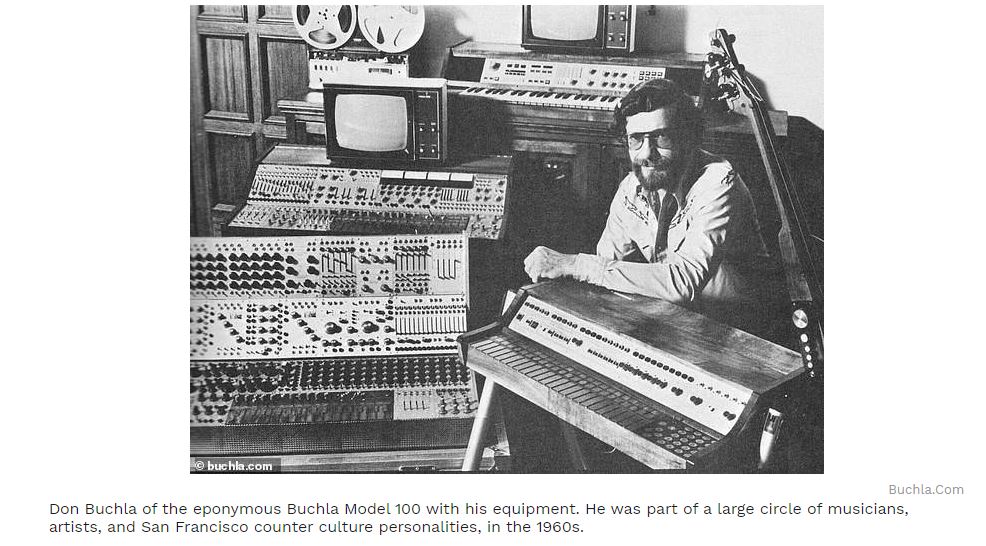
Oh no, here’s something else for us to worry about when working on old gear. As if the treat of electrocution or radioactive poisoning were not enough, now we have to worry about being hit with a dose of the 1960’s drug culture. That could be one bad trip indeed. Imagine if you were having a hard time troubleshooting the Buchla Model 100. All of a sudden things start getting weird and your test gear starts dancing on the bench.

Fortunately, this is not likely to happen with a rig like the DX-100. With rigs like that the only similar danger is nicotine poisoning.

https://allthatsinteresting.com/engineer-accidentally-takes-lsd?fbclid=IwAR2KzZl3qoL6oqq5SqWYquKpHR2mGxk2GN2Kk0O-ytUb9MNXmVNX9XnyeaU

Thanks to Stephen Walters for finding this groovy story.

AA7EE Casually Kills a Direct Conversion Receiver, then Coldly Discards a Diode Ring Mixer

I was really glad to see that Dave AA7EE has — after a long absence — posted another article on his blog. The article has some great personal reminiscences about his involvement with direct conversion receivers. Here is one passage:

I spent many happy hours tuning around and listening on 80M with the DSB80. It was this first experience that cemented my affinity for direct conversion receivers built with commercially available diode ring mixer packages. It just seemed so simple – you squirt RF into one port, a VFO into the other, and (after passing the result through a diplexer) amplify the heck out of the result. The seeming simplicity of the process of converting RF directly to baseband audio has held great appeal for me ever since. Unfortunately, that project didn’t survive. One day, in later adulthood, in my apartment in Hollywood, I reversed the polarity of the 12V DC supply and, discouraged at it’s subsequent refusal to work, tossed the whole thing away. Now, I cannot quite believe that I did that, but it was during a long period of inactivity on the ham bands, and complete lack of interest. If only I could go back, and not have thrown it into the dumpster of my apartment building! Hollywood is ridden with recent notable history. My little double sideband transceiver met it’s unfortunate end just 100 feet from the spot where Bobby Fuller, of The Bobby Fuller Four, was found dead in his car, in 1966, the subject of a still unsolved mystery to this day. The death of my little DSB rig was a lot less mysterious. To think that I heartlessly tossed an SBL-1 mixer into a dumpster, is a mark of how far I had strayed from my homebrewing roots, forged in a little village in England. Now, a few years later, in a city known for it’s sin and excess, I had cruelly ended the life of a stout and honest diode ring mixer. I suppose I should spare a thought for the polyvaricon but, well, you know – it was a polyvaricon!

https://aa7ee.wordpress.com/2021/03/04/the-ve7bpo-direct-conversion-receiver-mainframe/

The SolderSmoke Team Talks to the River City Amateur Radio Communication Society (Video)

Pete and I had a great time speaking to this really nice California ham radio club (video of the event appears above). Special thanks to club president Dr. Carol Milano, MD. Wow, what an impressive person and ham radio operator she is: https://www.qsl.net/kp4md/#New%20York
This club is doing a group build of a version of the famed Tuna Tin Two. I mentioned that I had held the original TTT in my hands, and that Rex Harper had conducted a “Mojo Transfer Ceremony” that imparted TTT Mojo to my BITX17 transceiver (which was also discussed). I promised to share the video of that momentous event. Here it is: https://youtu.be/9RZRaFUtTcc
Thanks to Carol and the members of the RCARCS. This was a lot of fun.

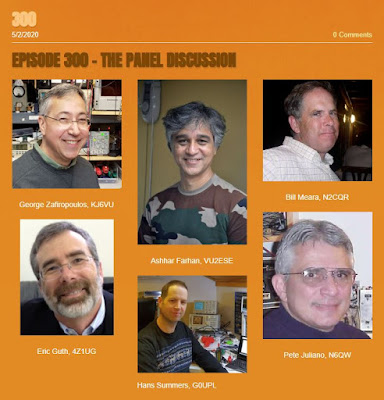
QSO Today — Episode 300 — Panel Discussion

Congratulations to Eric Guth, 4Z1UG for reaching episode #300 on his QSO Today podcast. To commemorate the event, Eric organized a panel discussion. It was a real pleasure and honor to participate.


Thanks again Eric!

SolderSmoke Podcast #208

SolderSmoke Podcast #208 is available:

http://soldersmoke.com/soldersmoke208.mp3

15 December 2018

Pete and the California fires
Bill goes to Brooklyn
2 meter simplex
A return of the trivial electric motor
Audio from Mars
HF Conditions — a real mixed bag

Pete looks back at 2018 — The Year of the SSB Transceiver — Lessons Learned

Hans Summers, the QSX and the virtues of SDR
W7ZOI’s DC Receiver Retrospective
The 1972 Solar Flare and the Vietnam War

SHAMELESS COMMERCE: Buy your gifts through the Amazon link to the upper right.
Consider SolderSmoke the book as a gift. Visit Pasta Pete’s for cooking ideas.

Don’t Build It! Sage — but unexpected — advice from Pete.

Straight Key Night approaches.

Book Reviews:
–“What is Real?” (Quantum Physics)
— RHdb by K6LHA.

Movies
“Bohemian Rhapsody”
“First Man” (Not yet!)

MAILBAG:
Steve G0FUW
Ed KC8SBV


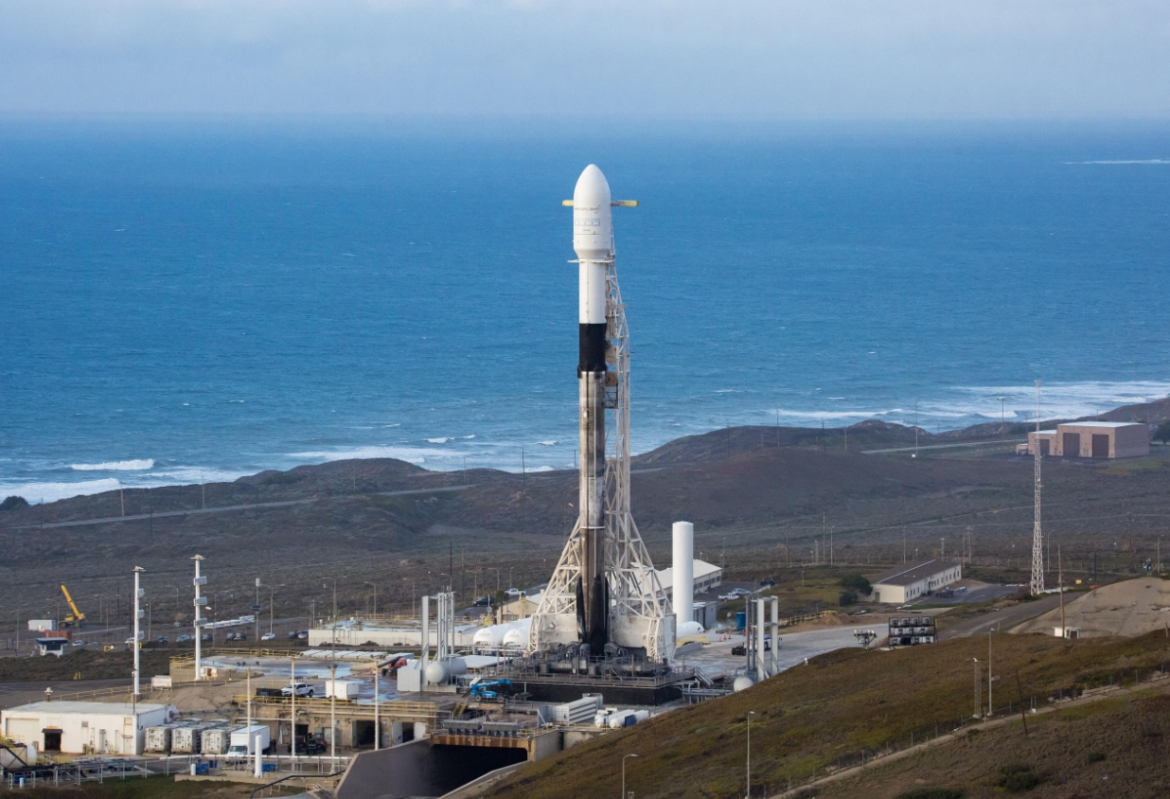
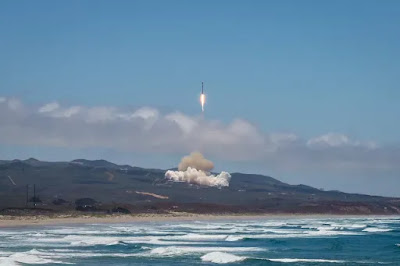
Launch Day! Godspeed Exseed! 1:31 pm Eastern time. Video links here.

Farhan posted this message and the above video to Facebook today (I have the video cued up to around the 5 minute point):

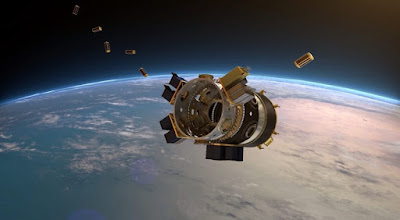
We are all set for the launch of ExseedSat… There are two tiny switches at the bottom of the satellite that keep the satellite switched off while it stays in it’s container. Once the satellite is ejected, the switches are released and the satellite wakes up.
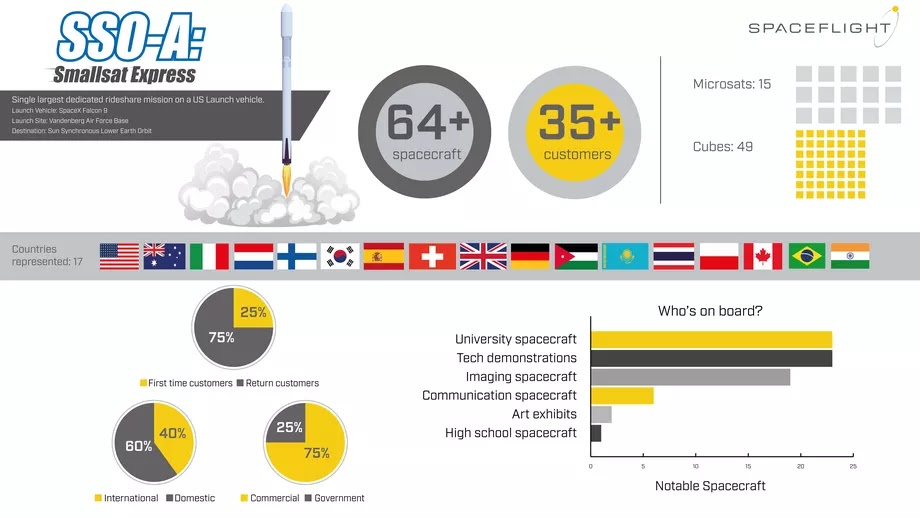
There are 36 satellites on this launch, some belong to close friends in the satellite fraternity. We wait for all the satellites to drift out and after 45 minutes, the antennas are depolyed and we will start beeping signals home.
Here is a test of that process. You can skip to the fifth minute to watch the antenna depoly .


I really like the tape measure antenna. This recalls the earliest OSCAR satellites. And let’s not forget that OSCAR 1 also launched from Vandenberg. So there a lot of good tradition flying with Farhan’s bird.

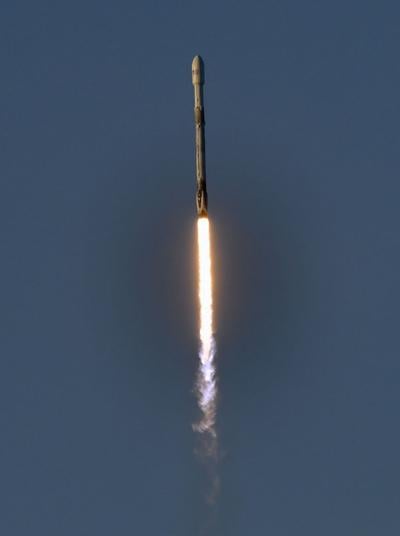
Press reports indicate a launch time of 1:31 pm Eastern time today. I think you can watch it live through the video window below. Or try this link:

https://www.youtube.com/watch?v=Wq8kS6UoOrQ

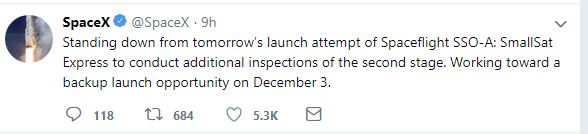
Cubesat Launch Now Scheduled for Sunday Morning (California time)


Here is an update from the San Luis Obispo News:
It kind of makes you wish you were out there…


https://spacenews.com/dedicated-rideshare-falcon-9-launch-raises-satellite-tracking-concerns/

https://www.theverge.com/2018/12/1/18114894/spacex-falcon-9-reusability-sso-a-mission-rideshare-satellites