SolderSmoke Book Only $15.99 this weekend

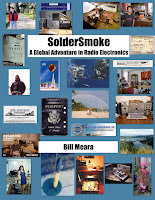
Lulu.com is running a weekend “Rollback the Clock” Sale on the SolderSmoke book. 20% off! That puts the price of the U.S.-printed edition at around $15.99 Use the coupon code: FALLBACK when you are checking out.

For shipping from a printer in the U.S. (probably better for N. American buyers) Click here: SolderSmoke USA Version

For shipping from a printer in the UK, Spain, or the USA (probably better for UK and other European buyers)
Click here: SolderSmoke EU Version

The two versions are identical, except for a minor difference in the paper used. That’s why the prices are a bit different.

Disclaimer: Save 20% off site-wide when you use coupon code FALLBACK at checkout (Maximum savings $100). Discounts cannot be used to pay for, nor shall be applied to, applicable taxes or shipping and handling charges. Promotional codes cannot be applied to any previous orders. No exchanges or substitutions allowed. Only one valid promotional code may be used per account. Offer expires November 2, 2009 at 11:59 PM GMT. Lulu.com reserves the right to change or revoke this offer at any time. Void where prohibited.

Weekend Sale: Save 15% on “SolderSmoke — The Book”

For shipping from a printer in the U.S. (probably better for N. American buyers) Click here: SolderSmoke USA Version

For shipping from a printer in the UK, Spain, or the USA (probably better for UK and other European buyers)
Click here: SolderSmoke EU Version

The two versions are identical, except for a minor difference in the paper used. That’s why the prices are a bit different.

Enter coupon code ‘TRICK‘ at checkout and save 15% off any purchase – maximum discount $35 per account. Enter coupon code ‘TREAT‘ and save 20% off on any order of $500 or more – maximum discount of $500 per account. Discount cannot be used to pay for, nor shall be applied to, applicable taxes or shipping and handling charges. Promotional codes cannot be applied to any previous order. No exchanges or substitutions allowed. Only one valid coupon code may be used per account. Offer expires on 10/25/09 at 11:59 PM GMT. Lulu.com reserves the right to change or revoke this offer at any time. Void where prohibited.

Columbus Day Sale on SolderSmoke (The Book) Save 14.92%

Enter coupon code ‘PINTA’ at checkout and save 14.92% off any purchase – maximum discount $25 per account. No exchanges or substitutions allowed. Only one valid coupon code may be used per account. Offer expires on 10/12/09 at 11:59 PM GMT. Lulu.com reserves the right to change or revoke this offer at any time. Void where prohibited.

AA1TJ’s Nifty Fifties Pixie

Once again great things are happening in the underground lab of Michael, AA1TJ. Michael has temporarily put aside his work on Iron Pyrite-based receivers, and is now working the world with 50’s era point contact transistors. I can feel the enthusiasm, even all the way over here in Rome. I particularly liked Michael’s description of the QSO in which the other guy heard his backwave. Backwave is the very small signal that is sometimes put out when the key of simple transmitter is up. For example, the oscillator on my old VXO-controlled 6 watter (from “QRP Classics”) ran all the time — I just keyed the amplifiers. Sometimes guys would report hearing some of the RF from the oscillator even when the key was up. (By the way, the term backwave reminds me of a word used sometime by Billy and Maria: backwash. As in, “No Maria, you can’t have a sip of my soda — you always leave backwash!”)

In his e-mails, Michael mentions that the physics of the point contact devices are a bit of a mystery for him. I recall that the book “Crystal Fire” by Riordan and Hoddeson had some pretty good info on how these early transistors worked.

Here are some excerpts from Michael’s e-mails on this project:

I haven’t had time to document this pyrite/tunnel diode receiver on account of a phone call that I had two weeks ago from Jack Ward at the Transistor Musuem. Jack approached me with an idea to recreate the first ham radio contacts using transistors. Of course, the point-contact transistors involved are now pretty rare items. No problem for a fellow with a transistor museum though!
Jack kindly sent me a couple of Western Electric, 2N110 “relics.” I had some initial trouble with “squegging,” and I wasn’t able to produce oscillation above 380kHz. To read a recent tale of one fellow’s trouble trying to tame the 2N110, please see
I especially liked where he wrote, “I did seriously consider giving up at this stage and taking up heavy drinking.” ;o)
However, I located an old textbook that discussed circuit design theory using point-contact transistors (the physics of these devices are still clouded in mystery). What I learned made all the difference. A few more hours at the bench and I had an 80m transmitter putting out 10mW.
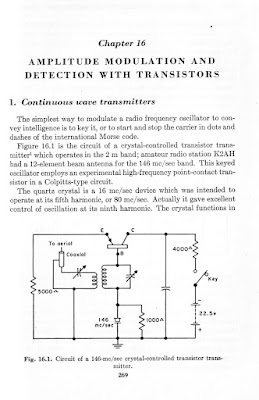
The story gets better though, Ned. A circuit briefly described in another old book really caught my attention. It was pretty much the same circuit as was used by George Rose, K2AH, in his first transistor QSO. Only, a circuit (designed by G3IEE) showed a pair of headphones in dotted lines, next to the collector resistor. The text merely said
“As indicated, the circuit also functions as an oscillating detector type of receivere for local continuous wave operations whith head phones plugged into the collector circuit instead of resistor R3. Good reception and break-in operation were obtained.”
That got my blood moving! Positive results came right away on the bench. The received signals were every bit as strong as with my Reggie and the Cub Scout heterodyne (what I started calling, “Chester,” after the name of the mine where the pyrite was found).
I had my first QSO last week using Jack’s point-contact transistor (made in 1956) in the transceiver designed by G3EII (in 1954). Jim, W1PID, was my first contact. Since then I’ve made over a dozen QSO’s with five different stations.
FYI, I’ll paste a message below that I sent to Jack Ward this weekend. One thing I forgot to add is that W1VZR copied my 10mW signal on his Cake Pan regenerative receiver over in Maine last week. Aside from my three QSO’s with VE3DJX at a distance of 319 miles, the other notable results to-date were hearing both W1DFU and W1PID – in the course of separate QSOs – when they dropped down to an output power of 100mW.
Again, I haven’t had a chance to post much on my web site, but I do have the current schematic up, and you can see both K2AH and G3IEE’s circuits in scans from the old transistor book. G3IEE’s circuit is shown in Figure 16.2 in the second jpeg image.
One more thing, Ned. I hooked up this past week with G3JNB. Victor was one of the fellows (he was only 21 at the time) working with Tony, G3IEE, back in 1954 to make the first-ever, UK ham radio QSOs using transistors. Victor has already posted an envelope containing copies of his log, the QSL card from G3IEE and the original, 1954, Wireless World article describing their results. In the course of our Skype video call last week, Victor held up to the camera the RAF telegraph key that he used for his QSO with Tony. Pretty neat, eh?
I’ve got to get back to work here. Congratulations on getting your Reggie up and running, Ned. I look forward to seeing the photos and I’d surely like to hear about any contacts you make with it. Speaking of which, I have some photos of Jim, W1FMR’s beautifully constructed Reggie that I’ve been meaning to post on my web page. Once I get around to it would you mind if I include one of your photos as well?
Best wishes,
Mike, AA1TJ
Hi Jack,

Yes, I had great fun with our little 2N110’s this past week. Of of now, I’ve had well over a dozen radio contacts with five different stations. I used 10mW of output power to make these contacts. The distances shown are all “as the crow flies.”

W1PID, Sanbornton, NH, 67miles; lowest power used on his end 100mW
VE3DJX, Smith Falls, Onatario, 319 miles; 10watts on his end
W1DFU, Wallingford, VT, 42 miles; his lowest power was 100mW
W1VZR, Limerick, ME, 100 miles; 40w

Pete, the last fellow listed, heard the 2N110 while it was running as a “beacon” with a continuously looped Morse code message. Having received my call-sign he located my email address and shot off a reception report. I saw his message pop up on my computer and quickly looked up his telephone number. He was still at his radio when he picked up the phone. I found him pretty excited as my signal strength had sharply risen in the last few minutes. He asked if there was a problem with my keying circuit as he could still hear a faint tone on my frequency when my transmitter should have been silent. “Ha!” sez I, “You’re hearing a 100 microwatt back-wave radiation!” The distance separating us divided by the 100uW power is equivalent to 1 million miles per watt; a very impressive figure!

One more station answered my CQ this past week from near Hartford, CT. However, I can’t recall his call sign and I’m currently at work but my logbook is at home. My output power was up to 17mW during that contact; on account of a temporary change that I made to the circuit. However, pushing the transistor to that power level reduced the quality of the keying, and so I returned to 10mW following that contact (earlier, I’d reported that my output power was 12mW, but a more careful measurement indicated that I was only putting out 10mW).

You might have noticed that I’ve posted the schematic to my web site. However, I expect the circuit will change over the next week, or so, as I still want to tinker with the keying circuit. By all reports my signal is good but it has just a touch of keying “chirp.” Chirp is what hams call a variation in the received signal tone when the telegraph key is first depressed. Again, I expect to have that sorted out before long.

Yes, it was a real pleasure talking with Victor, G3JNB. FYI, I’ll send you copies of all the documents that he provides. He said that he’s including some original data sheets for point contact transistors that he’s held on to these past 55 years. I’ll keep copies and send the originals to you.

I asked Victor if he’d like me to build a duplicate radio for him using the second 2N110 that you sent me. I think he was thrilled to hear my offer. Don’t you think it would wonderful if he, of all people, managed to make a contact using a reproduction of the point-contact transmitter that he and Tony, G3IEE, used in those pioneering days?

The order of business next week is to finalize the circuit design and begin building two identical circuits into permanent radios. Of course, I’ll take time off, now and then, to try and make more contacts. I’m already astonished that it was possible to span a distance of 319 miles (not once, but thrice!) using your ancient transistor relic.

Acting on your suggestion, I looked up the other fellows mentioned in K2AH’s article. It turns out that Tommy Thomas, W2UK, was quite a radio pioneer on VHF.

http://www.infoage.org/html/p-43W2uk.html

Unfortunately, I’ve learned that he passed away not so long ago. The call signs of the other two fellows are not currently in the FCC database (I suspect because they are gone as well). A quick search on the Internet turned up nothing on them.

Victor, G3JNB, remarked that he believes that he is the only one left of his original group of transistor enthusiasts. Doubtless, one reason is that he was only 21 years-old at the time of the experiments with G3IEE.

Victor reports that Tony, G3IEE, worked as an engineer for Mullard. I guess that explains where his transistors came from. Victor used a standard vacuum tube transmitter for his first contact with Tony, but sometime later he built his own one-transistor transmitter following Tony’s design. Victor says that he used it to make one or two contacts across town before he put it on the shelf. Again, I’ll be very interested to see the photocopy of his station log from that period.

One more thing, Jack. I’m fortunate to count George, G3RJV as a pal-o-mine. George is a recently retired Anglican vicar, but he also founded the GQRP; what began as a society of UK amateurs interested in low power operation. Since then, it has become something of an international institution. I had a message of congratulations this week from George; saying that he’s keeping a watchful eye on our project. In return, I inquired if George might be able to put me in contact with folk that might help shed light on what was going on at that time (transistor-wise) in the rest of “Hamdom”. That is, I’d like to assemble a folder on the topic of “first transistor QRP QSOs” for Japan, Western and Eastern Europe, Australia, etc.. I’ll keep you apprised of any news.

That’s all from here, Jack. Once again, I’d like to express my thanks to you for including me in your project. It’s already been great fun and a real pleasure to meet some wonderful people.

Kind regards,
Mike, AA1TJ
SolderSmoke (The Book) SAVE 20% ALSO: WE NOW HAVE SHIPPING FROM USA , UK, AND SPAIN

Lulu is running an Oktoberfest sale. You can save 20% on SolderSmoke (The Book). Please help spread the word to those who (gasp!) might not be checking this blog every day. Promo 1: Enter coupon code ‘PROST’ at checkout and save 20% on the purchase price of any order up (maximum discount $25. Promo 2: Enter coupon code ‘OKTOBERFEST‘ at checkout and save $50 on the purchase price of any order of $200 or more. Discount cannot be used to pay for, nor shall be applied to, applicable taxes or shipping and handling charges. Promotional codes cannot be applied to any previous orders. No exchanges or substitutions allowed. Only one valid promotional code may be used per account. Offer expires on 09/27/09 at 11:59 PM GMT. Lulu.com reserves the right to change or revoke this offer at any time. Void where prohibited.

For the version that ships from Europe use this URL:
http://www.lulu.com/content/paperback-book/soldersmoke—-a-global-adventure/7708153

For the version that ships from the USA use this URL:
http://www.lulu.com/content/paperback-book/soldersmoke/6743576

SolderSmoke Book “Pirate Day” Sale! 15% off

Looks like Lulu is running a 15% off sale for “Talk like a Pirate Day.” Apparently you just have to write “AHOY” when they ask for a promotional code. Here is what Lulu says:

Enter coupon code ‘AHOY’ at checkout and save 15% off any purchase (up to $100). Discount cannot be used to pay for, nor shall be applied to, applicable taxes or shipping and handling charges. Coupon codes cannot be applied to any previous orders. No exchanges or substitutions allowed. Only one valid promotional code may be used per account. Orders must be in U.S. Dollars. Offer expires on 09/20/09 at 11:59 PM GMT. Lulu.com reserves the right to change or revoke this offer at any time. Void where prohibited.

SolderSmoke: The Book NOW ONLY $19.99

I found a way to bring down the price on SolderSmoke — The Book.
It is now $19.99 plus shipping. Check it out:

http://www.lulu.com/content/paperback-book/soldersmoke—a-global-adventure-in-radio-electronics-%28ships-from-a-us-printer%29/6743576

This all has to do with paper availability, so this version ships only from U.S. printers. This will be a good deal for most buyers, but for buyers in Europe and Asia shipping costs might make this version too expensive. I will put up a standard version that ships from Lulu printers in Europe in a day or so.

Mixing it up

OK, enough of the pretty pictures from outer space, now it’s time to go back to mixer math.

In the podcast, on this blog, and in the SolderSmoke book I have chronicled my efforts to understand how mixer circuits REALLY work. For some of us, the trig is just not enough. We want intuitive understanding. Ya’ gotta draw us a picture. Mike KC7IT, and Dennis W6DWF, both alerted me to a good one. It is from a new book “RF Front-End: World Class Designs”, Edited by Jane Sullivan Love. The chapter on mixers is available online here:
http://i.cmpnet.com/rfdesignline/2009/08/C0429pt1.pdf

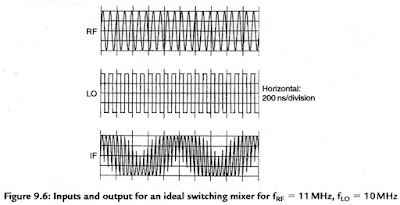
I really like figure 9.6 (above). You can really SEE how the switching action that is driven by the LO kind of “chops up” the RF signal and produces the complex waveform that is the IF. The neat thing about the IF waveform in this drawing is that you can clearly see both the sum freq (the smaller squiggles) AND the difference freq (the overall movement inside which the smaller squiggles are present). Go ahead, count them up! Sums and differences!
This is a special kind of mixer: a polarity-reversing switching mixer. When the LO is negative, it inverts whatever is at the RF port. From this you can see why mixers are described mathematically as “multipliers.” This mixer is multiplying the instantaneous value of the RF input by +1 (when the LO is positive) and then by -1 (when the LO is negative).
I think it is quite a bit harder to “see” the genesis of the sum and difference freqs when you are working with non-switching mixers, but this diagram is, I think, really useful in gaining an intuitive understanding of what goes on in the mixing process.

SolderSmoke (The Book) Reaches the Oregon Coast

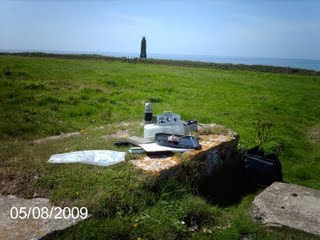
Wes, W7ZOI, took the book with him on vacation and sent along this shot from the Oregon coast. I told Wes that I was really nervous when I saw his e-mail in my in-box. The book has sections about my “understandings” of various aspects of electronic theory. I worried that the e-mail would reveal that these were all “MIS-understandings.” I was very relieved that wasn’t the case! Wes provided an interesting bit of ham radio history/trivia: Around page 169, I have the iconic picture of Wes out in the winter woods somewhere, with a homebrew QRP rig in his hands. I remember seeing this picture as a kid. I found it inspirational: a stoic homebrewer, using his invention to communicate from out in the hostile wilderness. In his e-mail, Wes tells me that in that photo, he was actually in contact with another station. It was Lionel, VE6WG, up near Calgary. This photo was taken by K7IUN. Thanks Wes!

Chuck Penson — Heathkits, Nukes, and QRP

Back in my days as an anchor-ologist (a fan of old, heavy “Boatanchors” radios), I frequently consulted Chuck Penson’s wonderful book about Heathkits. I was glad to see that he has developed an interest in QRP and is going to speak at CactusCon. Here is what the AZ Scorpion web site had to say about Chuck:

Chuck has a background in industrial archeology and a passion of the history of science and technology, with a special interest in nuclear weapons. He recently retired from the University of Arizona and now spends his time as the historian for the Titan Missile Museum in Green Valley Arizona. He is the author of two books: “Heathkit–A Guide to the Amateur Radio Products” and more recenty “The Titan II Handbook: A Civilian’s Guide to the Most Powerful ICBM America Ever Built.”

Penson has been a ham radio operator since 1966 and currently holds an advanced class license. His other interests include renewable energy, astronomy, hiking and pizza. He lives with his wife, Kathryn, at their off-the-grid ranch in the desert west of Tucson.

Apollo 11

I was 10 years-old and totally involved with the mission. Armstrong
was my hero. I kept a scrapbook (still have it). There is an
interesting Italian angle: Collins was born in Rome. His dad was with
the US Embassy. Glad to see Buzz is doing well. There is a great story
in the book Moondust about his dealings with an obnoxious reporter. I
think Buzz handled it perfectly.

Into Space (almost) with the Basic Stamp

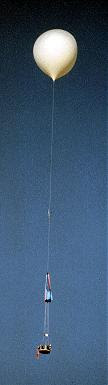
L. Paul Verhage has been a leader in the edge-of-space balloon game for a long time now. This morning, Hack-A-Day led me to a site that has an on-line version of his book, and a collection of his balloon and Basic Stamp articles for Nuts-and-Volts. Inspirational stuff.

Here it is: http://www.parallax.com/tabid/567/Default.aspx

SolderSmoke — The Book. Table of Contents

As promised in SolderSmoke 109, here is the Table of Contents for the new SolderSmoke book.

CONTENTS

Preface

Chapter 1 Electrically Inclined – Tales of an Electromagnetic Youth
Electrons and Electricity
Radio Waves
Some Basic Equations
Einstein in the Transformer
Semiconductors

Chapter 2 Off-the-Air—Amateur Radio Goes Into Hibernation
Junctions and Diodes

Chapter 3 Tropical Rebirth—Ham Radio in the Dominican Republic
The Lowly Capacitor
Resonance and Oscillation
Series and Parallel Tuned Circuits

Chapter 4 Boatanchors in Virginia—Back in the U.S.A.
Transistor Amplifiers
Mixers
Modulation: AM, DSB, SSB

Chapter 5 Mid-Atlantic Outpost—Amateur Radio from the Azores
Balanced Modulators

Chapter 6 Urban Radio—Solder Smoke in Central London
Amplifier Loads

Chapter 7 Rome—Secret Radio in the Eternal City
Feedback in Amplifiers

Chapter 8 Conclusions—A Brotherhood Without Borders

Acknowledgements

Index

To order: http://www.lulu.com/content/paperback-book/soldersmoke/6743576

Alan Yates Making X-Rays from Rectifier Tubes

Anytime you find yourself writing a sentence like this…
“At only 20-30 kV and a few hundred uA in cold-cathode mode the x-ray radiation pours out, making the end-window Geiger counter scream from more than a meter away.
… perhaps some alarm bells should be going off.

Our friend Alan, VK2ZAY, has been busy in the lab, generating X-Rays from old 2X2 rectifier tubes. This reminds me of one of the articles in the wonderful C.L. Strong book, “The Amateur Scientist.” Check it out: http://www.vk2zay.net/article/222

Hey Alan, can you make us up some of those X-Ray glasses that they always advertised in the backs of magazines? As a teenager, I somehow always wanted one of those…

SolderSmoke — The Book! On Sale Now!

SolderSmoke is the story of a secret, after-hours life in
electronics. Bill Meara started out as a normal kid, from a normal
American town. But around the age of 12, he got interested in
electronics, and he has never been the same.
To make matters worse, when he got older he became a diplomat. His
work has taken him to Panama, Honduras, El Salvador, the Spanish Basque
Country, the Dominican Republic, the Azores islands of Portugal,
London, and, most recently, Rome. In almost all of these places his
addiction to electronics caused him to seek out like-minded radio
fiends, to stay up late into the night working on strange projects, and
to build embarrassingly large antennas above innocent foreign
neighborhoods. SolderSmoke takes you into the basement workshops and
electronics parts stores of these exotic foreign places, and lets you
experience the life of an expatriate geek. If you are looking for
restaurant or hotel recommendations, look elsewhere. But if you need to
know where to get an RF choke re-wound in Santo Domingo, SolderSmoke is the book for you.
SolderSmoke is no ordinary memoir. It is a technical memoir. Each
chapter contains descriptions of Bill’s struggles to understand (really
understand) radio-electronic theory. Why does P=IE? Do holes really
flow through transistors? What is a radio wave? How does a frequency
mixer produce sum and difference frequencies? If these are the kinds
of questions that keep you up at night, this book is for you.
Finally, SolderSmoke is about brotherhood. International,
cross-border brotherhood. Through the SolderSmoke podcast we have
discovered that all around the world, in countries as different as
Sudan and Switzerland, there are geeks just like us, guys with
essentially the same story, guys who got interested in radio and
electronics as teenagers, and who have stuck with it ever since. Our
technical addiction gives us something in common, something that
transcends national differences. And our electronics gives us the means
to communicate. United by a common interest in radio, and drawn closer
together by means of the internet, we form an “International
Brotherhood of Electronic Wizards.”

Thunderstruck!

Chris Trask, N7ZWY, recommended this book. I’m really enjoying it. Maybe too much: I was reading it on a crowded Rome bus this week, and was so absorbed by the chapter on Marconi’s first efforts to transmit beyond line-of-sight that I didn’t notice the pickpocket. He got my little radio receiver/MP3 player. The radio gods let me down that morning!

Lots of Great Old Radio Books FREE!

Our man in Helsinki, Greg, OH2FFY, reports that “Armstrong: A Man of High Fidelity” is available free online. We talked about this book in a recent SolderSmoke. I checked it out and found the online version to be very easy to read. I suggest you click on the “flip” version — you get a very nice display that is much like looking at a real book. Here’s the link:
http://tinyurl.com/cvc4qd
That link led me to Project Gutenberg where I plugged in the word “radio” and was instantly given a list of really nice old books, including the Radio Amateur’s Handbook by A. Frederick Collins of Congers N.Y. (my home town). Here it is:
http://www.archive.org/details/theradioamateurs06935gut
Thanks Greg!