SolderSmoke Podcast #181 Of Dongles and DX-100s — SDR vs. HDR, Music & Art, 2B, HB2HB, Noise, The Martian, VK3YE’s New Book

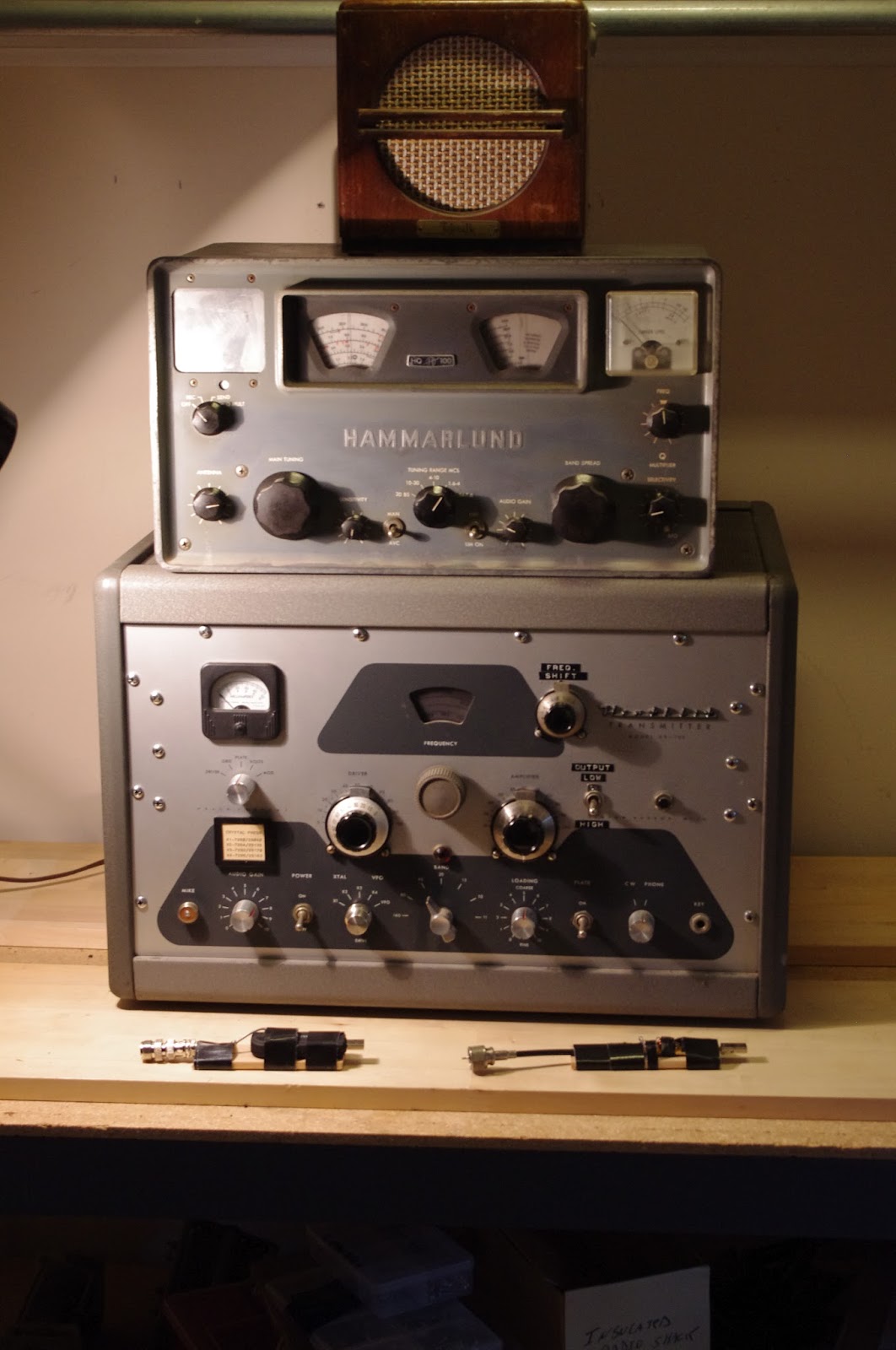
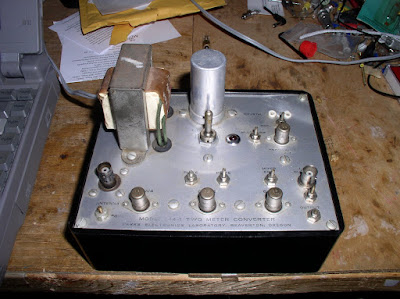
Two RTL SDR Dongles in front of a DX-100 Transmitter

SolderSmoke Podcast #181 is available:

17 October 2015

— Our audience IGNORES Pete’s guitar intro!
— Pete on QSO Today Podcast.
— Part 97, The Radio Art and International Goodwill.
BENCH REPORTS:
— Pete connects his new beam to the KX3.
— Pete puts the Bell-thorn on 20.
— Simple-ceiver update.
— Pete’s new drum machine: http://makezine.com/2015/10/15/learn-electronics-worlds-oldest-drum-machine/
— Bill fights noise in the DIGI-TIA.
— Bill fights power-line noise (and wins!).
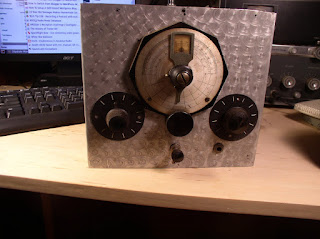
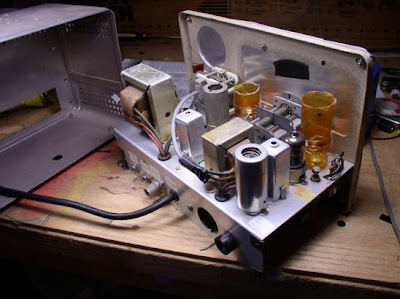
— Drake 2B, skirts, reduction drives, and tuning rates.
— Warming up (with!) the DX-100.

— N2CQR — N6QW First Ever HB2HB QSO.

— On 40 AM with an HT-37
— Listening to Chinese CubeSats.
— SDR Dongle as a bandwidth checker.

— SDR and the Future of Homebrew Radio.

— Bryan’s LBS Receiver.
— Dean’s First Ever QSO with his HB rig.

— 32 Mighty Mites Completed

— The Martian — Did Mark Watney REALLY have the Knack?

— MAILBAG:
Peter Parker’s New Book
Sparks from Ron Sparks
Armand’s 1Watter
Rogier’s pyro machine
BIG boxes from Tim KI6BGE
Mikele’s ZIA and N6QW rig collection
SPRAT 141 and SPRAT 164

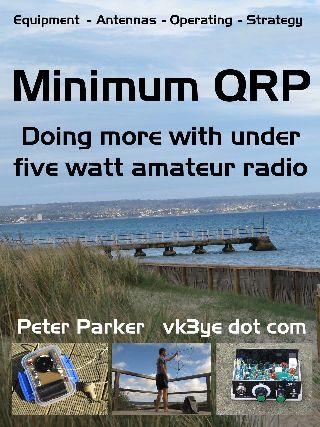
Peter Parker’s New QRP Book

The wizard of Melbourne Beach, Peter Parker VK3YE, has written a book about QRP. Check it out here.

Peter is a true QRP guru. His Beach 40 transceiver is shaking the ether from locations around the world. I am really glad that he put that Melbourne dock on the cover. That dock has been the test site for many of Peter’s amazing creations. The railing has supported many great antennas. So many wonderful YouTube videos have been recorded there. There really should be a plaque or something…

Peter’s book is available as an e-book from Amazon. Details on how you can get it are here”
http://home.alphalink.com.au/~parkerp/miniqrp.htm

Thanks Peter for this important addition to the QRP literature.

Interview with Paul Horowitz (W1HFA) — A Giant In Radio Electronics (Video)

I’ve been hearing about this book for years, but until I watched this interview, I knew nothing about the author. Thanks Lady Ada. (And thanks to Farhan for the alert.)

As a native New Yorker, I’m pleased to include in the blog yet another reminder that the Big Apple is not all fashion and finance — a lot of solder has been melted in my home town.

Paul Horowitz has a truly awesome bio. He got his ham license at age eight. QST tells us that lots of little kids do this, but unlike some of the youngsters we see in the magazine I suspect young Paul really mastered the theory. Paul Horowitz has “The Knack.” Big time.

PhD from Harvard. Author of “The Art of Electronics.” Pioneer in the Search for Extraterrestrial Intelligence. Carl Sagan is believed to have modeled the main character in “Contact” partly on Paul. Check out the wiki page:

https://en.wikipedia.org/wiki/Paul_Horowitz

Our book: “SolderSmoke — Global Adventures in Wireless Electronics” http://soldersmoke.com/book.htm Our coffee mugs, T-Shirts, bumper stickers: http://www.cafepress.com/SolderSmoke Our Book Store: http://astore.amazon.com/contracross-20

“The Soul of a New Machine”

We talk a lot about putting soul in our new machines. The phrase comes from a book by Tracy Kidder. Ira Flatow of NPR’s Science Friday recently took a new look at this book. There are TWO recordings in this link. Both are worth listening to. The second is an interview with the author, conducted at Google HQ in New York City. Woz chimes in.
At about 6:43 in the second interview, Ira Flatow and Tracy Kidder get into a little argument about how to pronounce the word “kludge.” I’m with Ira — the fact that he pronounces it this way makes me think that we are using a New York, or at least and East Coast pronunciation.
I am a big fan of Tracy Kidder. His “Mountains Beyond Mountains” is about Dr. Paul Farmer, a heroic physician who has dedicated his life to treating the poor people of Haiti. “My Detachment” is about Kidder’s stint as an army officer in Vietnam. Kidder and his editor wrote a nice book about the crafts of writing and editing: “Good Prose.” “Strength in What Remains” is about the genocide in Burundi.

Our book: “SolderSmoke — Global Adventures in Wireless Electronics” http://soldersmoke.com/book.htm Our coffee mugs, T-Shirts, bumper stickers: http://www.cafepress.com/SolderSmoke Our Book Store: http://astore.amazon.com/contracross-20

Adam Savage (Myth Busters) Interviews Andy Weir (Author of “The Martian”)

I liked this interview a lot, and I am sure SolderSmoke listeners will like it too.
Weir admits to NOT having the Knack, but Mark Watney clearly does have it.

Also, check this out: http://www.cannonade.net/mars.php#map

Our book: “SolderSmoke — Global Adventures in Wireless Electronics” http://soldersmoke.com/book.htm Our coffee mugs, T-Shirts, bumper stickers: http://www.cafepress.com/SolderSmoke Our Book Store: http://astore.amazon.com/contracross-20

Knack Movie and Book — SolderSmoke on Mars — “The Martian”

I realize I’m very late in reading this book. Billy read it last winter. The movie is already coming out. I guess I didn’t see the Knack element in this story until I saw the movie trailer. Wow. This is a book and movie for us. Dude is stranded on Mars and has to fix the radio (with Hendrix playing in the background). I’m reading the book now (appropriately, on my I-phone). I find myself thinking about the Elser-Mathes Cup.

More on the book here: https://en.wikipedia.org/wiki/The_Martian_(Weir_novel)

From the Wiki article:
Andy Weir, the son of a particle physicist, has a background in computer science. He began writing the book in 2009, researching related material so that it would be as realistic as possible and based on existing technology.[4] Weir studied orbital mechanics, astronomy, and the history of manned spaceflight.[6] He said he knows the exact date of each day in the book.[7]
Having been rebuffed by literary agents when trying to get prior books published, Weir decided to put the book online in serial format one chapter at a time for free at his website.[4] At the request of fans, he made an Amazon Kindle version available at 99 cents (the minimum he could set the price).[4] The Kindle edition rose to the top of Amazon’s list of best-selling science-fiction titles, where it sold 35,000 copies in three months, more than had been previously downloaded free.[4][7] This garnered the attention of publishers: Podium Publishing, an audiobook publisher, signed for the audiobook rights in January 2013. Weir sold the print rights to Crown in March 2013 for over a hundred thousand dollars.[4]
The book debuted on the New York Times Best Seller list on March 2, 2014 in the hardcover fiction category at twelfth position.[

Our book: “SolderSmoke — Global Adventures in Wireless Electronics” http://soldersmoke.com/book.htm Our coffee mugs, T-Shirts, bumper stickers: http://www.cafepress.com/SolderSmoke Our Book Store: http://astore.amazon.com/contracross-20

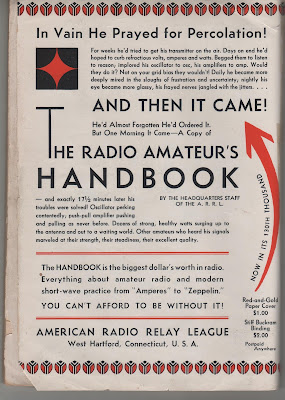
Been There, Done That: “…he begged his oscillator to osc and his amplifiers to amp.”

This ad is from the December 1931 issue of QST. This copy has a LOT of mileage on it. In 1993 or 1994, David Cowhig (now WA1LBP) was living in Okinawa Japan and was operating as 7J6CBQ. I was living in the Dominican Republic and operating as N2CQR/HI8. We were both contributing to a 73 magazine column (as “Hambassadors”!) and we were both in the Foreign Service. I wrote to David — he wrote back, sending me some old QSTs, including the one from which the above ad is taken.

This ad shows that many of the homebrew/troubleshooting woes that we face today are very old. And that having access to good technical books is very important when you are trying to overcome these difficulties.

Our book: “SolderSmoke — Global Adventures in Wireless Electronics” http://soldersmoke.com/book.htm Our coffee mugs, T-Shirts, bumper stickers: http://www.cafepress.com/SolderSmoke Our Book Store: http://astore.amazon.com/contracross-20

Frank Harris and the Nobel Prize for Sideband

A lot of wisdom and good info in this chapter (and in the whole book);

http://www.qrparci.org/wa0itp/chap15.pdf

http://www.wa0itp.com/crystalsetsssb.html

Our book: “SolderSmoke — Global Adventures in Wireless Electronics” http://soldersmoke.com/book.htm Our coffee mugs, T-Shirts, bumper stickers: http://www.cafepress.com/SolderSmoke Our Book Store: http://astore.amazon.com/contracross-20

Italy, Spain, Gibraltar, a Flight to Prague, and How the Mighty Mite Really Works


Gab IZ1KSW is a true Knack-afflicted member of the International Brotherhood of Electronic Wizards: He is an Italian homebrewer who lives in Spain and works in Gibraltar. At the end of this e-mail exchange he has a great story about reading “SolderSmoke — The Book” on a flight to Prague with his Greek girlfriend. It reminded me a bit of the problems I’ve had with fellow passengers while reading “Hot Iron” on the Washington DC train system.

A blog post about Gab’s version of the Mighty Mite is here: http://soldersmoke.blogspot.com/2015/02/iz1ksws-italian-mighty-mite-video.html
His desire to REALLY understand the circuit is, I think, admirable. I know that my quick explanation of how the Mighty Mite circuit works isn’t complete, and I’m sure that others will jump in with more details.

……………………

Hi guys,

I write to you because I’m a bit lost.
Ok, the MMM is oscillating, brilliant!
Now I’d like to understand why it’s working and how it’s working.
I’ve been sitting on the workbench with the schematics in front of me and I found some resources on the internet, I’ve understood the concept of feedback loop but what really make me scratching my head is that I cannot match the MMM schematic with anyone of the typical oscillator design I found (Pierce, Colpitts, Hartley).
I’ve read online that it can be considered as a Pierce oscillator but from what I’ve found online I cannot find the purpose of the tapped coil. Maybe you can point me in the right direction before my GF starts complaining about the pile of schematics I’m accumulating in the living room!
Also, if you have any books to recommend, I’ll be happy to go “back to the books”

Thank you and 73
Gab – IZ1KSW

……………..

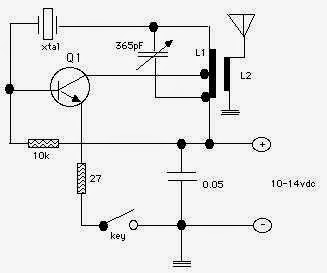
OK Gab. I’ve been meaning to do this. This little circuit needs some explanation. I’ll take a shot:

Start by thinking of this circuit as an amplifier. The 27 ohm resistor from the emitter to ground (negative terminal) puts a limit on how much current will flow.

The 10K resistor from the base to the positive terminal puts a positive voltage on the base and biases it so that current will flow through the transistor.

Now the fun begins! It is an amplifier, but it has no input signal! The input signal is the output signal — it is like a dog chasing his tail!

The crystal is very important. It is the main frequency determining element, and it is the conduit for the feedback that gets this thing oscillating. It is a piece of quartz. If you put a voltage across it, it will begin vibrating (physically) at a specific frequency. As it physically vibrates, it also creates electrical vibrations.

So, when you turn this thing on, noise in the circuit will put a bit of charge on the crystal. It will begin to ring, much like a musical tuning fork. The electrical vibrations from the crystal will go to the base. They will be amplified by the transistor and will emerge (stronger) from the collector. From the collector, they go to the 3.579 MHz tuned circuit formed by the big coil and the variable capacitor.

The coil wound on the film box serves several purposes. The portion of the coil between the positive terminal and the collector carries the 12V DC to the collector of the transistor. It also carries the amplified 3.579 MHz signal coming from the collector. This signal goes through the lower portion of the coil and causes the coil and the capacitor to resonate. The signal at the top of the tuned circuit peaks when the tuned circuit is tuned to…. 3.579 MHz.

The capacitor/coil tuned circuit (with the tapped coil) are set up so that the right amount of energy is fed back from the output to the input, and that this energy is fed back in the proper phase relationship to the signal at the input. Think of a child’s swing at a park: To keep the swing oscillating, you have to push at the right moment (frequency and phase) and with the right amount of energy.

The little capacitor across the battery is to prevent “key clicks.” The output coil on the main coil takes some of the energy and sends it to the antenna while converting the impedance of the antenna to a suitable “load” for the transistor.

Whew, how did I do? Lots of electronics and physics in those 7 parts!

73 Bill

…………….


Hi Guys,
Bills explanation is absolutely perfect –but there is some additional Math in the woodworks known as the Barkhausen criteria where kB = 1
73’s
Pete N6QW


……………

Well, what can I say Bill? Grazie mille!!

I keep thinking that you would have been a great teacher, you have the rare ability to explain complicated concepts using simple words.
Yesterday I finished reading your book SolderSmoke GAWE (yes, you deserve an acronym too) and there have been several “eureka” moments while I was reading it. It gave me a lot of motivation to go in depth and understand what’s going on in a circuit down to the physics of the components. I got the Kindle version but I’ll order the paper version too, I love the hand make schematic and they’re not very readable in the electronic version, plus I believe that a book about radio home brewing must be in the old fashioned paper version don’t you think?
There’s a funny story about the book. Few days ago I was on a flight to Prague with my YL, I was reading the book and zooming on the schematics to see them better, I was really into it and I didn’t notice that the guy sitting on the seat next to me started to look at the kindle nervously, he probably though I was an bomb home brewer HI! So I decided to pass the Kindle to Angeliki so that she could read her books. She’s Greek and she started reading a Greek book, written with the Greek alphabet which looks quite weird if you don’t know it. At that point probably the guy thought to be sitting in the middle of some exotic terrorist… it was funny.

Wow… as most of the Italians do, I talked too much! Thanks again both for the big effort you make spreading the tribal knowledge with the podcast, the ARCI LBS articles and the books.
Siete fantastici!

73
IZ1KSW – Gab

Our book: “SolderSmoke — Global Adventures in Wireless Electronics” http://soldersmoke.com/book.htm Our coffee mugs, T-Shirts, bumper stickers: http://www.cafepress.com/SolderSmoke Our Book Store: http://astore.amazon.com/contracross-20

New Homebrew Book: The Joy of Homebrew Oscillations

Sent to us by Ben Tovar. Soon to be available in EE-book (get it!) Thanks Ben!

Our book: “SolderSmoke — Global Adventures in Wireless Electronics” http://soldersmoke.com/book.htm Our coffee mugs, T-Shirts, bumper stickers: http://www.cafepress.com/SolderSmoke Our Book Store: http://astore.amazon.com/contracross-20

“Science Friday” Interviews Author of “The Innovators” (listen)


Michael Rainey alerted me to Ira Flatow’s Science Friday interview with author Walter Isaacson. I’m reading Isaacson’s new book “The Innovators” (appropriately, on my Iphone 5). The book is very good, with surprisingly frequent references to ham radio. Flatow’s interview with Isaacson is also quite good, and will give you a better idea of what the book is about. Here it is. It is worth a listen:
http://www.sciencefriday.com/segment/10/24/2014/meet-the-innovators-who-made-the-digital-revolution.html

Our book: “SolderSmoke — Global Adventures in Wireless Electronics” http://soldersmoke.com/book.htm Our coffee mugs, T-Shirts, bumper stickers: http://www.cafepress.com/SolderSmoke Our Book Store: http://astore.amazon.com/contracross-20

Author Walter Isaacson was a Radio Amateur

This is the guy who wrote the biographies of Einstein, Steve Jobs, and Ben Franklin that I’ve been talking about on the podcast. President of the Aspen Institutes, former Chairman of CNN and editor of Time Magazine. And, as I learned today, a former ham radio operator. In his new book, “The Innovators,” he writes:

“My father and uncles were electrical engineers, and like many of the characters in this book, I grew up with a basement workshop that had circuit boards to be soldered, radios to be opened, tubes to be tested, and boxes of transistors and resistors to be sorted and deployed. As an electronics geek who loved Heathkits and ham radios (WA5JTP) I can remember when vacuum tubes gave way to transistors.”

When I told Billy about this, he said, “No wonder you like his books so much!” Indeed. Walter has THE KNACK. I’m enjoying his book, “The Innovators.”

Our book: “SolderSmoke — Global Adventures in Wireless Electronics” http://soldersmoke.com/book.htm Our coffee mugs, T-Shirts, bumper stickers: http://www.cafepress.com/SolderSmoke Our Book Store: http://astore.amazon.com/contracross-20

SolderSmoke Podcast #164 Ancient Tribal Knowledge: Tube and Tube-like Radios


SolderSmoke Podcast #164 is available:

August 16, 2014

http://soldersmoke.com/soldersmoke164.mp3

ANCIENT TRIBAL KNOWLEDGE — TUBE AND TUBE-LIKE RADIOS

Workbench Updates:
— Pete’s Arduino Keyer Project
— Bill Builds (and LIKES!) a REGENERATIVE RECEIVER
— The Joys of Regen Shortwave Listening
— Grayson Evan’s Tube (Thermatron) Book
— Book review: “The Joy of X” (It’s about math).
— Shameless Commerce: A Plug for Bill’s Book
— Pete discusses tube projects
— Making your own enclosures from Home Depot flashing
— Amplitude Modulation
— Compactrons, Nuvistors and other unusual tubes
— BANDSWEEP: Radio Havana on Bill’s new regen


Bill’s Mate for the Mighty Midget Receiver
3 6U8 Tubes on a Benton Harbor Lunch Box Chassis


Nuvistor 2 meter down converter

Our book: “SolderSmoke — Global Adventures in Wireless Electronics” http://soldersmoke.com/book.htm Our coffee mugs, T-Shirts, bumper stickers: http://www.cafepress.com/SolderSmoke Our Book Store: http://astore.amazon.com/contracross-20

A New Look at BITX Carrier Suppression; N6QW IN EMRFD!

Bert, WF7I, was recently struggling to get his BITX 20 going and he asked some good questions about carrier suppression. I realized that I hadn’t really paid much attention to this. Perhaps as a result of my long experience with DSB, I was happy as long as I was able to null out MOST of the carrier.

I fired up the scope and took a look at the output from the BITX 2040 on 40 meters. Here’s the test setup: Coax from the antenna terminal to a 50 ohm resistive load at the Rigol O’scope probe. Just keying the transmitter (no mic connected), carrier was at 980 millivolts rms or about 19 milliwatts. I then connected an AF sig generator into the mic in connector and pumped in some 1000 Hz sine wave. Peak output was 20.7 volts rms, or about 8.6 watts. That puts the carrier about 27 db down. I felt I should be doing better.

I took a look at the shape of my crystal filter and the frequency placement of my carrier oscillator. I noticed that the carrier oscillator freq was fairly close to the bandpass portion of the crystal filter — fairly high up the skirt, only about 9 db below the passband level. I figured that if I just moved that carrier oscillator up around 300 Hz, I would get around 10 db of additional carrier suppression.

Sure enough, with the carrier moved a mere 300 Hz further away from the passband, the residual carrier dropped to 346 millivolts rms, or about 2.4 milliwatts. Now peak output was 20.9 volts rms, or 8.7 watts. 36 db of carrier suppression.

I guess I could do better if I moved the carrier up another little bit, but I like the sound of it now. I may have been able to better if I’d fiddled with the balanced modulator diodes a bit more. But what do you guys think? Should I worry about 2 milliwatts of residual carrier? Heck I once ran a CW rig (W1VD’ VXO 6 watter) that kept the oscillator running on key up, producing about 15 mw of “backwave.” No damage was done, few noticed, no one complained.

Oh yea, is this the way to measure carrier suppression?

—-

While doing all this, I pulled out my trusty copy of EMRFD. The index led me to the balanced modulator section on page 6.56. There I spotted a familiar call: W6JFR!!! That’s Pete Juliano, N6QW! Pete is credited with a mod to the SBL-1 mixer that adds a balance control pot to the device. Wow, actually being IN EMRFD fully confirms Pete’s homebrew guru status.

Our book: “SolderSmoke — Global Adventures in Wireless Electronics” http://soldersmoke.com/book.htm Our coffee mugs, T-Shirts, bumper stickers: http://www.cafepress.com/SolderSmoke Our Book Store: http://astore.amazon.com/contracross-20

Pete Friedrichs’ Amazing Books, Projects, and Guests

H.P. “Pete” Friedrichs is the author of two books that belong on our book shelves: “Voice of the Crystal” and “Instruments of Amplification.” http://www.hpfriedrichs.com/mybooks/mybooks.htm

This morning I got a nice e-mail from Pete. He’s been listening to the podcast.

His e-mail caused me to revisit his web site. Lots of minimalist homebrew gold there!

Check out the collection of projects sent to Pete from all around the world by readers of his books:

http://www.hpfriedrichs.com/guestgallery/guestgallery.htm

Our book: “SolderSmoke — Global Adventures in Wireless Electronics” http://soldersmoke.com/book.htm Our coffee mugs, T-Shirts, bumper stickers: http://www.cafepress.com/SolderSmoke Our Book Store: http://astore.amazon.com/contracross-20

First Light


Preston: Your use of the term “First Light” is especially appropriate. I got the concept from a wonderful book of that title by the author Richard PRESTON. I pulled it off the shelf this morning, and, as my coffee was brewing, read this on the dust cover:

“First Light won the American Institute of Physics award in science writing. An asteroid has been named “Preston” in honor of First Light. It is likely someday to collide with Mars or the earth.”

The book’s glossary defines first light as: “A technical term from astronomy signifying the moment when starlight is allowed to fall on a new mirror for the first time.” The first light experience must, I think, be similar to the feelings we get when we first allow RF to fall on the front end of a new homebrew receiver.

Congrats on the S-107 OM.

73 Bill N2CQR

——————————————

From Preston Douglas WJ2V:

I am happy to report that my little novice rig (well it’s not so little if you weigh it) consisting of my restored circa 1960 Hallicrafters S-107 and circa 1959 KnightKit T-50 (with V-44) made our first QSO with a guy 20 miles away on Staten Island. This was Saturday afternoon, in full daylight, on 40 meters. He was also running vintage equipment (Heath) but running an SB-200 Heath linear. I have no idea why he needed a linear on 40 meter CW, but he seemed happy with it. I could easily hear his signal via leakage through my Daiwa cavity switch, so it was a pretty powerful signal. The T-50 puts out maybe 20-25 watts full bore, but it certainly works fine, and got a 569 signal report. The 9 part was obviously the important one.

I had just turned on the equipment, so the S-107 needed to be adjusted a bit during the QSO to allow for a bit of warm up drift. It stabilizes ten or fifteen minutes after warmup. I had to use a straight key as I have not yet built the little kit that interfaces solid state keyers with old rigs. I’ll get to it on a slow afternoon this winter perhaps. But for now, a straight key is about the right speed for this setup. T/R requires switching the antenna, the VFO to transmit, and the receiver to standby for transmitting. Not exactly QSK. Since there are so many switches, it may not pay to add an antenna relay switch to this setup. Besides, switching is part of the fun.

I did not get set up in time for New Years, so missed the chance to operate SKN.

I learned about first light from Bill Meara’s podcasts. It refers to the first time a telescope is used, but, as he says, it applies just as well to a new (old) rig.

All of this was caused by a local ham offering a Hallicrafters S-107 for ten bucks. Even with the few bucks needed to put it right, I sure got my money’s worth.

Regards guys and Happy New Year,

Preston WJ2V
—————————————-
Earlier from Preston:
I am pleased to report my S-107 is restored to full function. Based on the build up of filth on it before cleaning, it is also cleaner than it has been for many years. The greasy dirt (I shudder to think what it was made of) in between the flutes of the control knobs has succumbed to a toothbrush and detergent. Who’d have thought what a difference clean controls would make in the overall appeal of a radio?

The S-107 was purchased without negotiation from a local and fellow member of the Long Island Mobile Radio Club for ten bucks. I cheerfully handed over a ten spot and drove home with this rig.

On the bench, the tubes lit, and I could hear a couple of AM stations, but it made an awful racket with 60/120 cycle hum. New electrolytic caps cured that. The chassis felt “hot” to the touch. Resistance checks on the HV-to-AC sides of the transformer confirmed that, thankfully, there were no shorts. On advice of some pros on this list and elsewhere, I removed a cap and resistor from the AC line to the chassis that Hallicrafters thought was a good idea. With a new three wire grounded plug, the chassis was now cold.

Alignment was done with an old Conar signal generator (my $1 victory from an old hamfest) and trusty Tek 465 with frequency counter connected to its rear connector. The double IF transformers peaked up, and so did the front end compression caps on all bands. And now, the radio really receives CW and SSB! With a simple dipole (my beam seems to have gotten sick from Irene and Sandy) I get good signals on 80, 40, and 20. Maybe next weekend I will have time to try the upper bands during daylight hours. But, the signal generator suggests they should be fine.

The ten buck receiver needed ten bucks worth of electrolytics. And I needed to buy a little 20 buck kit of Bristol Splined wrenches. (Nobody I thought to ask had a set to lend.) They were needed because: Another Hallicrafters bit of wonderment is that the setscrews in the control knobs need to be turned with these unusual wrenches that look like, but aren’t, hex keys. Well, I suppose I can say I have the wrenches if I decide to restore another Hallicrafters. I hear Collins has them too.

I think I mentioned that I had to restring both the band spread and main tuning with real dial cord. Another three bucks, perhaps. So, my ten buck receiver is still a bargain at around 40 bucks in all. And, I had a lot more than 40 bucks worth of fun. I spent part of the afternoon just listening to the receiver, it sounded so good. You know how it is when you first listen to a new receiver.

Now, next thing will be to see how it does making contacts with a Knight T-50. I know the T-50 is not quite QRP. I probably puts out about 25 or 30 watts.

This will be about as close to my novice station as I am willing to fall. The original station had the T-50, but no VFO (which came with the T-50 I have now); but the receiver was an S-38E, which was, (collectors notwithstanding) a piece of crap. And it’s dangerous since it is really one of those transformerless AM radios in shortwave clothing. No wonder I only made a handful of contacts with it as a novice. I have no nostalgia for my old Hallicrafters S-38E. I hear folks recommend operating it with an isolation transformer. I have a better idea. Don’t plug it in.

I had so much fun with the S-107, though, I am starting to think about restoring an S-108 or an SX-110.
Preston Douglas WJ2V

Our book: “SolderSmoke — Global Adventures in Wireless Electronics” http://soldersmoke.com/book.htm Our coffee mugs, T-Shirts, bumper stickers: http://www.cafepress.com/SolderSmoke Our Book Store: http://astore.amazon.com/contracross-20

On the Wavelength of Santa’s Sled (with a nod to FA Wilson)

About a year ago, David, M0VTG, was reading “From Atoms to Amperes” by FA Wilson. His thoughts turned to a seasonal application of Wilson’s lessons…. Thanks David!

WAVELENGTH OF SANTA AND HIS SLEIGH

We’re going to need to know the following:

Total mass of the sleigh, reindeer, Santa and his presents, and the speed at which the sleigh travels. Assuming that the sleigh travels relatively close to the surface of the earth, the mass can be regarded as the same as the weight. Now assume each reindeer weighs 100 kg. Traditionally there are nine of them so total mass of the reindeer is 900kg. Say the sleigh also weighs 500kg and Santa and his presents weigh 400kg; then the total mass is 1800kg. To get round all the children who believe in him in one night would mean him travelling at a speed of say 1000kph (277.8 m/s). (Note that scientific notation for numbers used is that used on some calculators)

So mass (m) is 1800kg
velocity (v) is 1000kph (notice the not so subtle change from a scalar quantity to a vector quantity).

Max Plank came up with a formula: E = hf relates Energy to frequency using h (Plank’s constant = 6.626 E-34 Joule seconds).

Albert Einstien (as everyone knows) says that E = mc2 (where c is the velocity of light).

So it follows that hf = mc2 and therefore, m = hf/c2.

The momentum of a photon (p) is defined as mass x velocity or p = mv and as every radio amateur knows, wavelength (λ) is the velocity of light divided by frequency or λ = c/f (or f/c = 1/ λ).

So mv = hf/c2 x c (velocity of a photon is c don’t forget); so p = hf/c

Since f/c =1/ λ, then p = h/λ i.e. λ =h/p

Also since p = mv then λ = h/mv (This expression is known as the de Broglie wavelength – Louis Victor de Broglie)

Notice that the velocity of light does not directly feature is the expression. We can, therefore use it the calculate the wavelength of anything!

So the wavelength of Santa’s sleigh is Plank’s constant divided by the mass times the velocity or

λ = 6.626 E-34 J s / (1800 kg x 277.8 m/s) which equals 1.325 E-39 m – an unbelievably small number! Make up you own mass and velocity for the sleigh if like.

I defy NORAD to track such a short wavelength.

Our book: “SolderSmoke — Global Adventures in Wireless Electronics” http://soldersmoke.com/book.htm Our coffee mugs, T-Shirts, bumper stickers: http://www.cafepress.com/SolderSmoke Our Book Store: http://astore.amazon.com/contracross-20

“The Amateur Scientist” by C.L. Stong (FREE!)

This great book is available on-line: You guys will really like it:

https://archive.org/details/TheAmateurScientist

Our book: “SolderSmoke — Global Adventures in Wireless Electronics” http://soldersmoke.com/book.htm Our coffee mugs, T-Shirts, bumper stickers: http://www.cafepress.com/SolderSmoke Our Book Store: http://astore.amazon.com/contracross-20

Renaissance Man Illustrator for Scientific American

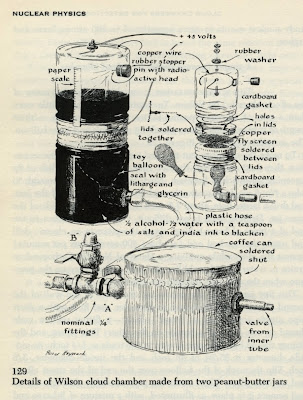
C.L. Stong wrote the “Amateur Scientist” column for Scientific American for many years. When I was a boy, my mom saved up to buy me the anthology of Strong’s columns. It had a big impression on me — I still have a copy on my shelf. I never gave much thought to the illustrations, but I now realize that they were responsible for much of the impact that that book had on me. The cloud chamber drawing was one of my favorites. Note the use of peanut-butter jars. Yea!

This morning an article on the Maker blog focused on the genius who did all those wonderful drawings: Roger Hayward (I wonder if there is any relation to Wes and Roger — all three are from Oregon and all three are technical geniuses.)

I found this very nice web site about Roger Hayward: http://scarc.library.oregonstate.edu/omeka/exhibits/show/hayward/introduction/introduction/
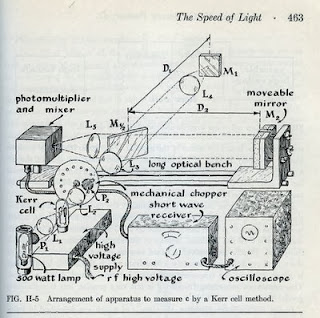
There are great illustrations in many places. For the Scientific American drawings go to the 1960s section.

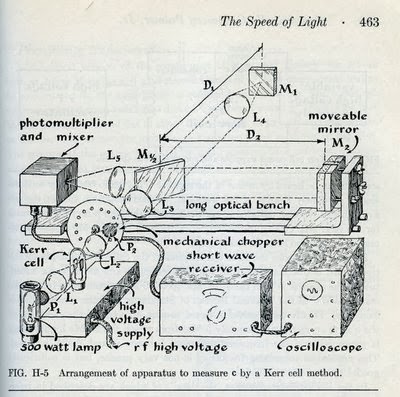
And check out this one:

From: http://scarc.library.oregonstate.edu/omeka/items/show/4456

Our book: “SolderSmoke — Global Adventures in Wireless Electronics” http://soldersmoke.com/book.htm Our coffee mugs, T-Shirts, bumper stickers: http://www.cafepress.com/SolderSmoke Our Book Store: http://astore.amazon.com/contracross-20

Renaissance Man Illustrator for Scientific American

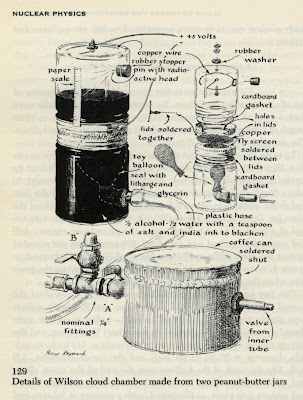
C.L. Stong wrote the “Amateur Scientist” column for Scientific American for many years. When I was a boy, my mom saved up to buy me the anthology of Strong’s columns. It had a big impression on me — I still have a copy on my shelf. I never gave much thought to the illustrations, but I now realize that they were responsible for much of the impact that that book had on me. The cloud chamber drawing was one of my favorites. Note the use of peanut-butter jars. Yea!

This morning an article on the Maker blog focused on the genius who did all those wonderful drawings: Roger Hayward (I wonder if there is any relation to Wes and Roger — all three are from Oregon and all three are technical geniuses.)

I found this very nice web site about Roger Hayward: http://scarc.library.oregonstate.edu/omeka/exhibits/show/hayward/introduction/introduction/
There are great illustrations in many places. For the Scientific American drawings go to the 1960s section.

And check out this one:

From: http://scarc.library.oregonstate.edu/omeka/items/show/4456

Our book: “SolderSmoke — Global Adventures in Wireless Electronics” http://soldersmoke.com/book.htm Our coffee mugs, T-Shirts, bumper stickers: http://www.cafepress.com/SolderSmoke Our Book Store: http://astore.amazon.com/contracross-20