Book Review: “Man of High Fidelity: Edwin Howard Armstrong” (Free Download)

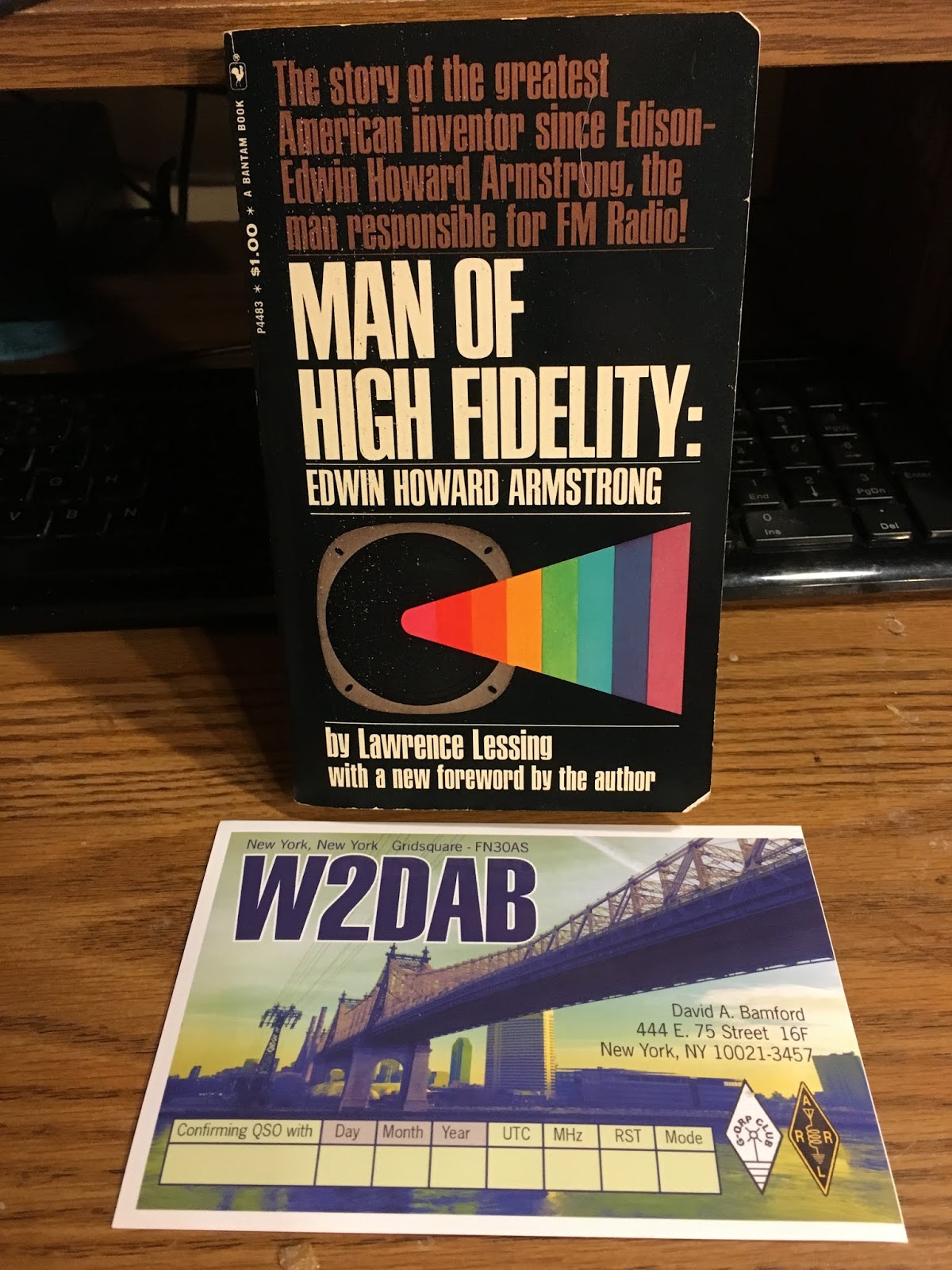
Dave W2DAB sent me this wonderful book. He picked up a copy at a recent Columbia University lecture on E. Howard Armstrong. Written by the notable science writer Lawrence Lessing, the book was first published in 1956. The paperback copy that Dave sent me came out in 1969; while 50 years old, my copy is in remarkably good shape.

I really liked the book. The author captures the technical achievements of Armstrong, while also describing vividly the world in which Armstrong lived. Being from the area, I especially liked Lessing’s description of New York City and the Hudson Valley in the early years of the 20th century. This was the world of my grandparents; Lessing’s book helped me understand it better.

For the radio amateur, I think the most gripping part of the book is the way Lessing describes the excitement of early radio. Armstrong was a true enthusiast for the new technology, and he was — even as a teenager — at the cutting edge. He was constantly striving to improve the technology, especially the receivers. Like us, he often became obsessed with his radio work, often forgoing sleep and missing family meals as he toiled away in his workshop. Lessing tells us of Armstrong’s astonishment and joy, when, upon inventing the regenerative receiver, he was suddenly able to clearly receive signals from distant stations that previously had been barely discernible. Realize that when he was doing that, he was the only person on the planet who was doing it. He was the inventor. He was the first.

Lessing gives us a lot of great information about Armstrong’s work as an officer in the U.S. Army Signal Corps in Paris during World War I. We learn more about how his desire to be able to detect noise from the electrical systems of enemy airplanes led him to the invention of our beloved superhet receivers. But my favorite Armstrong in WWI story involves his visit to the radio shack of the ship that was carrying him to the war. In the radio shack he found a conventional station. But he asked the operator if he happened to have one of the then new audion tubes. On the spot, Armstrong took the tube and rigged up a regenerative receiver. He and the ship’s radioman then delighted in hearing stations that had never before been audible. Amazing.

I was less interested in the sad tale of Armstrong’s legal patent battles, so I kind of skimmed through that. I’m also not much of an FM guy, so I’ll save those portions of the book for a later date.

I think this is an important book about a significant part of radio history. It is well written. It gets almost all of the technical details right (but sorry Mr. Lessing, radio waves are not composed of electrons). The book deserves a place on the shelf of all radio history libraries. If you can’t get a print copy, an online version can be downloaded here:

https://archive.org/details/in.ernet.dli.2015.189098

Thanks again to Dave W2DAB.
SolderSmoke Podcast #208

SolderSmoke Podcast #208 is available:

http://soldersmoke.com/soldersmoke208.mp3

15 December 2018

Pete and the California fires
Bill goes to Brooklyn
2 meter simplex
A return of the trivial electric motor
Audio from Mars
HF Conditions — a real mixed bag

Pete looks back at 2018 — The Year of the SSB Transceiver — Lessons Learned

Hans Summers, the QSX and the virtues of SDR
W7ZOI’s DC Receiver Retrospective
The 1972 Solar Flare and the Vietnam War

SHAMELESS COMMERCE: Buy your gifts through the Amazon link to the upper right.
Consider SolderSmoke the book as a gift. Visit Pasta Pete’s for cooking ideas.

Don’t Build It! Sage — but unexpected — advice from Pete.

Straight Key Night approaches.

Book Reviews:
–“What is Real?” (Quantum Physics)
— RHdb by K6LHA.

Movies
“Bohemian Rhapsody”
“First Man” (Not yet!)

MAILBAG:
Steve G0FUW
Ed KC8SBV


More Homebrew Wisdom from Frank Harris, K0IYE


In Chapter 13A, Frank Harris writes:

The Vanishing Art

The 1986 ARRL Amateur Radio Handbook reported that hardly anyone was building homebrew ham receivers…. Out of hundreds of contacts, so far I’ve worked four guys, George, K7DU, Mike, NØMF, Biz, WDØHCO and Jack, W7QQQ who were using homebrew receivers for the QSO. Three of these receivers were made from vacuum tubes. George’s receiver is a beautifully crafted instrument that looks like a commercial design from 50 years ago. All of these receivers had no trouble hearing me on 40 meter CW. I talked to one other fellow, Gil, N1FED who told me he had just finished a vacuum tube receiver. Unfortunately, it was performing so poorly he was still using his modern transceiver on the air. Gil told me he didn’t like transistors. I guess he found printed circuit boards and those pesky oscillations too much trouble. In spite of this pessimism, you CAN build transistorized receivers that work reasonably well. I built mine because I was intrigued by mysterious circuits like “balanced mixers,” “product detectors,” “cascode amplifiers” and “crystal ladder filters.” Before this project, I could recite the purposes of these circuits, but I had no “feel” for how they worked and why receivers are designed the way they are. What better way to learn than to build one?

Aside from the need to shield circuit blocks from one another, a homebrew receiver with a single big board full of discrete components has another problem. If you build the whole thing at once without buying a kit and pre-cut board, I guarantee it won’t work. To make homebrew stuff that works, you have to develop your own technology based on parts you can get and circuits you understand. Learning to think this way was difficult for me. Rather than “building a receiver,” I had to lower my sights and build one circuit at a time, e.g., “an oscillator,” “a mixer,” “an audio amplifier,” etc. Then I put the blocks together to complete my project. Some of these circuit blocks didn’t work the first time so I had to build a new block. There were various reasons the modules didn’t work. Usually, I wasn’t able to buy the exact parts used in the circuits I was copying. Or my craftsmanship or shielding wasn’t adequate. Sometimes I never did learn why one version of a circuit block was superior to another. By building my receiver using separate little shielded modules for each circuit block, I could replace a circuit block whenever I managed to build an improved version. Otherwise, I would have ruined the entire big board.

On rare occasions my circuits didn’t work because there were errors in circuit diagrams in QST magazine or in the handbooks. I found some serious errors in my 1979 ARRL Handbook and a minor one in my 1998 edition. Perfect editing is not possible, so we shouldn’t expect it.

GET THE WHOLE BOOK HERE (FREE!)
http://www.qsl.net/k0iye/

“From Crystal Sets to Sideband” — Homebrew Wisdom from Frank, K0IYE (Free Book)

Get Frank’s book here (FREE!) http://www.qsl.net/k0iye/

I’ve had Frank’s book on the blog many times over the years, but it is a book that merits repeated mention. It is filled with great advice and homebrew wisdom. I found myself looking at it again recently, and at Frank’s QRZ.com page. I came across lots of wisdom that I may have missed in earlier visits. For example:

From the QRZ page:

My version of ham radio is 100% scratch built equipment. I buy nothing manufactured for ham radio except log books…My rig is based mostly on the 1986 ARRL handbook. Modern designs in today’s QEX and Handbooks are usually full of mysterious ICs. In my opinion, they don’t qualify as homebrewing.

From his book (Chapter 15):

I was fascinated by ham radio, but I didn’t learn much about how sideband worked. I had the impression that sideband was MODULATION FOR MILLIONAIRES and too complicated to homebrew. The 1957 ARRL handbook’s opaque descriptions of “phase shifters” and “balanced modulators” only confirmed my opinion.

If you are like me, you will have a devil of a time getting your SSB drivers to produce intelligible speech without hissing and noise problems. All I can tell you is to keep your brain mulling over your difficulties. Shield and filter your prototype until the darn thing works. Keep careful notes so you don’t make the same mistakes twice. Persistence will win in the end.

My sideband transmitters are still in the experimental category. You will find that it takes a great deal of tweaking and fussing to get SSB tuned so it sounds good and doesn’t radiate on unplanned frequencies. You won’t believe how many diseases your SSB transmitter will create for you to conquer! Sideband is not a project for impatient people.

Foreword:

We homebrewers are nearly extinct, but there are still hundreds of us scattered around the world, some are even in the USA. Yes, there ARE American homebuilders! We’re rare, but thanks to the QRP hobby, the number is growing. Even if we homebrewers don’t change the world, I guarantee you will enjoy learning radio technology and building your own equipment.

Get Frank’s book here (FREE!) http://www.qsl.net/k0iye/
THANKS FRANK! Send Frank a thank you note: Frwharris@live.com

Tom Swift had The Knack


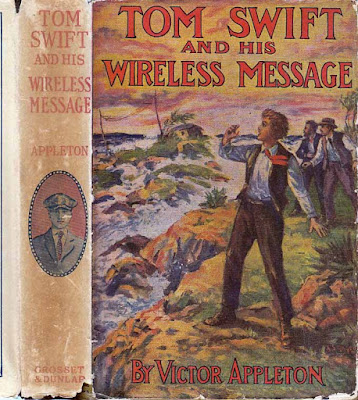
Thanks to Richard for alerting us this important piece of Knack history. Not bad for 1910. You can see Tom’s shack and antenna in the cover image (above). I don’t think he was going for a fan dipole. He built the kind of multi-wire antenna that was in fashion in the early days of radio.

The full text of the book is avaialble free on-line. The radio fun begins in Chapter 20:

Bless my door knob, this was a lot of fun!

Bill,

I am certain I missed the origin of “the knack” as used on your blog. I, wonder, however, if in your youth you read Tom Swift novels? Although now they seem somewhat politically incorrect, I feel that the word may have, for our purposes, evolved there.

In the first novel, “Tom Swift and His Motor-Cycle” (sic) Tom repairs a butter churn’s “system of cogs and handles.” When praised for his abilities he declares, “It’s just a knack.” Stick with me.

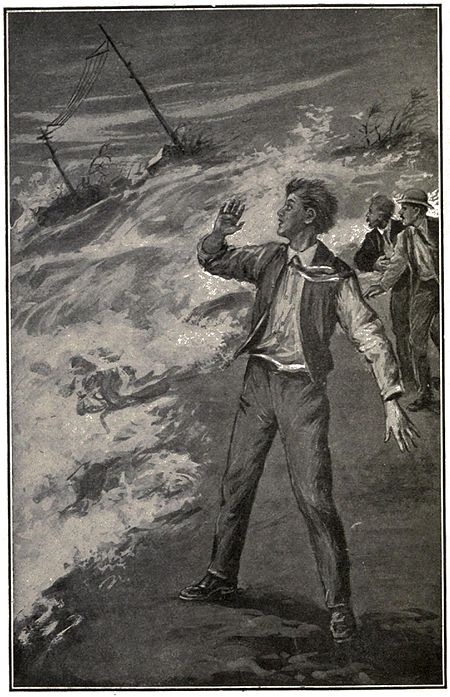
In a later novel, written around 1910, “Tom Swift and His Wireless Message” Tom is shipwrecked on an ebbing volcanic island. He saves the day by constructing a transmitter and receiver from the wreckage of his plane, even though he “did not have the magnets, carbons, coherers and needles” needed. He strings “ wires from the top of the dead treed, to a smaller one, some distance away, using five wires, set parallel, and attached to a wooden spreader, or stay. (Fan dipole?) The wires were then run to the dynamo, and the receiving coil, and the necessary ground wires were installed.” Then,”once the impulses, or electric currents, are sent out into space, all that is necessary to do is to break, or interrupt them at certain intervals to make dots, dated and spaces.” He sent “C.Q.D. (come quick—danger) even though a “new code has been instituted for them, but I am going to rely on the old one, as, in this part of the world, the new one may not be so well understood.” Needless to say, a ship hears, responds and rescues the crew.

That”s “the knack”, alright!

Never give up, and 73.
Richard, KD0NPM


Cliff Stoll — K7TA — Has THE KNACK. And a GREAT NOVA Video

Hack-A-Day had a piece on Cliff Stoll of “The Cuckoo’s Egg” and “Silicon Snake Oil” fame. I read these books years ago. I included a quote from Cliff on page 45 of the SolderSmoke book (the quote seemed to foreshadow my aversion to SDR).

I didn’t know that NOVA produced an hour-long program on Stoll’s Cuckoo’s Egg adventures. It is really good. Many of those involved play themselves in the video. Very cool. See above.

I checked Cliff’s QRZ.com page. We wrote several years ago that Cliff has THE KNACK. Note below his preference for thermatrons and the affection for Heathkits. Diagnosis confirmed.

From QRZ.com:

Hi gang! This is Cliff Stoll, K7TA
Way back in the Jurassic, I was licensed as WN2PSX, in Buffalo NY. Got my general ticket around 1967 as WB2PSX, and helped build ham radio stations at Hutch-Tech high school, University/Buffalo, and University of Arizona. When I went to Tucson for grad school, I passed my extra ticket and snagged the call K7TA (back when this meant 20wpm cw). I held a first-class commercial ticket, which let me engineer at WBFO radio, but I don’t know if commercial licenses even exist anymore.
I now live in Oakland California, and occasionally get on the cw lowbands with old heathkit gear … just rebuilt my novice NC-270 receiver with filaments that glow in the dark. Gotta restring my 40 meter dipole that came down in a windstorm.
You can guess that I’m pretty much retired. Along the way, I’ve worked in FM radio, planetary physics, computing, writing, speaking, teaching, and math. Best way to reach me is through my website www.kleinbottle.com
Warm wishes to all — 73’s,
-Cliff

Info on Cliff’s latest gig:

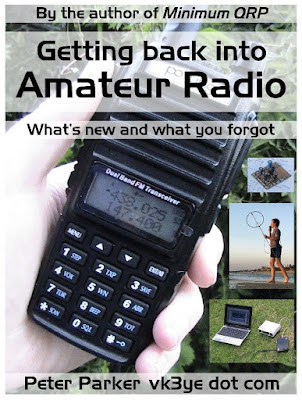
Peter Parker VK3YE on Vintage Gear (in his new book!)

Homebrew Hero Peter Parker has a new book on the market. I was really taken by his description of the joys of restoring older gear. Peter really nails it. Here is an excerpt:

Vintage Equipment

The collection, restoration and use of historical equipment is another movement in amateur radio. The musty smell of warming dust, the heavy clunk of rotary switches and the velvet smoothness of precision tuning drives are joys of every use.
Such sensuality is absent from modern plastic-fronted, wobbly-knobbed transceivers. Old rig cabinets felt they had something in them. A kick would hurt you more than them. And etched panel markings confirmed they were built to last.
Unlike today’s dainty push buttons with stunted travel and disembodied beep, toggle switches showed you where they stood. Weight, life and play made adjusting controls for nulls and peaks (as often required) both a pleasure and occasional frustration. Even if only as mechanical backlash on a bad tuning dial, it was as if the equipment was telling you something, like a ridden horse does through its reins. Not like newer gear’s lack of tactility which is like a ‘dead fish’ handshake, all take and no give.
There are psychic as well as physical joys. The thrill of bringing neglected or dead equipment to life drives many. It’s an underestimated skill. You start with nothing and almost anything done represents progress when building from scratch. Whereas with a repair it is very easy to render something that’s 80% good completely useless with a careless drop or slip.

More about ‘Getting back into Amateur Radio’ is at
http://home.alphalink.com.au/~parkerp/gettingback.htm
& the video at https://www.youtube.com/watch?v=g4ktP5K4x-I

Wonderful “QSO Today” Interview with Ian Keyser G3ROO

N2CQR and G3ROO
I knew it was going to be a good Sunday morning in the shack when I saw that Eric 4Z1UG had posted an interview with Ian Keyser G3ROO. This wonderful interview brought back memories of my visit to G3ROO’s amazing facility in Dover. (Thanks to Tony Fishpool who brought me out there.)

In this interview, you will hear Ian state — in a very nonchalant English way — that he built his first receiver at age 8. And I really loved the story of how Ian got his call sign. FB Ian.

Ian is a very prominent member of the G-QRP club. I was oddly relieved to learn that he is working on a LEGAL LIMIT LINEAR AMPLIFIER. I hope he has special dispensation from Rev. George Dobbs. I intend to cite this project if we ever have to defend Pete Juliano from charges of QROism.

Listen to the interview here:


That is a key designed for use aboard a hydrogen balloon. This is the kind of thing that Ian has in his shack.

This is Ian’s variometer — mentioned in the interview.

That’s me using one of Ian’s spy sets.
Ian’s antenna book:
Here are the SolderSmoke Daily News posts about Ian and the Dover Construction Club:


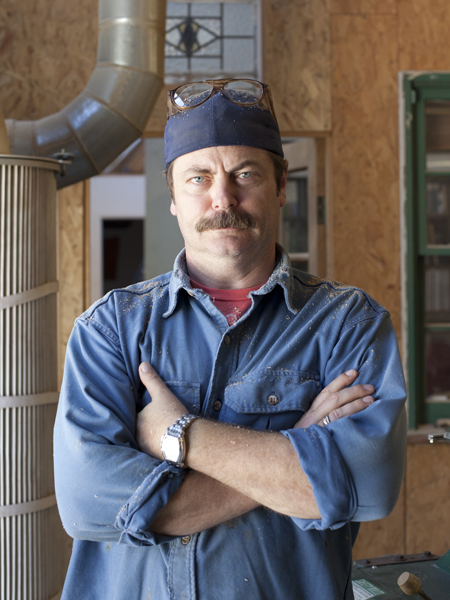
Ron Swanson (Nick Offerman) on Making Things and Making Mistakes

Driving home from work the other day I heard this NPR interview with the woodworking guy from the TV show “Parks and Recreation.” I’ve never seen the show, but I really liked the comments on the benefits of what we would call homebrewing:

MCEVERS: I feel like there are a lot of people out there listening who have spent exactly zero days being handy, like, their entire lives. Is there hope for people like this, and does your book provide it?

OFFERMAN: I think so. I mean, a lot of my own woodworking education comes from books and periodicals like Fine Woodworking and Popular Woodworking magazines. They’re great teachers, but they’re very somber. They’re very sober. So it was important to me for this book to be really friendly and gentle and fun to let you know that whether you’re getting into woodworking or making anything with your hands, it’s really important to know going in that you’re supposed to make mistakes. You’re supposed to screw it up.

And not only do I think this is a very friendly introduction to woodworking, but I really have become a little bit of an evangelist to encourage – find something to make. If you make stuff for your house or your loved ones, you’re curating your life in a way, saying, I don’t have to just limit my choices to what I can buy at Amazon. I can also choose to make a table myself. And even if it looks crappy, it’s still so much more charming because you’ve made that gesture.

You can listen to the 6 minute interview (it is funny) by clicking on the “PLAY” arrow in the upper left of this page:

http://www.npr.org/2016/11/17/502476216/nick-offerman-shares-his-love-of-woodworking-in-good-clean-fun

SolderSmoke Podcast #191 RIGS! REAL RIGS!, BITX40 Module, EMRFD, MAILBAG


SolderSmoke Podcast #191 is available:

http://soldersmoke.com/soldersmoke191.mp3

TRAVELOGUE AND FAMILY DOINGS: Pete son’s wedding, Billy’s Birthday, Gonzalo safely home in the Dominican Republic, MORE BEARS IN THE SHENANDOAH WOODS

BIG NEWS: EMRFD LIVES ON! Three cheers for Wes and for Tom Gallagher of the ARRL.

BENCH REPORTS:

PETE: FPM Rig. Some Halli history. A TRUE RIG! Working Japan.
WITH 600 WATT LINEAR AMPLIFIER!!!!!!!!!!!!!!!!!!!!!!
New FEELTECH Sig Gen.

BILL: Farhan’s BITX Module
Built to Mod, built to get you started in homebrew
Very impressive. BITX in miniature. But completely recognizable.
REMARKABLY stable.
Farhan personally checking each one.
Ladies collective doing toroids. DONATION money bought them some Diwali candies!
VFO Drift: Will NP0 SMD caps and lower current help enough?
My Analog VFO — BANDSWEEP

QRPppppppppppp with REX’s Hamfest Buddy. Thanks Rex and Bob Crane.

HB2HB with KW4KD

MAILBAG
Jan’s Netherland Mate Mighty Midget
Charlie’s Kiwi DSB
Steve, Donald Fagan, and Jean Shepherd
Rob VK5RC repairs Tek Tube ‘scopes
Colin M1BUU Si5351 superhet
Denis Klipa and NRL 3538
Jonathan M0JGH Wizard of Wimbledon Matchbox rig
JH8SST Simpleceiver
Peter Parker Vk3YE Reviews Book
Peter GW4ZUA Welsh LBS
Michael Rainey helping hobbyist in Germany with tuning forks.

Beautifully Ugly! A Homebrew Receiver from the Netherlands (video)

This one is similar to the receiver I’ve been working on: middle of the HF band, discrete components, all analog, 455 kc IF, wooden chassis, eclectic circuit boards. Very cool.

The builder is Ko Tilman. His YouTube channel is here:
https://www.youtube.com/channel/UCqe1Y4StR9cZ8BQDWuoMq9w

I came across Ko’s channel when I was looking for a circuit for an AM detector. I have been experimenting with the standard one diode and two diode (Germanium) circuits, but the receiver doesn’t sound very good when using these circuits. Any recommendations for something a bit better (without getting carried away with complexity)?

About Ko Tilman:

Ko Tilman (1955) lives in the Netherlands and is active in electronics since 1967. His focus is on analog electronics, audio, shortwave radio’s, small (solar) energy systems and measurement and control systems. He is the author of “Retro Radio”, Isbn 978-90-5381-234-1, published by Elektor International Media in the Netherlands. In this book (Dutch text) you will find several simple schematics from Shortwave radio’s (2 MHz – 16 MHz), including radio’s with SSB reception. His long time knowledge about small audio systems (for household use) is available in his book “Schematics 2, audio amplifiers and loudspeaker boxes “, available on this website (a summary of the content is visible). Also in an E-book format: Isbn 978-1-4475-7336-4. In the past (2008-2010) he was active on You Tube under the name “radioam232”, now he is active on Youtube as “radiofun232”. A free download from the activities in the “radioam232” period is available on this website in the content “blueprints 1”.

Ko’s Books: http://www.lulu.com/spotlight/radioam232

Occam’s Bench: M0XPD on the Minimalist Measurement Mindset


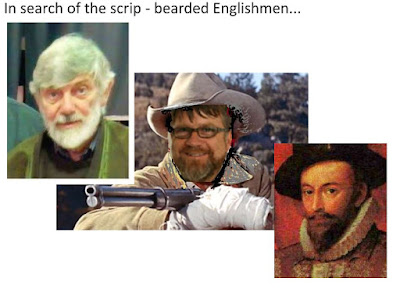
Our ace correspondent in Dayton, Bob Crane W8SX, caught up with Paul Darlington M0XPD (above, the guy with the rifle) and interviewed him about his presentation at Four Days in May 2016. You can listen to the interview here by clicking on the link below. I especially liked the comments on the joys of fixing things and the advantages of SIMPLE analog circuitry. Listen to the end and you will learn about Paul Darlington’s connection to the famous Darlington Pair.

http://soldersmoke.com/M0XPDFDIM.mp3

Paul provided more info (including his slide show and presentation notes) on his BRILLIANT Dayton talk here:
https://sites.google.com/site/shacknasties/presentations/fdim-2016

You can buy Paul’s book here:
https://www.amazon.com/getting-there-Paul-Darlington/dp/1523452196

Thanks Paul! Thanks Bob! And thanks to George Dobbs and William of Occam!

Great “QSO Today” Interview with H.P. Friedrichs AC7ZL — “My nature is to build.”

Eric 4Z1UG has a really wonderful interview with H.P. “Pete” Friedrichs AC7ZL. Pete is the author of “The Voice of the Crystal” and “Instruments of Amplification.”

I sat in the shack this morning with a cup of coffee, mesmerized by the things Pete was saying. I actually took notes. Some highlights:

— In describing his zeal to avoid the use of store-bought components, Pete acknowledged that there are limits to this. But then he revealed that his limits are different than those of even the most fundamentalist of homebrew fundamentalists: “Well, I’m not going to mine my own copper.” Don’t worry Pete — no one will call you an appliance operator if you use store bought wire.

— On the same subject, when describing his homebrew diodes for crystal radios, Eric asked Pete why he didn’t just go out and buy a Germanium Diode. “That would be cheating,” replied Pete. Indeed.

— “Obsolete technology often gets short shrift.”

–“My nature is to build.”
Check out the podcast here:

http://www.qsotoday.com/podcasts/ac7zl

EMRFD Joy of Oscillation (Part 1)

Guys:

I have been catching up on the last few SolderSmoke podcasts after
that little QSO Today diversion. I wonder how many others did the
same thing? I have really enjoyed these recent ‘casts. Lots of
fantastic HB content. Funniest moment was when Bill described his
post-project workshop as looking like the aftermath from an electronic
barfight.

I took a new ham up on a SOTA activation last year. Then about a
month ago, he said that he wanted to do HF HB. He said he had been
googling and found so much that he didn’t know where to start. I told
him that I’d be interesting in doing a beginner HF HB project with
him.

I could have pointed him to LBS, et al. I could have pointed him to
the Michigan Mighty Mite. I did neither. I pointed him to:
http://web.cecs.pdx.edu/~campbell/EMRFD1dot34.pdf Note the name of
the document. I pointed him also to:
http://www.arrl.org/files/file/Product%20Notes/chapter_1.pdf
(Did you guys know that chapter was online and free?) We scaled to 20m and
kitted parts for this. And parts for a 4th transistor PA for serious
QRO. 🙂

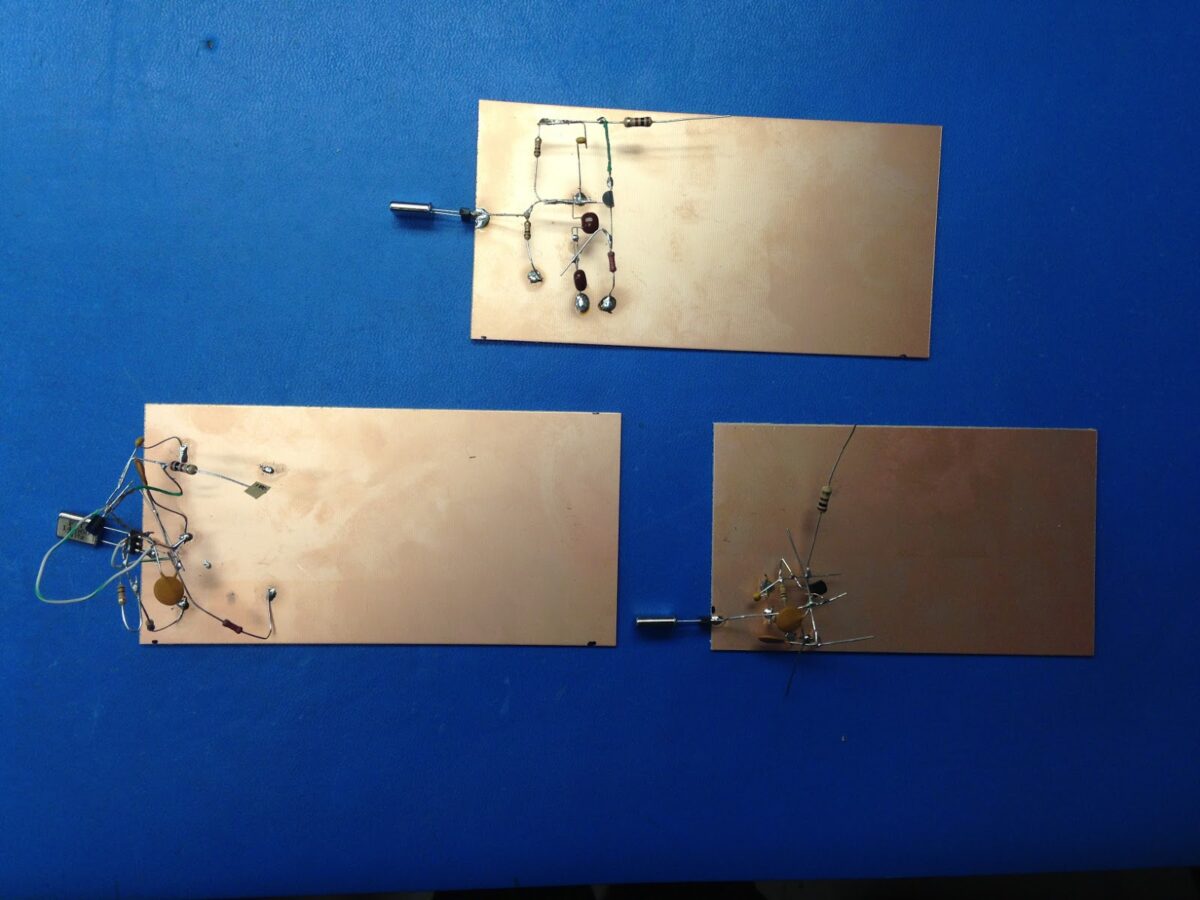
Two others joined us building for 40m. Check out the attached photos
of the first 3. The joy of oscillation was experienced by all.

After testing each oscillator, and borrowing from an article KK7B ran
in CQ VHF, I told each that he had to ID every 10 minutes. Even
though nobody was going to hear these signals a few hundred yards
away. (But it sounds loud on a shortwave portable a few inches away!)
I even wrote out the dots and dashes for a couple of them.

Next stop: to have everyone find a curbside TV discard, rip out some
parts, and get on 5 meters! Haven’t we gotten it back now, after the
transition to digital TV? 🙂

OK, maybe the next stop is to add some gain stages and experience the
joy of communication. The joy of QSO-ification? The joy of
EM-radiation? 🙂

Best regards,

Drew
kb9fko

2 Attachments

From Paul Darlington M0XPD: A Book!


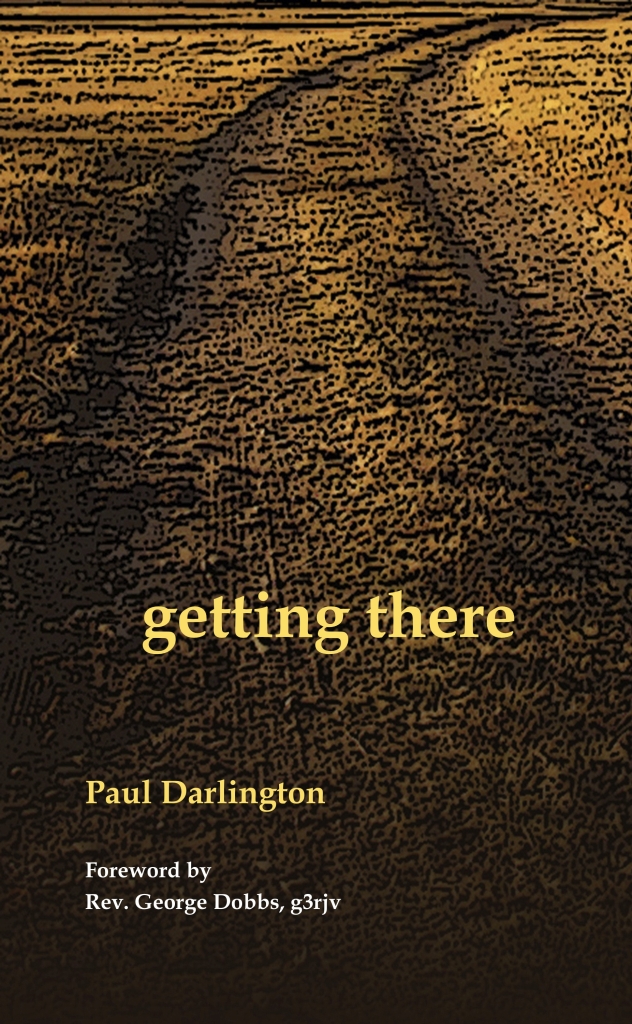
Our friend Paul Darlington M0XPD is a member in good standing of the International Brotherhood of Electronic Wizards. His AD9850 Arduino shield propelled me into the world of I and Q. His “Shack Nasties” blog is a valuable resource for all of us. And now he has written a book. Paul was kind enough to let me read it before it was published — I enjoyed it very much. It is the story of a very personal journey. At one level it is about Paul’s trip to the Dayton Hamvention. But the trip goes much further than Dayton, both geographically and personally. I especially enjoyed Paul’s observations on the United States — our British cousins often see things we ourselves overlook. I’m really pleased that George Dobbs wrote the foreword — he is the ideal person to do this for Paul’s very philosophical book.

We give “Getting There” our highest review: the coveted FIVE SOLDERING IRONS. And we are nominating Paul for a Brass Figlagee with Bronze Oak Leaf Palm.

Read Paul’s description of the book here:

Buy the book here:
Congratulations Paul!

Hardware Hacking by Nicolas Collins


David Cowhig WA1LBP and I are the only two Foreign Service officers to have also been 73 Magazine “Hambassadors” (impressive, right?). David was covering Okinawa for 73 (and for Uncle Sam!) while I was doing the same in the Dominican Republic.

Today David sent me a link to the book “Hardware Hacking” by Nicolas Collins: http://www.nicolascollins.com/texts/originalhackingmanual.pdf

It is not exactly about ham radio, but there is a lot of electronic wisdom in Mr. Collins’ book. You folks will like it. I especially liked the hand-drawn schematics — this adds soul to the book.

Nicolas Collins is an interesting fellow. He is Profesor, Department of Sound, The School of the Art Institute of Chicago.
https://en.wikipedia.org/wiki/Nicolas_Collins

http://www.nicolascollins.com/read.htm

SolderSmoke Podcast #181 Of Dongles and DX-100s — SDR vs. HDR, Music & Art, 2B, HB2HB, Noise, The Martian, VK3YE’s New Book

Two RTL SDR Dongles in front of a DX-100 Transmitter

SolderSmoke Podcast #181 is available:

17 October 2015

— Our audience IGNORES Pete’s guitar intro!
— Pete on QSO Today Podcast.
— Part 97, The Radio Art and International Goodwill.
BENCH REPORTS:
— Pete connects his new beam to the KX3.
— Pete puts the Bell-thorn on 20.
— Simple-ceiver update.
— Pete’s new drum machine: http://makezine.com/2015/10/15/learn-electronics-worlds-oldest-drum-machine/
— Bill fights noise in the DIGI-TIA.
— Bill fights power-line noise (and wins!).
— Drake 2B, skirts, reduction drives, and tuning rates.
— Warming up (with!) the DX-100.

— N2CQR — N6QW First Ever HB2HB QSO.

— On 40 AM with an HT-37
— Listening to Chinese CubeSats.
— SDR Dongle as a bandwidth checker.

— SDR and the Future of Homebrew Radio.

— Bryan’s LBS Receiver.
— Dean’s First Ever QSO with his HB rig.

— 32 Mighty Mites Completed

— The Martian — Did Mark Watney REALLY have the Knack?

— MAILBAG:
Peter Parker’s New Book
Sparks from Ron Sparks
Armand’s 1Watter
Rogier’s pyro machine
BIG boxes from Tim KI6BGE
Mikele’s ZIA and N6QW rig collection
SPRAT 141 and SPRAT 164