
Category: book
Big Lulu Sale this Weekend: Save 20%
 When you go to Lulu, don’t just buy “SolderSmoke — Global Adventures in Wireless Electronics” but check out these other fine Knack-related publications:
http://stores.lulu.com/6sj7comics (“Lid, Kid, Space Cadet” “Sky Buddies” by Jeff K1NSS
http://stores.lulu.com/ian_g3roo (Ian, G3ROO’s amazing antenna book)
http://www.lulu.com/copperwood (“Carl and Jerry” books — scroll down a bit)
http://stores.lulu.com/soldersmoke (SolderSmoke and Bill’s other book — the other one is available in .pdf)
Put them all together in one package to save shipping. Help your wife with the Christmas shopping! Use the coupon code DONE and save 20%
Today only! 20% off Veterans Day sale on “SolderSmoke — Global Adventures in Wireless Electronics”
 Lulu is at it again. Just use the coupon code VETSDAY and get 20.10% off on your purchase of
“SolderSmoke — Global Adventures in Wireless Electronics”
Happy Halloween! 20% off SolderSmoke
 I hope to have a new podcast out soon, perhaps a Halloween edition. Lulu is offering 20% off on SolderSmoke — The Book. Just use the coupon code: TRICK305
Linux makes you younger! “Aha! moments”
Listeners seem to like the audio quality of SolderSmoke episode #126. I was surprised by this because I didn’t do any of the post-recording processing that I’d done in earlier episodes. I didn’t even have the foam “Popping P Protector” on the mic. And the equalizer that Brent sent hasn’t been put in service yet. The improved audio may simply be the result of broader bandwidth — I didn’t use the Audacity equalizer to drop off the lows and highs. Perhaps that explains why the file was over 40 MB instead of the normal 20 MB. Several listeners said that I sounded 10 years younger in 126 — it must be a Linux thing.
Chris KJ4GUU posted a nice comment about my book “SolderSmoke — Global Adventures in Wireless Electronics” (which he calls SSGAWE):
“I have started reading I have started reading SSGAWE again. Whenever I have a question about a project I can usually find help in your book, its becoming more of a cherished reference guide that has produced more Ah-ha! moments than any other book I own. Thanks again!”
Thanks Chris — those “Ah-ha! moments” were what I was hoping to produce.
For more info on the book, go here:
http://soldersmoke.com/book.htm
Update, Columbus Day

OK, the Drake 2-B is running. I’m listening to 75 meter SSB. Coffee is on. Solder has been melted in the new shack — I had to replace the MPF-102 in my little DaVinci Code beacon MEPT 30 meter transmitter. Little by little, SolderSmoke HQ is coming back together, this time in Northern Virginia.
Lulu reports a big holiday weekend sale: 14.92 percent off this weekend only. Just put the EXPLORE305 code in when checking out.
http://www.soldersmoke.com/book.htm
Save 20% on SolderSmoke — The Book
Lulu just announced a big summer sale, good through August 1. This is a good chance to get “SolderSmoke — The Book” in time for that late-summer beach trip. Just use the coupon code SANTA when checking out. (U.S. buyers may find it more advantageous to use the summer-long free shipping offer.)
Find the book here:
Back in Northern Virginia, SUMMER SALES
It seems like I have personally moved back several chapters in “SolderSmoke — The Book.” After being away for 10 years, we are back in the same part of Northern Virginia that we lived in before. The SS Shack is still out at sea — it is due in sometime next month. We should be settled by early September.
The “free shipping”offer for the SolderSmoke book is still in effect. That is for shipment in the U.S. only, but buyers elsewhere can take advantage of a special 15% off option by using coupon code BEACHREAD305 on the U.S. version of the book.
I hope everyone in the Northern Hemisphere is having a good summer, and that our “down under” listeners are having an easy winter.
73 Bill
SolderSmoke is Moving the Markets!
Hi Bill,
I was at the East Suffolk Wireless Revival yesterday (Sunday) morning – hardly FDIM, but still a nice little flea market / boot sale, maybe 20 / 25 people selling odds and ends from SMD components to rigs and other bits of kit. Finished up in a bit of a good natured scrum fighting over variable capacitors made all the more desirable for having proper shafts and being made of something other than plastic.
Your name came up as being the inspiration for a resurgence in home building and the subsequent rise in prices of desirable bits as they became scarce as more people wised up to the fun of building and the ease of just melting solder straight on to the PCB rather than trying to etch something. Rather suspect that your podcasts and that book are actually being more influential than you realise. Read my copy lying on the beach in Antigua, but still keep going back to it, and as you have said in the past, the rest of the library – it’s making a very pleasant change from the Masters that I’m buried in at the moment.
Bought the UK equivalent of a Harbor Freight punch over a few days back, so can now make my own little round pads out of old PCB – magical !!
Good luck with the move – I was brought up on a prison farm in Tanzania amongst other places, so recall all too well that strange sense of loss when you leave a country for pastures anew. Lovely to hear Maria sounding so Italian – picking up another language at that age is a wonderful thing to have done and will no doubt stand both her and Billy in good stead over the years. I still manage a little Swahili after 50 years, including teaching my last 2 dogs a few commands which is always funny.
Looking forward to the next podcast – they have become an important little interlude in my life and keep my interest in amateur radio invigorated
All the best
Nick
The Amateur Scientist, Trivial Motors, Influential Books…
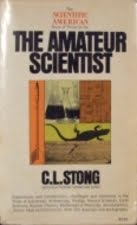
I got a nice e-mail from Keith, VE3TZF, that got me thinking about “The Amateur Scientist” by C.L. Strong. The Wiki article on this book is very interesting:
http://en.wikipedia.org/wiki/The_Amateur_Scientist
Check out the part about Forrest Mims.
Here’s Keith’s e-mail:
—-
Hello again Bill,
In your podcast you frequently make reference to the book, The Amateur Scientist.
This got me thinking back to what REALLY got me started along the path of building stuff for fun.
There were three books I remember reading over and over, even though at the time I had a very hard time really understanding what was on all of those pages. Those books were:
1. ‘Codes, Ciphers, and Secret Writing’, by Martin Gardner (unfortunately, he recently passed away).
2. Some type of ‘build yourself a science laboratory’ book.
3. Some type of ‘build electric motors‘ book.
I explicitly remember that one of the tasks in the ‘science laboratory’ book was to take a burnt out light bulb, etch around the neck, break it off, and turn it into a flask. The flask was supposed to sit on a stand that you already made out of wire (a coat hanger?). I’ve been trying all sorts keyword searches in Google to fine the name of the book. I’m sure I would recognize it if I saw it. Is this ‘The Amateur Scientist’? The closest I have gotten is “Build-it-yourself science laboratory: work like a scientist: build your own equipment, make real findings” by the Oregon Museum of Science and Industry. I’m still looking…
On the other hand, when you described the trivial electric motor, something twigged in my memory. I’ve built one of those! Many of those in fact! Decades ago! The ‘electric motor’ book made reference to 3 basic designs. They were called the ‘mini’, the ‘midi’, and the ‘maxi’. The ‘mini’ motor was in fact the trivial electric motor. The ‘midi’ motor used fixed magnets on the armature, and the ‘maxi’ motor used electromagnets only. I remember salvaging an old wooden pencil box, and stealing some of my mom’s knitting needles, to build the ‘maxi’ motor. I used a 6 volt lantern battery to power it. It worked extremely well, but got incredibly hot! And the sparks! I had not yet learned about volts, amps, and watts. Also at the time I was too young to get the mini/midi/maxi references to womens’ skirts.
After a little searching with Google, I hit the jackpot:
* “How to make and use electric motors”, Al G. Renner – 1974
* Text and diagrams give instructions for building the mini, midi, and maxi motors and for performing various experiments.
Now I just have to find a copy.
I’m currently spending a lot of time with my nephew, building blinking LED circuits, buzzers, motors, and listening to Morse code. He’s really getting into it, and I KNOW that this is important.
I just wanted you to know that your podcast (and excellent book) have far reaching impacts that you may have never intended.
-Keith Robert Murray VE3 TZF
G3ROO’s AMAZING Antenna Book
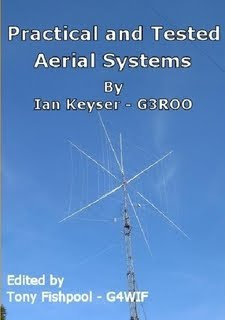
 A few years back Ian Keyser, G3ROO, put together a really wonderful antenna book. It is very “down to earth,” very practical, very useful for hams seeking to succeed with homebrew antennas. The book was edited by another great person from G-QRP Club — Tony Fishpool, G4WIF. It has been out of print, but Ian has just made it available through Lulu.com.
Lulu is the printer who also handles my book: “SolderSmoke — Global Adventures in Wireless Electronics.” This means that you can order both books at the same time, perhaps saving on shipping costs. (But remember, for U.S., buyers shipping is free all summer long. ) And there is a 10 percent off sale for all buyers during the month of May (Coupon Code: FLOWERS).
Check out Ian’s book here:
http://www.lulu.com/product/paperback/practical-and-tested-aerial-systems/10904725
For more info on the SolderSmoke book, go here:
http://soldersmoke.com/book.htm
Special on Book: 20% off TODAY only
Andrew, G4CWX, reminded me that the folks at Lulu are having a 20% off sale. Today only. So you can save a lot on SolderSmoke — The Book. The coupon code is THANKS305.
U.S. buyers might be better off using the free shipping option, but this 20 percent sale will definitely be a good deal for everyone else. http://soldersmoke.com/book.htm
Better than EE text books! With Free Shipping and 10 % off
I was feeling kind of bad about the fact that while free shipping for the book is available for readers in the U.S., people from other countries are not eligible. But Lulu came through! During May readers everywhere can get 10 percent off by using the coupon code FLOWERS. Lulu won’t let you combine free shipping AND the 10 percent off; U.S. customers are probably better off sticking with the free shipping. Customers from other countries can use the 10% discount during May.
Steve, KC2VNI, sent in some nice comments on the book:
—————————
I am an electrical engineer and I will say that the way Bill explains things is far, far, better than what I’ve seen in most books dealing with either communications theory or with communications electronics.
Not to go on a rant, but the college level electrical engineering text books are very poorly thought out and are really not written for the beginner (even an undergraduate electrical engineering student) who does not share the author’s years of insight.
I would recommend that people who read the book should post comments about it where hams will find it. I posted comments on E-Ham. I will probably post to Ham Radio nation.
Several tweaks to the book (with the understanding that my comments are NOT meant as a slam on the book nor am I an electronics expert):
1) Give me a more detailed troubleshooting methodology- The literature associated with testing and troubleshooting is very,very limited.
A flow chart or diagram of some sort would be very helpful. I get the impression that Bill’s efforts in this area were “cut and try” because of his obvious enthusiasm. Having said this, the beginning home-brewer has NO IDEA as to what he needs in the way of test equipment, what he should look for when testing a circuit, what the wave forms should look like, etc. (Note from Bill: A detailed discussion on troubleshooting methodology would be very helpful to students taking electrical engineering online.)
2)Very little discussions about the more mundane things like power supplies, connectors and the like. These trivial items can cause you hours of frustration if you don’t think this through. If you want to string things together on a bench, I suppose it does not make difference. However, if you want to operate say QRP mobile in the woods then you need something that has a little bit of thought.
3) Very little discussion about heat sinks and thermal management- This is one of the most neglected areas for most people in electronics (and not just the homebrewer of radio equipment). Here, I recommend the ASME text “Hot Air Rises and Heat Sinks: Everything You Know About Cooling Electronics is Wrong”. When I read the discussion about a transistor running hot and extra heat sink compound being applied in the book, I wanted to scream!
One other thing-is there any way I can get an autographed copy of the text?
Thank You very much for this very fun book
73
Steve KC2VNI
“It’s all your fault!”
Lulu just announced free shipping on the book (to U.S. addresses only) for the whole summer. Starting now. But before you order, consider these words of warning from one reader:
Bill,
I just finished your Soldersmoke book. I really enjoyed it – but…
I got the radio and electronics bug a bit late and was 23 years old before I got my ham license. I was truly fascinated by it all. Then I started wanting to learn why it all worked. It was truly a challenge to start figuring out how electronic circuits work with nothing more than my average intellect and a few books. I strained my gray matter over the electrons and P and N type material. Finally I decided to ignore it and move on – just put the ‘trons into the black box and pick them up on the other side. I eventually became proficient enough to build kits and do some basic troubleshooting. I had SSDRA and a bunch of stuff by Doug DeMaw, but never could get too deep into it. Eventually I had what I believe was a neat miss from lightning and station KC4GIA went silent for a number of years.
Then I found your podcast. I’ve really enjoyed it. I’ve slowly started getting back on the air. I’ve bought my old dream rigs (Drake Twins, B line) and built an ATS3B. But the urge to learn more and progress to the true homebrewer level has taken hold. It’s all your fault. I blame you completely. I now have a copy of EMRFD, the latest ARRL Handbook, and even have started trying to figure out LTSpice. Ok, that’s also the fault of the Hands On column in QST.
I do have to thank you for the excellent descriptions of the electrons moving through P and N material. I actually think I’ve got it now. Now if I can figure out all this biasing, and impedance matching, etc. I might get somewhere. Your description of how you have to match impedance through different stages makes sense, but I’m still fuzzy on how to determine the impedance in the 1st place, etc. I’m truly excited by the possibility of learning how to design circuits on my own rather than building by rote. Again – it’s all your fault.
Back to the book. I really enjoyed the story of the 17M DSB rig you built in the Azores. It was like an adventure story. Very cool. I’m still a bit vague on why DSB, but you seem to like it, so whatever moves you my friend. I am also intrigued by the satellite contacts. I had always thought you had to spend a small fortune on an az-el rotating antenna array. I’m looking forward to trying it out with normal antennas. My only satellite contacts have been through RS-12 (I think that’s the right number) using the 15 and 10 meter bands. I don’t think there is anything out there using that mode any more.
I also find it fascinating that a guy who used to live a little over an hour from my QTH in Winchester, VA and is now halfway around the world has had such an impact on my enjoyment of the hobby. If you do end up back in the DC cesspool, I hope to get the chance to meet you.
Final thought – Audio Book! I’m used to you talking to me. There ought to be a way to sell a download or something. I think the book is awesome, and may even become a scribbled in resource at some point, but an audio version would be a good companion to the print version. Just a thought…
Thanks for the motivation. You’ve brought me back to what’s fun in Amateur Radio – learning!
Mark
KC4GIA
SolderSmoke Book Helps With License Upgrade SAVE 10%!
Thanks to all those who are helping to get the word out about “SolderSmoke — The Book.” I put together a web page about the book:
http://soldersmoke.com/book.htm Lulu is running a sale: 10% off during April. Coupon Code: SHOWERS
I got a very gratifying e-mail from OM Walter. I was very pleased to hear that the technical portions of the book helped him in his license upgrade efforts:
Bill,
Just thought I would drop you a note to let you how much your podcasts and book have influenced my life (for better or worse). I have been listening to you podcast since last summer and have all of them on CD and have listened to them all. Living in Florida for the past 10 years I have not been active because I thought I could not get a proper station and antenna setup here (HOA restrictions). Boy was I wrong. Late last year I bit the bullet and bought a Icom 703+ QRP rig and hooked it to my computer for digital modes. Antenna of choice? A PAC12 vertical antenna kit. The antenna is indoors sitting on a small photo tripod.
With this setup using PSK and RTTY I have over 1/2 of the US confirmed and 8 countries including England and Germany. I am having a ball. My wife calls it “Playing with Radio’s”. At least she knows where I am…
Next steps is to get my code speed up and I have a couple of kits on order (QRP of course).
Your book was instrumental in me ugrading from General (N2LTB) to Extra (AJ4UM) in Dec 2009. Read your book and used the ARRL study guide. Your explanations hit home and I believe made studing for the test easier. Also very entertaining.
Thanks again for all you do for the Ham community and keep it up.
Walter
AJ4UM
Online Preview of SolderSmoke — The Book, SALE!
I was working on the websites for SolderSmoke — The Book, and I managed to set it us so that you can get a preview of the first part of the book. Just click on one of the links on the upper right hand side of this blog page, and look for the preview link (under the picture of the front cover). Lulu is running a 10% off sale this month. Use the coupon code “IDES” when you check out. (Very approriate – tomorrow marks the Ides of March.)
SolderSmoke Store on Lulu: http://stores.lulu.com/store.php?fAcctID=3999032
Book Review (and a price reduction)
Lulu is having a sale this month. Just enter the coupon code IDES at checkout and save 10% on SolderSmoke — The Book
http://stores.lulu.com/store.php?fAcctID=3999032
Dale, G4IPZ wrote this review of the book:
It’s not often that I’ve come across a book that combines the fun of Amateur radio along with understandable explanations of difficult technical concepts as well as being a damn good read.
This book not only achieves this but does it perfectly.
It’s described on the back cover as “… the story of a secret, after-hours life in electronics.” Why after hours? Well because the author, Bill Meara (N2CQR, M0HBR, CU2JL) is a diplomat, a consul for the United states of America, having been posted to such diverse locations as Rome, London, Panama, El Salvador, the Dominican republic and many other places.
During his career as a diplomat his hobby of ham radio and in particular QRP and home-brewing has followed him around the world.
He admits that he did take time out for a while on meeting his future wife and then marrying her. Then, as so many of us have done before, he began to be drawn back into the hobby; the warmth of the shack, where on a cold night, he could sit clutching a hot coffee, listening to the bands, talking to friends and surrounded by the smell of solder smoke.
During his years as a diplomat-ham he has spent much of his free time trying to understand some of the whys and wherefores of the circuits he was building, attempting to build and attempting to fault find when they didn’t work. And so many of us have been right down that road!
And that explains what this book is; it’s a form of diary of Bill’s Eureka moments combined with an insight into his travels and life as a diplomat.
The technical range covered is quite large and despite all my years in electronics I found many of his eureka moments clarified some of my ingrained foggier thinking.
For example we all know how mixers work. Or do we? How many of us can actually explain what goes on even in the simplest of two diode balanced mixers? Most of us just accept that, by the black necromancy of radio in which we dabble, fearing the release the magical smoke at the wrong moment, it just mixes and that’s that.
But Bill took time to ask, query and eventually, by making notes to himself, come to understand what was going on. And his explanations of mixers and other such subjects are indeed highly illuminating. He explains semiconductor principles (Do you really understand hole flow versus electron flow?). And how about resonant circuits for example? Bill explains these and much more in a refreshing new way along with capacitors, crystals, and a host of other often accepted but often not fully understood truths that we, as amateurs just take for granted.
This is an ongoing life’s trip through the hobby which we all share with Bill, and remember that he is not a professional electronics engineer; he is a radio ham who wants to be more than an “appliance operator”.
He enjoys tinkering and has stuck with some pieces of equipment for more years than I will mention but it hasn’t stopped him working through the satellites and bridging the oceans on less watts than a nightlight.
And as well as his obvious love of his hobby, he introduces us to many of the other amateurs he has met on his travels and at his various postings. He paints a wonderful picture of the people that many of us may get to meet on the air but he’s been lucky enough to meet face to face.
And as well as doing all this he also ventured into the world of Pod-casting and blogging, the outputs which has reached thousands world-wide on his SolderSmoke website.
I cannot recommend this book too highly and I found that it was one which I couldn’t put down until I’d finished.
Dale Haines G4IPZ
Weekend Sale 15% off on SolderSmoke –The Book
Lulu is running a sale through Monday. 15% off on all books.
Just use the code word WASHINGTON when asked for a coupon.
Click here: SolderSmoke – A Global Adventure in Radio Electronics

15% off on SolderSmoke — The Book

Lulu is running a sale today. You can get SolderSmoke at 15 percent off by using the coupon code SHADOW when you check out of the Lulu site. It is better for me if you get to Lulu via Amazon. Here is the link: