Please Help Get SolderSmoke into RadioShack Stores


Several listeners sent me the link to a new campaign by the RadioShack stores. They apparently want to get back into supplying parts for the electronics DIY community. Great! I always liked the oft-maligned stores. I missed them when overseas, and was always saddened to see them drifting away from the world of our kind of radio shack. But it appears that the ‘shack might be coming back! RadioShack has asked customers to leave comments on their blog page listing the three items that they would like to see added to the RadioShack inventory.

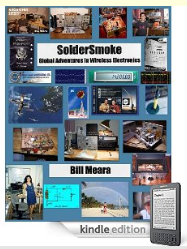
I would really appreciate it if you guys would go to that page and tell them that you think it would be a good idea for them to sell the book “SolderSmoke — Global Adventures in Wireless Electronics” in their stores. You can point them to the link http://soldersmoke.com/book.htm

Some things you might mention in your comments on the RadioShack blog:

— One of the reasons I wrote the book was because I wanted to try to help perpetuate the old, friendly, cooperative ham radio spirit: The culture of the Elmer and all that. The shared junk box. The willingness to help someone with a project or a technical problem. This book might help foster the kind of sense of community that would help everyone (including RadioShack!)

— The book was in part inspired by the RadioShack publications of the great Forrest Mims. Like Mim’s books, SolderSmoke has lots of hand-drawn diagrams.

— The book actually contains (already!) a very favorable comment about the important role played in DIY by the RadioShack stores.

— While it is mostly about ham radio, it was written to appeal to the broader electronics DIY community, and contains wide variety of projects including astronomy, kite aerial photography and rocketry.

— The author — Bill Meara — would be willing to work something out with them (!)

So, gentlemen: Please get typing! Don’t tell them I sent you šŸ˜‰ Let’s make this seem like a spontaneous outpouring of popular support.

Here is the blog location for RadioShack: http://blog.radioshack.com/post/2011/05/19/RadioShack-And-The-DIY-Community-You-Talked-Were-Listening.aspx

or http://blog.radioshack.com/post.aspx?id=f7239c83-8fd3-47e4-9fb9-395f57b56bb7

If you are so inclined you could also tweet them your input @Radio Shack

And you could put your comments on their Facebook page: http://www.facebook.com/RadioShack

Thanks a lot!

We’re #1! (On Kindle) Free Kindle Reader

I’m happy to report that the Kindle edition of SolderSmoke — Global Adventures in Wireless Electronics is proving to be wildly popular. For a while this week it was #1 in Amazon Kindle’s
“Electronics” category, and #2 in “Radio and Wireless” (we were beat out by Thunderstruck by Erik Larson — a book that I liked very much).

Here’s the link: http://www.amazon.com/dp/B004V9FIVW

It is a lot cheaper and easier to get this e-version of the book. And you don’t even need a Kindle! If you go to the Amazon Kindle site, and go to the lower right, you will find links to download free software that will turn your PC, or Blackberry or other mobile device into a virtual Kindle.

One reader noted that the system used by Amazon to electronically distribute the books (over the cell phone systems) is called Whispernet. Not to be confused with our beloved WSPRnet QRSS QRPp system (the download would take a LONG time on WSPRnet!)

Here’s the back cover blurb on the book:

SolderSmoke is the story of a secret, after-hours life in electronics. Bill Meara started out as a normal kid, from a normal American town. But around the age of 12 he got interested in electronics, and he has never been the same.

To make matters worse, when he got older he became a diplomat. His work has taken him to Panama, Honduras, El Salvador, the Spanish Basque Country, the Dominican Republic, the Azores islands of Portugal, London, and, most recently, Rome. In almost all of these places his addiction to electronics caused him to seek out like-minded radio fiends, to stay up late into the night working on strange projects, and to build embarrassingly large antennas above innocent foreign neighborhoods. SolderSmoke takes you into the basement workshops and electronics parts stores of these exotic foreign places, and lets you experience the life of an expatriate geek.

If you are looking for restaurant or hotel recommendations, look elsewhere. But if you need to know where to get an RF choke re-wound in Santo Domingo, SolderSmoke is the book for you.
SolderSmoke is no ordinary memoir. It is a technical memoir. Each chapter contains descriptions of Bill’s struggles to understand (really understand) radio-electronic theory. Why does P=IE? Do holes really flow through transistors? What is a radio wave? How does a frequency mixer produce sum and difference frequencies? If these are the kinds of questions that keep you up at night, this book is for you.

Finally, SolderSmoke is about brotherhood. International, cross-border brotherhood. Through the SolderSmoke podcast we have discovered that all around the world, in countries as different as Sudan and Switzerland, there are geeks just like us, guys with essentially the same story, guys who got interested in radio and electronics as teenagers, and who have stuck with it ever since. Our technical addiction gives us something in common, something that transcends national differences. And our electronics gives us the means to communicate. United by a common interest in radio, and drawn closer together by means of the internet, we form an ā€œInternational Brotherhood of Electronic Wizards.ā€

A Language Guide for the International Brotherhood of Electronic Wizards

Hello Bill,

I heard mention of your book, Soldersmoke – Global Adventure in Radio Electronics, on the G-QRP reflector and bought it on a whim. Since it arrived I have not been able to put it down. What a great read! Very enjoyable and an inspiration. I say that because my homebrewing had taken a bit of a back seat while other hobbies – flying RC gliders, ballroom dancing etc – came to the fore. But after reading just a few chapters of your book, the old soldersmith in me was stirred and I had to go and make something.

Like most Hams I am the ‘caretaker’ of a huge stock of components – well let’s face it we are really just looking after part of the world’s supply of components for the other guy who might need them! – I decided on a simple phase shift oscillator for 600 Hz and soon found a circuit from my old collection of circuit drawings. I had all the parts and quickly soldered it together. Sadly my elderly ‘scope confirmed that it was not working and after a bit of head scratching I decided to make it up on a construction board. In the process I realised that my design had included components of the wrong values and if it had oscillated at all, it would have been in the MHz region! The final product worked a treat and I cobbled together some photos (in the attached PDF) to send to my radio pal – Roger DL3RMU – in Berg Bacchaussen in Bavaria. From your podcasts, I suspect you are a bit of a language wizard as well, but just in case – “Jede Schaltung braucht eine Lichtdiode !!” means, ‘Every circuit needs an LED!’ and “Erfog!” means ‘success!’ The result was a lovely 600Hz sine wave at nearly 5V p-p. Not exactly wizardry but very satisfying. Now wouldn’t it be great if I could get it to oscillate at RF frequencies!?

Roger DL3RMU and I have shared an hour long, weekly, CW QSO since early 2005. Just to make it that bit more interesting we do it in German! Helpfully CW overcomes my pronunciation problems. This all started with my realisation that my urban location and limited antenna space restricted my effective operating range for a number of reasons. I am not a great linguist but I have always been interested in languages and I figured that while I might not have much reach, I could have a lot of fun trying out CW QSOs both QRO and later QRP in the language of the other guy rather than ‘rubber stamp English’. To my surprise my rusty schoolboy French and slightly better German were well received. I met Roger a few times on the air and we decided to keep a weekly sched. I decided to give European languages a real go, so I cobbled together a handful of common phrases from dictionaries and online language resources to get by, before embarking on a more ambitious project: a set of translations for every European language.

Originally I wrote to the radio societies of every European country to seek help but this was not an effective approach. So I then contacted every non-English member of WACRAL (to which I belong) and asked them if they would kindly translate roughly 50 common QSO related phrases into their mother tongue. To my delight and surprise the response was great and a number of guys helped put together the translation files. There are now 15 European languages on my fledgling website. I call the website, ‘Parlez Vous QSO’ and it can be found at: http://web.onetel.com/~stephenseabrook/. I really ought to find out how to get a proper domain name sorted out (any advice welcome!) but it is easiest to find by typing ‘Parlez Vous QSO’ into your search engine. The site itself somehow caught the attention of a number of enquirers, some of whom simply emailed me the translations in their own language! This is the sort of ‘fraternity of amateur radio enthusiasts’ that makes our hobby great! There are quite a few ‘missing’ languages but the pleasure of being able to communicate – even falteringly – in the other guy’s language is great and I am delighted with the response I have had from the guys on the other end of the QSO.

My construction was mainly limited to station accessories: PSK interface, RTTY interface, CAT interface and various test equipment before I got into QRP. I built a FoxIII, MFJ Cub for 20m and a couple of Christmas‘ ago a K1. What a great radio! I never cease to be amazed that if the station Icom 706 or the Kenwood 570D fails to yield a QSO with lots of Watts, a changeover to the K1 often finds a QSO within minutes! How can that be!?

Keep up the good work on Soldersmoke. I thoroughly enjoy the podcasts and look forward to the sequel to the book!

kind regards

Steve Seabrook M0ECS

Sittingbourne

England

Free Shipping on SolderSmoke — The Book

Use Coupon Code Ground 305 and get free shipping on “SolderSmoke — Global Adventures in Wireless Electronics” http://soldersmoke.com/book.htm

Don’t just buy “SolderSmoke — Global Adventures in Wireless Electronics”
but check out these other fine Knack-related publications:

http://stores.lulu.com/6sj7comics
(“Lid, Kid, Space Cadet” “Sky Buddies” by Jeff K1NSS

http://stores.lulu.com/ian_g3roo (Ian, G3ROO’s amazing antenna book)

http://www.lulu.com/copperwood
(“Carl and Jerry” books — scroll down a bit)

http://stores.lulu.com/soldersmoke (SolderSmoke and Bill’s other book)

SolderSmoke at Winterfest

I’ll be at the Vienna Wireless Society’s Winterfest hamfest tomorrow morning. I’ve gathered up all the unnecessary junk in the shack, and hope to replace it all with new and better junk tomorrow. I’ll also have a few copies of “SolderSmoke — The Book” for sale. I’ll be at table D4 inside the facility. Hope to see many of you there!

20% off on Book! 35% off on T-Shirts!

Lulu is running a President’s Day sale on SolderSmoke The Book (and everything else they are selling!). Through Feb 21 use the coupon code Happy 305 at checkout and save 20%.
http://soldersmoke.com/book.htm

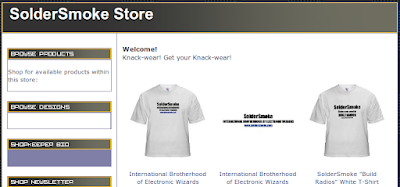
Speaking of sales… We will soon be in T-shirt weather in the Northern Hemisphere. And hamfest season is approaching. Now is a good time to stock up on SolderSmoke T-shirts. CafePress is offering 35% off on all T-shirts now through Sunday. It’s 15% off site-wide and you get another 20% off with the coupon code PREZ
http://www.cafepress.com/SolderSmoke

VFO = Very Frustrating Object

Bill,
I immensely enjoyed Solder Smoke — The Book, and have given it as gifts to several friends. It has rekindled the homebrewing spark, and I have been operating only homebrew gear this year as a result. My transmitter is a rockbound 40 meter rig, and I am using a HF regen receiver.

Tiring of QRM on 7.030 MHz, I decided to cobble up a VFO. Well, you know how that can take on a life of its’ own. I decided to build a Hartley oscillator at 3.5 MHz, and then double it to 7.030. The initial stages of the oscillator and buffer went well, but then I ran into a brick wall with the doubler, which performed admirably as an attenuator, but nothing else. The circuit was simple enough, but it just wouldn’t work. For a week I tweaked and tuned, to no avail. (as a result of all this effort, my wife said VFO must mean Very Frustrating Object). Then this morning I was going over the circuit again, and discovered that one side of the doubler tank circuit capacitor was grounded, and not supposed to be. It seems the knob shaft of the variable cap was in contact with the metal front panel, and being grounded out. I corrected the problem, and almost shouted EUREKA! when the doubler sprang to life and generated a big and perfect sine wave exactly at 7030!

I just wanted you to know that the story of your doggedness in tracking down the cause of harmonics on one of your homebrew rigs provided moral support to help keep me coming back again and again.

So, thanks again for the inspiration Bill.

Hey, I hope you are going to FDIM this year. If so, you should bring a good supply of SSTB. I bet you would go home with new junk, but no books.

73 de KD7KAR
Rob Pursell

Einstein and Lead-Acid Batteries

In “SolderSmoke — Global Adventures in Wireless Electronics” we discuss the way in which Einstein’s Special Relativity explains how and why transformers and coils work. I thought it was very cool to be able to see the role of Einstein’s theory in our little toroidal transformers. Yesterday The New Scientist (perhaps the best science weekly in the world) brought news that we need to consider relativistic effects if we want to understand how and why our car batteries (and, I suppose, our gel-cells) work:

Thank relativity every time your car starts. Lead-acid batteries get about 80 per cent of their voltage from special relativistic effects.

Check it out (the NS story is short and gets right to the point): http://www.newscientist.com/article/dn19978-car-batteries-run-on-relativity.html?DCMP=OTC-rss&nsref=online-news

Support independent publishing: Buy this book on Lulu.