Category: BITX20
Possibly the Best Ham Radio Interview Ever: Farhan on “QSO Today”

Stop what you are doing. Run — don’t walk — to the “QSO Today” website of Eric Guth 4Z1UG. There you will find his interview with Ashhar Farhan VU2ESE.
There is so much great information, inspiration and wisdom in this interview. I was so captivated by it that — even with the availability of the pause button — I was unable stop listening even for the time it would take to walk to the kitchen to refill my coffee cup. But at the same time, listening to Farhan describe the joy of bringing a new receiver into operation compelled me to go over to the bench — in mid-podcast — to tweak a receiver that I am working on.
In this podcast you will hear about how Farhan got started in ham radio, about his Elmers about the origins of the BITX, about the Minima and the new HF-1 rig, about Farhan’s spectrum analyzer project and about a new goodwill effort to send BITX circuitry to aspiring hams around the world, especially in developing countries.
Throughout you will hear Farhan speak of the importance of the book, Experimental Methods in RF Design.
N6ORS’s Min-X Crosses the Pond on First Contact
Well I just finished tweaking my new rig, I named it Min-X because I outright stole bits and piecesof the BITX and the Minima, thanks Ashhar. I made my first contact today and what a contact!
Oh, most of the rig was ‘noodled’ and constructed while enjoying you and Pete on the
Best 73,
Keith N6ORS
TIA-Tube Hybrids from Steve N8NM (Part 1)
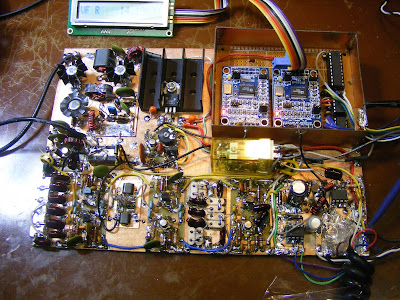
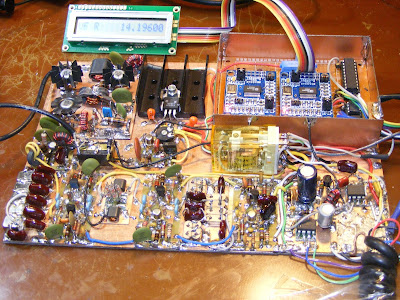
Last week Steve sent us a picture of his Straight Key Night rig which consisted of a homebrew thermatron transmitter and a TIA BITX as the receiver. I asked Steve for more info on the TIA BITX.
Bill:
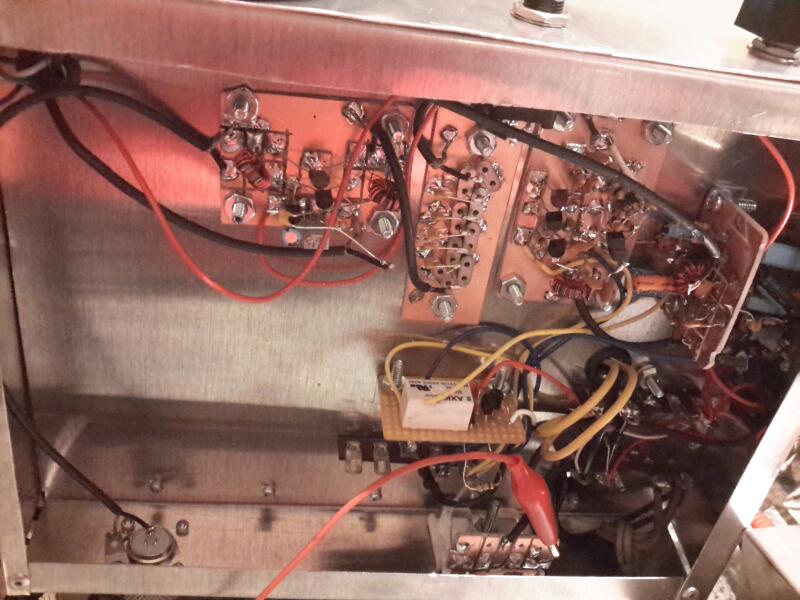
Shot these right after making the first QSO using the TIA rig as the receiver. The Arduino and ‘5351 are still on a breadboard, otherwise, all of the PCB modules except the filters and PA are installed on the chassis.
The QSO was uneventful, which is a good thing!
73!
Steve
DL1DN’s First Homebrew Contacts with a BITX40
FB!
Listen to my BITX17 Signal as Heard in France
November 2015 QST — Wrist Radios, Phase Noise, and a 1958 BITX!

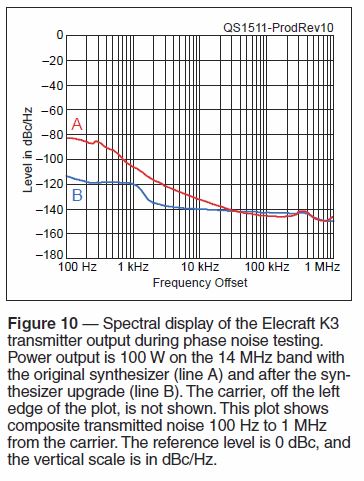
Wayne Burdick, N6KR, of Elecraft e-mailed us to let us know that there was an error in this QST article. The original graph in the article showed an improvement in phase noise at close-in frequencies, but it also showed a significant worsening of the phase noise beyond 10 kHz. THIS CHART WAS INCORRECT. The Upgrade does, in fact, improve the phase noise performance. A corrected version of the article appears here:
First Ever SSB Homebrew to Homebrew Contact by N2CQR. With…
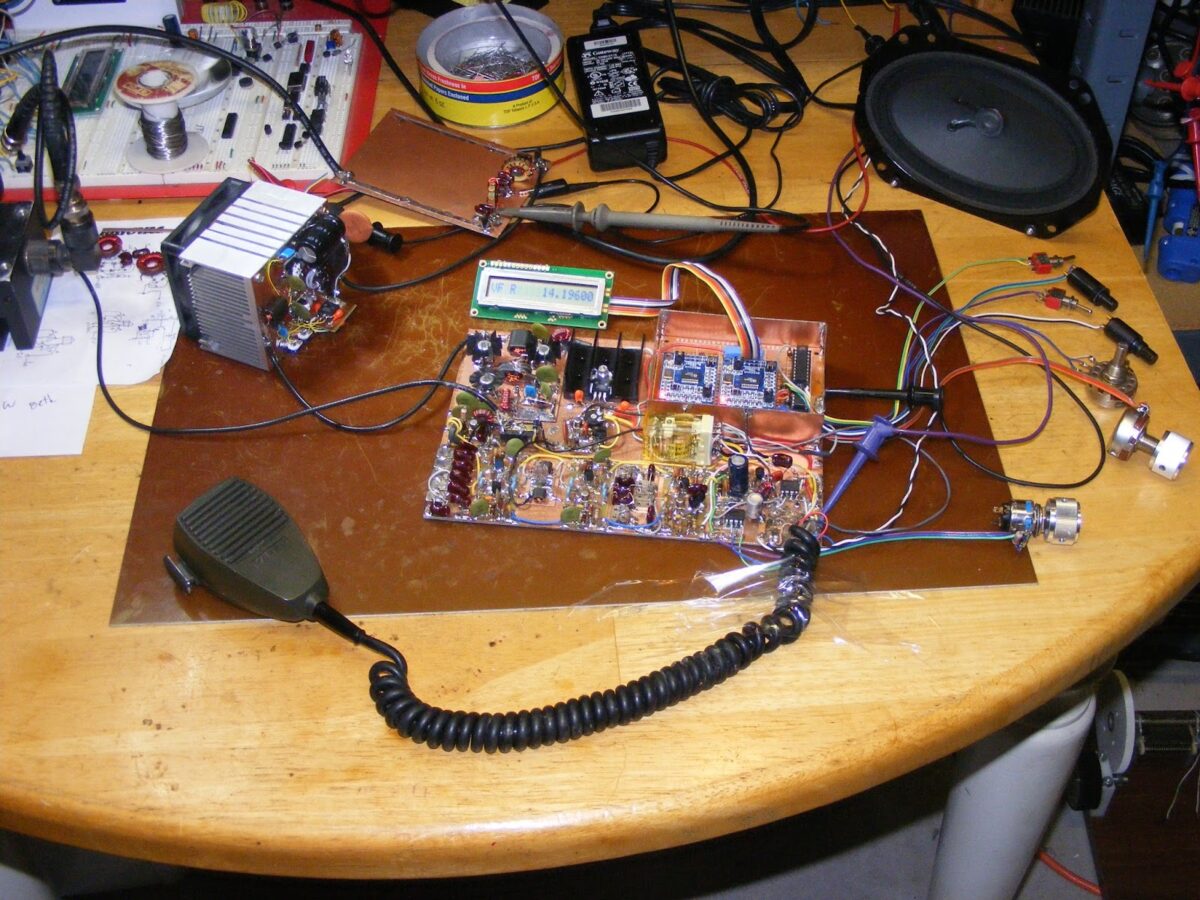
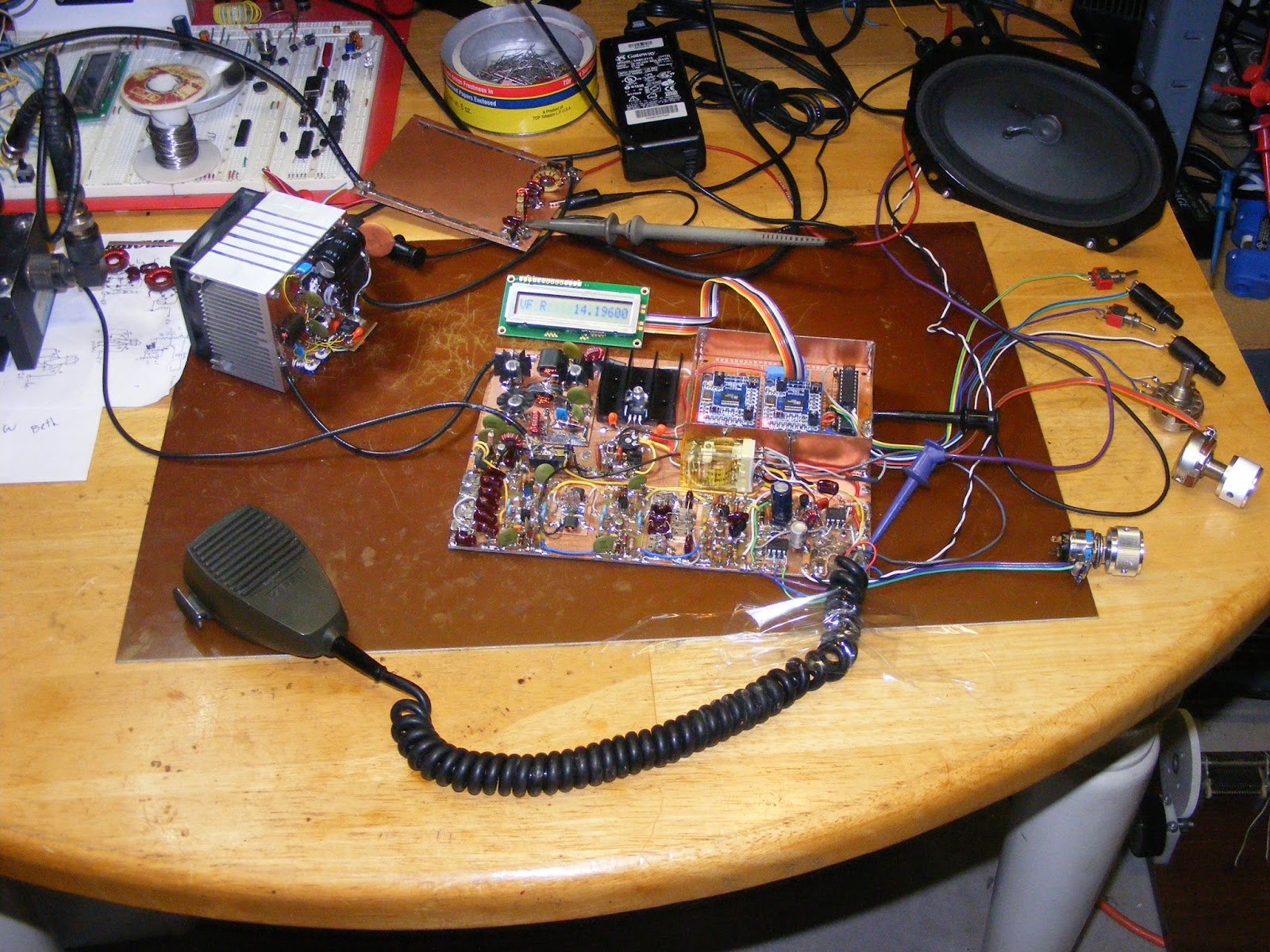
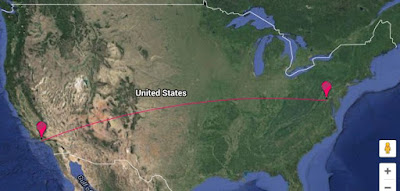
Pete Juliano and I were talking on Skype yesterday evening. He was regaling me with tales of the wonders of his new beam antenna. He mentioned that he was working a lot of East Coast stations… Wait a minute, I thought, I’m an East Coast station. And I have a 20 meter rig sitting right in front of me. “Meet me on 14.190 Pete!” It took me a minute or so to get the rig connected to the CCI amplifier and the 20 meter dipole. By the time I got everything fired up, there was a station on the frequency. I thought we’d lost the spot. But no! I realized it was Pete calling me.
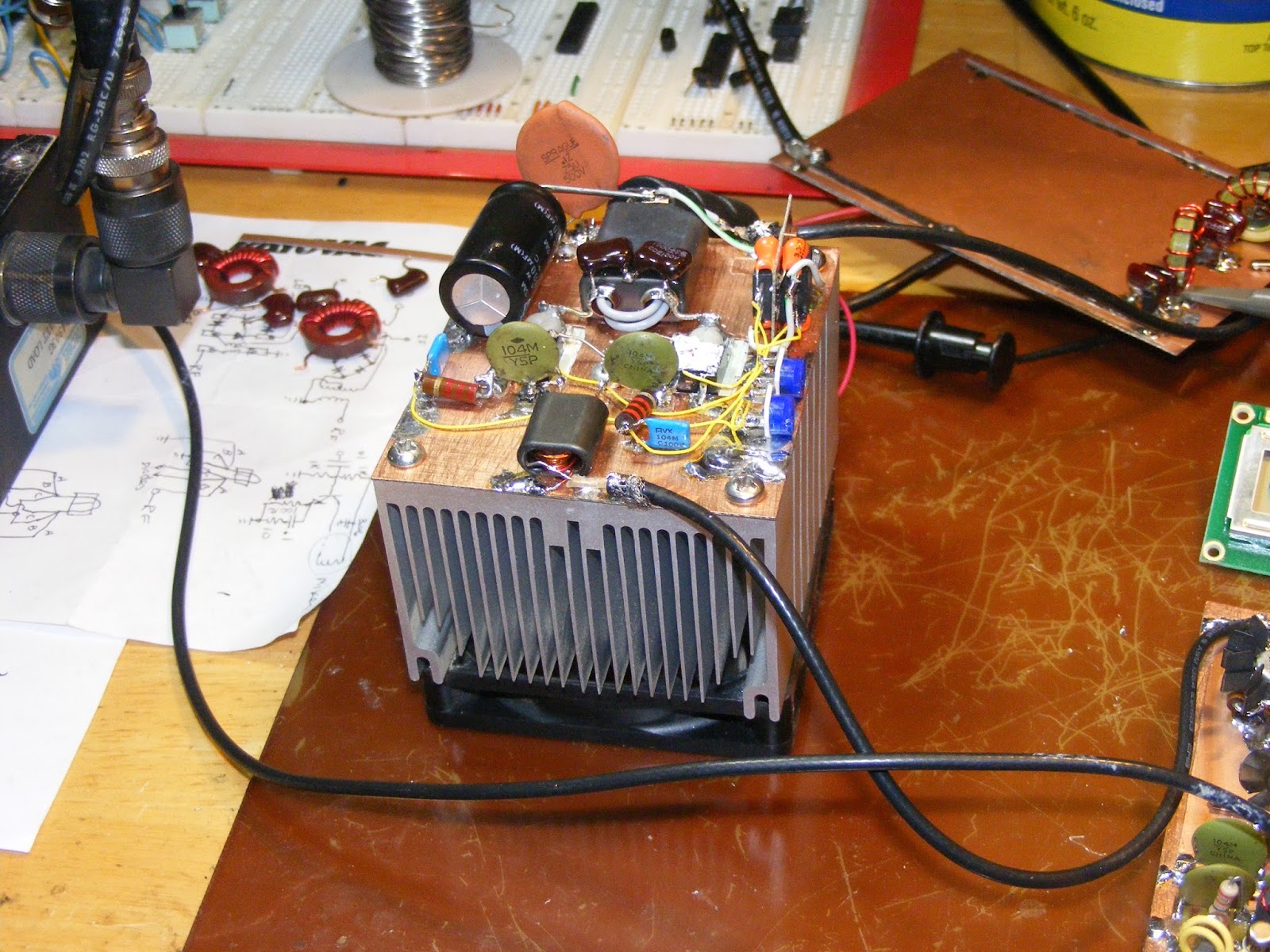
This was extremely cool. Pete was using his ZIA rig with the brand new beam. I was on my VFO BITX20. And I was using the CCI amp that Pete had coached me on (he taught me how to tap the holes for the heat sink).
This was the first time I had ever contacted another homebrew SSB station — and the first time Pete and I had spoken on the air. THE RADIO GODS WANTED THIS ONE TO HAPPEN!
I recorded the QSO:
http://soldersmoke.com/n6qwn2cqr.mp3
I will ask Pete to provide more detail regarding the California end of this QSO in the comment section below. Did you have your amplifier on Pete?
Amplifier Woes! Instability at Low Drive Levels! (Video)
I have to keep reminding myself: This is not “plug and play.” These are not appliances.
After I got my 40 meter problems squared away, I was doing some testing on my beloved 17 meter BITX. I noticed something weird: With the CCI EB63A amp feeding my 17 meter Moxon antenna, as I raised the output of the BITX17 driver, at one point (at about half the max input power) the SWR would suddenly spike. Then, as I raised the drive level above that point, the SWR would go back to normal.
I looked at it on the ‘scope. I can see the signal go very ugly at the mid-level drive point. In the FFT display, I can see that there is a strong signal at around 435 kHz. The 18 MHz signal seems to be riding along on top of it. Take a look at the video above.
Additional clues:
I see no signs of the 435 kHz signal at the output of the BITX 17. It seems quite clean.
This problem disappears if I replace the Moxon with a dummy load.
This problem does not show up if I feed the EB63A with my almost identical BITX20. And I use the same LP filter on both 20 and 17 in the CCI amp.
Any suggestions? Has anyone had this kind of problem?
Allison and Pete have been helping me with this. Thanks to both of them.
Our book: “SolderSmoke — Global Adventures in Wireless Electronics” http://soldersmoke.com/book.htm Our coffee mugs, T-Shirts, bumper stickers: http://www.cafepress.com/SolderSmoke Our Book Store: http://astore.amazon.com/contracross-20
Video of Curiously Strong Altoids Tin Frequency Counter
Our book: “SolderSmoke — Global Adventures in Wireless Electronics” http://soldersmoke.com/book.htm Our coffee mugs, T-Shirts, bumper stickers: http://www.cafepress.com/SolderSmoke Our Book Store: http://astore.amazon.com/contracross-20
A “Curiously Strong” Frequency Counter
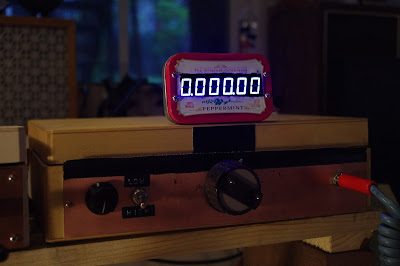
I got a six digit San Jian frequency counter for use with my BITX20. I was trying to figure out how to put it in a box and mount it on the rig when I realized that the counter fits almost perfectly in an Altoids tin. THE RADIO GODS HAVE SPOKEN.
I found the counter on Amazon. I use an eight digit version with my BITX17. But I think the six digit version is better (it fits in an Altoids tin!)
Our book: “SolderSmoke — Global Adventures in Wireless Electronics” http://soldersmoke.com/book.htm Our coffee mugs, T-Shirts, bumper stickers: http://www.cafepress.com/SolderSmoke Our Book Store: http://astore.amazon.com/contracross-20
Colin’s Tuna Tin Mighty Mite (Video)
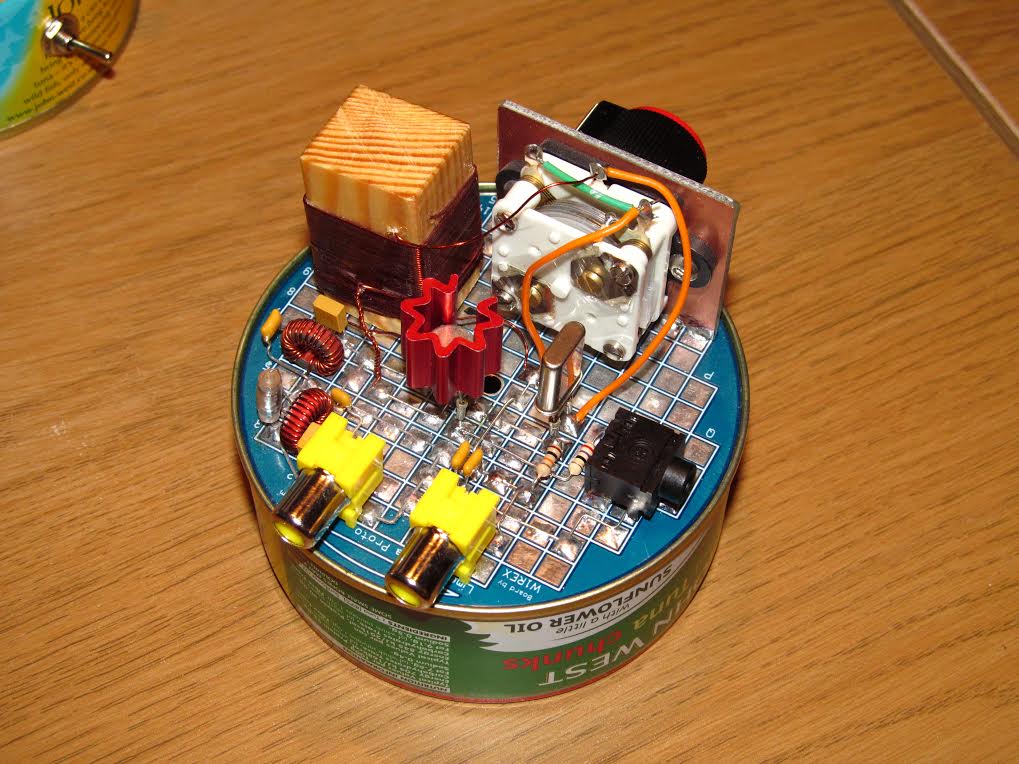
You will remember Colin as the builder of that beautiful BITX20 that he first used from his backyard and later used with great success from a hilltop in Northern England. In this video we see Colin demonstrating his Michigan Mighty Mite. Lots of soul in that little machine! Colin notes that this rig worked well from the start. The Radio Gods were obviously pleased by his use of a tuna tin as the chassis. I think they also liked the MePads from W1REX and the Tek 465 ‘scope. And of course the T-shirt was obviously a key element in Colin’s success.
Here is that beautiful BITX, now equipped with an internal speaker:
Our book: “SolderSmoke — Global Adventures in Wireless Electronics” http://soldersmoke.com/book.htm Our coffee mugs, T-Shirts, bumper stickers: http://www.cafepress.com/SolderSmoke Our Book Store: http://astore.amazon.com/contracross-20
Dean’s Tiny Tia — Hardcore Homebrewing
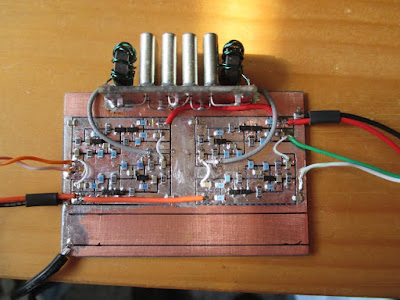
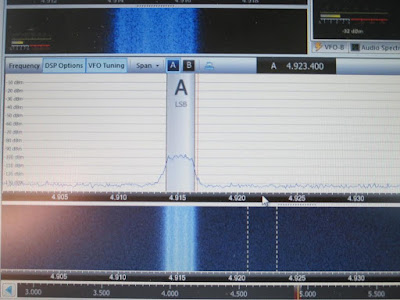
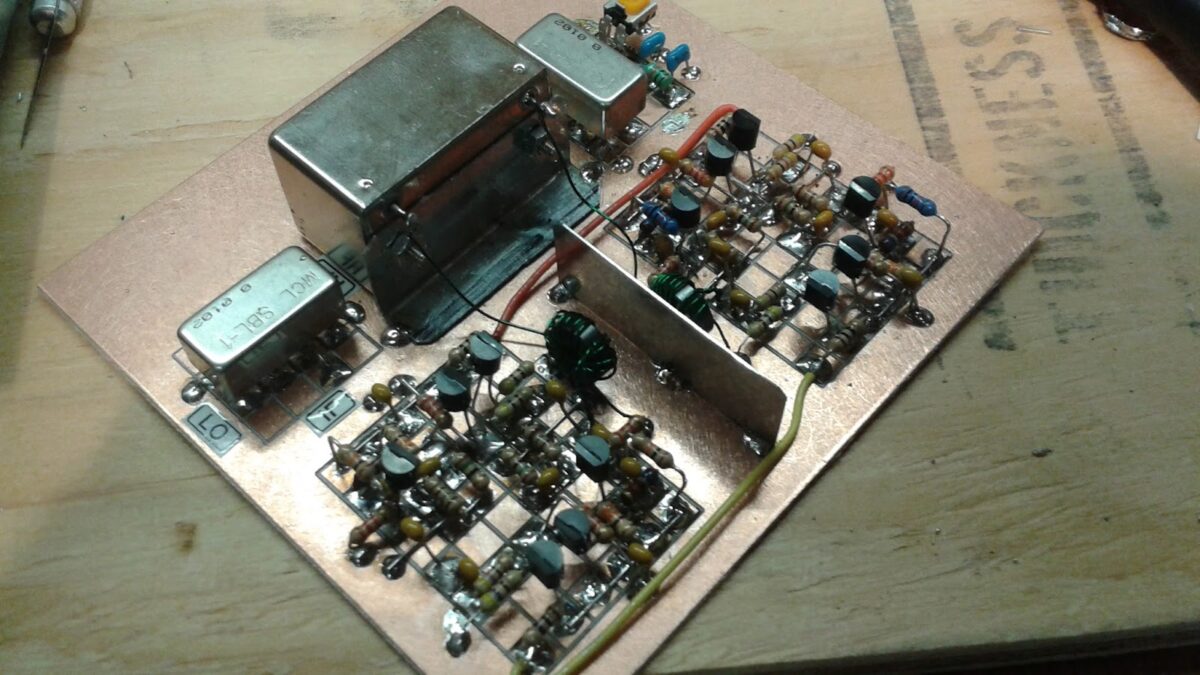
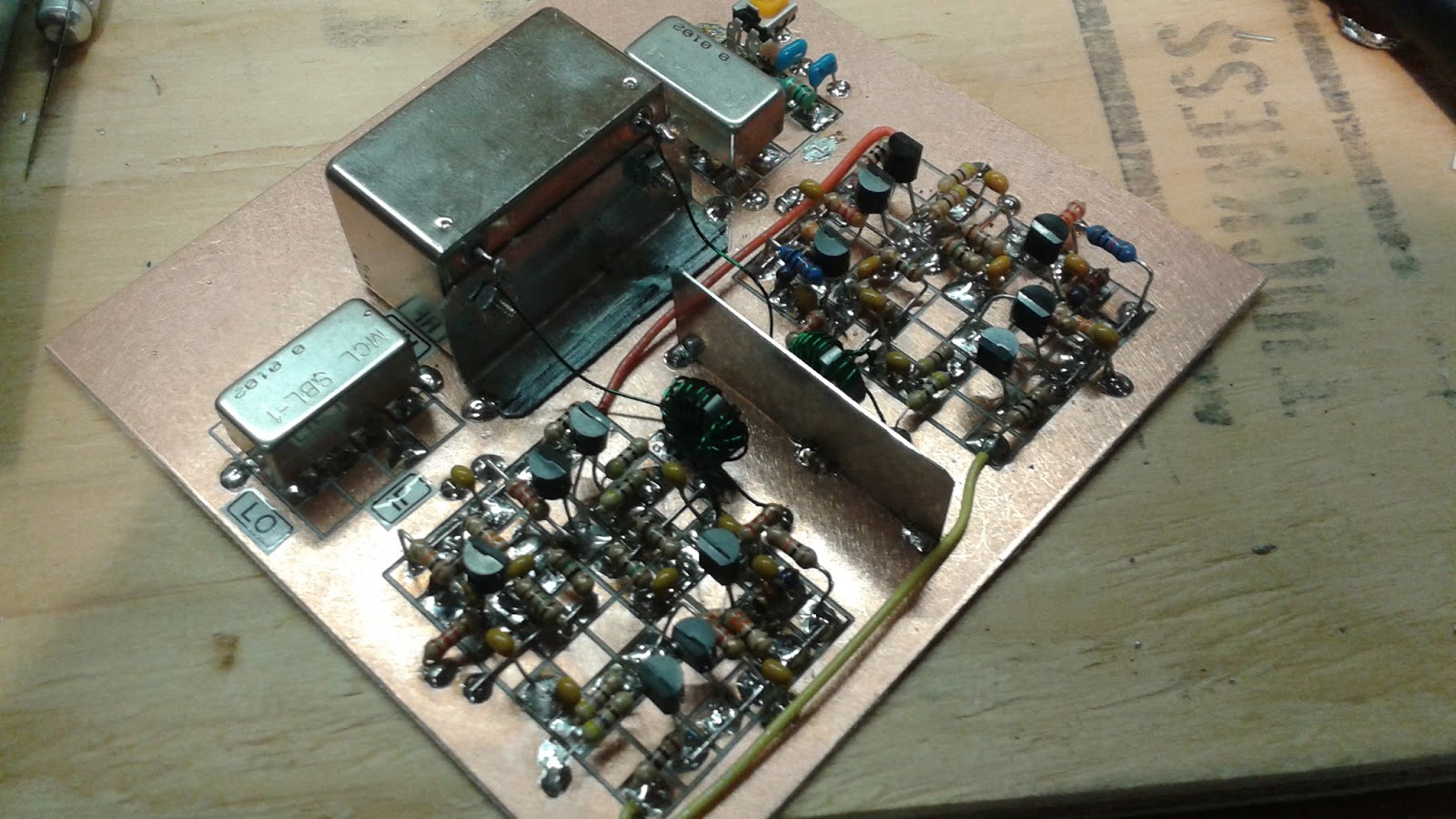
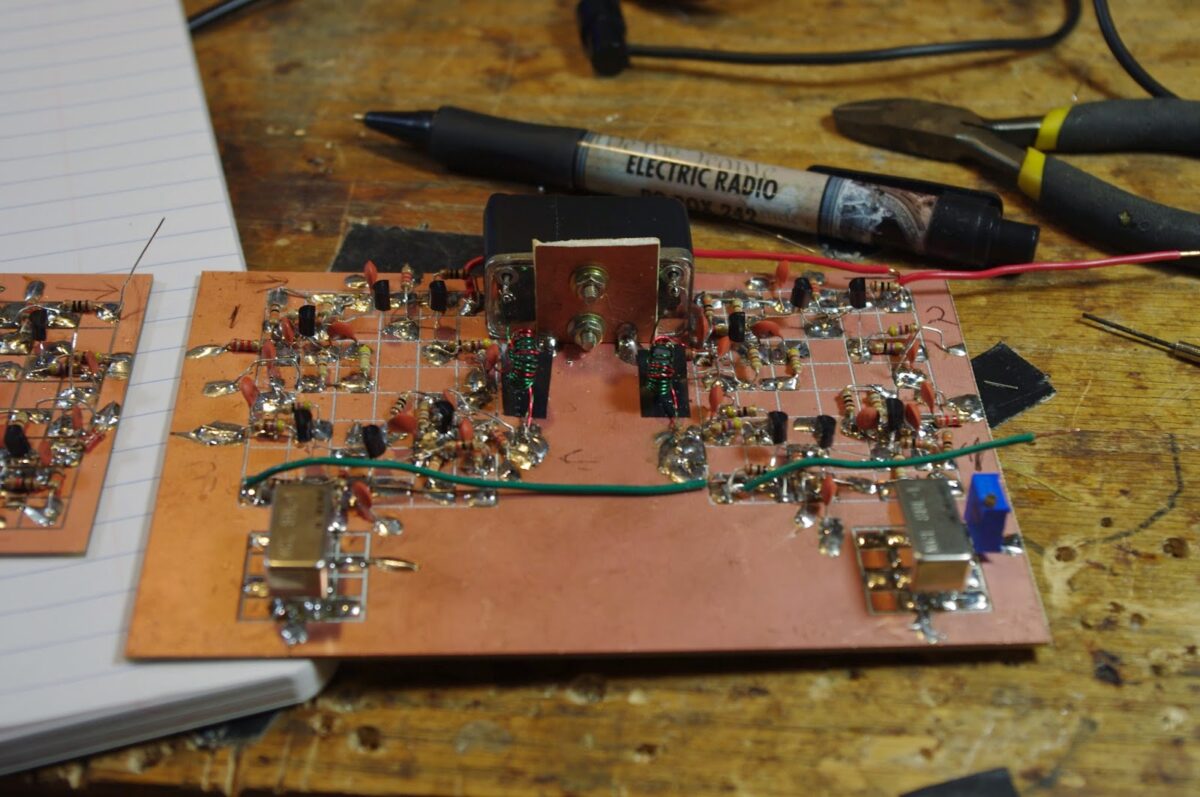
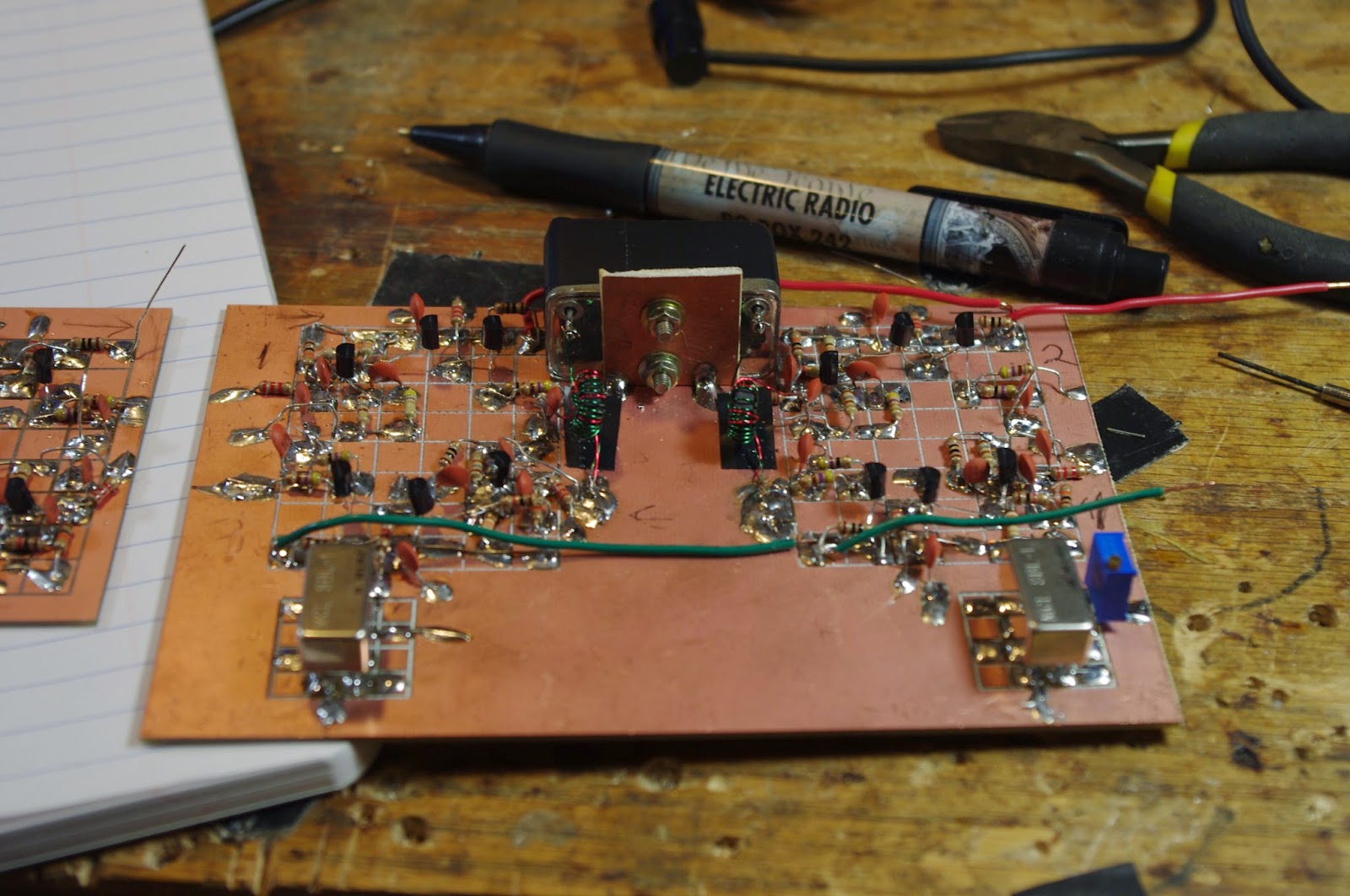
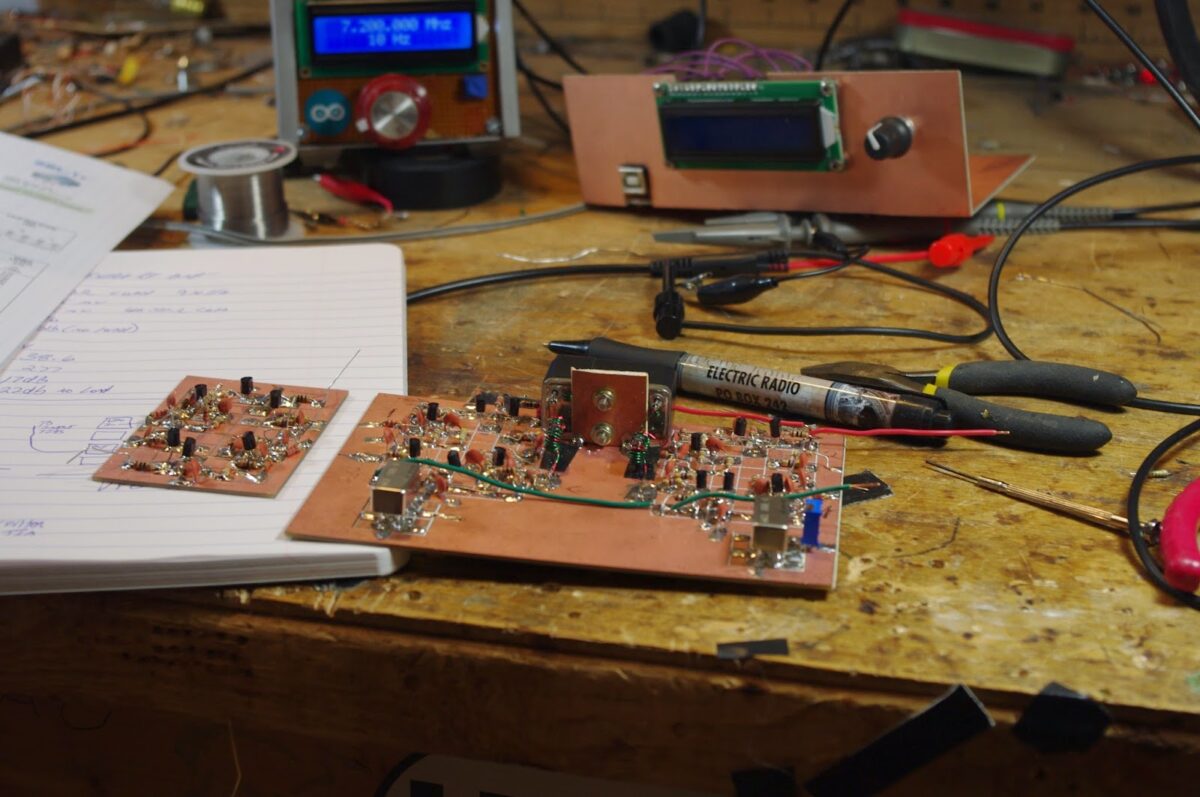
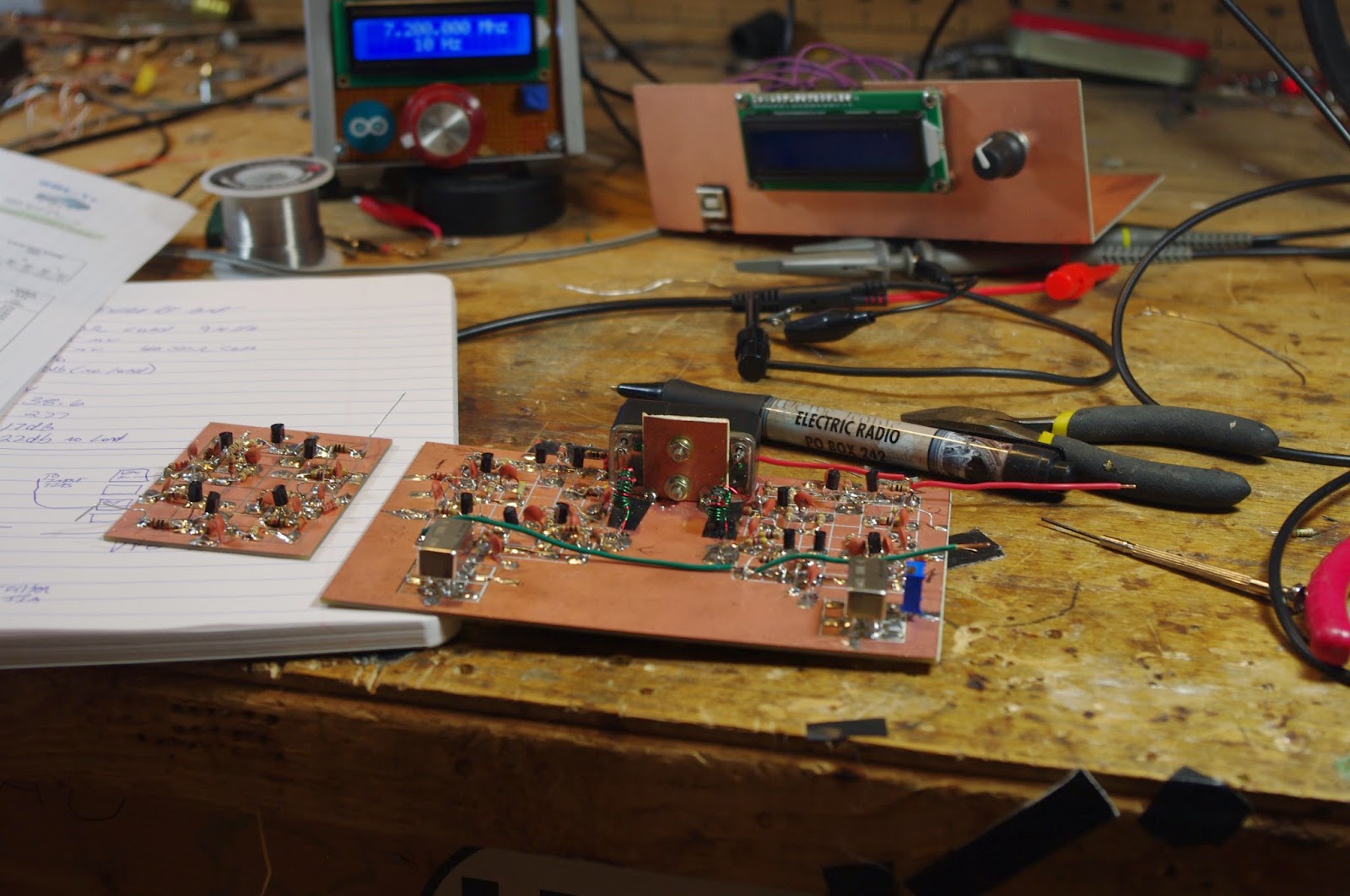
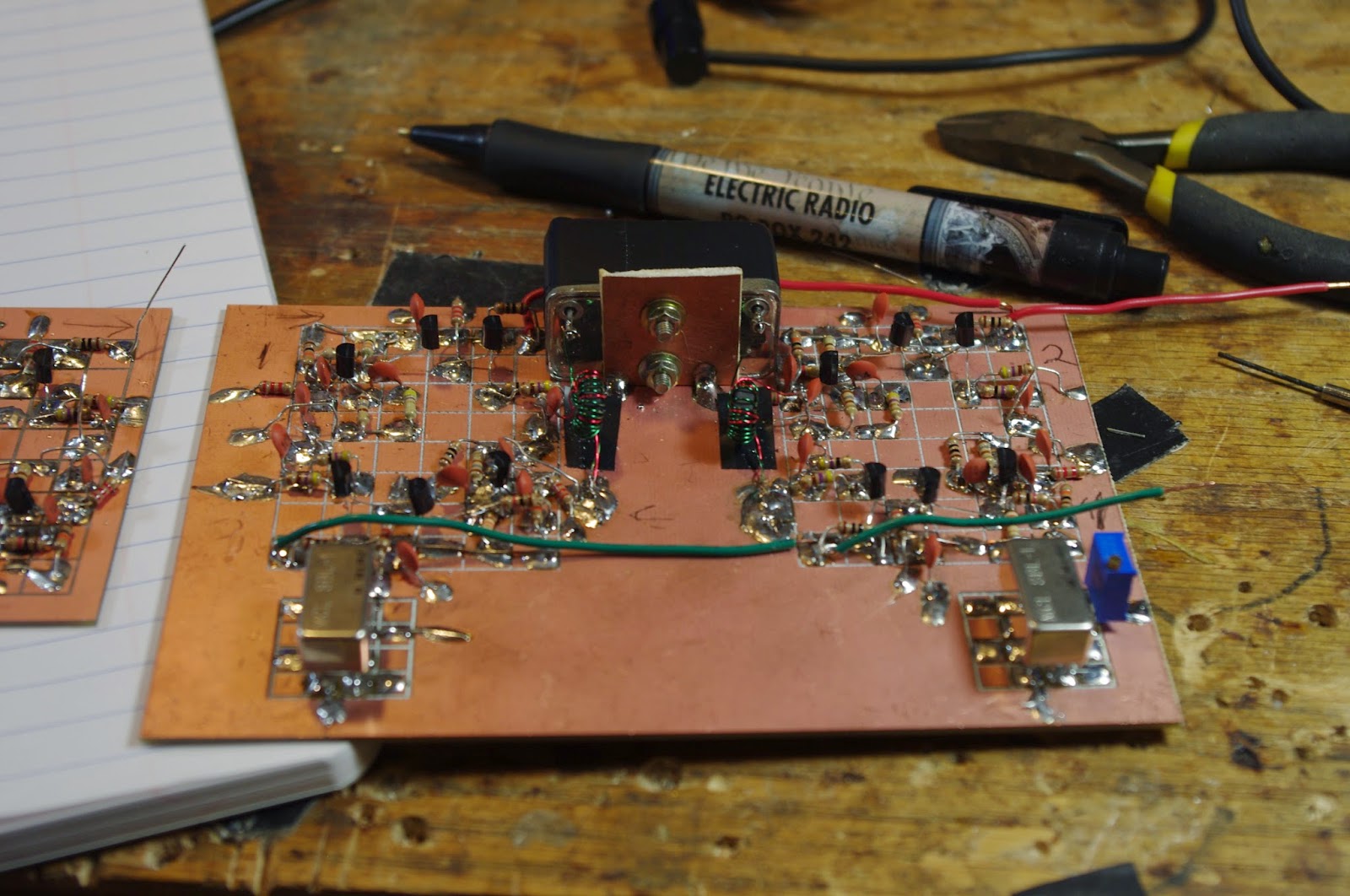
I’ve been on kind of a building hiatus due to various issues, but after seeing the work being done with the termination insensitive amplifiers I had to start noodling again…..as Pete would say. Well I have decided to build a TIA (ZIA according to Pete) SSB transceiver. I’ve decided to homebrew everything including the DBM, crystal filter, and even the Si5351 module. As I wait for more parts to come in, I wanted to show the 2 TIA amps and crystal filter assembly I’ve built. I’ve included a screenshot of the pass band response through the amps and the crystal filter. It looks the same in both directions and everything fits into an area of 2 x 2.5 inches. With the space left on the board, I hope to be able to put my SBL-1 clones on as well. I follow up as I get more completed.
73
Dean AC9JQ
Our book: “SolderSmoke — Global Adventures in Wireless Electronics” http://soldersmoke.com/book.htm Our coffee mugs, T-Shirts, bumper stickers: http://www.cafepress.com/SolderSmoke Our Book Store: http://astore.amazon.com/contracross-20
New Rigs but Old Mics
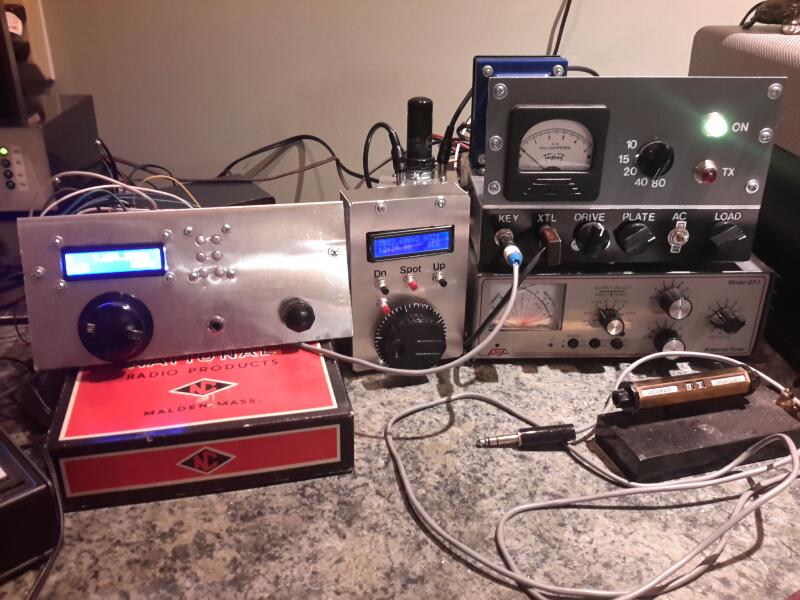
So now I have THREE BITX transceivers on the operating bench. I’ve been getting tired of moving the old D-104 around as I change bands. Surely each of these rigs merits its own mic. This would allow me to avoid the hassle of having to adjust the level on the D-104 each time I change rigs.
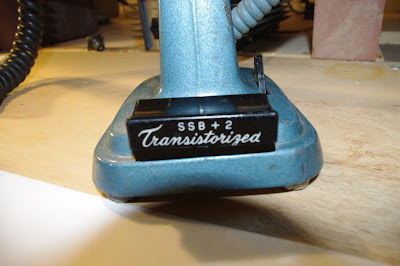
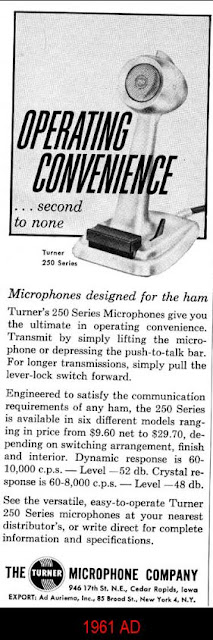
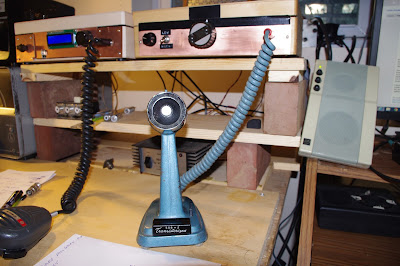
Fortunately in the junk box I have some useable old mics. An old “Turner SSB+2” mic has been kicking around in there for decades. I probably got it when I was a kid. The element was no longer working, so I just popped an electret element in there, took out the preamp circuit, but kept the adjustment pot. At first I had a 3.3 uF coupling cap in there at the output, but this was letting too much 300 Hz energy through. So I changed the coupling cap to .1 uF and this seemed to even things out a bit.
I know, I know: It is CB gear. It is painted BLUE and it looks like something George Jetson would use to talk to his interstellar Good Buddies. But it was preceded by a very similar mic made for hams (see above). And I like it. It even has the word “Transistorized” emblazoned in script across the PTT bar.
Our book: “SolderSmoke — Global Adventures in Wireless Electronics” http://soldersmoke.com/book.htm Our coffee mugs, T-Shirts, bumper stickers: http://www.cafepress.com/SolderSmoke Our Book Store: http://astore.amazon.com/contracross-20
Termination Insensitivity — Only Three TIAs in the World?
Termination Insensitivity. Is this like when your girlfriend dumps you and you just don’t care?
No. It’s more like this:
http://www.n6qw.com/TIA.html
Wes Hayward and Bob Kopski developed the Termination Insensitive Amplifier circuit back in 2009. With a bidirectional rig it is important that the crystal filter face the same impedance in both directions. Simpler bidirectional amps are impedance “transparent” in that their input impedance depends on what is on the output (and vice versa). The circuit that Wes and Bob developed solved this problem: these amps always look like 50 ohms. That’s very useful. When I was building my earlier BITX rigs, Farhan suggested that I try the termination insensitive amp circuits. On my latest project I followed his suggestion. At the same time, Pete was building a new BITX, also using the TIA amps.
Pete wrote to Wes and Bob and asked if anyone had followed through on their 2009 article by building a rig using this circuit. Wes said that he was unaware of any TIA rigs. It turned out that Tom Hall up in New York City had built one (video below). So I guess Pete’s rig is TIA 2 and mine is TIA 3! (But I was thinking, because of Pete’s Italian ancestry, shouldn’t we call his rig a Zia?)
Please let us know if you know of any other TIAS (or ZIAS!) out there.
Here is Tom Hall’s very FB TIA:
Our book: “SolderSmoke — Global Adventures in Wireless Electronics” http://soldersmoke.com/book.htm Our coffee mugs, T-Shirts, bumper stickers: http://www.cafepress.com/SolderSmoke Our Book Store: http://astore.amazon.com/contracross-20
SolderSmoke Podcast 176: Knack-Related Conditions: Termination Insensitivity, Sideband Inversion, Dongle Modification, Area 5351 Conspiracy Disorder
SolderSmoke Podcast #176 is available! (And it is GOOD!)
http://soldersmoke.com/soldersmoke176.mp3
16 May 2015
Bench Update:
Pete releases some magic (amplifier) smoke
Pete’s new termination-insensitive transceiver makes first contact
Bill goes Yaesu (well, just a filter)
Juliano Mill-Pad boards
Termination Insensitivity is not a personality disorder!
Flip those Bilat Boards! Pete’s cool technique for bilat building
Bill’s project notebook and stage testing
Installing the W6JFR EMRFD SBL-1 Bal-Mod Mod
AREA 5351: Myths, Urban Legends, and Conspiracy Theories about the Si5351
A Rule of Thumb for Sideband Inversion
Dongle Madness and the Dangers of Dongle Modification
What is a dongle?
24 Mhz to 1.7 GHz right out of the box
Modification for 0-29 MHz
Tapping the IF of a Drake 2-B
Getting another one for VHF-UHF
Dongling Meteors, Satellites and Airplanes
SPRAT cover AD9850 in 1988! Three cheers for SPRAT (and QQ and QST).
Elecraft’s new Rig
Our book: “SolderSmoke — Global Adventures in Wireless Electronics” http://soldersmoke.com/book.htm Our coffee mugs, T-Shirts, bumper stickers: http://www.cafepress.com/SolderSmoke Our Book Store: http://astore.amazon.com/contracross-20
SolderSmoke Podcast 176: Knack-Related Conditions: Termination Insensitivity, Sideband Inversion, Dongle Modification, Area 5351 Conspiracy Disorder
SolderSmoke Podcast #176 is available! (And it is GOOD!)
http://soldersmoke.com/soldersmoke176.mp3
16 May 2015
Bench Update:
Pete releases some magic (amplifier) smoke
Pete’s new termination-insensitive transceiver makes first contact
Bill goes Yaesu (well, just a filter)
Juliano Mill-Pad boards
Termination Insensitivity is not a personality disorder!
Flip those Bilat Boards! Pete’s cool technique for bilat building
Bill’s project notebook and stage testing
Installing the W6JFR EMRFD SBL-1 Bal-Mod Mod
AREA 5351: Myths, Urban Legends, and Conspiracy Theories about the Si5351
A Rule of Thumb for Sideband Inversion
Dongle Madness and the Dangers of Dongle Modification
What is a dongle?
24 Mhz to 1.7 GHz right out of the box
Modification for 0-29 MHz
Tapping the IF of a Drake 2-B
Getting another one for VHF-UHF
Dongling Meteors, Satellites and Airplanes
SPRAT cover AD9850 in 1988! Three cheers for SPRAT (and QQ and QST).
Elecraft’s new Rig
Our book: “SolderSmoke — Global Adventures in Wireless Electronics” http://soldersmoke.com/book.htm Our coffee mugs, T-Shirts, bumper stickers: http://www.cafepress.com/SolderSmoke Our Book Store: http://astore.amazon.com/contracross-20
BITX DIGI-TIA Build Update #2 Installing and Testing Yaesu SSB Filter
Termination Insensitivity. It sounds like some sort of psychological problem, but it is not!
Our book: “SolderSmoke — Global Adventures in Wireless Electronics” http://soldersmoke.com/book.htm Our coffee mugs, T-Shirts, bumper stickers: http://www.cafepress.com/SolderSmoke Our Book Store: http://astore.amazon.com/contracross-20
BITX DIGI-TIA Build Update #1 Building the First 2 TIA Amplifiers
Our book: “SolderSmoke — Global Adventures in Wireless Electronics” http://soldersmoke.com/book.htm Our coffee mugs, T-Shirts, bumper stickers: http://www.cafepress.com/SolderSmoke Our Book Store: http://astore.amazon.com/contracross-20
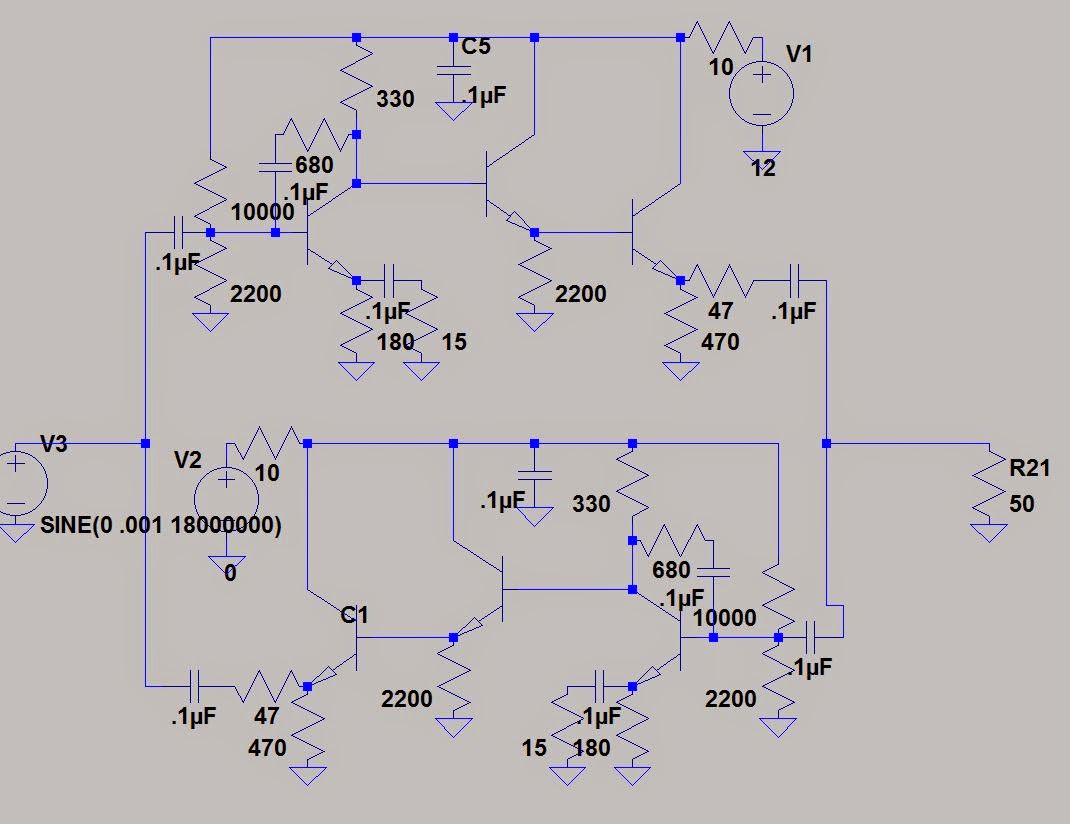
Termination Insensitive BITX Amps
Back in 2009 Wes Hayward and Bob Kopski designed a termination insensitive amplifier block for use in BITX-like transceivers. Farhan urged me to use it. The advantage of this design is that the input impedance stays at 50 ohms no matter what you hang off the other end. That’s very helpful, especially when you start trying to get specific impedances at the ends of crystal filters. I’m planning on using this circuit in my next BITX. This morning I was playing around with it in LTSPICE. The “mirror” feature in that program is quite helpful when you are working on circuits like this!
Here is the article by Wes and Bob that describes this great circuit:
http://w7zoi.net/bidirectional_matched_amplifier.pdf
Our book: “SolderSmoke — Global Adventures in Wireless Electronics” http://soldersmoke.com/book.htm Our coffee mugs, T-Shirts, bumper stickers: http://www.cafepress.com/SolderSmoke Our Book Store: http://astore.amazon.com/contracross-20