Category: BITX DIGI-TIA
Retro QRP Rigs of the 1960’s, 70’s, and 80’s — Video by Mike WU2D
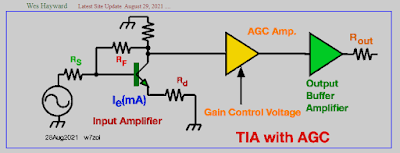
Adding Automatic Gain Control to the Termination Insensitive Amplifier
SolderSmoke Podcast #232 — Mythbuster, Pete’s Tube CW Rig, Pete’s DC RX and Simple SSB Rig, NanoVNA and TinySA, Very FB Mailbag
Frank Jones and the FMLA — Possible Victory?
IBEW Stickers: NASA, Johns Hopkins APL….
Cycle 25 Lookin Better Today: SFI 93 SN 47
Toobular! A Tube Transmitter
SR-160
Simple SSB rigs around the world!
KI7NSS’s Pacific 40
The Mythbuster and the Struggle Against the Urban Legend
W2EWL’s Cheap and Easy SSB
W4IMP’s IMP. Articles in ER by Jim Musgrove K5BZH and Jim Hanlon W8KGI
The Spirit of Homebrew SSB. From Electric Radio K5BZH December 1991
Reduced Front End Gain on the DIGITIA
Back on 17! HP3SS sells HBR receiver to Joe Walsh
Maybe another Moxon?
NanoVNA — Alan W2AEW helped solve mystery of why NanoVNA not providing accurate readout of circuit impedance. Over driving. Need attenuator.
TinySA — Limited Resolution Bandwidth. But you can listen with it! See video on blog.
— Google Feedburner to end e-mails from the blog 🙁
— Paul VK3HN — TIA AGC? Farhan and Paul looking into options
— Ciprian’s Romanian Mighty Mite
— Dino KL0S SolderSmoke GIF and graphical presentation on sideband inversion
— Allison KB1GMX helped me on 24 volts to IRF 510 issue.
— Dave K8WPE Wabi Sabi and Martha Stewart. And thanks for parts! 40673s!
— Steve N8NM building a 17 meter rig with 22.1184 crystals in a SuperVXO and a 4 MHz filter.
— Dean KK4DAS restoring an old Zenith. One hand behind your back OM.
— Pete Eaton debating SSB or DSB for 17. Go DSB Pete!
— Richard KN7FSZ a FB HBer. Asked about my solid-stating of Galaxy V VFO.
— Walter KA4KXX on benefits of no-tune BP filters like Farhan’s FB.
— Jack 5B4APL on Time Crystals and Homebrewing in the 4th dimension. FB OM!
— Moses K8TIY listens to the podcast with his young son Robert. Crank it in Robert!
— Farhan and the SBitx on Hack-A-Day
— Also Tom’s receiver from junked satellite rig on Hack-A-Day
— Todd K7TFC sent in beautiful message about the spirit of homebrewing. On the blog.
— Grayson KJ7UM was on Ham Radio Workbench with George Zaf
— AAron K5ATG running a uBitx with a homebrew tuner and antenna. Hope I can work him
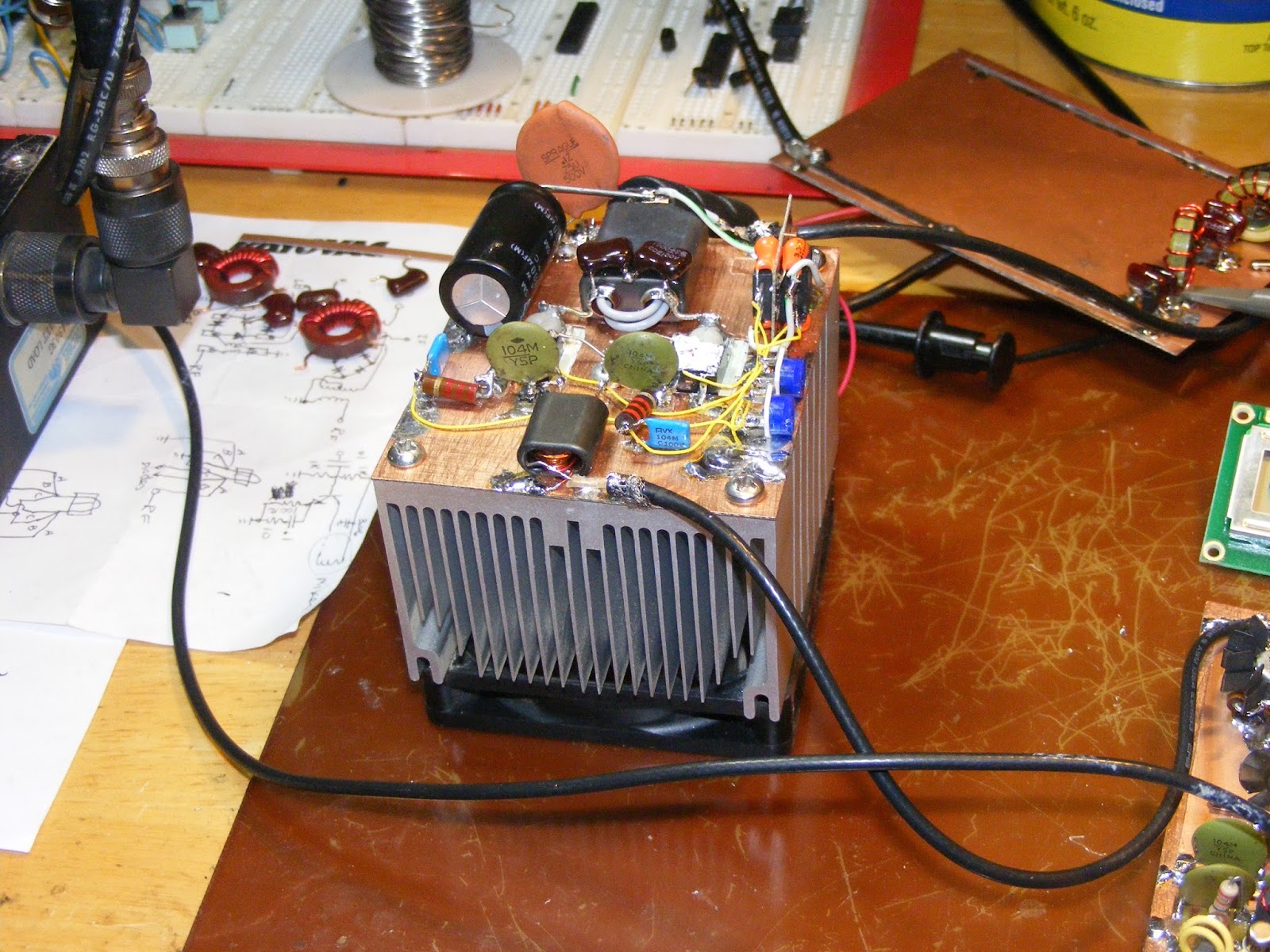
— Heard Mike WA3O last night on 40 DIGITIA. Water cooled amplifier
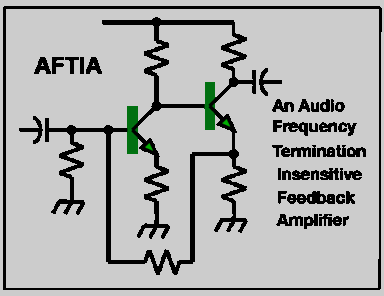
AFTIA! The Audio Frequency Termination Insensitive Amplifier from W7ZOI
Face the TRUTH! LOOK at Your Signal with an Antuino!
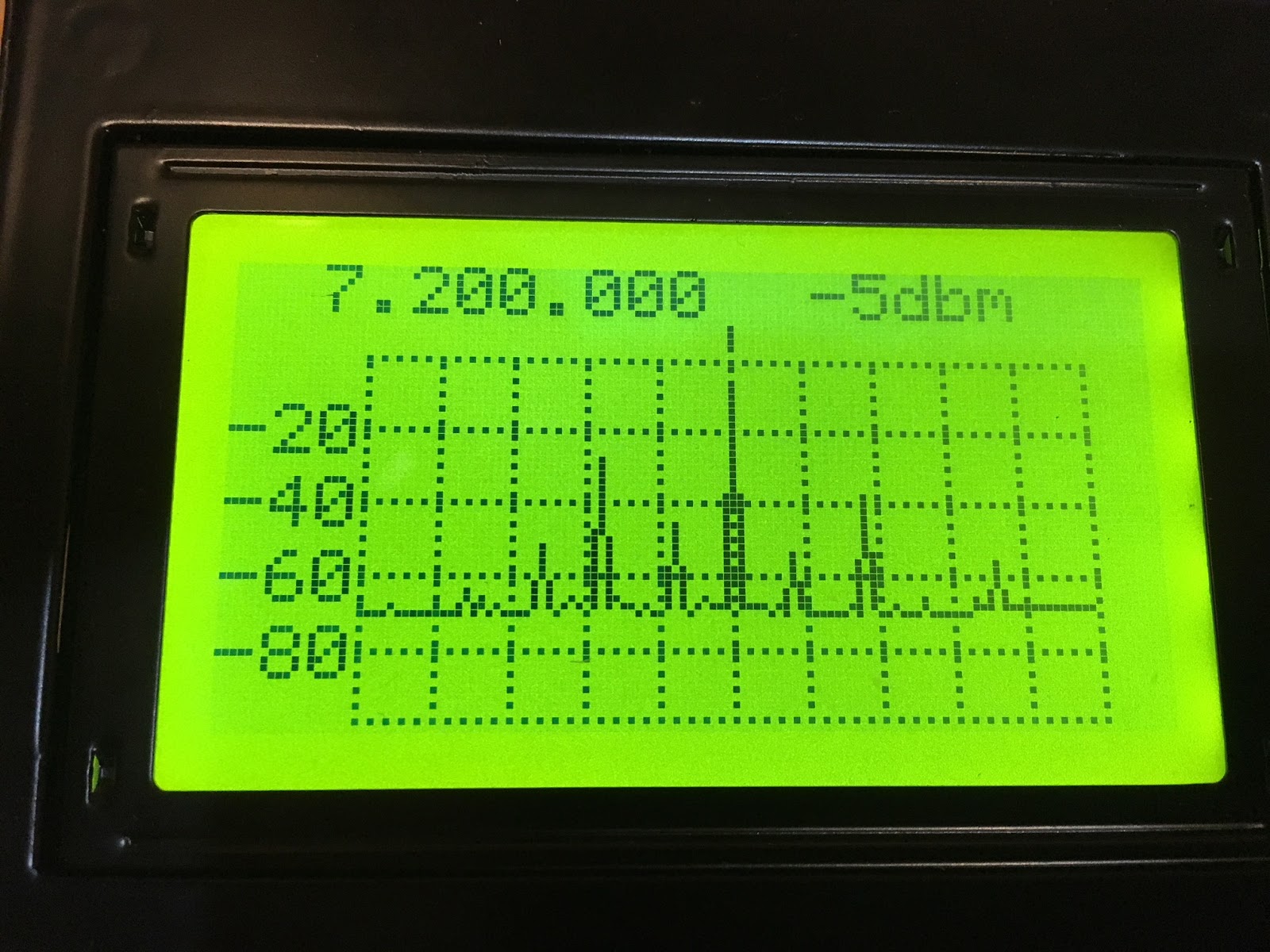
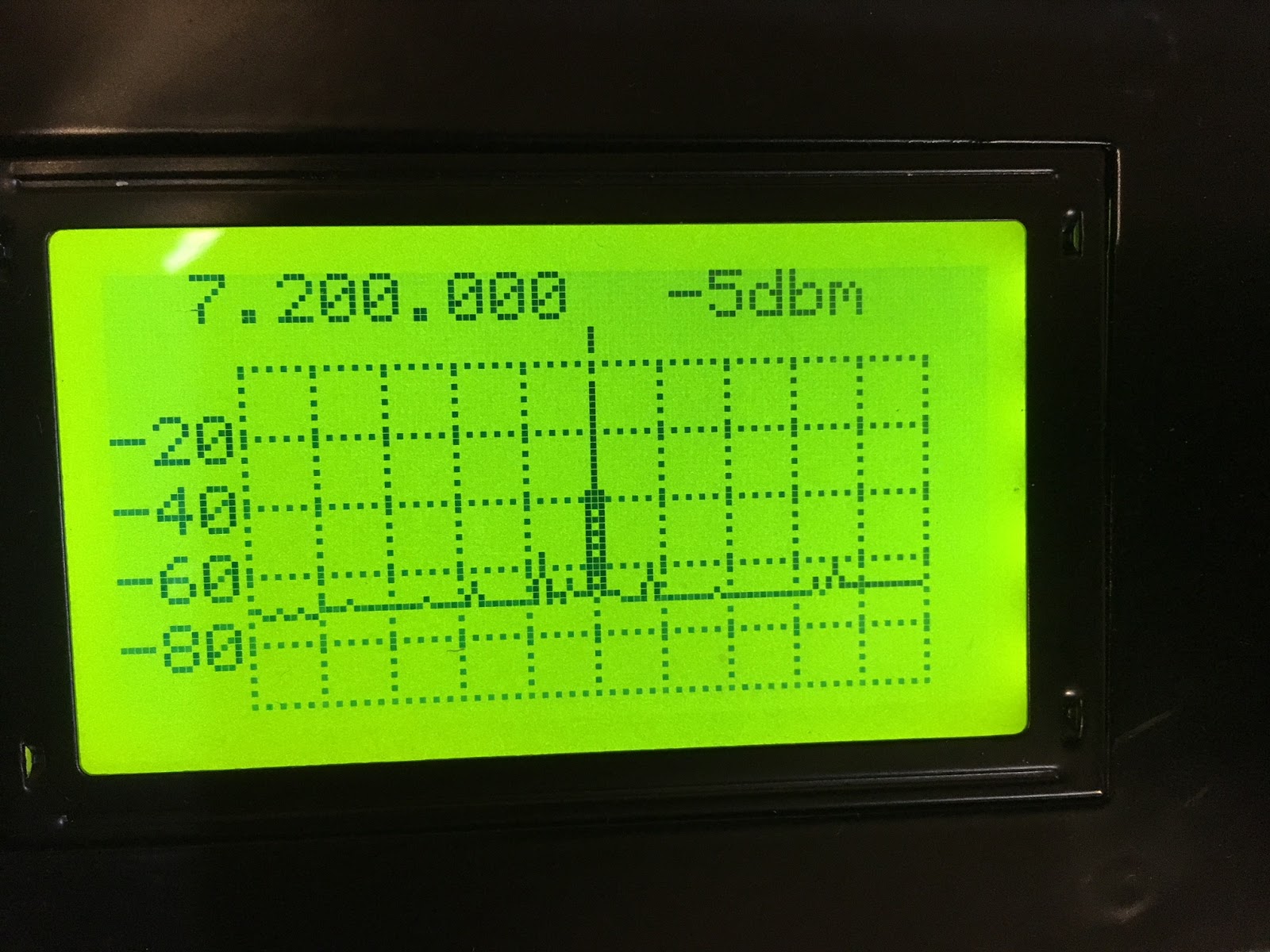
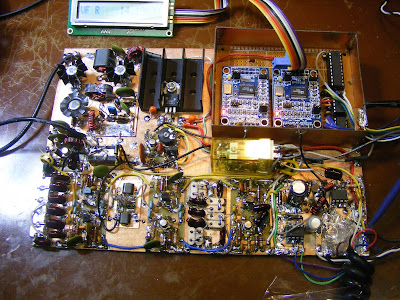
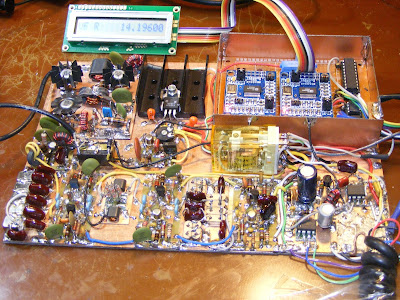
At first, I didn’t want to believe it. I was in denial. I wanted to shoot the messenger (in this case, the Antuino). How could my beloved HB 40 meter DIGITIA transciever have an output that was so…. so DIRTY! Everyone tells me it sounds great. But the little Antuino screen told a different story. Strong spurs up at 9 MHz and down at around 5.4. And lots of places in between. (In these display images, the center frequency is 7.2 MHz and each division to the left or right is 1 MHz.)
Farhan tried to get me to face the truth: “The frequency domain viewing of RF Signals is the opening of the third eye. Once you start seeing signals as a bunch of simultaneous sines, you will always be wary of the waveforms on the scope. In fact, time domain readings make little sense.”
At first I blamed strong VHF RFI and my somewhat hay-wire test set up. My homebrew Rube Goldberg 20 db attenuator was probably picking up some of the VHF RF. But as I looked more closely at the output of the transceiver in the frequency domain, I gradually accepted that it was true. There were a lot of spurs. I have a general coverage receiver in the shack, and with it I could hear the little devils. And after some adjustment I could see them in the FFT display on my Rigol o’scope. An exorcism was definitely needed.
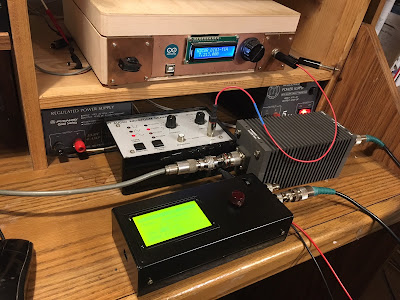
But first came a tightening up of the test setup. Pete advised me to do this. I had in the shack some really nice dummy load/attenuators from the HP8640B Signal Generator that Steve Silverman had given me (and that Dave Bamford had hauled across New York City for me). I ordered the necessary N connectors and adapters and soon my test setup improved a lot.
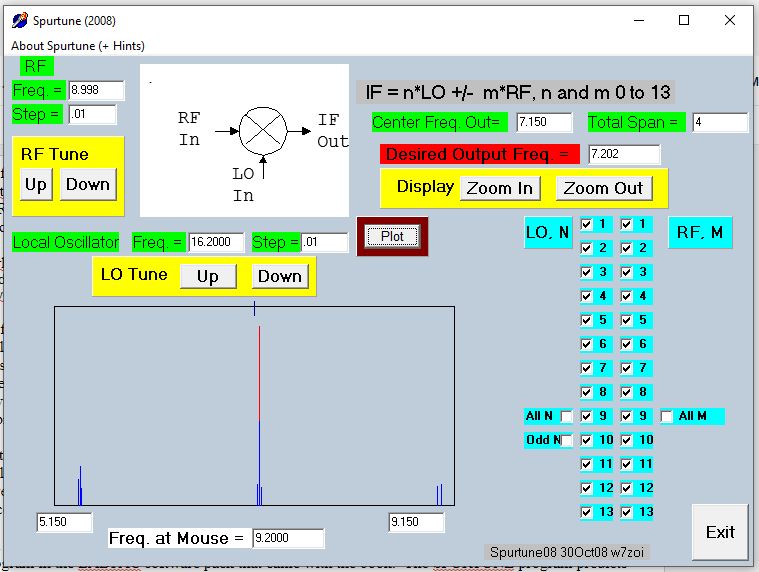
All this got me thinking about spurs. I consulted EMRFD and was reminded of a really great program in the LADPAC software pack that came with the book. The SPURTUNE program predicts spurs and tells you what to look out for. It is really illuminating. Try SPURTUNE.
Through this, I gained a better appreciation of the importance of the bandpass filter in an SSB transceiver. I’d always thought of it as something that allowed the other mixing product to be eliminated while passing the one you want. But I came to realize that it does a lot more than that — it also helps get rid of spurs. If it is designed right. Mine was not. I had plucked it out of an old QST article and had not paid much attention to it. All it needed to do was knock down the unwanted mixing product, right? And in my transceiver (9 MHz IF, VFO running 16.0 – 16.3) MHz that unwanted product would be way up at 25 MHz. It wouldn’t take a lot of selectivity to knock that down. But I’d forgotten about the closer-in spurs. Antuino reminded me of them. And SPURTUNE explained where they came from.
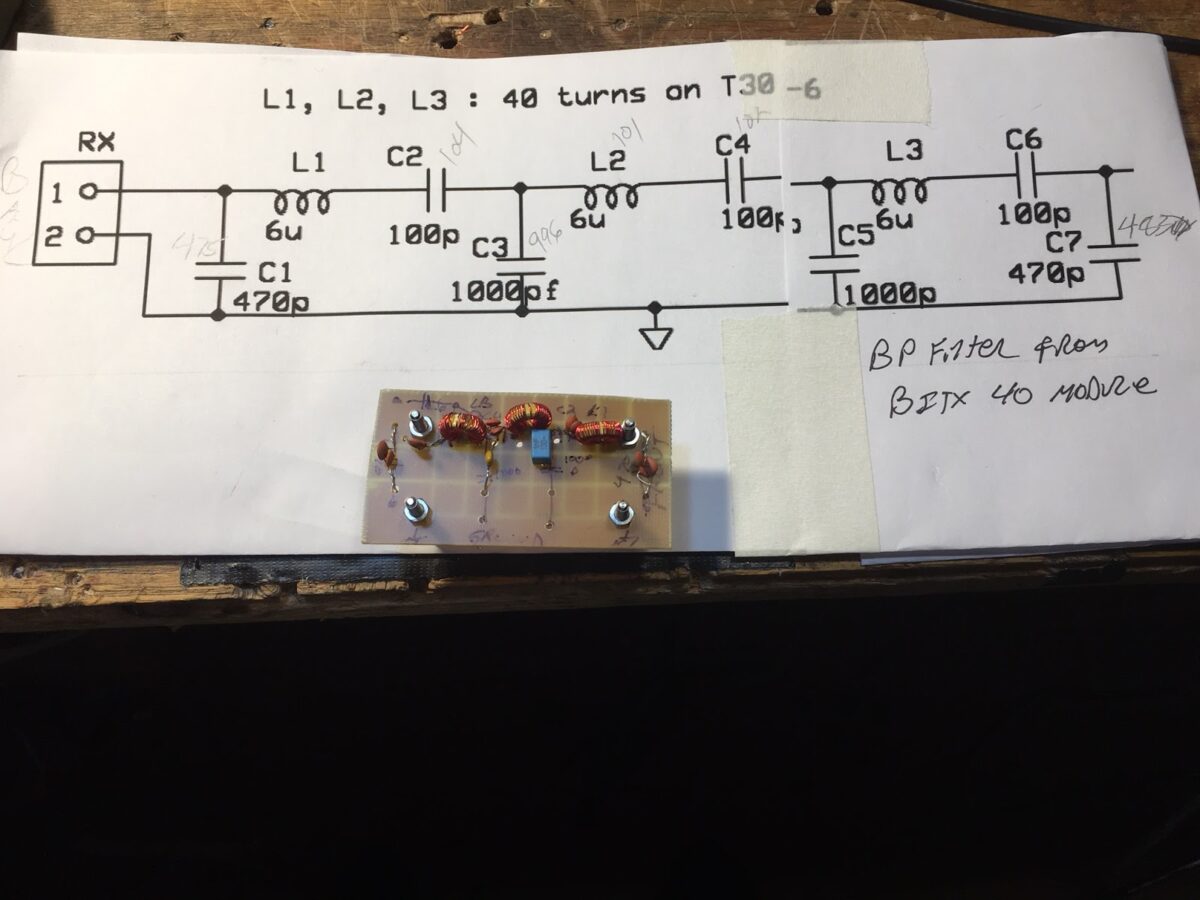
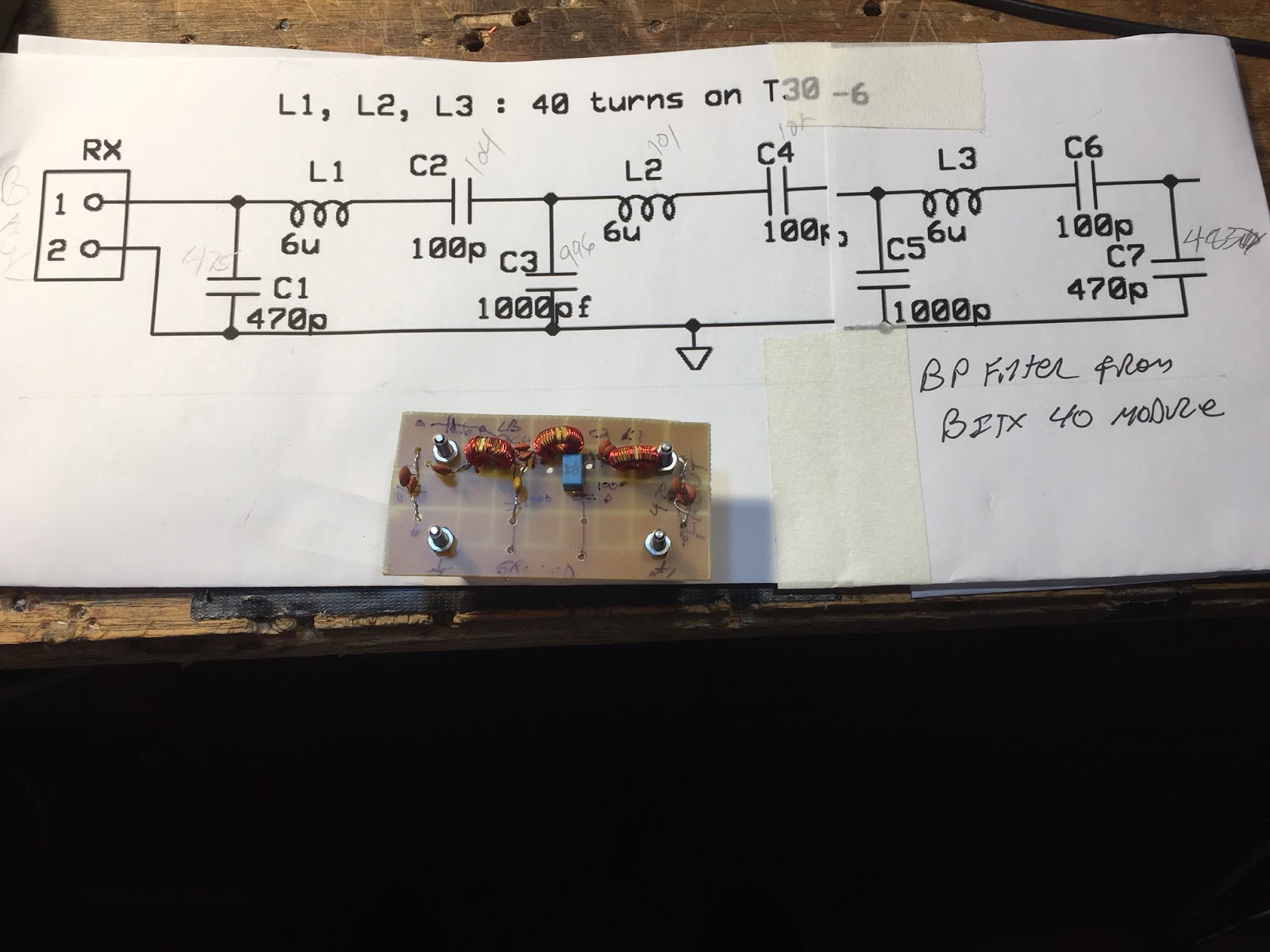
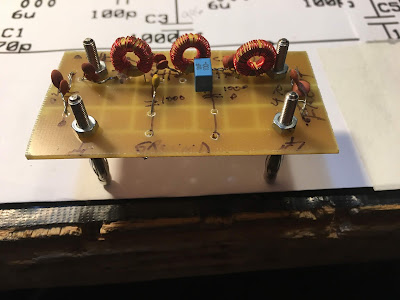
For the exorcism, I decided to use the bandpass filter design from Farhan’s BITX-40 Module. I had made the BP filter on this rig “plug-in” so it was easy to build a new filter.
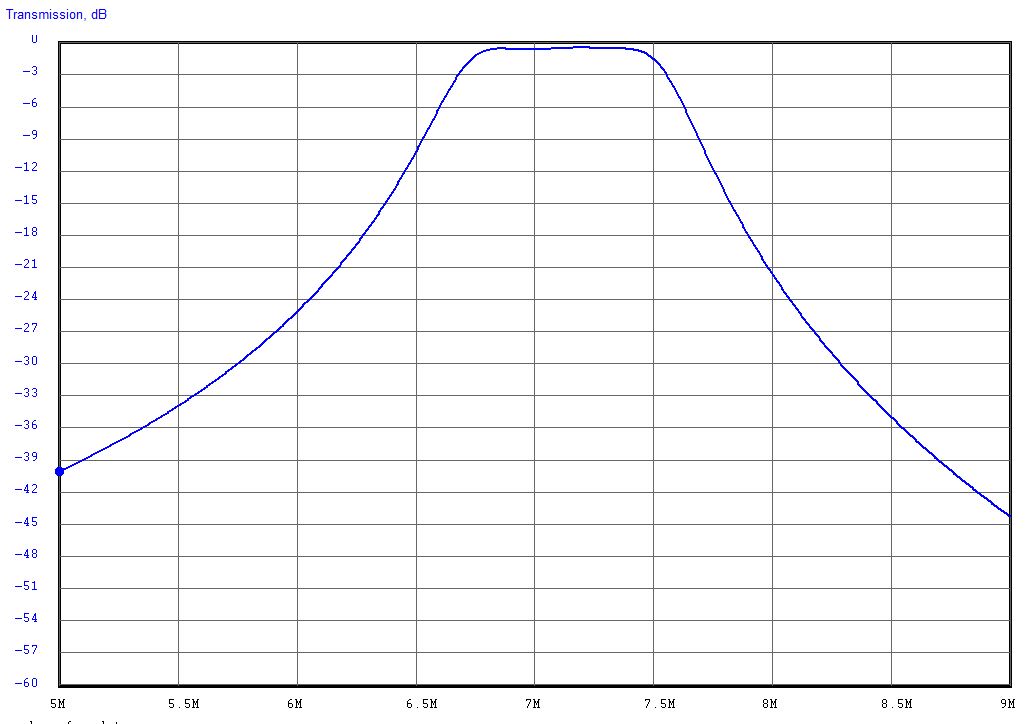
I even checked out the filter design in a simulator. For this I use ELSIE. Another very useful program. Here is what ELSIE predicted for Farhan’s BITX40 Module filter:
VU3XVR’s EMRFD TIA HB TRANSCEIVER

Ram did a beautiful job on this 40 meter rig. You can read about this project here:
https://vu3xvr.blogspot.com/2018/10/homebrew-5-watts-cw-transceiver-using.html
Amazing Homebrew/Boatanchors QSOs on 40 –Six solder melters in a row!
![]() |
| Al W8VR |
![]() |
| W4IJ Boatanchors |
Jan’s FB Slovakian SMD TIA Boards
Video: Farhan in the SolderSmoke Shack! BITX, JBOTS, McDonald Straw Sig Gen, uBITX, Sweperino and more!
Thanks again to Farhan for visiting us. It was great to see his reaction to my humble implementations of his great designs. I got him to sign my BITX17. This was really a fantastic day for me and for my family.
Video (Audio) of N2CQR (me) on 40 Meters with BITX DIGI-TIA
This was the icing on the cake. Ruben AC2RJ up in New York was monitoring as I called CQ with my BITX Digi-Tia last night on 40 meters. He recorded the contacts that ensued. I was really glad that he recorded VE3XBO describing his experiences with a BITX 40 Module at his local radio club — The WAX Group of the Barrie Radio Club in Ontario.
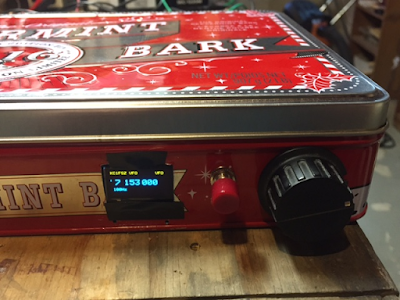
Farhan’s module is really starting to show up more often on the band. On the 19th of April I talked to Bruce KC1FSZ — he was on his Peppermint Bark BITX 40. And on March 30 I talked to Josh KE8CPD on his BITX 40.
Click on the arrow (above) to listen to Ruben’s recording. Ruben has a nice YouTube channel here:
https://www.youtube.com/channel/UCXClX_GBzFQIiqTwgnt8qxA
HB2HB! BITX40-BITX40 with KC1FSZ
HB2HB: Contact on 40 meters with W0PWE
HB2HB: N6ORS, W0PWE (and me!)
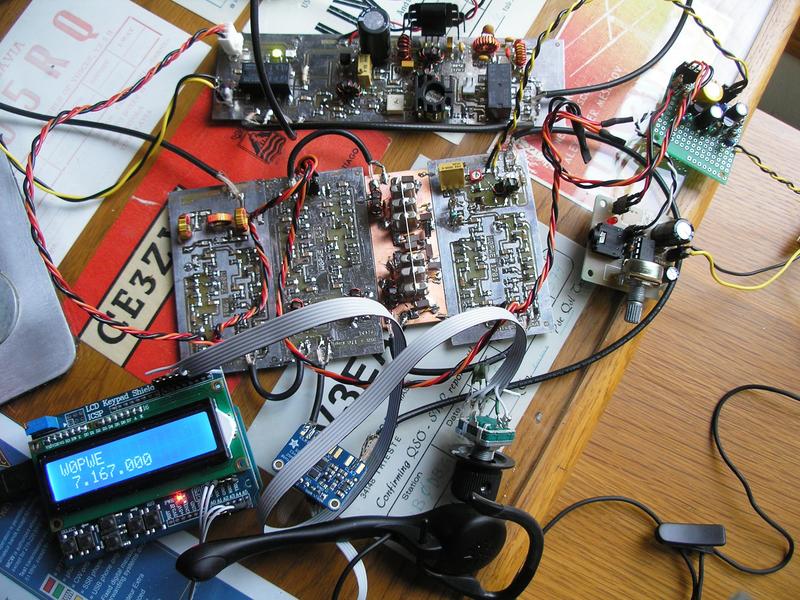
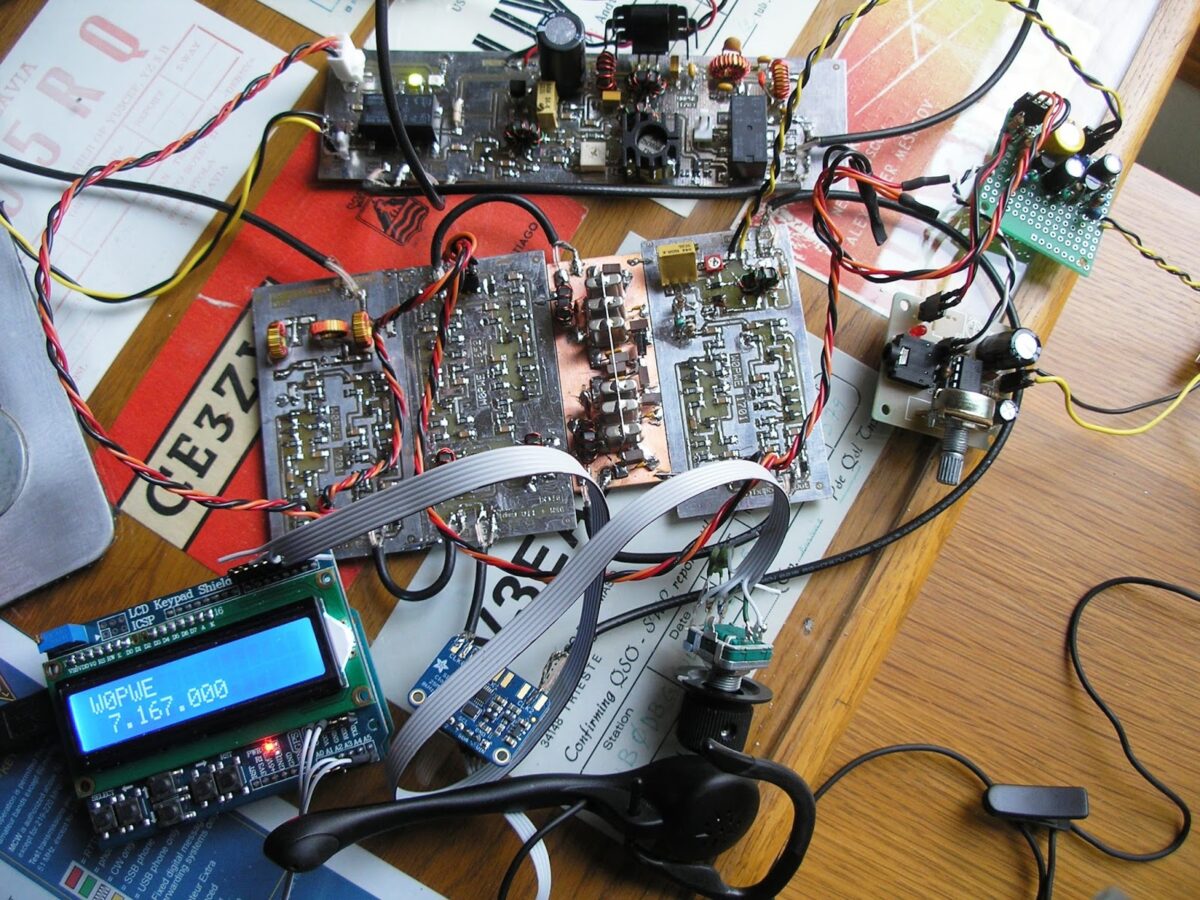
projects I should finish but boy was it ever fun to start a new one. This morning I soldered the
last part in my newly hatched Bitx, drug it over to the operating position and had two great QSOs
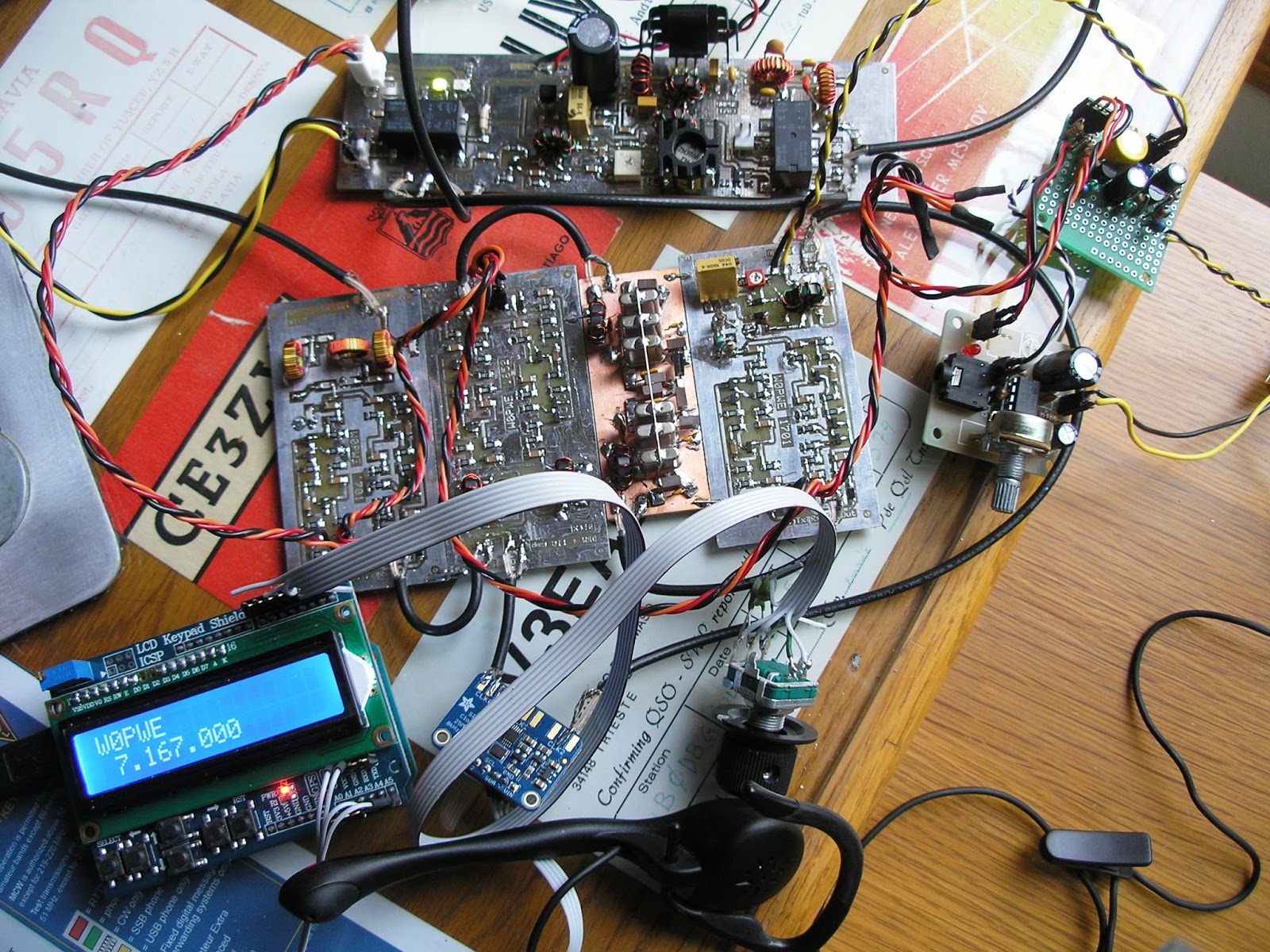
with it. See attached photo shows the rig as it was during those QSOs.
When I finished my first QSO with W9SX, Keith in WI N6ORS called me. He was running a multi-band Bitx he had built and we had a great HB2HB qso. Awesome!
My rig is scratch built, mostly SMT and generally follows the 40M schematic that Farhan has on
his HFsignals page. I am using the Kopski/Hayward TIAs though and I designed a 6 pole crystal
filter for it since 6 of the 10 crystals I bought were very similar when I characterized them
with my PHSNA setup. It uses the Adafruit SI5351 board and I modified a sketch that LA3PNA wrote for the Arduino.
I designed and fabricated the boards for it using the software and process described by K7QO and
W5DOR. Toner transfer with the Hammerhill Gloss paper is working great. The heatsink on my IRF510 is a little light. I could smell the MOSFET warming up during a few of my lengthy transmissions with Keith.
Now the SWL report. While listening on the receiver portion of my Bitx last week I heard you on
7260 at about 0030Z. I think that was Tuesday or Wednesday. I wished I could give you a call but
at that point my PA was merely a few traces on the computer screen. Hope to hear you again on
40M.
73/72,
Jerry – W0PWE
The Nauen Transmitter Station (Germany)
There is a lot of radio history in this shortwave transmitting station. I came across it tonight with my BITX DIGI-TIA rig. It was on 7.215 MHz transmitting in Indian (South Asian) languages. But alas, the signals were not from distant India (home of the BITX!). Instead — as often happens these days — the signals were from a relay station. In this case they came from relatively nearby Germany, from the Nauen transmitter site.
Check out the Wikipedia page:
https://en.wikipedia.org/wiki/Nauen_Transmitter_Station
HB2HB! KW4KD and N2CQR (video)
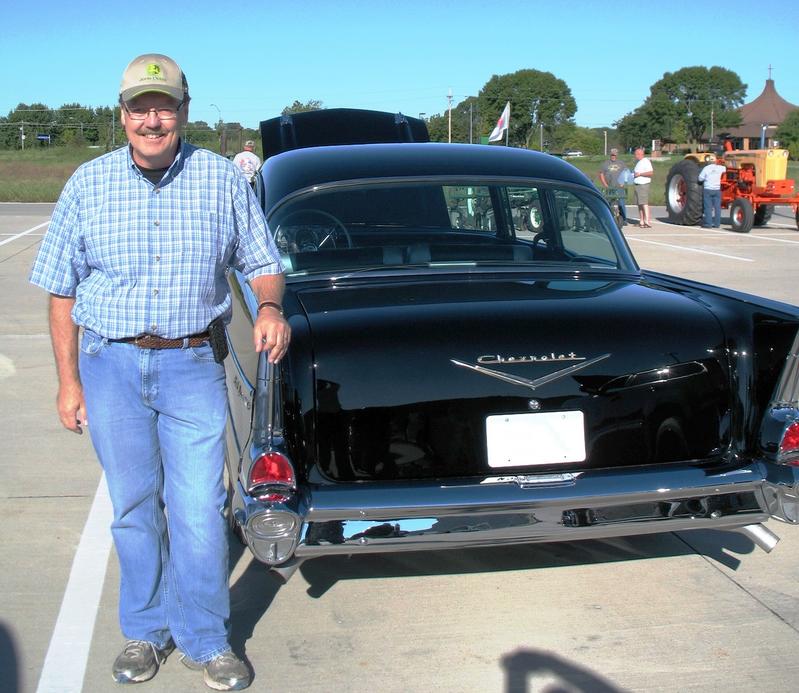
A couple weeks ago I ran into Jim KW4KD on 40 meter SSB. Jim is in Chattanooga, Tennessee. He was running a modern “black box” rig, but he mentioned that he had on the shelf two complete homebrew stations, one of which was for 40 meter SSB. He hadn’t used this gear in 40 years. I encouraged him to blow the dust off and get it on the air. Yesterday, Jim did just that. We met up on 40, first at 1730 local (my time) and again at 1930. Excellent! Another HB2HB contact. Check out the video (above). Thanks Jim.
If you run into someone who mentions having some old homebrew gear, encourage them to blow the dust off and get it on the air.
Jim’s SSB rig:
N6ORS’s Min-X Crosses the Pond on First Contact
Well I just finished tweaking my new rig, I named it Min-X because I outright stole bits and piecesof the BITX and the Minima, thanks Ashhar. I made my first contact today and what a contact!
Oh, most of the rig was ‘noodled’ and constructed while enjoying you and Pete on the
Best 73,
Keith N6ORS
TIA-Tube Hybrids from Steve N8NM (Part 1)
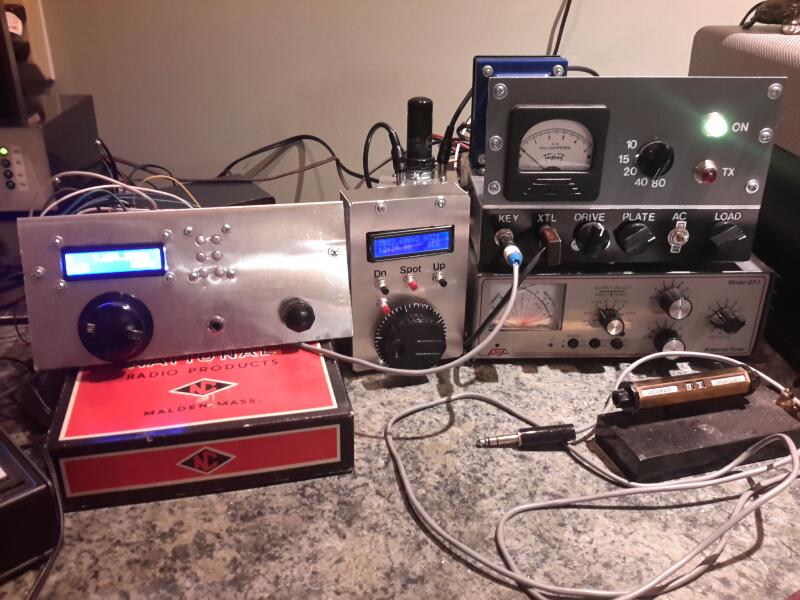
Last week Steve sent us a picture of his Straight Key Night rig which consisted of a homebrew thermatron transmitter and a TIA BITX as the receiver. I asked Steve for more info on the TIA BITX.
Bill:
Shot these right after making the first QSO using the TIA rig as the receiver. The Arduino and ‘5351 are still on a breadboard, otherwise, all of the PCB modules except the filters and PA are installed on the chassis.
The QSO was uneventful, which is a good thing!
73!
Steve
HB2HB! AC9JQ — N3FJZ on 40 with Homebrew Rigs
On Saturday October 24, Dean AC9JQ (Indiana) and Rick N3FJZ (Maryland) made contact on 40 meter SSB using Si5351/TIA BITX rigs. FB!:
Bill:
Dean and I made contact. We both were in and out most of the time, but conditions seemed to improve towards the end where I could understand Dean about 90%. Using the RST “by the book”, I would say he was a 33, 3 =(readable with some difficulty), and signal strength was 3=(weak), and based on what Dean was reporting, my signal back to him was the same – 33.
73 to you both.
Rick – N3FJZ.
HB2HB! AC9JQ and N2CQR Make Contact on 40 with Homebrew Rigs on Both Sides (with help from N3FJZ/HB)
This weekend brought another HB2HB (Homebrew to Homebrew) contact. We have been following with interest the 40 meter transceiver project of Dean, AC9JQ. Above you can watch a video of Dean’s rig in action before it went into the box. Earlier this month Dean achieved a remarkable “Double First” when he made his very first amateur radio contact. He was using his homebrew rig to do it. So his first contact was also his first homebrew contact. FB. More info on Dean’s rig and homebrew exploits can be seen here:
http://soldersmoke.blogspot.com/search?q=ac9jq
This week Dean got a decent 40 meter dipole up in the air. We arranged (via e-mail) to meet on 40 on Friday evening. We made contact, but conditions weren’t great. We tried again several times on Saturday, looking for open spots amidst the madness of the CQ WW DX contest. Rick N3FJZ joined us and also tried to make contact with Dean, but had no luck either. Daytime conditions didn’t allow for a good contact between Indiana and the Washington/Baltimore area where Rick and I are located.
Finally, last night after family obligations at both ends settled down, Dean and I found a relatively open frequency on 40 and made a good contact. A short snippet of it can be heard by clicking on the link below. Keep in mind that Dean was running about 2 watts to a dipole on 40 at night.
http://soldersmoke.com/HB2HBAC9JQ.mp3
Thanks Dean! Thanks Rick!