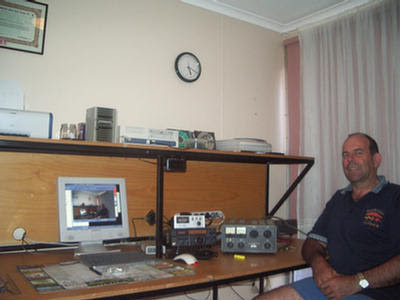
VK2TPM made some nice videos of the Weak Signal Propagation Reporting System (WSPR) maps over time. Its kind of fun to watch the propagation shift from trans-Atlantic to trans-Pacific.
More: http://www.youtube.com/user/vk2tpm#p/u/4/U1sBGZzNv8s
SolderSmoke Daily News — Ham Radio Blog
Serving the worldwide community of radio-electronic homebrewers. Providing blog support to the SolderSmoke podcast: http://soldersmoke.com
VK2TPM made some nice videos of the Weak Signal Propagation Reporting System (WSPR) maps over time. Its kind of fun to watch the propagation shift from trans-Atlantic to trans-Pacific.
More: http://www.youtube.com/user/vk2tpm#p/u/4/U1sBGZzNv8s
Dear Bill,
You might vaguely remember I sent you some audio for Soldersmoke a year or two back that was recorded at the New South Wales home brew group here in Australia.
The home brew group is wonderful: it’s not a club. you can’t join. no-one is in charge. Every so often we have a “challenge” (which is not a competition – no-one wins).
Anyhow, recently the “challenge” was to home brew a direct conversion receiver that could be used to listen to the sunday morning broadcast here on 80m 3959KHz.
On Sunday we got together to present what we’d come up with. Alan, VK2ZAY, does great work but couldn’t come so he sent in a video of his creation.
I videoed the proceedings, badly edited it, and stuck it up here:
http://www.youtube.com/watch?v=rF1WoPDajsU
This challenge was good because it was achievable by dunces like me and because the objective was the same for everyone – listening to a certain broadcast. I hope the video might encourage new home brewers.
Keep up the great work, I watch your blog and always enjoy a new podcast.
best 73’s
Peter, VK2TPM
Peter Parker, VK3YE, is one of the real DSB Gurus. When I got started in the world of double-wide RF, I would frequently turn to his web site for ideas and inspiration. So you can imagine my delight in getting this e-mail from him (his DSB WSPR video is embedded above):
Hi Bill,
Discovered SolderSmoke a few weeks back and love the show.
You might be interested that another DSB WSPR station is on air.
A video demo appears at http://www.youtube.com/watch?v=2aUHNRgV7kw It’s still very crude (eg manual T/R switching) and the receiver is getting false spots. However the transmitter is working very well, with some long distance spots.
73, Peter VK3YE
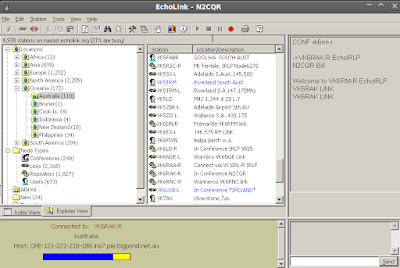 I’ve been away from Echolink ever since my eeemachines PC went toes up and wiped out the Windows XP operating system. Echolink had always been a bit difficult to get running, even under Windows, so when I returned the eeemachne to life with Ubuntu, I never really even considered trying to get Echolink running on it. There is no Linux version of Echolink. But then, yesterday, somehow I got inspired. Something told me I should give Echolink a try using the Linux WINE Windows emulator. After all, I’d found that LTSpice worked great under WINE. I went to the Echolink download site, and hit the button. Ubuntu Karmic Koala (the version I am using) automatically fired up WINE and put the new windows program in the appropriate place. Echolink started right up. That night I was able to check into the Sunday evening QRP group for the first time in years. It was great. Now I’m on Echolink in the morning, talking to hams in Western Australia. The cheers for Jonathan Taylor, creator of Echolink! And three cheers for Ubuntu (especially Karmic Koala)!
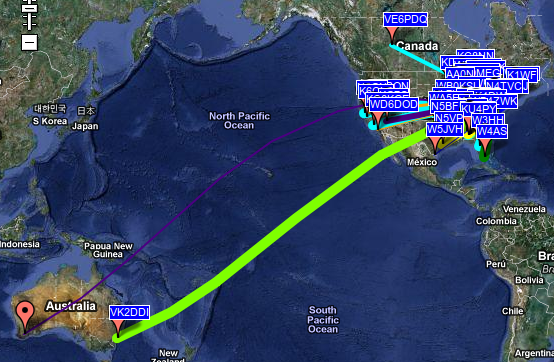 Yesterday spaceweather.com was reporting that a big sunspot was coming around the solar rim. I guess it arrived! Last night my WSPR sig was picked up by VK6XT during what must have been a gray-line situation, but this time with me going into sunset. Then, just about all night I was being picked up by VK2DDI. So, there may be hope for this solar cycle. 2011 seems to be off to a good start!

| Timestamp | Call | MHz | SNR | Grid | Pwr | Reporter | RGrid | km | az | |
|---|---|---|---|---|---|---|---|---|---|---|
| 2010-12-22 09:28 | N2CQR | 10.140215 | -28 | FM18jv | 0.2 | VK6XT | OF86td | 18576 | 288 | |
| 2010-12-21 10:28 | N2CQR | 10.140221 | -28 | FM18jv | 0.2 | VK6XT | OF86td | 18576 | 288 |
I know some of you guys consider WSPR kind of weird, kind of narcissistic, more like broadcasting than real amateur radio. I hear you. As creator Joe Taylor himself has pointed out, these are not really QSOs. But I have to tell you, it is very satisfying to walk into the shack, and, with coffee cup in hand check the WSPRnet screen to see who has recently received your little QRPp signal. For the last two mornings, I’ve found VK6XT receiving mine. That’s 18,576 kilometers covered by 200 milliwatts to a low dipole. In Western Australia my signal is 28 db below the noise (that means below the noise in a standard SSB passband). I see that I’m making the trip only once each day, at around the same time, and that VK6XT is the only Oz station picking me up. Very cool.
Here is Richard, VK6XT, the fellow at the other end of the path:

From London I used to talk to Phil, VK6ADF, on Echolink. We have a lot of interests in common. This may be due to the fact that we were both born in the International Geophysical Year. Phil is now reading “SolderSmoke — The Book,” so we will probably discover other areas in which we have crossed paths. This week, I decided to get back onto Echolink, and in my first session I was looking for OM Phil. He wasn’t on, but, IN A VERY MYSTERIOUS TWIST, that morning he sent me an e-mail. Spooky, eh? Anyway, yesterday we got on Echolink and covered our usual wide-range of tech topics. Phil alerted me to a web site called Real Flight that provides an on-line simulator for Radio Controlled airplane pilots. Obviously Billy and I could use some time in the simulator!
Phil is also into WSPR and as we spoke I fired up my 20 mW DSB WSPR rig. I was immediately heard by an Irish station, and Phil almost instantly saw the report on the WSPR database. I noticed that the EI station was reporting that I was on 40 meters, when in fact I was rock-bound on 30. Again, as Phil and I talked, I went to the WSPR chat section and asked about the freq discrepancy. Another VK6 (a friend of Phil’s!) answered my question (a simple set-up problem). Small world.
Phil and I have similar curmudgeon-like thoughts on Surface Mount Soldering, and he seemed sympathetic when I said that I think I am more of a “Hardware Defined Radio” guy. Again, this may be an IGY thing. Oh yea, almost forgot: We’re not crazy about LINUX either. We are only a few short steps away from the “SPARK FOREVER” mentality and full-fledged Luddite status.
One interest that Phil and I DO NOT share is Six Meters. Phil is now addicted to the Magic Band (which I still consider to be a white noise generator). Check out his video on his six meter yagi.
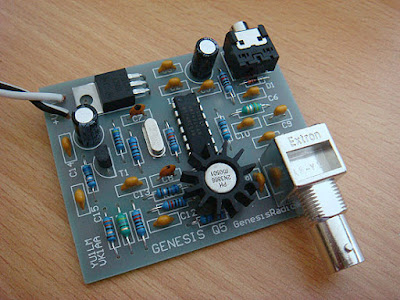
For more information visit
http://www.genesisradio.com.au/Q5/
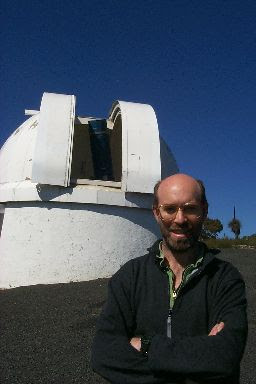 Well I guess the hours are not great, but how about the job satisfaction! Rob McNaught works at the Sliding Spring Observatory about 400 km from Sydney, Australia. The observatory searches for comets and asteroids that could do to us what they may have done to the dinosaurs (see below). A significant fringe benefit of this job is that Rob gets to discover new comets. He recently set world record by finding his 50th. Congrats Rob!
The mission of the Siding Spring Survey is to contribute to the inventory of near-earth objects (NEOs), or more specifically, the potentially hazardous asteroids (PHAs) and comets (PHOs) that may pose a threat of impact and thus harm to civilization. The identification of the iridium anomaly at the Cretaceous-Tertiary boundary (Alvarez et al., 1980) and associated Chicxulub impact crater (Hildebrand et al., 1991) and perhaps recently the Australian Bedout crater (Becker et al., 2004) associated with the Permian- Triassic “great dying” (although the presence of shock metamorphism has not yet been adequately demonstrated), strongly suggests that impacts by minor planets play an important role in the evolution of life. These are a natural result of the accretionary process that formed the Earth and planets. Indeed, the 1994 impact of D/Shoemaker-Levy 9 on Jupiter provided tangible evidence of this. Although the collision frequency is much lower than in the past, the question is not whether there will be other impacts, but when.
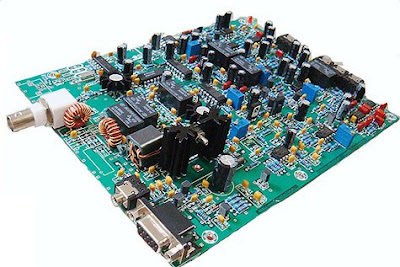 SolderSmoke is very pleased to have GenesisRadio of Australia as our first sponsor. Check out their site: http://www.genesisradio.com.au/G40/index.html
 Yesterday I got a very interesting message from Rye, K9LCJ. The map of Tasmania comes from the Modulated Light DX portion of the KA7AOI site (below).
Hi Bill:
I really enjoy your Solder Smoke show and news feeds. Great stuff that has got me back into ham radio again. Your note about optical comms got me fired up enough to add some notes that you might not be aware of.
There is a substantial worldwide community playing with optical communications and they have achieved some amazing records using simple off the shelf components – mostly big Luxeon LEDs which have some (debatable) advantages over Lasers. The most sophisticated component in typical systems is the Fresnel lens – which can be obtained at office supply stores or ebay as “page magnifiers” for a couple of bucks.
There seem to be about four major groups:
The Radio and Electronics Association of Southern Tasmania has an active bunch and they have achieved some great distance records with (QRP) LEDs. They have also been bouncing signals off of geographic features to establish communications paths. They are also doing some cloud/sky bounce things that are quite amazing. The REAST web site has lots of well documented test data that’s really interesting to read.
K3PGP has an exceptional web page full of test reports and construction details. His K3PGP preamp/receiver (and variants) are the basic building block for most systems. It uses a $1.00 pin diode, a MPF103 FET and a handful of common parts to get some almost fantastic performance.
Yves, F1AVY has a strong theoretical background and has been doing interesting stuff in France for quite a while and his web page has lots of interesting technical details.
Clint, KA7AOI has a very comprehensive web page. Clint holds the record for long distance communications (173 miles) and describes much of his equipment and testing. There is also a bunch of historical material that is very interesting.
There are probably a bunch of folks I have forgotten, but all of them are noted in the many and varied links found on these web sites.
I think that the most interesting thing about the activities is how the teams have adapted available technology to an interesting problem. Much of the work resembles current amateur weak signal activities. In fact, Spectran and WSJT are part of almost every activity. Much of the work is unique outside of the academic community and might even be called groundbreaking in some areas.
We have a small group here in the Raleigh North Carolina area, but so far we haven’t done anything of note other than build equipment and play in the local park. The fact that this sort of thing must be done outside at night draws all kinds of attention – some of which is not necessarily good. …a bunch of strange looking guys running around in the dark with strange flashing red lights…. I have a special cap that I wear for the occasions.
Keep up the good work.
Rye Gewalt
K9LCJ
Well, not exactly SolderSmoke, but these VK3 hams were obviously melting a lot of solder. One of them recorded some of their 1944 QSOs. (I may have mentioned this recording before, but it is good enough to mention again!)
Have a listen: http://www.crossbandradio.com/xbands/ehams.mp3
Cheerio and 73 Old Boy!