But why? Why Can’t I Listen to DSB (or AM) on my Direct Conversion Receiver?

I’ve said this before: I just seems so unfair. We just should be able to listen to DSB signals with our beautifully simple homebrew Direct Conversion receivers. I mean, building a DSB transmitter is a natural follow-on to DC receiver construction. And we are using AM shortwave broadcast stations (Radio Marti –I’m looking at you) to test our DC receivers for AM breakthrough. But when we tune these stations in, they sound, well, awful. So unfair! Why? Unfortunately it has to do with laws. Laws of physics and mathematics. Blame Fourier, not me.

Over the years there has been a lot of handwaving about this problem. From Doug DeMaw, for example:

In his “W1FB’s Design Notebook,” Doug wrote (p 171): “It is important to be aware that two DSSC (DSB) transmitters and two DC receivers in a single communication channel are unsatisfactory. Either one is suitable, however, when used with a station that is equipped for SSB transmissions or reception. The lack of compatibility between two DSSC (DSB) transmitters and two DC receivers results from the transmitter producing both USB and LSB energy while the DC receiver responds to or copies both sidebands at the same time.”

That’s correct, but for me, that explanation didn’t really explain the situation. I mean we listen to AM signals all the time. They produce two sidebands, and our receivers respond to both sidebands, and the results are entirely satisfactory, right? Why can’t we do this with our Direct Conversion receivers? I struggled with this question before: https://soldersmoke.blogspot.com/2015/07/peter-parker-reviews-dsb-kit-and.html You can see in that post that I was not quite sure I had the answer completely correct.

It took some discussion with a fellow Vienna Wireless Society member, and some Googling and Noodling for me to figure it out. But I think I’ve got it:

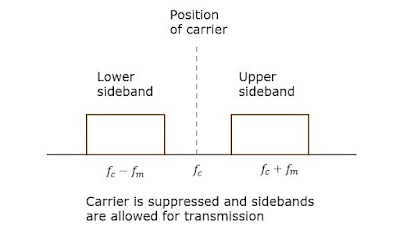
Imagine a station transmitting a DSB signal at 7100 kHz with a 1 kHz tone at the AF input. There will be signals at 7101 kHz and at 7099 kHz. Assume the carrier is completely suppressed.

We come along with our DC RX and try to tune in the signal.

Remember that they heart of the DC RX is a product detector, a mixer with the VFO (or PTO) running as close as we can get it to the suppressed carrier frequency (which we can’t hear).

Lets assume that we can somehow get our VFO or PTO exactly on 7100 kHz. The incoming signals will mix with the VFO/PTO signal. We are looking for audio, so we will focus on the difference results and ignore the sum results of the mixing.

The difference between 7101 and 7000 is 1 kHz. Great! And the difference between 7099 and 7000 is 1 kHz also. Great again, right? We are getting the desired 1 kHz signal out of our product detector, right? So what’s the problem?

Here it is: SIDEBAND INVERSION. Factoring in this part of the problem helps us see the cause of the distortion that plagues DSB-DC communication more clearly.

Remember the Hallas Rule: Whenever you subtract the modulated signal FROM the unmodulated signal, the sidebands invert. So, in this case, we are subtracting that 7099 “lower sideband” signal FROM the 7100 VFO/PTO signal. So it will invert. It will become an upper sideband signal at 1 kHz. We will have two identical 1 kHz signals at the output. Perfect right? Not so fast. Not so PERFECT really.

The perfect outcome described above assumes that our VFO/PTO signal is EXACTLY on 7100 kHz. And exactly in phase with the suppressed carrier of the transmitter. But if it is even SLIGHTLY off, you will end up with two different output frequencies, signals that will move in and out of alignment, causing a wobbling kind of rapid fade-in, fade-out distortion. You can HEAR this happening in this video by Peter Parker VK3YE, starting at 6:28:

And you can see it in this LTSpice simulation.
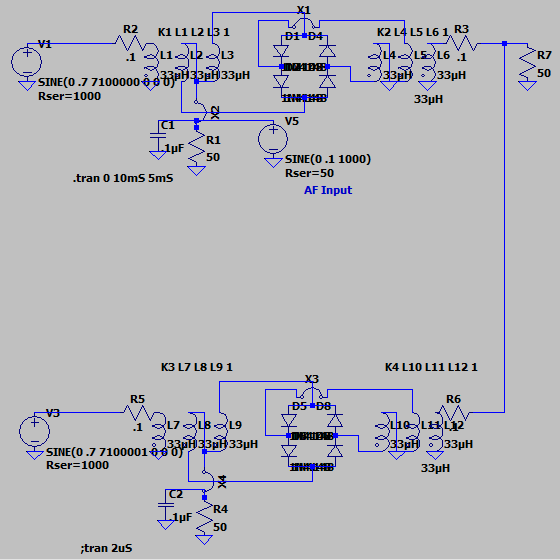

This LTSpice model just shows two diode ring mixers. The transmitter is on the top, the receiver is on the bottom. The transmitter has RF at 7100 kHz at L1 and audio at 1 kHz at R1. The receiver has the VFO at 7100.001 L7, DSB from the transmitter at L12 with audio appearing at R4. It is instructive to watch the output as you move the VFO frequency. If you move the VFO freq away from the transmit carrier osc frequency you will see the distortion. Here is the netlist for the LTSpice simulation:


On paper, using simple mixer arithmetic, you can tell that it will be there. With the VFO/PTO just 1 Hz (that’s ONE cycle per second) off, you will end up with outputs at 1.001 kHz and at .999 kHz. Yuck. That won’t sound good. These two different frequencies will be moving in and out of alignment — you will hear them kind of thumping against each other. And that is with a mere deviation of 1 Hz in the VFO/PTO frequency! We are scornful when the SDR guys claim to be able to detect us being “40 Hz off.” And before you start wondering if it would be possible to get EXACTLY on frequency and in phase, take a look at the frequency readout on my PTO.

Now consider what would happen if the incoming signal were SSB, lets say just a tone at 7101 kHz. We’d put our VFO at around 7100 kHz and we’d hear the signal just fine. If we were off a bit we’d hear it a bit higher or lower in tone but there would be no second audio frequency coming in to cause distortion. You can hear this in the VK3YE video: When Peter switches to SINGLE Sideband receiver, the DSB signals sound fine. Because he is receiving only one of the sidebands.

The same thing happens when we try to tune in an AM station using a Direct Conversion receiver: Radio Marti sounds awful on my DC RX, but SSB stations sound great.

My Drake 2-B allows another opportunity to explore the problem. I can set the bandwidth at 3.6 kHz on the 2-B, and set the passband so that I will be getting BOTH the upper and the lower sidebands of an AM signal. With the Product Detector and the BFO on, even with the carrier at zero beat AM sounds terrible. It sounds distorted. But — with the Product Detector and BFO still on — if I set the 2-B’s passband to only allow ONE of the sidebands through, I can zero beat the carrier by ear, and the audio sounds fine.

There are solutions to this problem: If you REALLY want to listen to DSB with a DC receiver, build yourself a synchronous detector that gets the your receivers VFO EXACTLY on frequency and in phase with the transmitter’s oscillator. But the synchronizing circuitry will be far more complex than the rest of the DC receiver.

For AM, you could just use a different kind of detector. That will be the subject of an upcoming blog post.

Please let me know if you think I’ve gotten any of this wrong. I’m not an expert — I’m just a ham trying to understand the circuitry.
Another Trivial Electric Motor

The above video popped up on the BBC channel a few days ago. Three cheers for the Beeb for doing this, but I’d like to point out that we have been building Trivial Electric Motors for at least 16 years. We were inspired by Alan Yates VK2ZAY W7ZAY.

Below is a video from 2006:

And there are several links (and a video) about Alan and the Trivial Electric Motor here:

Thanks again Alan!

Building a Workshop (or a Shack) in a Crawl Space

At first, this video made me think of Michael AA1TJ and his underground Hobbit Hole workshop. Then I started thinking about my own crawlspace — it looks remarkably similar to the one in this video. Hmmm… But no, I think I will stay above ground.

One thing that would DEFINITLY not work for us would be the flooring that kind of eats small parts that get dropped. I would all soon have large numbers of small parts under those mats. This would drive me nuts.

But lots of good ideas from Australia in this video.

SolderSmoke Podcast #156 — November 4, 2013 — Interview with Peter Parker VK3YE of Melbourne, Australia

November 4, 2013
Special hour-long interview with Peter Parker, VK3YE
— Early experiences with radio
— CW
— DSB Gear
— Simple gear, and gear that is TOO simple
— VXOs, Super VXOs and Ceramic Resonators
— Building receivers
— Chips vs. Discrete
— Making the leap to SSB
— The Knob-less wonder and the BITX
— No need for a sophisticated workshop
— Advice for new phone QRPers


Peter’s Blog: https://vk3ye.com/

Peter’s YouTube Channel: https://www.youtube.com/user/vk3ye/featured

VK3IO’s Wonderful Antenna Tuning System

I have been ridiculed because my manual antenna tuner (that is screwed into the wall of our car port) requires me to step outside into the cold or heat to change bands.
On August 18, 2022 — with my Hex Beam, not with the tuner — I worked Ron VK3IO on 20 SSB. Check out Ron’s antenna tuning system. He used the same balanced tuner that I use, but he has them set up for FIVE bands. FB. The wire antenna was working very well — with 100 watts to the wire Ron was booming into Northern Virginia.

Ron’s QRZ.com page:

Watch out for those spiders Ron!

Hex DX! First Long-Haul Contact with the New Hex Beam – VK4KA on 20 SSB

This morning at around 1345 UTC I had the chance to try out my new Hex beam on some “down under” DX. 9,548 miles, 15,222 km The DX Spot page told me that VK4KA was on 14.255 MHz. QRZ.com said the beam heading for me was 270 degrees. He was quite strong. He was working a fairly huge pileup, going through callsign numbers. He was on the 6s when I tuned in, so I had some time to test the Hex beam. Above you can see a rough front-to-back test. Below you can see a comparison with my old 75 meter doublet.

A few minutes after the second video, in spite of the pileup I called VK4KA and made the contact. I congratulated him on his homebrew Moxon. https://www.qrz.com/db/VK4KA

It was fun to reach Australia with the new antenna.

Thoughts on Homebrew, Makers, DIY, and Hams — from Lex PH2LB

Sometimes we get a comment that is so good that we elevate it to the main blog page. That was the case with Lex PH2LB’s comment on the blog post of Owen Duffy (yesterday).

———————-

When I started the hobby, it arose out of technological curiosity, the interest in understanding things and the will to make things myself (designing myself was not my main goal). It doesn’t matter to me whether it is 100% DIY or a kit (such as Heathkit, Elecraft, QRP-Labs etc) which is modified or not after construction. Just having fun with the hobby and pushing boundaries. And yes I also have some off-the-shelf transceivers (I’m super happy with my FT817ND) and my QO-100 uplink is also a kit (which is then already soldered a little more than average). As far as new tools are concerned: here at home are 2 types of 3D printers, various tools for SMT assembly, and I have a nice workshop equipped with tools and equipment for metal / plastic / wood processing. And every day I try to learn something new, because I stand by the IBEW moto : If you know stuff, you can do stuff.

Am I a maker then? I wouldn’t call myself that. Just like I don’t call myself a hacker because I’m quite handy with computers, technology and have certain skills. I’m just a hobbyist who wants to do and make things after work.

———————
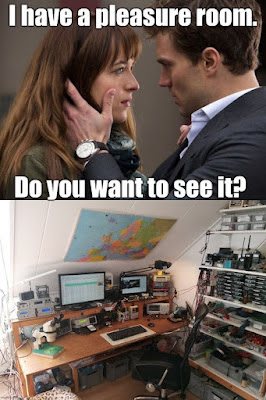
Lex is a true member of the International Brotherhood. He is the one who took our beloved stickers onto the European continent and into a Netherlands pub. He is the one who — unforgettably — saw the parallels between ham shacks and the “pleasure room” of “50 Shades of Gray” (See below — apropos of his current message, we labeled his meme “50 Shades of Homebrew”) For more on Lex see: https://soldersmoke.blogspot.com/search?q=PH2LB

Lex’s web site (Shack on the Internet): https://www.ph2lb.nl/blog/index.php?page=hamradio

Thanks Lex!


Australian Homebrew: Owen Duffy ex VK1OD now VK2OMD. Are Hams Makers?

This week I stumbled upon this amazing blog from Australia. I had to check with Australian friends to find out more about the author. Owen Duffy has for many years been a rigorous homebrewer who has documented his findings on his blog: https://owenduffy.net/blog/

For example, Owen asks the question, “Are hams makers?” https://owenduffy.net/blog/?p=122

There is a lot of great material on this blog. It goes back to 2013. Peter Parker notes that an earlier version of the blog (before Owen was forced to change his callsign from VK1OD to VK2OMD) goes back even further and is accessible via the Way-Back Machine: https://web.archive.org/web/*/vk1od.net

Check it out. Lots of really useful and interesting material there. Thanks Owen. And thanks to the Australian friends who provided background info.

VK2BLQ’s Two-Tube Regen with a SolderSmoke Dial

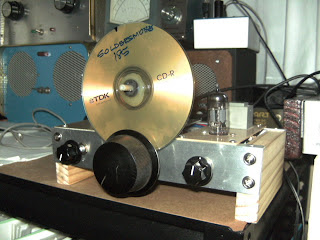
Thanks to Peter Marks VK3TPM (“a bloke with too many hobbies”) for alerting us to this magnificent homebrew receiver with the especially magnificent tuning dial.

We have used old CDs as dials for many years. I have one on my Q-31 Quarantine SW receiver. But never have we seen one with SolderSmoke emblazoned on it. FB OM.

Stephen VK2BLQ should make sure that those 6U8s haven’t gone old on him. I recently replaced the 6U8s in my Mate for the Mighty Midget with 6EA8s. This seemed to rejuvenate the receiver.

Also, it is shame that Stephen doesn’t keep that rig at 12 volts. 250 V? Yikes. As I often say, you CAN hurt yourself with 12 volts, but you really have to work at it. Not so with 250 V. One hand behind your back Stephen!

Thanks to Peter and Stephen.

VK3HN’s Amazing Summit Prowler 9 Homebrew Transceiver – A Masterpiece of Miniaturization (VIDEO)

I was wondering what Paul VK3HN was up to. Now we know: the Summit Prowler 9 transceiver.

This is yet another amazing rig by Paul, with GREAT documentation.

I was impressed by those bandpass filters. I will try to do something similarly robust on my 17/12 rig.

Paul’s miniaturization of this rig is really astonishing. I would go nuts trying to keep it this small. I just couldn’t do it.

Look closely at the boards he uses. They look like printed circuit boards, but with all the components and all the soldering on one side. This is very smart — this makes it easier to troubleshoot and to change components.

I was glad to see at least one NE-602 in there. FB.

The video is above. Check out Paul’s blog for more info:

Thanks Paul!

Peter Parker VK3YE Inducted Into QRP Hall of Fame

Wow, I was really pleased to learn that Peter Parker VK3YE was a 2021 inductee into the QRP Hall of Fame.

This is a richly deserved honor. Peter Parker has been making extraordinary contributions to QRP and homebrewing for many years. I remember reaching out to him when I was just getting started with homebrew phone gear. I considered him a guru of DSB. He helped me a lot. Peter Parker was interviewed on the SolderSmoke podcast in 2013:

Peter has published many books and has produced many YouTube videos. He hosts an annual QRP gathering in his beloved home-town of Melbourne Australia that gets attention from solder-melters around the world.

Three cheers for Peter Parker!

Congratulations Peter!

VK3YE’s Web Site: https://vk3ye.com/

VK3YE’s QRZ.com page: https://www.qrz.com/db/VK3YE

Thanks to VK3HN for alerting me to this.

SETI, Proxima Centauri, The Parkes Dish, and Intermodulation Distortion?

https://www.sciencealert.com/exciting-mystery-space-technosignals-were-indeed-produced-by-sentient-life-us

A cosmically interesting troubleshoot. But I’m not sure about their explanation. Why would the intermod disappear when they moved the Parkes Radio Telescope off of Proxima Centauri?

Opening up an Apollo Command Module Microwave Radio System

So much radio goodness in this video. The enthusiasm of the narrator is unmistakable, and entirely justified.

A number of things struck me:

— Nice shout out to our beloved Parkes Radio Telescope, of “The Dish” fame.

— I like how the French narrator takes some friendly jabs at out use of “archaic British measuring units,” and his skillful use of American slang” “Let’s open up these bad boys!”

— Wow, they filled the radio cases with Nitrogen! That will definitely save you money on De-Oxit!

— When they opened up the boxes, the construction looked very similar to what I found inside my HP-8640B frequency generator.

— Collins built some of this stuff.

— 11.6 watts to transmit the TV signal from the moon.

— PLL.

— A tube type amplifier.

— Lots of SMA connectors, but many BNCs also, right?

— Finally, and this is really amazing: THEY HAD A MORSE KEY WITH THEM, JUST IN CASE.

Thanks a lot to Bob, KD4EBM for sending this to us. There will be more episodes. These guys intend to fire up the equipment.

Opening up an Apollo Command Module Microwave Radio System

So much radio goodness in this video. The enthusiasm of the narrator is unmistakable, and entirely justified.

A number of things struck me:

— Nice shout out to our beloved Parkes Radio Telescope, of “The Dish” fame.

— I like how the French narrator takes some friendly jabs at out use of “archaic British measuring units,” and his skillful use of American slang” “Let’s open up these bad boys!”

— Wow, they filled the radio cases with Nitrogen! That will definitely save you money on De-Oxit!

— When they opened up the boxes, the construction looked very similar to what I found inside my HP-8640B frequency generator.

— Collins built some of this stuff.

— 11.6 watts to transmit the TV signal from the moon.

— PLL.

— A tube type amplifier.

— Lots of SMA connectors, but many BNCs also, right?

— Finally, and this is really amazing: THEY HAD A MORSE KEY WITH THEM, JUST IN CASE.

Thanks a lot to Bob, KD4EBM for sending this to us. There will be more episodes. These guys intend to fire up the equipment.

Adding Automatic Gain Control to the Termination Insensitive Amplifier

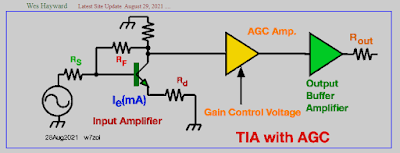
Earlier this month Paul VK3HN had a very interesting blog post about adding Automatic Gain Control to Termination Insensitive Amplifiers (TIAs).

Termination Insensitivity is especially important in bidirectional rigs. The shape of the crystal filter bandpass response is very dependent on the impedances presented at both ends of the filter. In bidirectional rigs you are changing the signal path direction through the filter when you go from transmit to receive. If the amplifiers at either end of the filter have impedances that vary depending on what is on the input or output of either stage, you will have great difficulty keeping the bandpass identical as you move from transmit to receive. Termination Insensitive Amplifiers let you do just that — they stay at one fixed input or output impedance (usually 50 ohms) independent of what is attached to the other end of the amplifier circuit. This greatly simplifies impedance matching at the ends of the crystal filter.

When I started building BITX rigs, I asked Farhan about the impedance matching problem. He advised me to use TIAs on both ends of the filter and pointed me to a great 2009 article by Wes Hayward and Bob Kopski. Using the information from that article, I built my DIGI-TIA transceiver, and I have used TIAs in almost all of the rigs I have built since that project.

In his August 2021 blog post, Paul wanted to add Automatic Gain Control to the TIAs. He came up with a way to do this, but we worried that his circuit would have an impact on the impedance of the amplifiers.

Yesterday, Wes Hayward W7ZOI posted on his web site a TIA circuit that lets us do it all: Termination Insensitivity with Automatic Gain Control:


I now find myself tempted to rebuild one of the TIA stages in my Mythbuster transceiver, adding the AGC circuitry from Wes’s design.

Thanks to Paul VK3HN for the blog post on this subject. And thanks to Wes Hayward for the TIA AGC design. It is a real privilege to have direct input from Wes on questions like this.

VK3HN on Scratch Building (Video)


Lots of wisdom and good info in Paul Taylor’s presentation.

Paul’s comment on the impact of abundant LiPo power in the field — we no longer have to scrimp and optimize power consumption — was very interesting.

And thanks for the nice mentions of the SolderSmoke podcast.

Thanks Paul!

https://vimeo.com/showcase/8253187?page=5

HRDX Interviews Paul Taylor VK3HN

Wow, Paul Taylor, VK3HN is working on homebrew rig #11. FB.

This interview was quite thought-provoking.

— I agree with Paul about the importance of not being dogmatic about
always staying under 5 watts. It sounds like Paul is having fun with his
100 watt SOTA project.

— It was great to hear that Leon VK2DOB is still active in ham radio and running a QRP company in VK. FB. An article by Leon on CMOS mixers in the summer 1999 issue of SPRAT played a key role in my understanding how switching mixers really work. I put Leon’s diagram in my book SolderSmoke — Global Adventures in Wireless Electronics.

— On blowing up the finals in simple HB gear. The first real transmitter that I built was the VXO-controlled 6 watter from QRP Classics by the ARRL. It had a 36 volt Zener diode across the collectors of the final. This was to prevent the kind of final destruction Paul suffered up on that summit: “D2 is used to clamp the collector voltage waveform to protect the output transistors if the transmitter is operated into an open circuit or high SWR antenna system.” Maybe we should revive the use of that simple SWR protection circuit, especially for SOTA rigs.

Mending vs. Ending — The Fight Against Planned Obsolescence

We don’t get a lot of mail from Darwin, Australia, so the message coming in from Phil VK8MC immediately got our attention. When I looked into the details I realized that it was very SolderSmoke-relevant. The Guardian article that Phil cited even mentions hobbyists tinkering with electronic devices in their sheds (that would be us!). Phil points to the connection between our repair efforts and the struggle to save the planet: “It’s not just a hobby, it’s an ethical position which contributes to the well being of the planet. A higher calling indeed!”

Here is the article Phil pointed us to:

https://www.theguardian.com/commentisfree/2021/mar/17/ending-over-mending-planned-obsolescence-is-killing-the-planet?CMP=Share_AndroidApp_ProtonMail

The poster above (which hangs above my workbench) is from https://www.ifixit.com/Manifesto.