
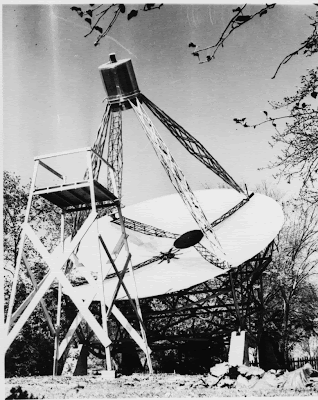
 Grote Reber has always been a hero of mine. Above you can see the dish that he built in his backyard to conduct radio astronomy in the 1930’s.
Read more about OM Grote here: http://www.nrao.edu/whatisra/hist_reber.shtml
Category: astronomy
International Year of Astronomy — 2009

Hey, the signals are electromagnetic. They are very QRP. And the receivers (well, at least the “amplifiers”) are often homebrew. It’s 400 years since Galileo spotted Jupiter’s moons. To commemorate this, we have IYA2009. The organizers are developing a program to allow people to build their own simple telescopes, and are encouraging those who already have ‘scopes to get out and let their neighbors take a look at the wonders of the universe. We did a bit of this “sidewalk astronomy” in London. We’ll do our part for IYA2009 by taking our 6 inch Dobsonian out into the piazza here in Trastevere. Check out the project web site:
http://www.astronomy2009.org/globalprojects/cornerstones/galileoscope/
Pictures of Saturn with a (sorta) Homebrew Rig
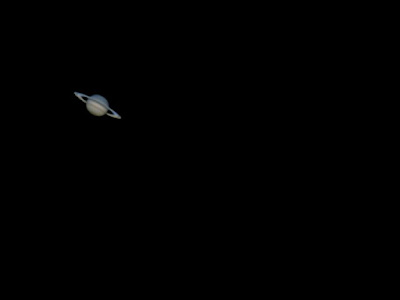
The e-mail and picture I received from Randy N3UMW could easily launch me (and perhaps others) into some adventures in the fascinating world of electro-astronomy. I have a telescope. I have an old webcam. I have some PVC…
 Randy’s message:
Attached is a photo of Saturn that I took with a modified webcam through an 8 inch scope in my very light polluted back yard near Washington DC. I can normally only make out a dozen stars due to all of the nearby street and porch lights. Luckily this does not affect the viewing of planets.
Taking the photo was very easy. You simply remove the webcam lens and add a telescope adapter (can be made from PVC tube), then you take a 2 minute movie through the webcam and use free software to align and stack each frame of the video. The end result is a hundred times better than what you actually saw. It’s funny that a cheap scope and cheap webcam can equal what the observatories were doing 20 years ago! The attached photo was my second attempt.
Damien Peach uses this same method with better hardware in better locations and takes fantastic photos. See them at http://www.damianpeach.com/
Shooting Lasers at the Moon
 Ron Sparks, AG5RS, sent us this very cool picture. My kids take great delight in shooting those tiny red laser pointers out the window, and as described in SolderSmoke we actually built a simple laser communications system. But so far we haven’t achieved the kind of “beam shooting into the sky” effect pictured here.
Here are Ron’s comments.:
“It was interesting for you to mention the lunar laser reflector. It had a very special impact on my life. You see, I grew up in Texas at about the midpoint of the 600 mile line between NASA Clear Lake and the McDonald Observatory in the Davis mountains and was in High School when Neil Armstrong walked on the moon. I had the pleasure to visit both NASA and McDonald at that time and had direct contact with some of the people responsible. I have actually put my hands on the controls for the laser in the attached photo. More importantly, the control box was opened up for me so I could see all the gizmos inside.”
Check out the website: The Lunar and Planetary Institute
The website has some interesting info on the width of the laser beam when it reaches the moon, and how they use the data to measure the distance. Sounds vaguely QRSS-ish:
“Laser beams are used because they remain tightly focused for large distances. Nevertheless, there is enough dispersion of the beam that it is about 7 kilometers in diameter when it reaches the Moon and 20 kilometers in diameter when it returns to Earth. Because of this very weak signal, observations are made for several hours at a time. By averaging the signal for this period, the distance to the Moon can be measured to an accuracy of about 3 centimeters (the average distance from Earth to the Moon is about 385,000 kilometers). “
Jupiter
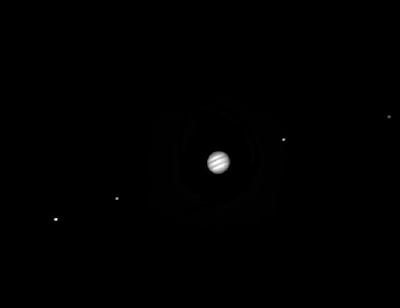 This image (by Michael Weasner) is very similar to what we see when we look at Jupiter through our six inch reflector telescope. Billy and I were up on the roof last night, looking at Jupiter and the moons. Sky and Telescope magazine publishes a nice chart showing how the moons will be configured each evening. Arnie Coro, CO2KK, in the most recent edition of Radio Havana Cuba’s “DXers Unlimited” program mentions how easy it is to receive radio signals from Jupiter. I haven’t tried that yet, but as a Knack victim, I feel the urge to do so.
We also watched OUR moon rise over Rome, and saw a satellite pass overhead. Saw some neat double-stars, and I taught Billy about averted vision.
“It’s always a hazy day on Titan.”
 Now for some real DX. The Cassini probe is exploring the moons of Saturn. Above you see a picture of the planet in eclipse — the sun is behind it. Click on the picture to make it larger. Look closely between the rings at around the ten o’clock position. That’s us. That’s Earth.
“New Scientist” has a really amazing video on the mission’s highlights: http://space.newscientist.com/article/dn14276