 George, K8VU, alerted me to this wonderful blog that presents interesting bits of correspondence: http://www.lettersofnote.com/ This telegram from the Secretary of the Navy caught my eye. There is also a letter from Galileo, complete with diagrams of Jupiter’s moons (his diagrams look just the ones I draw today). Also, check out the letter from Oppenheimer recommending Richard Feynman for a job at UCAL Berkeley: Feynman is described as being “a second Dirac, only this time human.” (Poor Dirac. He was once having dinner with a close friend. In an effort make conversation, the friend asked, “Have you been to the threater lately?” Long pause, then the response: “Why do you ask?” )
Category: astronomy
No Smoke, but stars, an HW-8, and one (dead) Cinghiale!

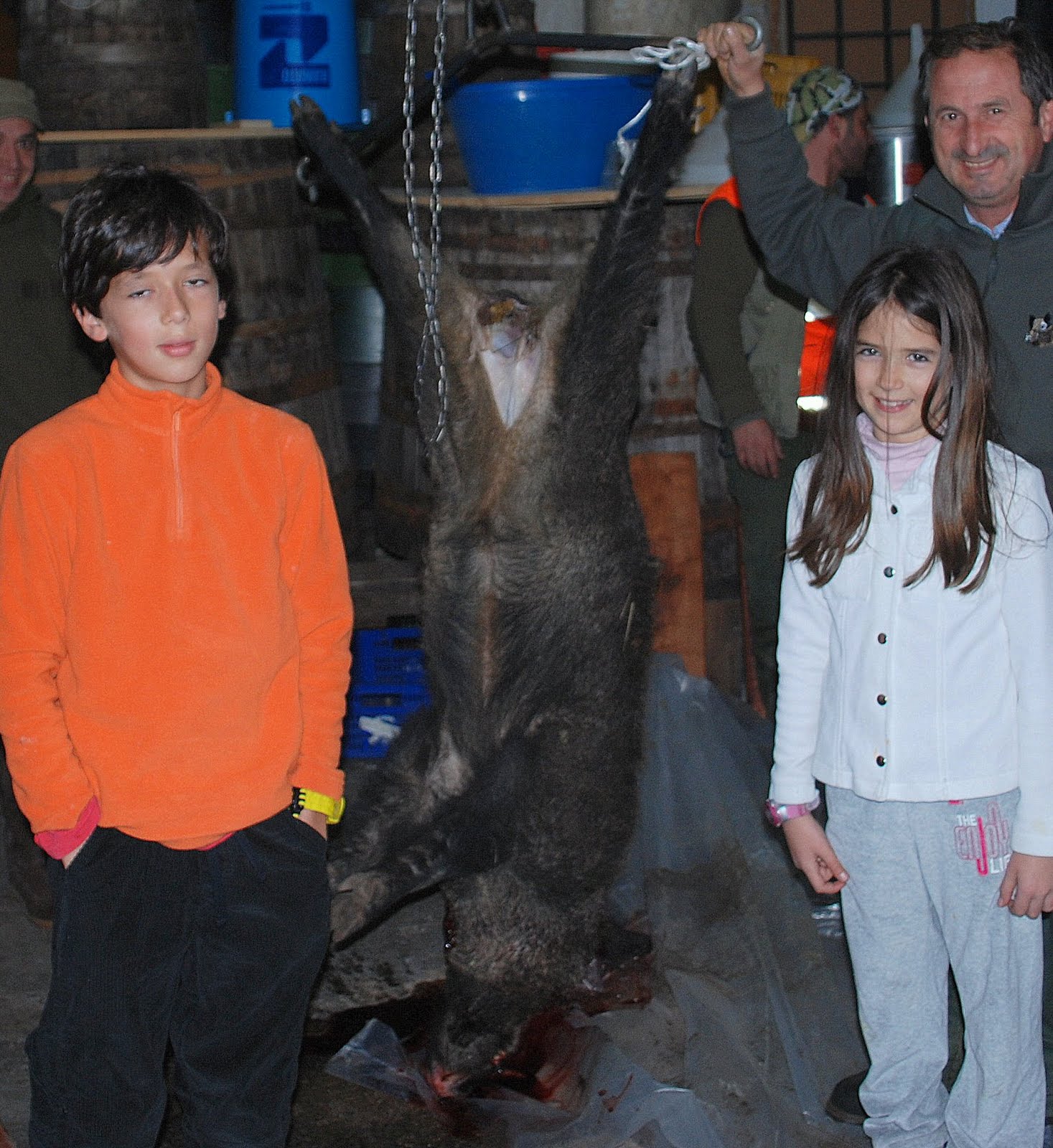 No podcast today — we were out in the country. As you can see from the picture above, the question of just how big the Sabina wild boars really are has been answered. The one pictured above was shot today very close to our country place (neither Billy nor Maria did the shooting!) The hunters tell us that this one was considered a big one. As you can see, it is about the size of Billy.
I had the telescope out this weekend — we were looking at the moon, Jupiter, Mars, and the Orion nebula. Also watched a satellite going over shortly before dawn. And one meteor.
I was on the air a bit, on the CQ WW DX contest. Worked about six stations. Was on 40, 20, and 15 with the HW-8.
I will try to get SS 119 out as soon as I can. I hope all you turkey eaters had a good holiday.
The GBT: Great Big Thing (Green Bank Telescope)
 Oh man, imagine sitting there in the Faraday-caged control room in the National Radio Quiet Zone, in an area in which things are kept so RF quiet that only diesel vehicles are allowed… “Wired” has a very nice on-line article and photo spread on this magnificent antenna:
http://www.wired.com/wiredscience/2009/10/gbt-nrao-tour/ 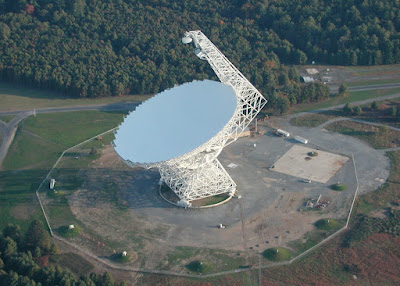
Great CQ Article on Joe Taylor, K1JT
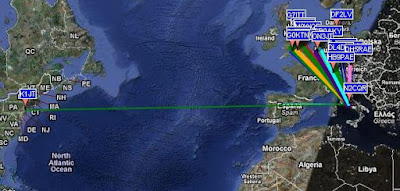 The October 2009 issue of CQ magazine has a really interesting article on Joe Taylor, K1JT. Joe is a winner of the Nobel Prize in Physics. The article is by CQ magazine editor Rich Moseson, W2VU. I was particularly interested in the Joe’s description of how his radio astronomy work led eventually to his creation of the WSJT and WSPR programs that many of us are now using. (Above you can see a WSPR report showing Joe’s station in New Jersey receiving my 20 mW WSPR signal.)
CQ magazine has put a “Digging Deeper” article on Joe on its web site. It is not the full October 2008 magazine article, but the on-line article has much of the tech info from Rich’s interview with Joe, and in some areas goes deeper. Great stuff! Here it is:
http://www.cq-amateur-radio.com/Joe_Taylor_webOct09.pdf
Thanks Rich! Thanks CQ! Thanks Joe!
Lunar Impact on October 9 — LCROSS Hits the Moon
It is a bus-sized object and it will hit at approximately twice the speed of a bullet!
Even though my telescope is a bit smaller than the recommended minimum, I’d be tempted to see if I could see it…. But that 1130 GMT impact time would make it difficult from Rome!
Hubble Space Telescope: New and Improved!
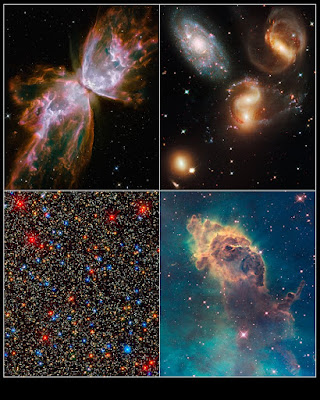 I know, I know, it is not exactly ham radio, but look at it this way: electromagnetic waves from far, far away! REAL DX. And some very cool gear to receive the signals. And some recent repair and modification work… So you see, this is really not so far afield after all.
I’ve been a big fan of the Hubble Space Telescope for a long time. When I was closer to the equator (in Santo Domingo) sitings of the HST were quite common. I’m glad to see that the recent repairs and mods worked out so well. Here is a really nice video on the new and improved Hubble: Hubble Space Telescope Video
Saving the world, finding comets….
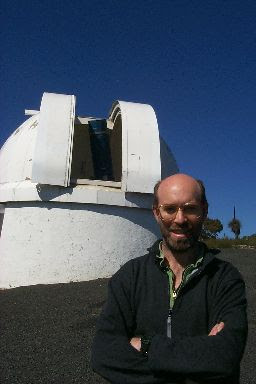 Well I guess the hours are not great, but how about the job satisfaction! Rob McNaught works at the Sliding Spring Observatory about 400 km from Sydney, Australia. The observatory searches for comets and asteroids that could do to us what they may have done to the dinosaurs (see below). A significant fringe benefit of this job is that Rob gets to discover new comets. He recently set world record by finding his 50th. Congrats Rob!
The mission of the Siding Spring Survey is to contribute to the inventory of near-earth objects (NEOs), or more specifically, the potentially hazardous asteroids (PHAs) and comets (PHOs) that may pose a threat of impact and thus harm to civilization. The identification of the iridium anomaly at the Cretaceous-Tertiary boundary (Alvarez et al., 1980) and associated Chicxulub impact crater (Hildebrand et al., 1991) and perhaps recently the Australian Bedout crater (Becker et al., 2004) associated with the Permian- Triassic “great dying” (although the presence of shock metamorphism has not yet been adequately demonstrated), strongly suggests that impacts by minor planets play an important role in the evolution of life. These are a natural result of the accretionary process that formed the Earth and planets. Indeed, the 1994 impact of D/Shoemaker-Levy 9 on Jupiter provided tangible evidence of this. Although the collision frequency is much lower than in the past, the question is not whether there will be other impacts, but when.
Carrington Flares, Aurora, Where were you on August 4, 1972?
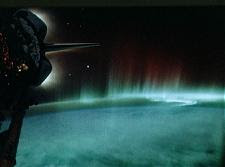 Greg, KC2DWF, sent me a really interesting story about the work of the English solar astronomer Richard Carrington. He discovered a kind of solar flare (named for him) that comes along every few centuries and could knock us all off the air.
As I was reading the article, I started to think about a childhood event that I think I mentioned in one of the podcasts. I have vivid memories of a summer night in which the skies were filled with really bright colorful lights. The article about Carrington notes that there was a major solar flare (but not of Carrington levels) on August 4, 1972 that caused auroral displays far into the southern part of the USA. The year is a bit later than I thought (I was 13 at that time) but the time of year is correct. And that flare was big enough to have caused really vivid aurora over New York.
The NASA site “Brushfires in the Sky” provides this very helpful list for people, like me, trying to figure out what we saw, and when:
The Aurora Watchers Handbook lists the following “Great Geomagnetic Storms” of the 20th century when auroras were seen much farther south than usual. If you have a childhood memory of aurora borealis, it may have come from one of these storms.
- October 31 – November 1, 1903
- September 25, 1909
- May 13-16, 1921
- April 16, 1938
- February 11, 1958
- July 8, 1958
- August 4, 1972
- December 19, 1980
- March 13-14, 1989
Looks to me like my event was August 4, 1972. Anyone else have memories of this storm?
Here is the article that Greg sent:
http://science.nasa.gov/headlines/y2008/06may_carringtonflare.htm
Carrington Flares, Aurora, Where were you on August 4, 1972?
 Greg, KC2DWF, sent me a really interesting story about the work of the English solar astronomer Richard Carrington. He discovered a kind of solar flare (named for him) that comes along every few centuries and could knock us all off the air.
As I was reading the article, I started to think about a childhood event that I think I mentioned in one of the podcasts. I have vivid memories of a summer night in which the skies were filled with really bright colorful lights. The article about Carrington notes that there was a major solar flare (but not of Carrington levels) on August 4, 1972 that caused auroral displays far into the southern part of the USA. The year is a bit later than I thought (I was 13 at that time) but the time of year is correct. And that flare was big enough to have caused really vivid aurora over New York.
The NASA site “Brushfires in the Sky” provides this very helpful list for people, like me, trying to figure out what we saw, and when:
The Aurora Watchers Handbook lists the following “Great Geomagnetic Storms” of the 20th century when auroras were seen much farther south than usual. If you have a childhood memory of aurora borealis, it may have come from one of these storms.
- October 31 – November 1, 1903
- September 25, 1909
- May 13-16, 1921
- April 16, 1938
- February 11, 1958
- July 8, 1958
- August 4, 1972
- December 19, 1980
- March 13-14, 1989
Looks to me like my event was August 4, 1972. Anyone else have memories of this storm?
Here is the article that Greg sent:
http://science.nasa.gov/headlines/y2008/06may_carringtonflare.htm
Sabina QRP Station and Astronomical Observatory
 This year, in an effort to get the kids out of Rome, we rented a summer house out in the Sabine Hills, a beautiful area just one hour north of the city. The picture shows a typical scene from the region. I brought out my HW-8, a gel-cell battery, my VW solar panel, the pi-network antenna tuner I picked up at the Trastevere flea market last winter, and about 50 feet of AC zip cord. I threw the wire into a tree and was able to tune up on 20 and 40. First station worked was near Catania, in Sicily (close to where we stayed last month). Also worked Germany and Bulgaria. I hope to use one of the tall Roman pines (like the one in the picture above) to support a vertical wire.
I also have my telescope out at the summer place, and we used it last weekend to look at Jupiter. I couldn’t see the recently discovered scar, but we got great views of the clouds, and the four Galilean moons. More to follow…
SolderSmoke 112
 http://www.soldersmoke.com/soldersmoke112.mp3
July 26, 2009
Jean Shepherd comments on solder smoke
Back to Sicily
Apollo 11
Hans Summers' Heroic Homebrew Grenadian QRSS Adventure
Regen progress (they ARE possessed)
Knack-related maladies
Amateur astronomer discovers scar on Jupiter
A reading from SolderSmoke (the book)
MAILBAG
Homebrew Telescope Finds Earth-sized Scar on Jupiter
 Wow! Amateur astronomer Anthony Wesley in Australia was the first one to see this new scar on Jupiter. Reminds me of the Shoemaker-Levy 9 comet impact back in 1994. I saw the results of that strike direct from my front yard in the Dominican Republic using a Tasco 4 inch reflector. (The story of that adventure is in the book, “SolderSmoke — A Global Adventure in Radio Electronics.”) Exciting stuff!
Icing on the cake: The discovery was made with a HOMBREW telescope! Here is the web page of the fellow who made the discovery:
http://jupiter.samba.org/
I really enjoyed reading his account of the discovery.
Here is a news article about the event:
http://www.cnn.com/2009/TECH/space/07/24/hubble.jupiter.scar/index.html
World Moonbounce Day
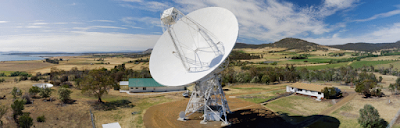 I was thinking that if you have World Moonbounce Day marked on your calendar, you probably have The Knack.
The picture above is of a dish in Tasmania.
Check out the article in Wired about this very interesting event:
http://www.wired.com/wiredscience/2009/06/moonbounce/
Jupiter from Rome (and from Mars)
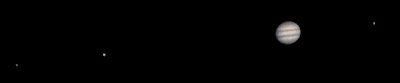 I was up earlier than usual this morning and decided to do some planetary astronomy from the Eternal City. The Heavens Above web site showed Jupiter high in the pre-dawn sky. A quick look out the window confirmed that from our courtyard it would be clear of the Trastevere rooftops. Soon the six inch Dobsonian Newtonian reflector was in operation. I got a very nice view of Jupiter and the four Galilean moons through fairly clear Roman skies.
The view was similar to that of the picture above. There are a lot of better shots of Jupiter available on the ‘net, but this one is a bit unusual. It was taken from Mars:
Jupiter/Galilean Satellites: When Galileo first turned his telescope toward Jupiter four centuries ago, he saw that the giant planet had four large satellites, or moons. These, the largest of dozens of moons that orbit Jupiter, later became known as the Galilean satellites. The larger two, Callisto and Ganymede, are roughly the size of the planet Mercury; the smallest, Io and Europa, are approximately the size of Earth’s Moon. This MGS MOC image, obtained from Mars orbit on 8 May 2003, shows Jupiter and three of the four Galilean satellites: Callisto, Ganymede, and Europa. At the time, Io was behind Jupiter as seen from Mars, and Jupiter’s giant red spot had rotated out of view. This image has been specially processed to show both Jupiter and its satellites, since Jupiter, at an apparent magnitude of -1.8, was much brighter than the three satellites.
Text and image from:
http://publicdomainclip-art.blogspot.com/2006/06/space-final-frontier-jupiter-and-moons.html
Herschel Space Telescope Opens its Eyes
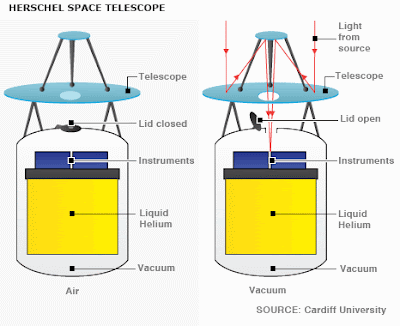 First light for a new telescope is always exciting, and even more so when the ‘scope is in space. Having all the instruments floating in liquid helium makes it all , well, even cooler.
Here is the BBC report:
http://news.bbc.co.uk/2/hi/science/nature/8099105.stm
Radio Signals from Jupiter and Io on 17 Meters
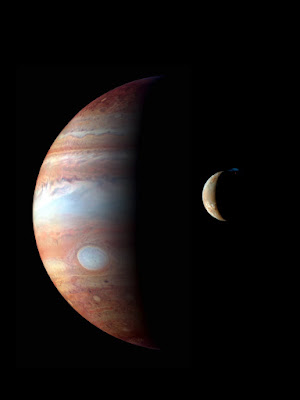 Jupiter and Io montage captured by the New horizons spacecraft.
 The Jupiter image is false-color near IR data obtained with the LEISA instrument, built at GSFC.
I try to always read the QRP-L postings of NA5N — Paul always has something interesting in his messages. Today I found this:
Jupiter emissions peak around 18-22MHz; they are a function of when the moon Io crosses certain longitudes of the relatively fast spinning Jupiter. There used to be a couple of calculators online (haven’t checked lately) as to when the L-bursts should occur. The timing is quite predictable; detecting them on every predicted occurrence is not. You have to have an antenna with a little bit of gain. The signals are generally weaker (that is, near the atmospheric noise level) than can be detected with a dipole. With a fairly decent setup, the Jovian L-bursts sounds like ocean waves crashing on a distant beach, just barely above the noise level. The S-bursts sounds like random pulse type static in short bursts. These are harder to detect than the L-bursts.
I had known about the Jovian radio emissions, but I didn’t know that the moon Io was involved. For me, Io’s involvement somehow makes this even more interesting. Jupiter and its moons (including Io) are some of the few celestial objects I can regularly see from central Rome.
Here is a good description of Jupiter’s radio signals, and Io’s role in transmitting them:
http://radiojove.gsfc.nasa.gov/library/sci_briefs/decametric.htm
And here is an interesting article about the discovery (50 years ago) of these signals:
http://radiojove.gsfc.nasa.gov/library/sci_briefs/discovery.html
Atlantis, HST in Front of the Sun
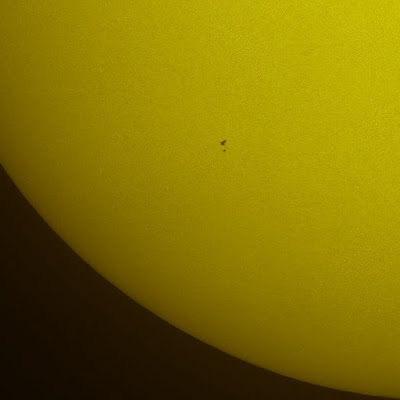
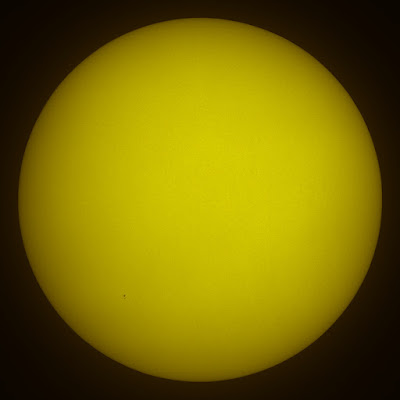 Check out the little black marks in the lower left of old Sol. That’s Shuttle Atlantis and the Hubble Space Telescope (you can see it in more detail below). The picture was taken from Florida by Thierry Legault. He calculated when the spacecraft would be aligned with the sun from his Florida location and took the shot. Well done. More innovative astrophotography at his site: http://www.astrophoto.fr/ Note: Too bad we don’t see any REAL sunspots!
Deep Solar Minimum
 Farhan alerted us to this. From the NASA website:
April 1, 2009: The sunspot cycle is behaving a little like the stock market. Just when you think it has hit bottom, it goes even lower.
2008 was a bear. There were no sunspots observed on 266 of the year’s 366 days (73%). To find a year with more blank suns, you have to go all the way back to 1913, which had 311 spotless days: plot. Prompted by these numbers, some observers suggested that the solar cycle had hit bottom in 2008.
Maybe not. Sunspot counts for 2009 have dropped even lower. As of March 31st, there were no sunspots on 78 of the year’s 90 days (87%).
It adds up to one inescapable conclusion: “We’re experiencing a very deep solar minimum,” says solar physicist Dean Pesnell of the Goddard Space Flight Center.
“This is the quietest sun we’ve seen in almost a century,” agrees sunspot expert David Hathaway of the Marshall Space Flight Center.
For the rest of the article:
http://science.nasa.gov/headlines/y2009/01apr_deepsolarminimum.htm?list830785

Heavens Above
 So I’m sitting there at 5:30 am talking on Echolink to Jerry, NR5A, in South Dakota about his ailing Pixie soon-to-be QRSS transmitter. All the talk about getting on the air and emitting signals causes me to get the urge to fix my antenna.
On Monday, I’d noticed (via Blackberry) that my signal had disappeared from ON5EX’s grabber. I could see a signal close to where I usually am, but it looked a bit different. On closer inspection I saw that EA6FNF had fired up a very nice 50 mw DFCW beacon on around 10140060 Hz. My signal was gone. When I got home I discovered a broken antenna wire. Once again, ON5EX and the internet had, in effect, relayed telemetry about the status of my QRSS system.
Fortunately I could fix this from the window — no roof work was required. Skies were fairly clear on Wednesday morning, and as I looked up across the Janiculum Hill at Rome’s pre-dawn sky, I saw a satellite going over from North to South. Of course, I wanted to know what I was looking at, so I turned to Chris Peat’s very useful web site, Heavens Above. Very quickly, I was able to find out that it was either the Russian Okean O Rocket, or something called RADCAT.
Check out Heavens Above. Lots of great info on astronomy, satellites, and ham radio spacecraft:
http://www.heavens-above.com/
The antenna was quickly fixed. I should be back on the Belgian grabber now. It was a good ham radio morning in Rome. Thanks Jerry. Thanks Chris Peat.
Comet Lulin
 I don’t think I will be able to see this one through the bright and murky skies of Rome, but I may give it a go. Sky And Telescope Magazine has a nice write up that tells you when and where to look. The best night for seeing this one are coming up soon:
http://www.skyandtelescope.com/observing/highlights/35992534.html