The Really BIG Discovery (Cosmology, Gravity Waves, Inflation)

The signals that were announced this week are a bit outside our normal frequency range, but this is a REALLY BIG discovery so of course, it needs to be covered by SolderSmoke Daily News. I liked this info-graphic from space.com. It is worth looking at. Note the line “The universe continues infinitely outside Earth’s Hubble volume.”

http://www.space.com/25075-cosmic-inflation-universe-expansion-big-bang-infographic.html

Source SPACE.com: All about our solar system, outer space and exploration.

Our book: “SolderSmoke — Global Adventures in Wireless Electronics” http://soldersmoke.com/book.htm Our coffee mugs, T-Shirts, bumper stickers: http://www.cafepress.com/SolderSmoke Our Book Store: http://astore.amazon.com/contracross-20

Brilliant! New “TX Factor” Ham Radio TV Show from the UK

I really enjoyed this. It is the first episode of what I hope will be a long-running series.
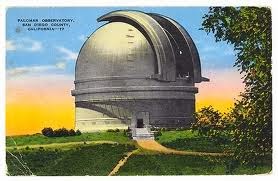
These guys did a great job. Excellent quality video production and very interesting subject matter. A LOT of work went into this. I liked the PSK from a smart phone on a foggy hillside (with Moroccan soup!). The Marconi stuff was wonderful. Beer barrels as 2 meter cavity resonators! Excellent Knackish-ness! And a two meter repeater in an astronomical observatory. Well done!

Thanks to Nigel and Dino for alerting me to the TX Factor.

Our book: “SolderSmoke — Global Adventures in Wireless Electronics” http://soldersmoke.com/book.htm Our coffee mugs, T-Shirts, bumper stickers: http://www.cafepress.com/SolderSmoke Our Book Store: http://astore.amazon.com/contracross-20

John Dobson (Sidewalk Astronomer, Telescope Maker) RIP

http://www.skyandtelescope.com/news/home/John-Dobson-1915ndash2014-240456881.html

Our book: “SolderSmoke — Global Adventures in Wireless Electronics” http://soldersmoke.com/book.htm Our coffee mugs, T-Shirts, bumper stickers: http://www.cafepress.com/SolderSmoke Our Book Store: http://astore.amazon.com/contracross-20

First Light


Preston: Your use of the term “First Light” is especially appropriate. I got the concept from a wonderful book of that title by the author Richard PRESTON. I pulled it off the shelf this morning, and, as my coffee was brewing, read this on the dust cover:

“First Light won the American Institute of Physics award in science writing. An asteroid has been named “Preston” in honor of First Light. It is likely someday to collide with Mars or the earth.”

The book’s glossary defines first light as: “A technical term from astronomy signifying the moment when starlight is allowed to fall on a new mirror for the first time.” The first light experience must, I think, be similar to the feelings we get when we first allow RF to fall on the front end of a new homebrew receiver.

Congrats on the S-107 OM.

73 Bill N2CQR

——————————————

From Preston Douglas WJ2V:

I am happy to report that my little novice rig (well it’s not so little if you weigh it) consisting of my restored circa 1960 Hallicrafters S-107 and circa 1959 KnightKit T-50 (with V-44) made our first QSO with a guy 20 miles away on Staten Island. This was Saturday afternoon, in full daylight, on 40 meters. He was also running vintage equipment (Heath) but running an SB-200 Heath linear. I have no idea why he needed a linear on 40 meter CW, but he seemed happy with it. I could easily hear his signal via leakage through my Daiwa cavity switch, so it was a pretty powerful signal. The T-50 puts out maybe 20-25 watts full bore, but it certainly works fine, and got a 569 signal report. The 9 part was obviously the important one.

I had just turned on the equipment, so the S-107 needed to be adjusted a bit during the QSO to allow for a bit of warm up drift. It stabilizes ten or fifteen minutes after warmup. I had to use a straight key as I have not yet built the little kit that interfaces solid state keyers with old rigs. I’ll get to it on a slow afternoon this winter perhaps. But for now, a straight key is about the right speed for this setup. T/R requires switching the antenna, the VFO to transmit, and the receiver to standby for transmitting. Not exactly QSK. Since there are so many switches, it may not pay to add an antenna relay switch to this setup. Besides, switching is part of the fun.

I did not get set up in time for New Years, so missed the chance to operate SKN.

I learned about first light from Bill Meara’s podcasts. It refers to the first time a telescope is used, but, as he says, it applies just as well to a new (old) rig.

All of this was caused by a local ham offering a Hallicrafters S-107 for ten bucks. Even with the few bucks needed to put it right, I sure got my money’s worth.

Regards guys and Happy New Year,

Preston WJ2V
—————————————-
Earlier from Preston:
I am pleased to report my S-107 is restored to full function. Based on the build up of filth on it before cleaning, it is also cleaner than it has been for many years. The greasy dirt (I shudder to think what it was made of) in between the flutes of the control knobs has succumbed to a toothbrush and detergent. Who’d have thought what a difference clean controls would make in the overall appeal of a radio?

The S-107 was purchased without negotiation from a local and fellow member of the Long Island Mobile Radio Club for ten bucks. I cheerfully handed over a ten spot and drove home with this rig.

On the bench, the tubes lit, and I could hear a couple of AM stations, but it made an awful racket with 60/120 cycle hum. New electrolytic caps cured that. The chassis felt “hot” to the touch. Resistance checks on the HV-to-AC sides of the transformer confirmed that, thankfully, there were no shorts. On advice of some pros on this list and elsewhere, I removed a cap and resistor from the AC line to the chassis that Hallicrafters thought was a good idea. With a new three wire grounded plug, the chassis was now cold.

Alignment was done with an old Conar signal generator (my $1 victory from an old hamfest) and trusty Tek 465 with frequency counter connected to its rear connector. The double IF transformers peaked up, and so did the front end compression caps on all bands. And now, the radio really receives CW and SSB! With a simple dipole (my beam seems to have gotten sick from Irene and Sandy) I get good signals on 80, 40, and 20. Maybe next weekend I will have time to try the upper bands during daylight hours. But, the signal generator suggests they should be fine.

The ten buck receiver needed ten bucks worth of electrolytics. And I needed to buy a little 20 buck kit of Bristol Splined wrenches. (Nobody I thought to ask had a set to lend.) They were needed because: Another Hallicrafters bit of wonderment is that the setscrews in the control knobs need to be turned with these unusual wrenches that look like, but aren’t, hex keys. Well, I suppose I can say I have the wrenches if I decide to restore another Hallicrafters. I hear Collins has them too.

I think I mentioned that I had to restring both the band spread and main tuning with real dial cord. Another three bucks, perhaps. So, my ten buck receiver is still a bargain at around 40 bucks in all. And, I had a lot more than 40 bucks worth of fun. I spent part of the afternoon just listening to the receiver, it sounded so good. You know how it is when you first listen to a new receiver.

Now, next thing will be to see how it does making contacts with a Knight T-50. I know the T-50 is not quite QRP. I probably puts out about 25 or 30 watts.

This will be about as close to my novice station as I am willing to fall. The original station had the T-50, but no VFO (which came with the T-50 I have now); but the receiver was an S-38E, which was, (collectors notwithstanding) a piece of crap. And it’s dangerous since it is really one of those transformerless AM radios in shortwave clothing. No wonder I only made a handful of contacts with it as a novice. I have no nostalgia for my old Hallicrafters S-38E. I hear folks recommend operating it with an isolation transformer. I have a better idea. Don’t plug it in.

I had so much fun with the S-107, though, I am starting to think about restoring an S-108 or an SX-110.
Preston Douglas WJ2V

Our book: “SolderSmoke — Global Adventures in Wireless Electronics” http://soldersmoke.com/book.htm Our coffee mugs, T-Shirts, bumper stickers: http://www.cafepress.com/SolderSmoke Our Book Store: http://astore.amazon.com/contracross-20

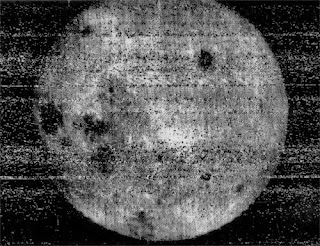
First Pictures of the Far Side of the Moon (1959!)

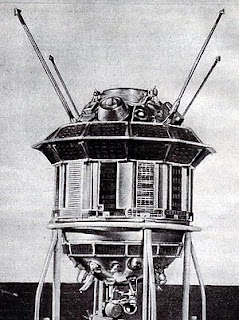
On October 7, 1959, the Soviets sent an “automatic interplanetary station” to the moon. This, in itself, was an amazing achievement. Even more amazing is how they managed — using 1950s technology — to photograph the far side of the moon and get the images back to the earth.

The Soviet document on the Harvard site (below) says that the transmitter put out “a few watts” and used semiconductors. There appears, however, to have been at least one vacuum tube aboard (the cathode ray tube used to scan the chemically developed photo negatives). Frequency modulated analog video similar to FAX) was used to send the data.

http://articles.adsabs.harvard.edu//full/1962IAUS…14….7L/0000007.000.html

From Wikipedia:

Luna-3 was the first successful three-axis stabilized spacecraft. During most of the mission, the spacecraft was spin stabilized, but for photography of the Moon, the spacecraft oriented one axis toward the Sun and then a photocell was used to detect the Moon and orient the cameras towards it. Detection of the Moon signaled the camera cover to open and the photography sequence to start automatically. The images alternated between both cameras during the sequence. After photography was complete, the film was moved to an on-board processor where it was developed, fixed, and dried. Commands from the Earth were then given to move the film into a scanner where a spot produced by a cathode ray tube was projected through the film onto a photoelectric multiplier. The spot was scanned across the film and the photomultiplier converted the intensity of the light passing through the film into an electric signal which was transmitted to the Earth (via frequency-modulated analog video, similar to a facsimile). A frame could be scanned with a resolution of 1000 (horizontal) lines and the transmission could be done at a slow-scan television rate at large distances from the Earth and a faster rate at closer ranges.
The camera took 29 pictures over 40 minutes on 7 October 1959, from 03:30 UT to 04:10 UT at distances ranging from 63,500 km to 66,700 km above the surface, covering 70% of the lunar far side. Seventeen (some say twelve) of these frames were successfully transmitted back to the Earth, and six were published (frames numbered 26, 28, 29, 31, 32, and 35). They were mankind’s first views of the far hemisphere of the Moon.

More info: http://www.svengrahn.pp.se/trackind/luna3/Luna3story.html#Film

Our book: “SolderSmoke — Global Adventures in Wireless Electronics” http://soldersmoke.com/book.htm Our coffee mugs, T-Shirts, bumper stickers: http://www.cafepress.com/SolderSmoke Our Book Store: http://astore.amazon.com/contracross-20

Carl Sagan, Astronomy, and the Zen Pencil


We presented Carl Sagan’s beautiful “Pale Blue Dot” quote back in September 2011, along with a nice video. This week a friend in Kathmandu sent me a link to a web site called The Zen Pencil. This fellow takes great quotes and draws cartoons to accompany them. I liked his cartoon for The Pale Blue Dot:

http://zenpencils.com/comic/100-carl-sagan-pale-blue-dot/

Our book: “SolderSmoke — Global Adventures in Wireless Electronics” http://soldersmoke.com/book.htm Our coffee mugs, T-Shirts, bumper stickers: http://www.cafepress.com/SolderSmoke Our Book Store: http://astore.amazon.com/contracross-20

Opening Scene of Contact (CQ at the end)


Mike Herr’s video on his use of an Arduino to call CQ SKN made it onto Hack-A-Day
yesterday and provoked some discussion there of the meaning of CQ. One fellow posted
this opening scene from the movie Contact. I thought you guys would like it.

Our book: “SolderSmoke — Global Adventures in Wireless Electronics” http://soldersmoke.com/book.htm Our coffee mugs, T-Shirts, bumper stickers: http://www.cafepress.com/SolderSmoke Our Book Store: http://astore.amazon.com/contracross-20

Uncle Sam Wants You! (Well, really your Telescope)


I don’t think they will be that interested in my $50 Tasco 4.5 inch reflector, but I am thinking about sending in a proposal for a 1.2 million dollar series of upgrades for the old ‘scope!

Our book: “SolderSmoke — Global Adventures in Wireless Electronics” http://soldersmoke.com/book.htm Our coffee mugs, T-Shirts, bumper stickers: http://www.cafepress.com/SolderSmoke Our Book Store: http://astore.amazon.com/contracross-20

Real DX: Hubble’s EXTRA Deep Field


http://www.clarksvilleonline.com/2012/09/26/nasas-hubble-space-telescope-takes-deepest-image-of-the-universe-to-date/

Our book: “SolderSmoke — Global Adventures in Wireless Electronics” http://soldersmoke.com/book.htm Our coffee mugs, T-Shirts, bumper stickers: http://www.cafepress.com/SolderSmoke Our Book Store: http://astore.amazon.com/contracross-20

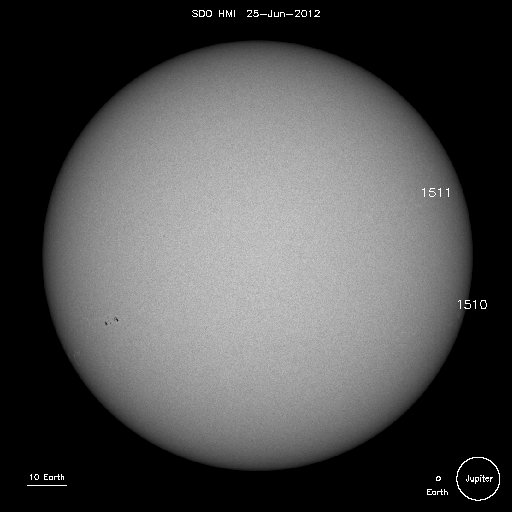
Poor Conditions: SFI 89. Venus Transit Hero

There’s today’s image from SOHO. Pretty barren. That’s why conditions on the HF bands are so poor today.

While looking for this I came across this account of Venus Transit Heroism:

In the days of heroic astronomy, Chappe d’Autoroches not only risked his life twice to obtain critical, new knowledge from transits of Venus, but gave his life to help others in dire need. Here is his tale from the h2g2 web site in an article entitled “Forgotten Male Astronomers:” A French expedition led by Jean-Baptiste Chappe d’Autoroche (1728 – 69) went to Tobolsk, Siberia, to record the 1761 Venus transit. The team survived a treacherous river crossing and a lengthy journey through difficult, boggy conditions, eventually arriving at their destination just six days before the transit was due. Just before the transit, Jean-Baptiste was attacked by some of the locals, who believed he had caused unusually severe spring floods by interfering with the Sun. Cossack guards managed to save the team of astronomers, who eventually managed to make good observations of the Venus transit.
The French Academy were so pleased with the success of his mission that they engaged Jean-Baptiste to record the next expected Venus transit, due in 1769. He specified that he would travel anywhere in the world as long as the temperature wouldn’t be below freezing. Tragically, when Jean-Baptiste and his team arrived at Vera Cruz in Mexico, they found themselves in the middle of a plague [yellow fever] epidemic. Instead of moving on to a safer place, the team decided to remain and help care for the sick villagers.
Even though he was mortally ill, Jean-Baptiste managed to record astronomical observations to establish the latitude and longitude of the site. These recordings were vital for the calculations of the astronomers back home in France, and were made with an astonishing accuracy, given the hazardous conditions in which the data were gathered. The observations they made provided some of the best data of the 1769 transit. Jean-Baptiste died of a fever just after the transit, aged 41 years.
A longer and more detailed version of these events can be found here: www.americanscientist.org

Our book: “SolderSmoke — Global Adventures in Wireless Electronics” http://soldersmoke.com/book.htm Our coffee mugs, T-Shirts, bumper stickers: http://www.cafepress.com/SolderSmoke Our Book Store: http://astore.amazon.com/contracross-20

“The Journey to Palomar”

This is a wonderful documentary that will definitely appeal to SolderSmoke listeners. Check out Jim Gunn working on the electronics for the CCD cameras that they attached to the 200 inch ‘scope (described in Preston’s “First Light”).


Once again, sorry if readers outside the U.S. have trouble with this link. I hope you all can find other ways to see this video.


http://www.hulu.com/watch/76165

Our book: “SolderSmoke — Global Adventures in Wireless Electronics” http://soldersmoke.com/book.htm Our coffee mugs, T-Shirts, bumper stickers: http://www.cafepress.com/SolderSmoke Our Book Store: http://astore.amazon.com/contracross-20

SolderSmoke Book Review: “The Day We Found the Universe”

I find myself reading a lot of books about telescopes and cosmology. I guess this is related to the desire to pull weak DX signals out of the noise. And I like the descriptions of the gear used to pull info out of the star light. These are, after all, big antennas.
I really enjoyed this book by MIT’s Marcia Bartusiak. She describes humanity’s effort to find our place in the cosmos. As she points out, the conventional wisdom seems to be that until Edwin Hubble came along everyone thought that the Milky Way was the universe. As it turns out, it is not that simple — going back to the time of Kant, there were scientists who suspected that the nebula that were showing up in telescopes were in fact “island universes.” Bartusiak takes us through the ups and downs of this idea, and in the course of the book provides some really great descriptions of the astronomers involved in the struggle to understand the nebulae. Most of them were great people. Others, well, not so great. George Ellery Hale comes out as one of the heroes, and Bartusiak seeks to refute the notion that Hale was schizophrenic — he was clearly suffering from depression, but Bartusiak says that the story about him being advised by a “little elf” was just an oft-repeated myth. Edwin Hubble gets a decidedly mixed review.

My guess is that the title was selected by the publishing company’s marketeers, and I think it was a poor choice: the whole point of the book was that we didn’t find the universe in one day. It took a lot longer than that!
Anyway, if you are looking for a good summer read, I recommend this book. You can get a copy through the link above.

Our book: “SolderSmoke — Global Adventures in Wireless Electronics” http://soldersmoke.com/book.htm Our coffee mugs, T-Shirts, bumper stickers: http://www.cafepress.com/SolderSmoke Our Book Store: http://astore.amazon.com/contracross-20

Transit of Venus

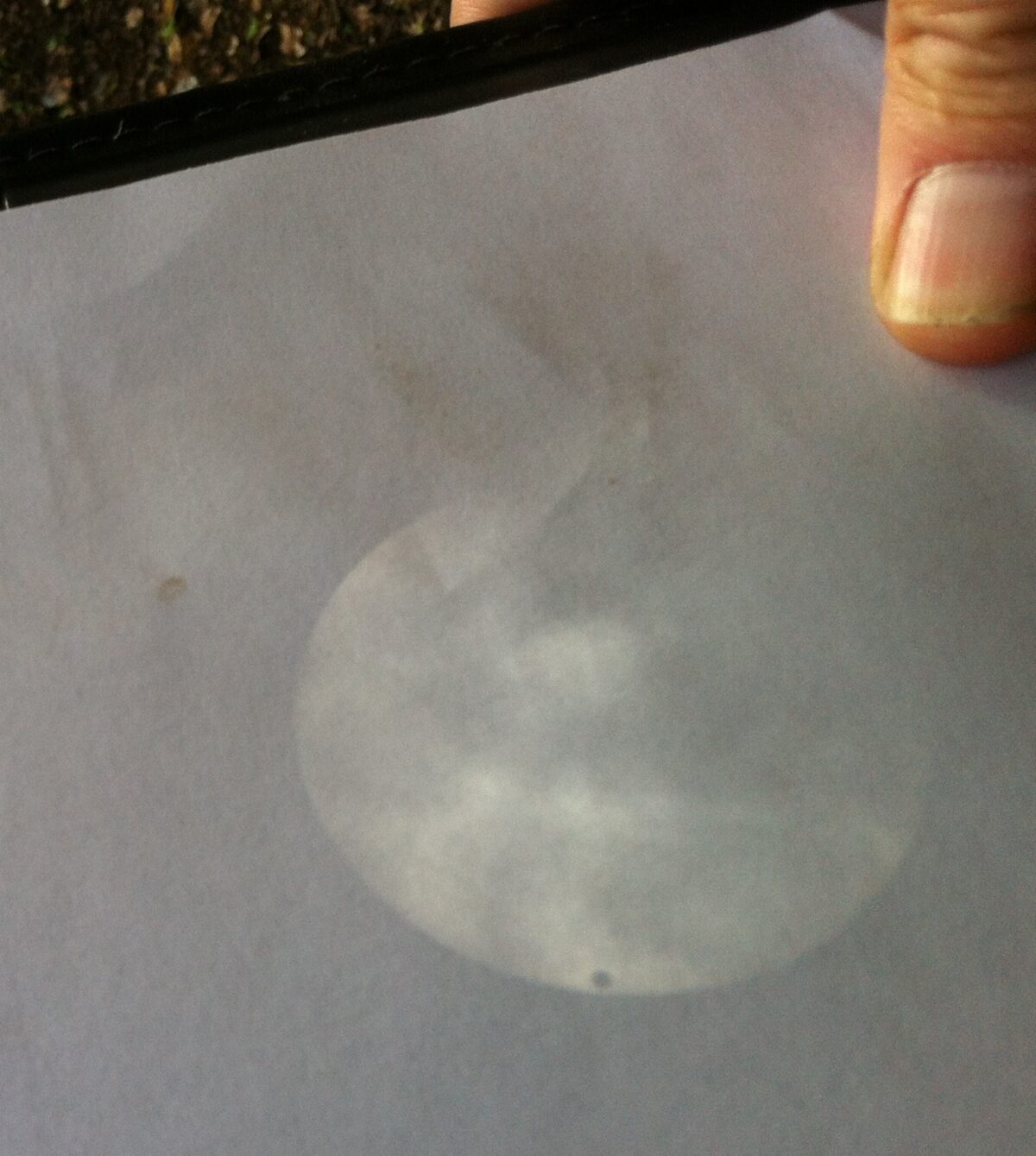
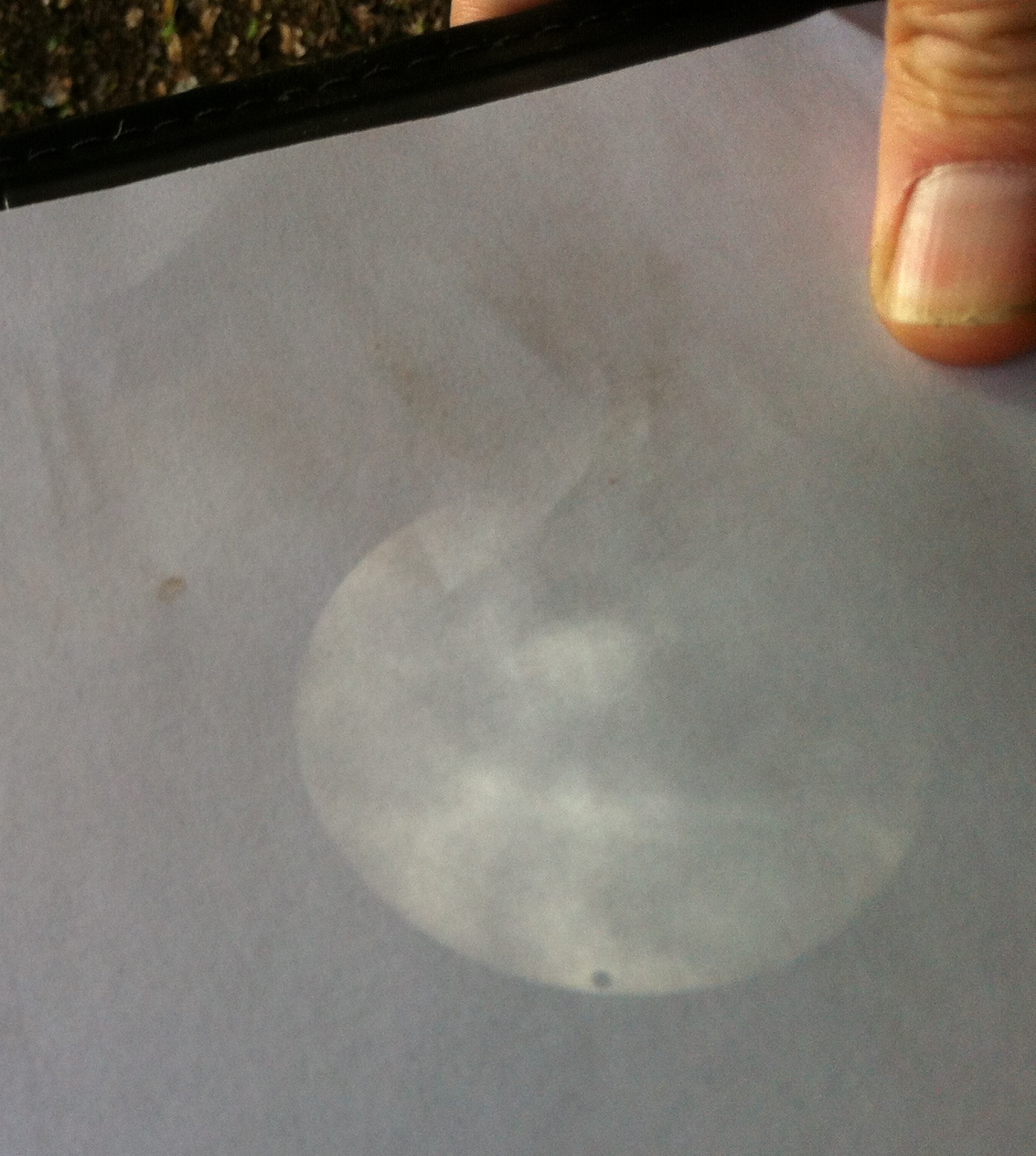
Yesterday afternoon at around 5:55 pm local time I was pedaling along the Washington and Old Dominion bike trail, on my way home from work. I was pedaling a little faster than normal because I wanted to try to see the transit of Venus. I came across a group of amateur astronomers who had set up their scopes alongside the trail — they were nervously looking at their watches and the clouds. I told them that I was going to set up my scope too. “Hurry up! You’ll miss it! It starts at 6:04!” I pedaled even faster.


The cloud cover was fairly thick, but just as I pulled into my driveway, the clouds broke and sunshine filled the front yard. I quickly set up the ‘scope and got the sun in the field of view. First I saw sunspots — lots of them. Then, sure enough, off near the rim was the unmistakeable shadow of Venus. Billy took the picture (above) with his I-phone 4. The neighbors and all the kids in the neighborhood came over and had a look. It was all very cool. Mission accomplished.

Our book: “SolderSmoke — Global Adventures in Wireless Electronics” http://soldersmoke.com/book.htm Our coffee mugs, T-Shirts, bumper stickers: http://www.cafepress.com/SolderSmoke Our Book Store: http://astore.amazon.com/contracross-20

Ponderosa Knack! Bonanza Astronomy!

I loved this episode, and I think most of you guys will too. I was alerted to it by an article by famed comet hunter David Levy. Wow! I never would have thought that in a 1962 episode of the cowboy show Bonanza, we would find amateur astronomy and experiments to determine the speed of sound and the speed of light. Amazing. There is no radio in this so it is not really The Knack, but young Mr. Michelson (yes, the Nobel Prize winner) does set up a shack-like workshop and he is trying to measure c. So this is all very Knack-like. There is also a very nice moral to this story, a moral that is related to our notion of an International Brotherhood of Electrical Wizards.
Three cheers for Ben Cartwright!

You can find the episode here. It runs for 48 minutes:
http://www.youtube.com/watch?v=hzPRGV0HbMk

Our book: “SolderSmoke — Global Adventures in Wireless Electronics”
http://soldersmoke.com/book.htmOur coffee mugs, T-Shirts, bumper stickers: http://www.cafepress.com/SolderSmokeOur Book Store: http://astore.amazon.com/contracross-20

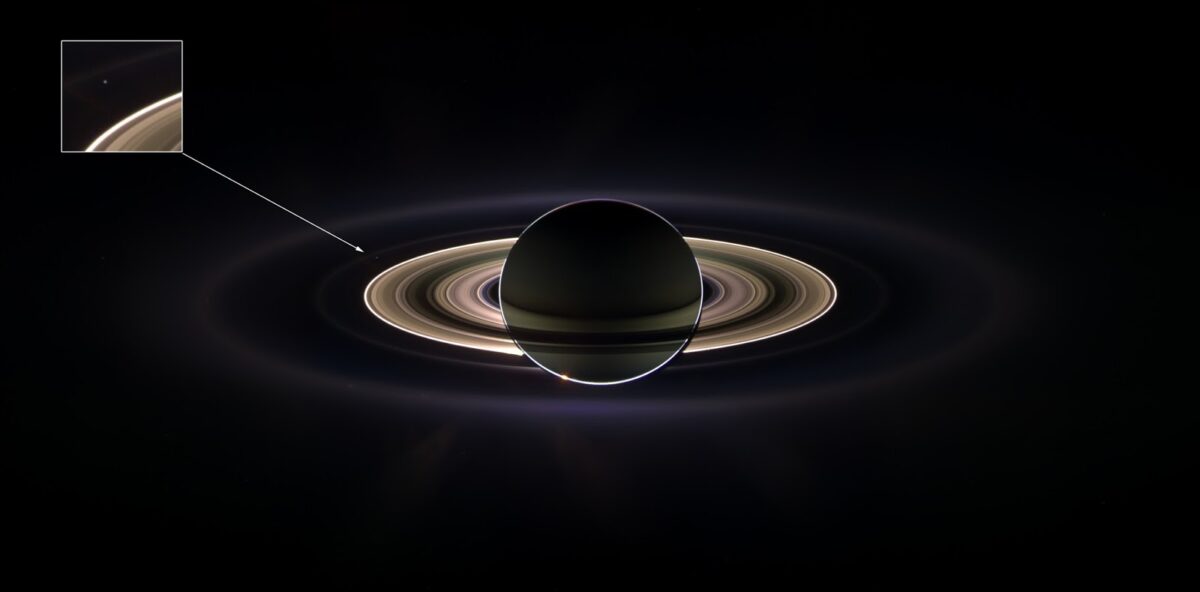
Saturn and Titan

One of the rewards of being an amateur astronomer is that from time to time you get to discover on your own astronomical facts that were actually discovered centuries ago. Like the orbital period of Titan. About ten days ago I reported on my early morning observations of Saturn. Titan was in the far right of my field of view. Then, a week later I looked again and saw that Titan was now in the far left of the field of view. It looked like it it had gone to the opposite end of its orbital track in about a week. I checked and, sure enough, Titan takes about 15 earth days to complete an orbit. Neat.

Our book: “SolderSmoke — Global Adventures in Wireless Electronics”http://soldersmoke.com/book.htmOur coffee mugs, T-Shirts, bumper stickers: http://www.cafepress.com/SolderSmokeOur Book Store: http://astore.amazon.com/contracross-20

The Giant Magellan Telescope

Wow, seven 28 foot mirrors! They just started blasting away the top of a mountain in Chile to make room for this magnificent ‘scope. More details here: http://www.gmto.org/index.html
For those of you who are looking, they have some job openings (link at the bottom of their site).

Our book: “SolderSmoke — Global Adventures in Wireless Electronics”http://soldersmoke.com/book.htmOur coffee mugs, T-Shirts, bumper stickers: http://www.cafepress.com/SolderSmokeOur Book Store: http://astore.amazon.com/contracross-20

SETI Live!

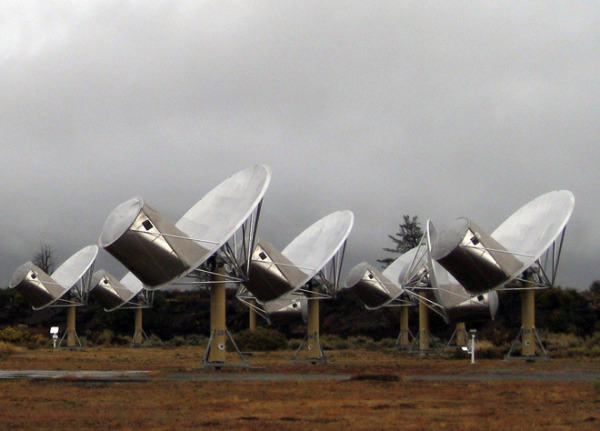
Wow, this is really very interesting. The Allen Telescope Array (seen above) is back in operation and they are looking for on-line volunteers to analyze the signals that are streaming in. But unlike the now-familiar SETI-AT-HOME screensaver system, in SETI Live, they want you to personally evaluate signals — very recent signals — from the Allen Array. You’ll be looking at waterfall displays similar to what we see with SDR rigs. They want you to mark and classify the signals and then upload your work. They are trying to screen out terrestrial sigs, man-made satellites, etc.

This is just the thing for those days when the solar flux is low and 17 meters is dead!

Check it out: http://setilive.org/

Our book: “SolderSmoke — Global Adventures in Wireless Electronics”http://soldersmoke.com/book.htmOur coffee mugs, T-Shirts, bumper stickers: http://www.cafepress.com/SolderSmokeOur Book Store: http://astore.amazon.com/contracross-20

Planets Galore!

Good times for astronomy in Northern Virginia. The temperature is freakishly high, and daylight savings time has pushed the darkness into my early-morning shack time. My telescope troubles are sorted out, and I just discovered that with my current contact lens prescription, my right eye is much better for telescope work than the left. (Who knew!) I found an excellent and inspirational book on astronomy: “The Four Percent Universe.” And this morning, while fooling around with my Stellarium program, I noticed that Saturn is high in the South-West before dawn. Coffee cup in hand I went out and was rewarded with a spectacular view of the ringed planet. I could even see one of the divisions between the rings. Titan was also visible. Last night Maria and I were looking at Mars. I can make out the ice cap and (vaguely) some the big valley features. No canals.

Our book: “SolderSmoke — Global Adventures in Wireless Electronics”http://soldersmoke.com/book.htmOur coffee mugs, T-Shirts, bumper stickers: http://www.cafepress.com/SolderSmokeOur Book Store: http://astore.amazon.com/contracross-20

Mars in Opposition

Jupiter and Venus are getting all the media attention because they happen to appear close in the sky, but Mars is the real object to see this month. It is in opposition (see diagram). This happens every two years. Last time we were out in the Sabine Hills north of Rome (sniff, sniff).

I cleaned the 6 inch mirror on my Dobsonian telescope a while back, and when I put the whole thing back together, something wasn’t quite right. I was getting dim and blurry views. So yesterday I went into telescope maintenance mode and, as the Brits would say, got it all sorted.

I was out looking at Mars last night. The view is not nearly as spectacular as the image above, but it is very nice. But I can’t see much of the northern polar cap — it is, after all, summer time in the Martian Northern Hemisphere.


Our book: “SolderSmoke — Global Adventures in Wireless Electronics”http://soldersmoke.com/book.htmOur coffee mugs, T-Shirts, bumper stickers: http://www.cafepress.com/SolderSmokeOur Book Store: http://astore.amazon.com/contracross-20