DDS amplifier

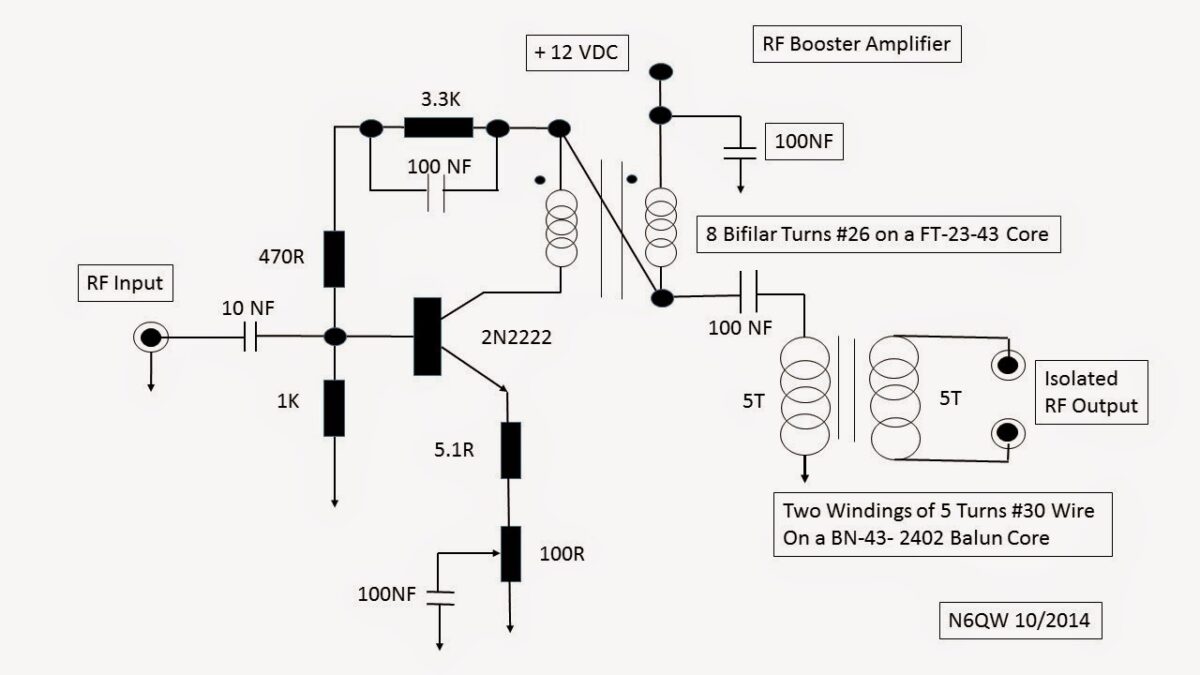
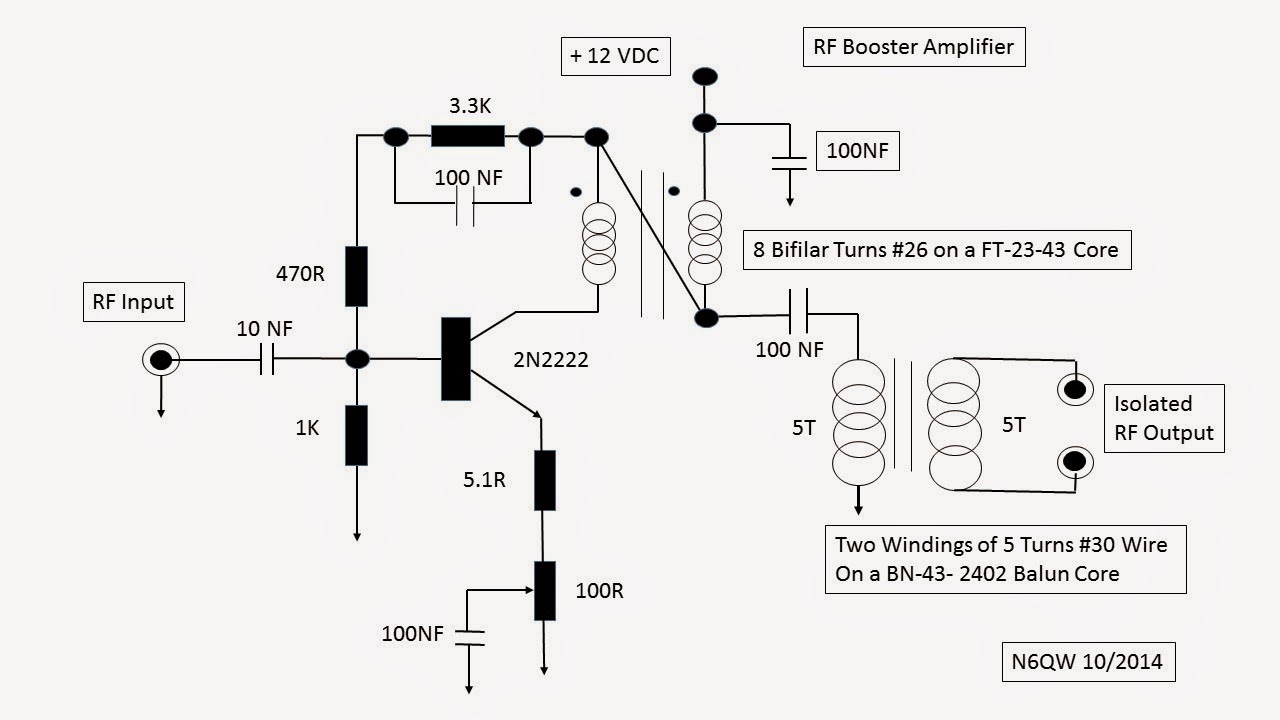
Tony, G4WIF, asked about an amplifier to boost the output of the AD9850 chip. Here is Dr. Juliano’s prescription:

You might find that once you plug that DDS into a circuit you may not quite get 1 V pk to pk and in fact after about 10 MHz it really starts to sag. See the attached drawing as you can put this “afterburner’ on the output of the DDS. The isolated output is good if you are interfacing with “toob” type equipment –it can be left off if you are doing SS or just left in place. This is the output from the amp and as you can see fairly clean.
73’s
Pete N6QW
IMG_0266

Our book: “SolderSmoke — Global Adventures in Wireless Electronics” http://soldersmoke.com/book.htm Our coffee mugs, T-Shirts, bumper stickers: http://www.cafepress.com/SolderSmoke Our Book Store: http://astore.amazon.com/contracross-20

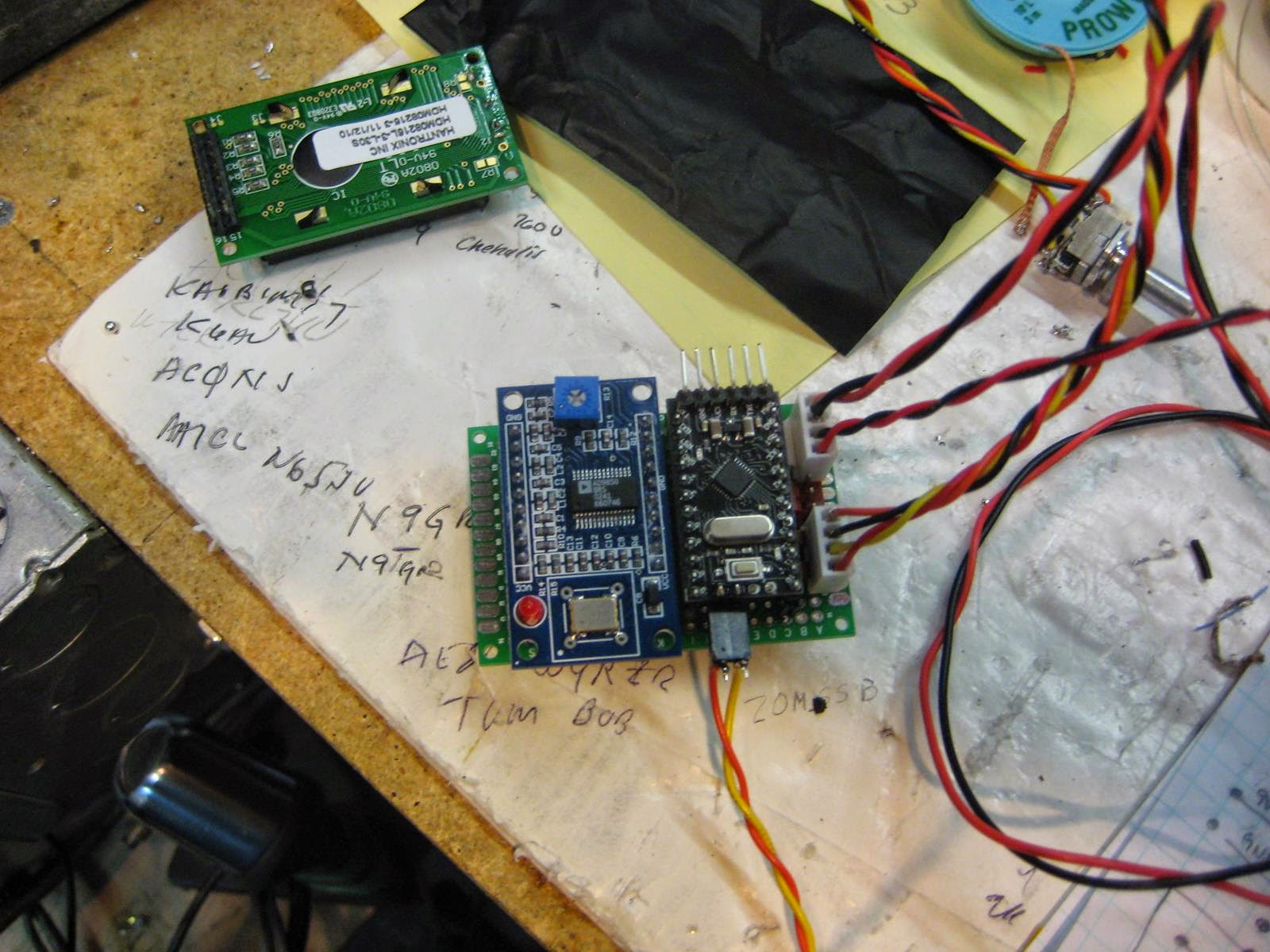
Digitizing my BITX17 with an Arduino and an AD9850 chip

This is only temporary! My analog, discrete, hardware-defined BITX17 was NOT harmed or even modified for this little experiment.

Our book: “SolderSmoke — Global Adventures in Wireless Electronics” http://soldersmoke.com/book.htm Our coffee mugs, T-Shirts, bumper stickers: http://www.cafepress.com/SolderSmoke Our Book Store: http://astore.amazon.com/contracross-20

Background on the use of Si5351 — code and integration with Arduino Nano (video)

I somehow missed this one. Here Pete talks about how the use of the Si5351 in ham radio has been evolving, who has been working on it, etc.

Our book: “SolderSmoke — Global Adventures in Wireless Electronics” http://soldersmoke.com/book.htm Our coffee mugs, T-Shirts, bumper stickers: http://www.cafepress.com/SolderSmoke Our Book Store: http://astore.amazon.com/contracross-20

BIG Amplifiers with SMALL Microcontrollers and LOTS of Tribal Knowledge

Hi Bill,
I wanted to forward to you a slightly edited email I sent to one of our podcast listener’s as I think this is a really good example of some “Tribal Knowledge”.
—————————————————————————————————————————————————————————————————————————–
Hi OM,

Ham radio publications are much like the Internet –all that is published must be scrutinized. One such publication had a beautiful QRP to QRO amp using a 3CX800A7. A few watts in and 800 Watts out. My daughter was in FM radio broadcasting and I told her to introduce herself to the station engineer and to look out for any pulls – then the floodgates opened –about a week later I had a 3CX800A7.
So I started to work on the amp. The circuits just didn’t make sense and parts were missing that would make it work correctly. I contacted the author and here is what he shared. He built the amp but never did get to proof the final article. In fact he sent me his notes and sketches which were correct. Thus I could have never built that amp using just the article. I built it for one band, 20 Meters. It has a tuned input and a Pi-L output so is quite excellent on harmonic reduction.
Oh BTW this amp caused me to learn about PIC Microcontrollers. You cannot hit the 3CX800A7 with HV voltage until the cathode is warmed up (must be a female tube). That time delay is 3 minutes. I could not find a suitable time delay relay with a 3 minute delay that didn’t cost an arm and a leg. So that is when I thought about using the PIC16F84 as a time delay relay. Later I ported that over to a 12F675. The cost was less than $10. In the 3CX1500A7 amp ( another free tube) I have two microcontrollers in there. One is used for a three second step start on the filaments (don’t want to shock the filaments with inrush current) and the second for the 3 minute delay before starting the HV step start sequence.
You can see the “Big AMP” on my website at http://www.jessystems.com.
There was only one problem – I was worried about the cooling of the tube so I made sure there was plenty of air which I dump into a very small sub-chassis and the exhaust is out through the tube. Well “Dah” large volume in and small port for exhaust and you have a jet engine sitting on the desk top. Man it was loud – I would wear headphones when it was working. When I built the 3CX1500A7 amp I used a larger plenum so not as loud.
There are several key points I want to make about tribal knowledge:
  1. Turn off the soldering iron and spend a good deal of time “noodling” over the circuit so that it is clear what each function will do and that all the wires connect to something.
  2. Contact the author and ask lots of questions and you might be surprised to find out the published design is not what was designed!
  3. Look for uncommon solutions to build problems. Many times parts used in the articles are so unique that only one exists in the whole world and it is installed in the authors unit.
  4. The amp was built in 2000 and the use of the PIC16F84 as a time delay for an amp was a bit leading edge but don’t be afraid to employ some advanced technology into your projects. [Today an Arduino built into the amp could do time delay, temperature control of blowers, SWR sensing, grid trip protection and even warm your coffee.]
  5. In the Big AMP I figured out how to keep the blower going for about 1 minute after the amp is turned off to “cool down” the tube. The point here is to think about not just the amp itself but refinements to make that $600 tube last for a very long time thus filament current inrush protection and tube cool down.
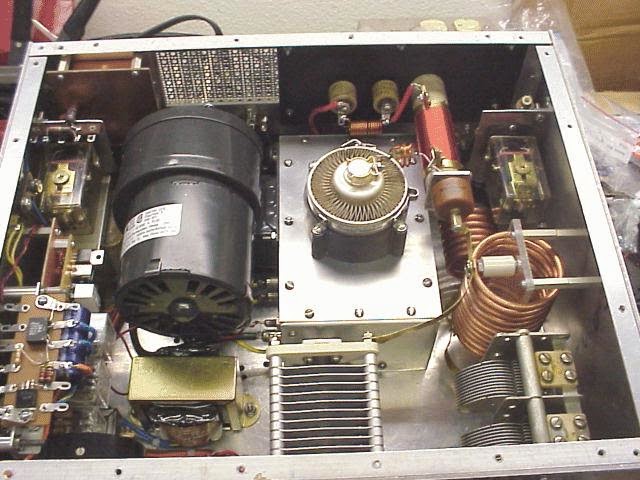
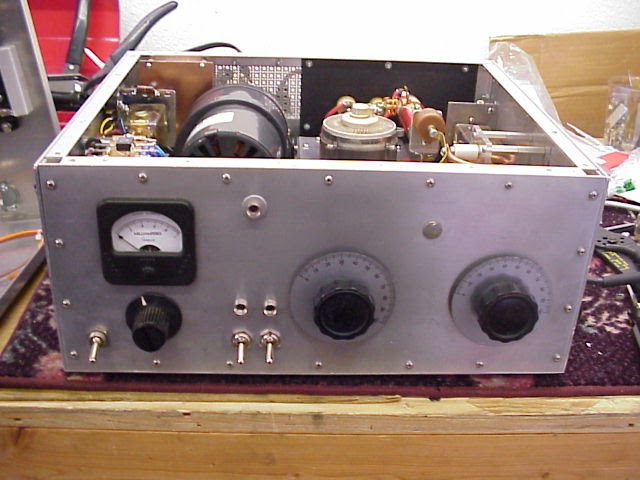
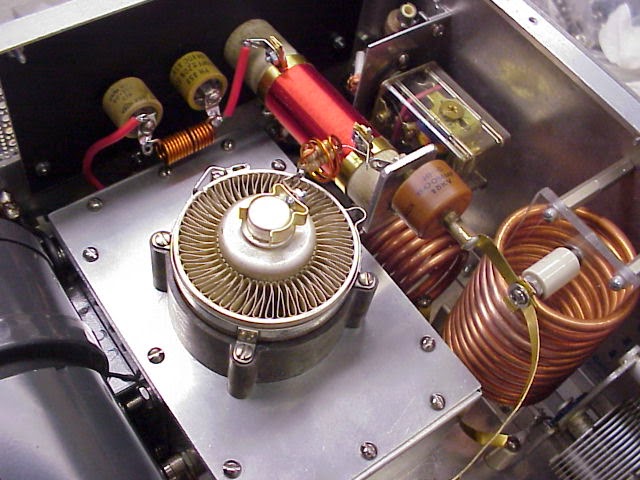
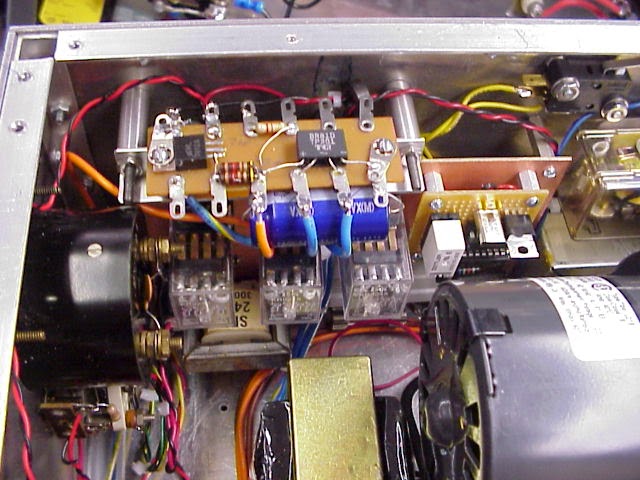
  6. Don’t forget SAFETY – there is 2000 Volts @ 1 amp running around chassis–it is an electric chair sitting on your desk top. I included a microswitch that when the top cover is off it de-energizes the HV circuits. See if you can spot it in the photos.
73’s
Pete N6QW
PS The amp really does exist –see below.

Our book: “SolderSmoke — Global Adventures in Wireless Electronics” http://soldersmoke.com/book.htm Our coffee mugs, T-Shirts, bumper stickers: http://www.cafepress.com/SolderSmoke Our Book Store: http://astore.amazon.com/contracross-20

Bandpass Filter Construction by Pete Juliano (video) TFMS!!!

MePads! Arduinos! Breadboards! SuperGlue! Graph paper! Noodling! Room for Relays!
TFMS (TUNE FOR MAXIMUM SMOKE!)

Another great video from N6QW. Thunder power!

Our book: “SolderSmoke — Global Adventures in Wireless Electronics” http://soldersmoke.com/book.htm Our coffee mugs, T-Shirts, bumper stickers: http://www.cafepress.com/SolderSmoke Our Book Store: http://astore.amazon.com/contracross-20

SolderSmoke Podcast #167: Arduinos, Amplifiers, Books, and Tribal Knowledge

SolderSmoke Podcast #167 is available:

http://soldersmoke.com/soldersmoke167.mp3

3 November 2014
Who the heck is Giovanni Manzoni?
Pete’s Bench Report:
“Let’s Build Something” Project
Arduinos and Si5351s
Bill’s Bench Report: 140 watt Amplifier Completed!
Low Pass Filter Design with the ELSIE Program
Samlex Power Supply
How I almost blew it up!
The new amp and the lids in the FT4TA pileup
Tribal Knowledge!
“Nature abhors a vacuum (tube)!” “The Innovators” by Walter Isaacson.
Carter, WA9DNF, REALLY knows which end of the soldering iron to grab!
Meeting with Thomas, KK6AHT. The two electronic cultures.
Interviews by Chris, KD4PBJ, at Two Days in Huntsville:
Glen Popiel, KW5GP, Author of “Arduino for Ham Radio”
John Henry of TenTec
Steve, WG0AT



Giovanni Manzoni
Giovanni Manzoni b. circa 1950 Civatavecchia, Lazio, Italy is a noted videographer specializing in the avante garde use of YouTube in ham radio homebrew settings. Long noted for his insistence on the use of completely home-made video equipment, Manzoni went so far as to demand that his cameras and recorders only use discrete components — he claimed that integrated circuits “freaked him out.” Manzoni’s collaborators have long been puzzled by his claim that all his videos are filmed “on location.” What he means by this remains unclear, however, in a 1997 interview in QST-Italia, he was quoted as saying “No matter where you go, there you are!”

Our book: “SolderSmoke — Global Adventures in Wireless Electronics” http://soldersmoke.com/book.htm Our coffee mugs, T-Shirts, bumper stickers: http://www.cafepress.com/SolderSmoke Our Book Store: http://astore.amazon.com/contracross-20
“Two guys and a Minima walk into a bar…”

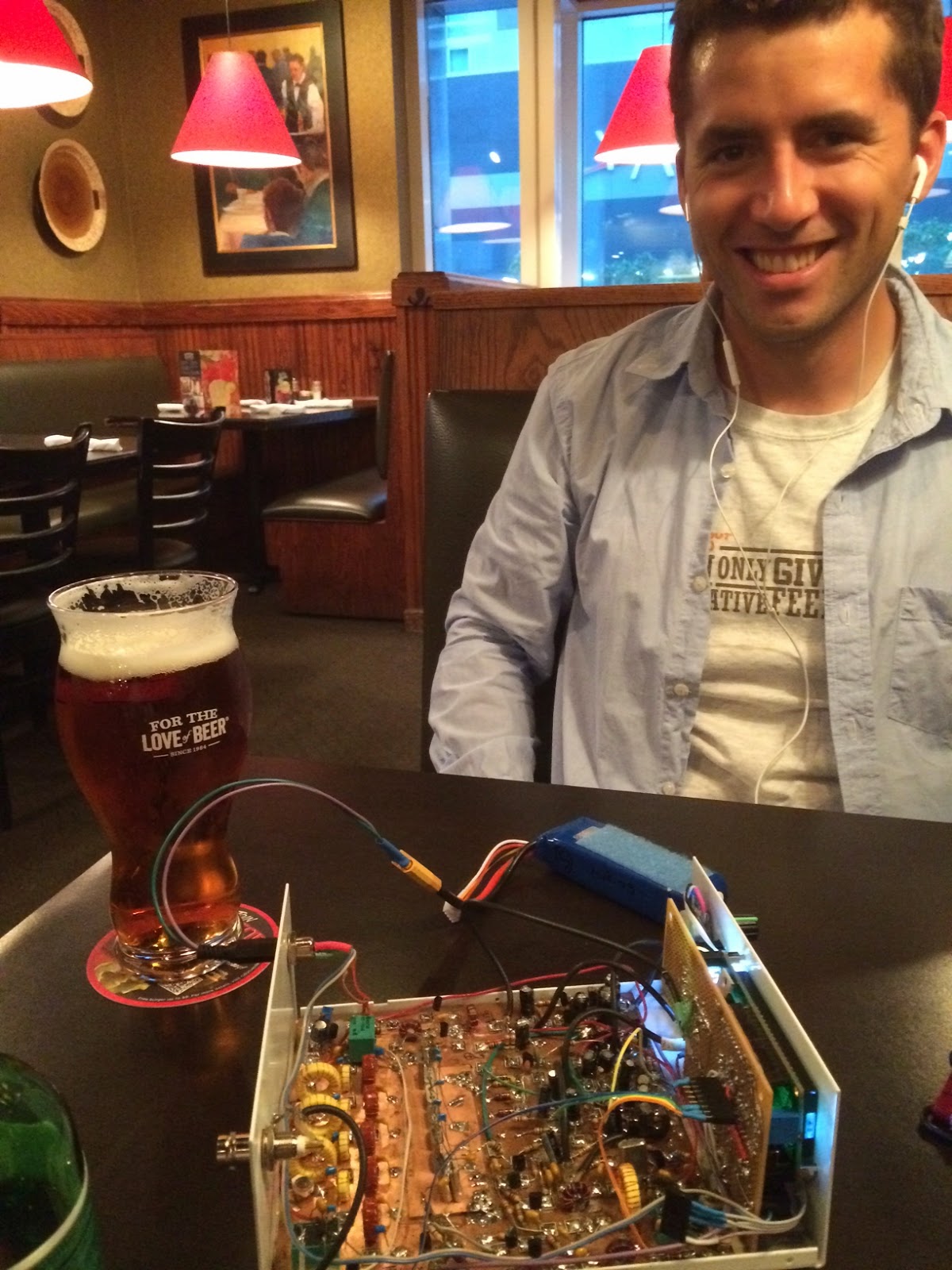
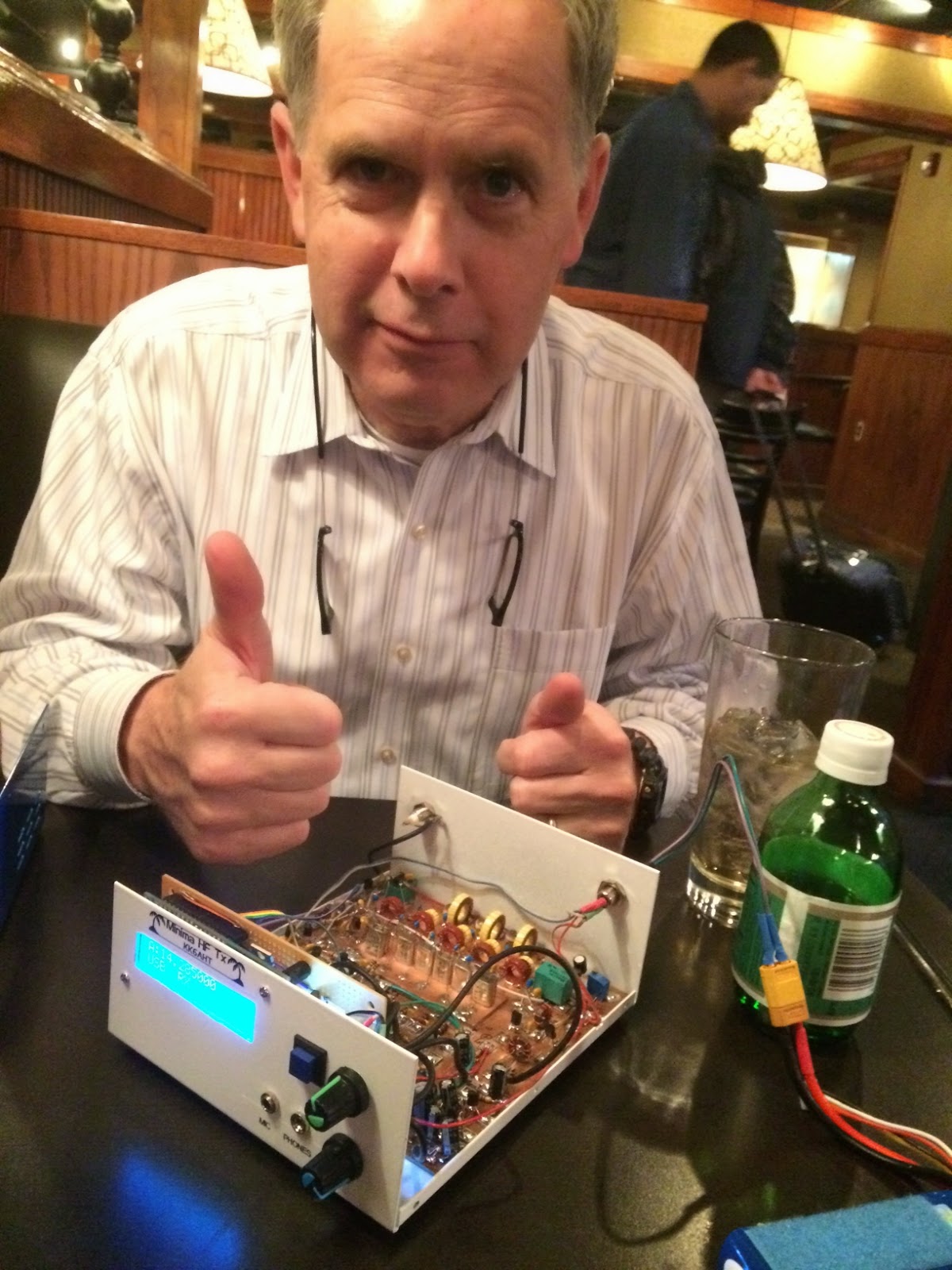
Thomas, KK6AHT, was in Washington this week. He and I got together for a beer and a look at his Minima.

I’d seen pictures of it, but it was much more impressive in person. Thomas did a great job on this rig. It is a really nice mixture of digital and analog. I liked the fact that he built the analog portion Manhattan style using MePads. He and I agreed that while it would make sense to produce a PC board for the Arduino/Si570/LCD portion of the rig, builders should be encouraged to do the rest Manhattan style.
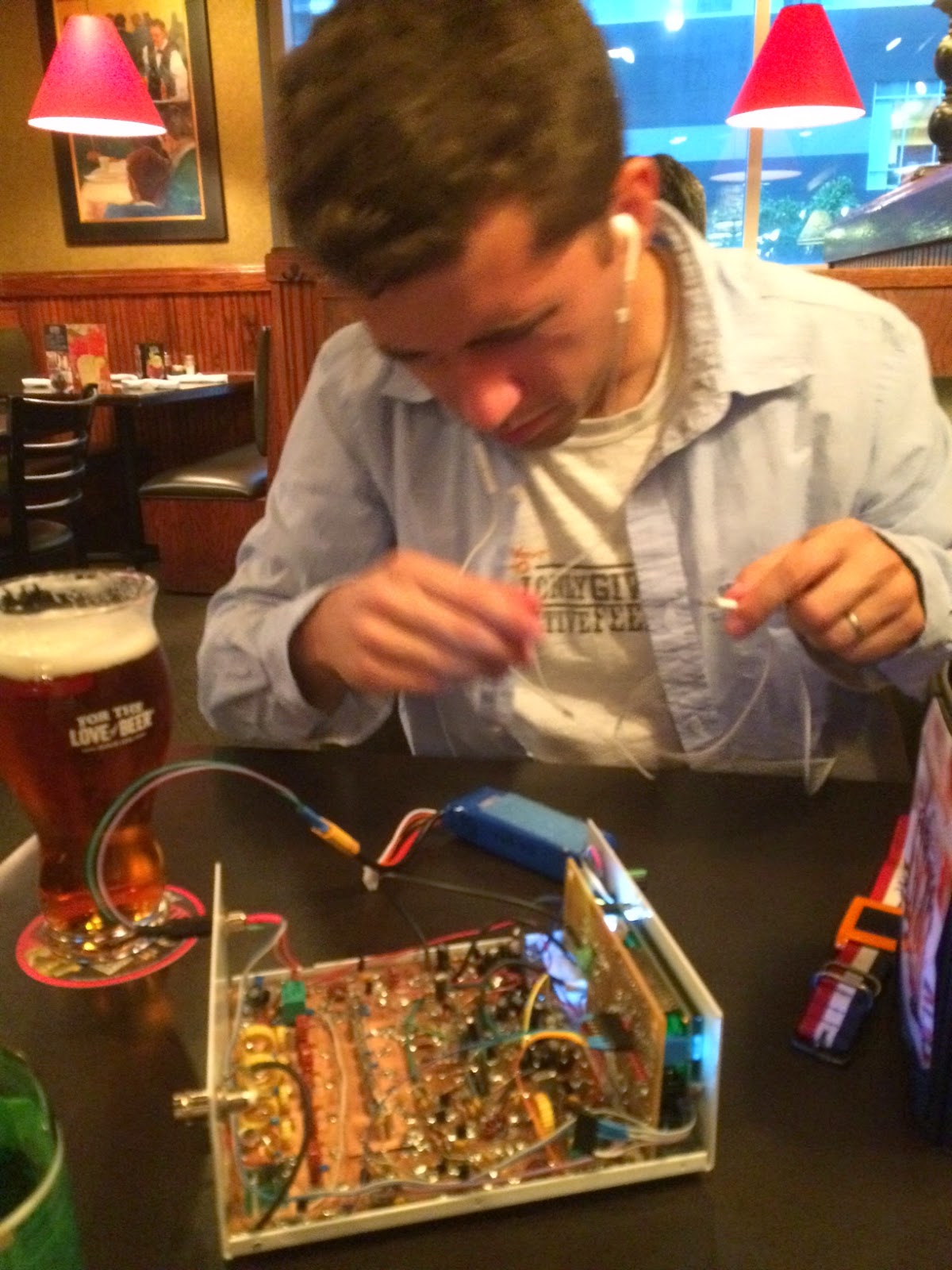
Showing true homebrew dedication, Thomas was unhappy with the level of audio output when we turned it on. He started to trouble-shoot right there in the Ruby Tuesday bar!

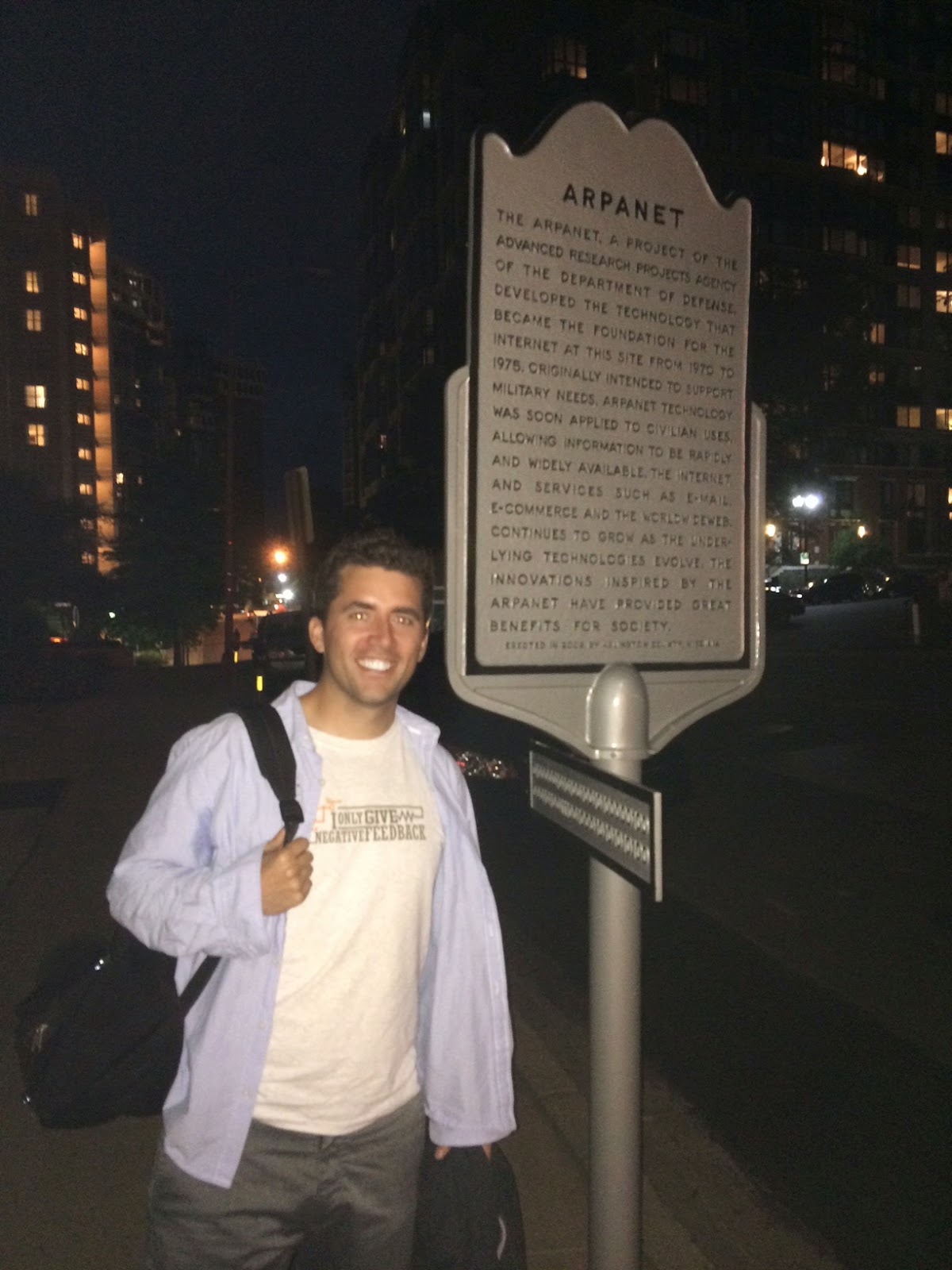
It turns out that we were in a very Knack-ish location. We were on the site where they created ARPANET.

Thomas very kindly left me with a nice package of Minima digi-parts including the Arduino chip loaded with the software and an SI570. So now I have no excuse.

Thanks Thomas!

Our book: “SolderSmoke — Global Adventures in Wireless Electronics” http://soldersmoke.com/book.htm Our coffee mugs, T-Shirts, bumper stickers: http://www.cafepress.com/SolderSmoke Our Book Store: http://astore.amazon.com/contracross-20
Arduino Hell!

Hi Bill,
I am a long time listener of SolderSmoke and a big fan! Since your last podcast was on the use of Arduino’s for ham radio, my Arduino Hellschrieber project may be of interest to you and your listeners. I am using the $15 dollar RadioShack color display they are closing out and a simple circuit with our favorite transistor!
I have a video in my second blogpost and all the details with code below.
Keep up the great work, I have your book both in print and Kindle!
73, Dan WA6PZB

Our book: “SolderSmoke — Global Adventures in Wireless Electronics” http://soldersmoke.com/book.htm Our coffee mugs, T-Shirts, bumper stickers: http://www.cafepress.com/SolderSmoke Our Book Store: http://astore.amazon.com/contracross-20
Drake-uino! Arduino DDS puts Drake 2B on 12 meter band!

After using the Arduino DDS as a crystal substitute with my 1982 Barebones Superhet recevier (scroll down), I moved back two more decades and used the DDS as a crystal substitute to put my (early ’60s) Drake 2B on the 12 meter band. This was a hack in which I actually used a hack saw — I used it to cut open the container holding a crystal so that I could make a socket that would carry the signal from the Arduino DDS into the Drake 2B.

This video is a bit repetitive, but it stated out at two different videos. I just put them together. The last part shows the actual crystal socket hack.

Our book: “SolderSmoke — Global Adventures in Wireless Electronics” http://soldersmoke.com/book.htm Our coffee mugs, T-Shirts, bumper stickers: http://www.cafepress.com/SolderSmoke Our Book Store: http://astore.amazon.com/contracross-20
Eclectic Electronics: Powering Arduinos with Tube Filament Voltage

You know that you are dealing with a broad range of technology when you find yourself discussing how to power an Arduino microcontroller from the 12V AC voltage on a vacuum tube filament line. Thanks Pete.

Hi Bill,
There is only so much that can be said in 1 hour and 19 minutes so maybe here is some stuff for the blog.
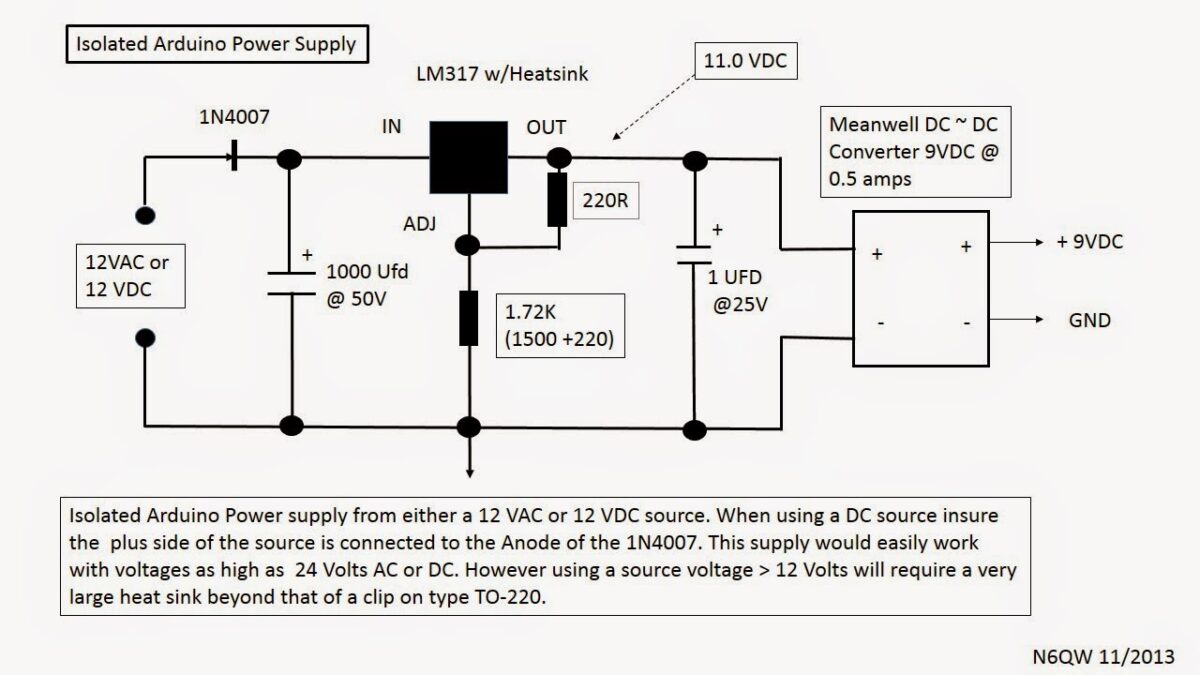
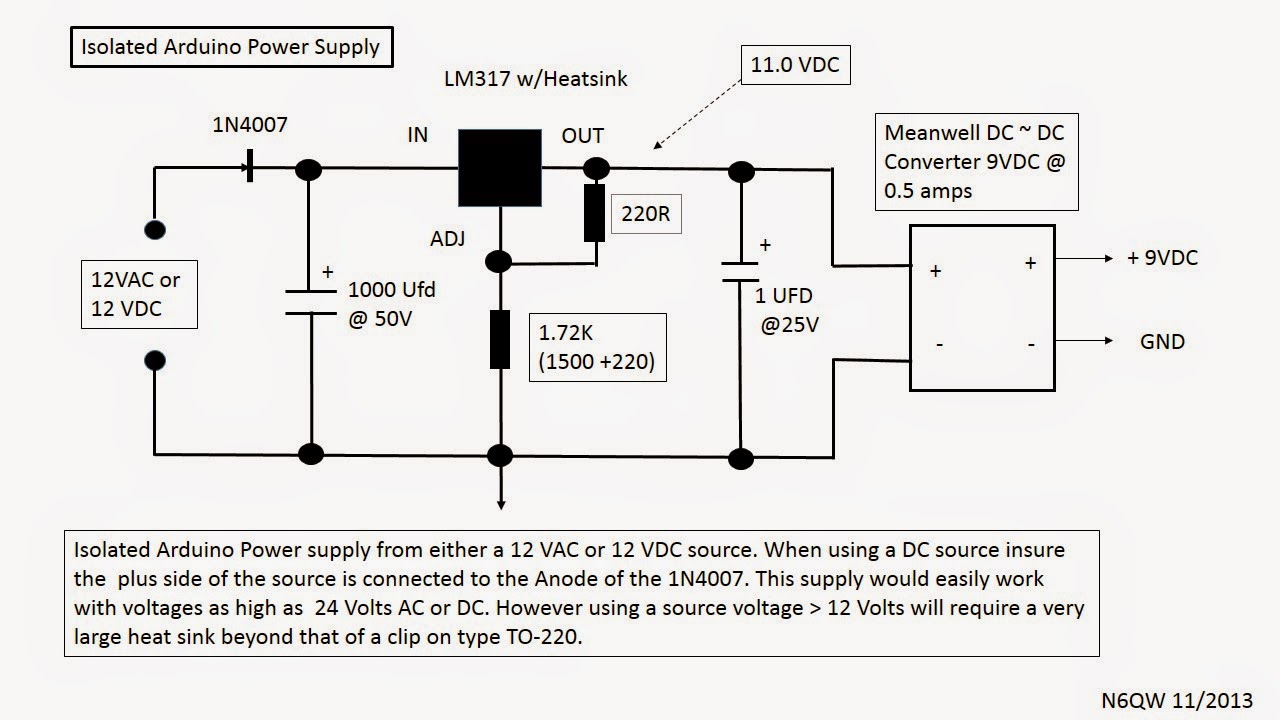
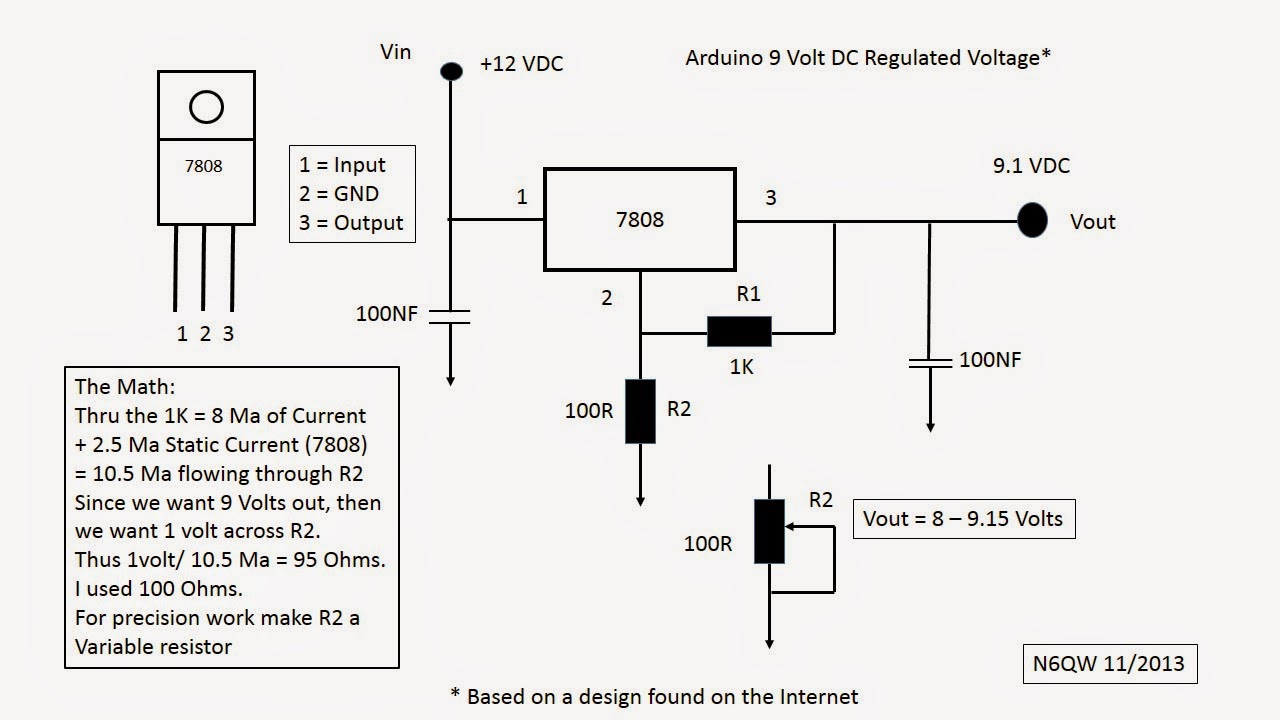
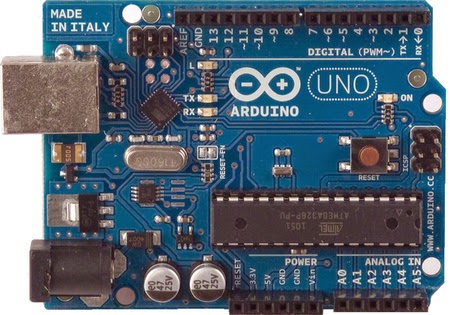
The 1st thing on the list when working with the Arduino when it is not connected to the computer is to have a proper power supply. My research as indicated that 9 VDC “raw” is a good starting point to power the Arduino boards so here are two supplies that will provide that power.
I did find that it was necessary to have an isolated supply when working with the “toob” radios and even to isolate the RF into the radio using a ferrite core transformer –some more tribal knowledge.
One supply takes an 8 VDC regulator and boosts its output to 9 VDC. The second uses a switching regulator and the beauty of the second is that the input can be either 12 V AC or DC. This is ideal for use in toob radios where you can sample the 12.6 VAC filament string.
73’s
Pete

Our book: “SolderSmoke — Global Adventures in Wireless Electronics” http://soldersmoke.com/book.htm Our coffee mugs, T-Shirts, bumper stickers: http://www.cafepress.com/SolderSmoke Our Book Store: http://astore.amazon.com/contracross-20
SolderSmoke Podcast #165 Arduinos!


SolderSmoke Podcast #165 is available:

http://soldersmoke.com/soldersmoke165.mp3

September 13, 2014

Workbench Update: Bill’s “Off the Shelf” Regen, Pete’s Boatanchors
Mysterious Echos on Shortwave Signals. Solve the Mystery. Please.
Microcontrollers — What they can do for you.
Small world: As a kid, Pete was neighbor of “Digital Dial” N3ZI
NEWS FLASH: Arduino creator Massimo Banzi was a ham!
Born in a bar, cheaper than pizza: The Italian origins of Arduino
Arduino CW generators
No coding skills needed
Arduino + AD9850 = Signal Generator or VFO
Arduinos in the Minma
What the heck is a Shield?
SolderSmoke Mailbag


Our book: “SolderSmoke — Global Adventures in Wireless Electronics” http://soldersmoke.com/book.htm Our coffee mugs, T-Shirts, bumper stickers: http://www.cafepress.com/SolderSmoke Our Book Store: http://astore.amazon.com/contracross-20
M0XPD Goes 3D with Boxed BITX with Digi-Hinge!

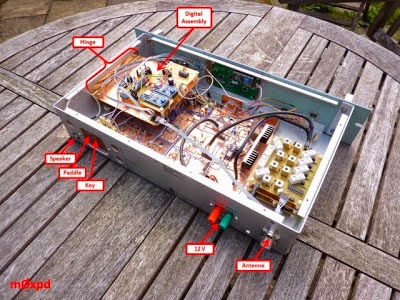
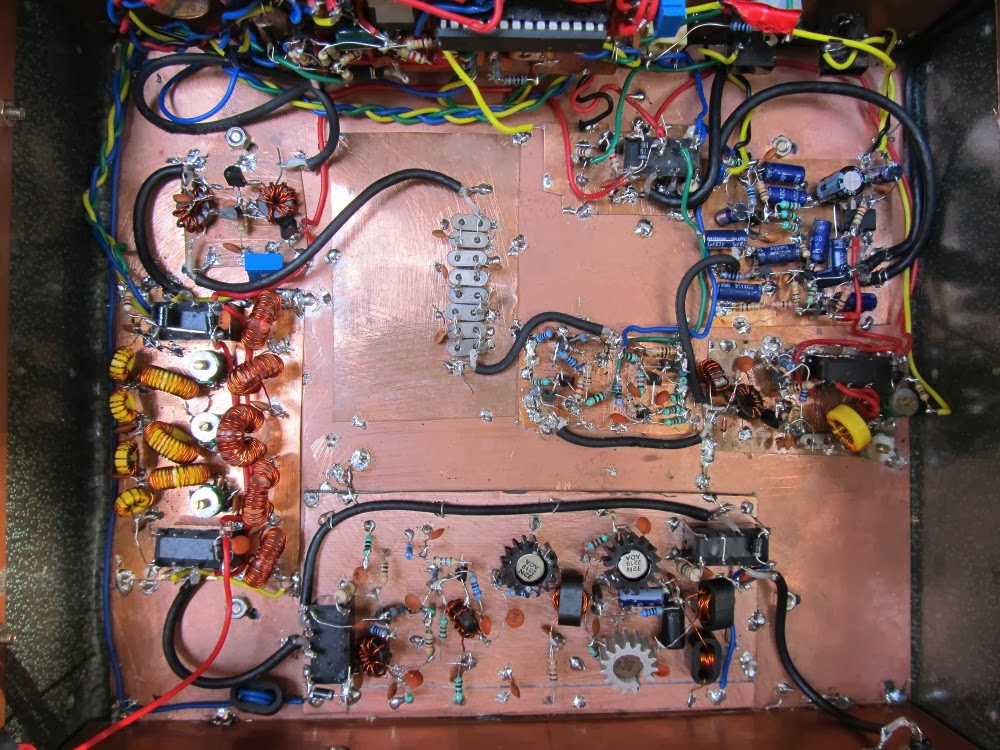
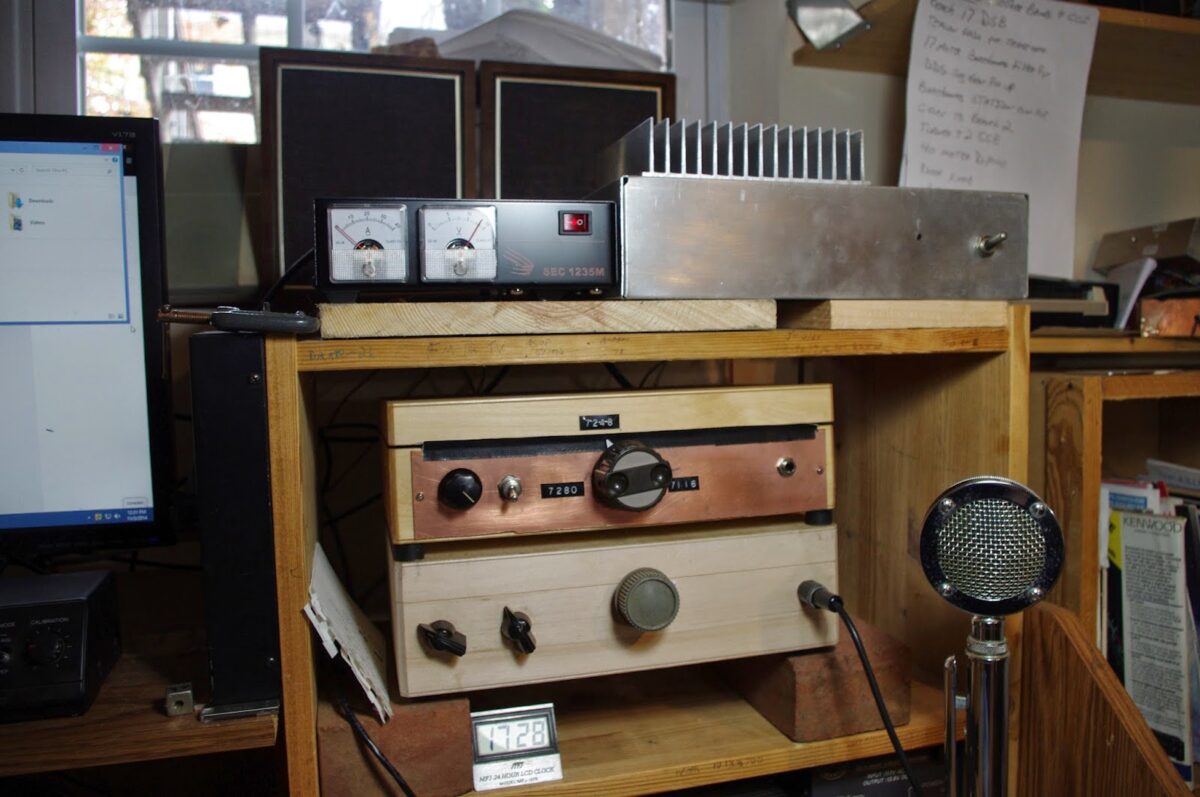
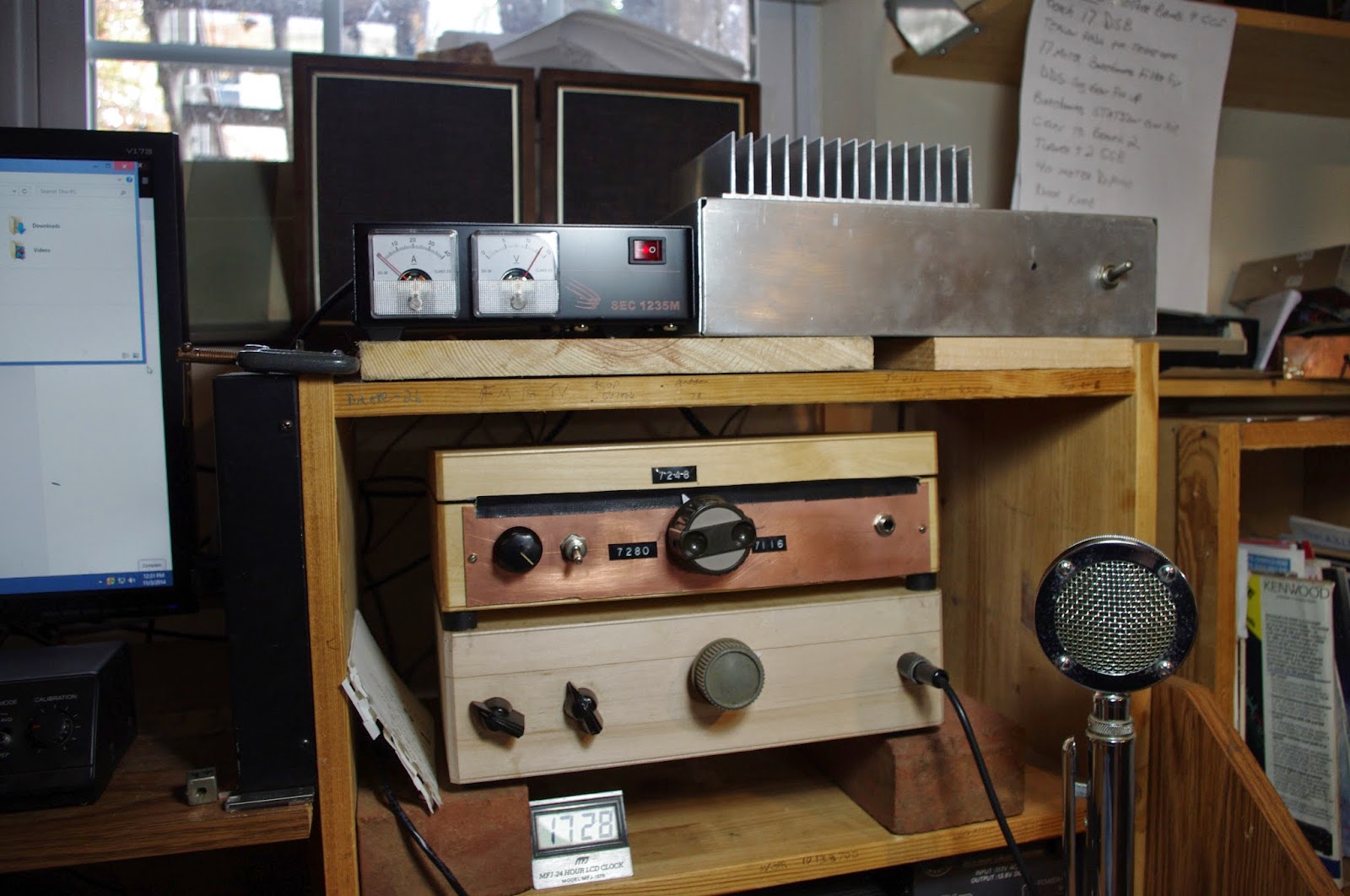
Paul, MOXPD, has put his BITX-based rig in a proper box. In spite of his recent collaboration with famed miniturizer Pete Juliano, Paul used a BIG box. It is not quite milk carton size, but it is getting there. Well done Paul. I really like the way Paul kept the digital and analog elements in different dimensions. The digi bit is sort of floating above the main analog board (almost in a “cloud”!). In SolderSmoke 163 Pete Juliano mentioned a downside of this kind of stacking: it makes it hard to get to the main board. Paul ingeniously solved this problem by putting the digital board on a hinge. Excellent. This will prevent you from becoming “unhinged” when the time comes to fix or modify the main board.

Here are all the details on Paul’s project:
http://m0xpd.blogspot.co.uk/2014/07/boxing-clever.html

Our book: “SolderSmoke — Global Adventures in Wireless Electronics” http://soldersmoke.com/book.htm Our coffee mugs, T-Shirts, bumper stickers: http://www.cafepress.com/SolderSmoke Our Book Store: http://astore.amazon.com/contracross-20
Video of Pete Juliano’s 20-40 Bilateral Rig

Wow, what a beautiful rig. Nice work Pete. Kind of eerie how we both chose the 20/40 combination after building 17 meter rigs. We’ll have to talk more about this in SolderSmoke 162. Soon!

Our book: “SolderSmoke — Global Adventures in Wireless Electronics” http://soldersmoke.com/book.htm Our coffee mugs, T-Shirts, bumper stickers: http://www.cafepress.com/SolderSmoke Our Book Store: http://astore.amazon.com/contracross-20
Homebrew Blimp with paper-thin Arduino (Printoo)

More on Printoo (very interesting!):

https://www.kickstarter.com/projects/1030661323/printoo-paper-thin-flexible-arduinotm-compatible-m

Our book: “SolderSmoke — Global Adventures in Wireless Electronics” http://soldersmoke.com/book.htm Our coffee mugs, T-Shirts, bumper stickers: http://www.cafepress.com/SolderSmoke Our Book Store: http://astore.amazon.com/contracross-20
G0MGX’s Minima

Wow, Mark didn’t waste any time in building his Minima. FB OM. His web site has a lot of good info on this project: http://g0mgx.blogspot.co.uk/

Our book: “SolderSmoke — Global Adventures in Wireless Electronics” http://soldersmoke.com/book.htm Our coffee mugs, T-Shirts, bumper stickers: http://www.cafepress.com/SolderSmoke Our Book Store: http://astore.amazon.com/contracross-20
Farhan’s New Design: A General Coverage Transceiver: The Minima!

The homebrew phone QRP community has been waiting anxiously for the unveiling of Farhan’s new design: The Minima. It is a general coverage transceiver with many innovative circuit features. It has an Arduino in it and an Si570. Farhan’s write up of the design process and the construction of the prototypes is really interesting.

http://www.phonestack.com/farhan/minima.html

I’ve built FOUR JBOTs and TWO BITXs. I even built Farhan’s Subway Sandwich Straw signal generator. So even though I’ve been trying to keep my rigs all discrete, I know I will build this one too.

Three cheers for Ashhar Farhan! Viva La Minima!

Our book: “SolderSmoke — Global Adventures in Wireless Electronics” http://soldersmoke.com/book.htm Our coffee mugs, T-Shirts, bumper stickers: http://www.cafepress.com/SolderSmoke Our Book Store: http://astore.amazon.com/contracross-20