SolderSmoke Podcast #140

Universal VXO


A new episode of the SolderSmoke podcast is now available:

http://soldersmoke.com/soldersmoke140.mp3

January 9, 2012

— Santa Claus: Ice Skates, Brownie Box Cameras, and Piper Cubs
— On the air with 17 Meter Azores DSB rig
— Seeking balance (with antennas)

— 23/24 recycling of Azores SSB Rig: Adding Soul to the Old Machine!
— Attacked by my own soldering iron!

— RG-174, swarf, and other insidious threats to the homebrewer
— Inspiration from QRP Quarterly
— G3RJV validates the D-104
— T/R admonition from the 1973 Handbook (words to live by)
— The Woz on electronics and teenage social isolation
— BANDSWEEP: Straight Key Night at WA6ARA
— MAILBAG
Our book: “SolderSmoke — Global Adventures in Wireless Electronics”http://soldersmoke.com/book.htmOur coffee mugs, T-Shirts, bumper stickers: http://www.cafepress.com/SolderSmokeOur Book Store: http://astore.amazon.com/contracross-20

2012 Off to a Good Start: Balanced ATU Success!

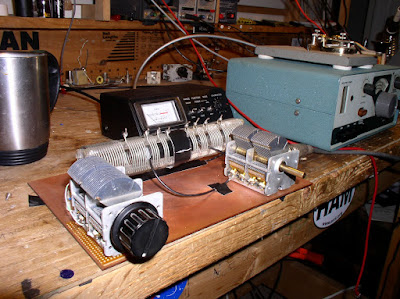
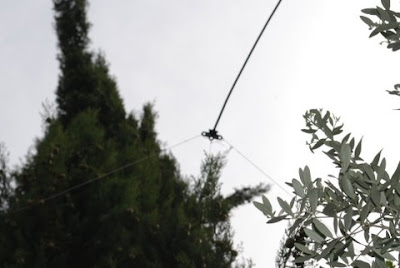
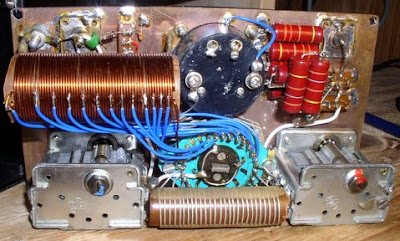
2012 is off to a good start here at SolderSmoke HQ. I’m planning on putting up an 80-10 dipole fed with open wire (window) line. So I need a balanced ATU. A very simple link coupled design appears in lots of the antenna books and handbooks (1980 ARRL Handbook page 19-8, RSGB’s “Practical Wire Antennas” by John Heys, page 86): Just a series LC circuit in the primary and another tuned circuit with a split stator variable cap in the secondary. The junk box was VERY cooperative: I found a big tuning coil (or might it have been two coils?) probably from an old Heathkit DX-40 or DX-60) — that would work for the secondary coil. Then for the primary I found a smaller coil that would fit perfectly (with one layer of Gorilla tape) inside the secondary. I also found two really pristine 1000 pF air variables (I know, they can’t handle much voltage, but, hey, that’s one of the benefits of being a QRP guy, right?) I used the HW-7 as a signal generator and this morning did some experiments with different loads. You have to play around a bit with the taps on the secondary, but the ATU seems quite capable of matching loads from about 50 ohms up to at least 10K, and it works from at least 40 meters to 15 meters.

I found it very pleasing to see that SWR meter go down to 1:1. I’ll now — in the finest traditions of ham radio — wait until the snow starts falling and the wind starts howling before I try to put an antenna in the trees.

Our book: “SolderSmoke — Global Adventures in Wireless Electronics”http://soldersmoke.com/book.htmOur coffee mugs, T-Shirts, bumper stickers: http://www.cafepress.com/SolderSmokeOur Book Store: http://astore.amazon.com/contracross-20

Snow Static

Related to our post about my new (old!) all-boatanchors heating system (see below), yesterday I had some really horrendous static. I think it was caused by the snow. A Google search on “snow static” brought me to this video (which Gregg in Finland found “shocking””). I liked the tuner and the neon bulbs too.

Our book: “SolderSmoke — Global Adventures in Wireless Electronics”http://soldersmoke.com/book.htmOur coffee mugs, T-Shirts, bumper stickers: http://www.cafepress.com/SolderSmokeOur Book Store: http://astore.amazon.com/contracross-20

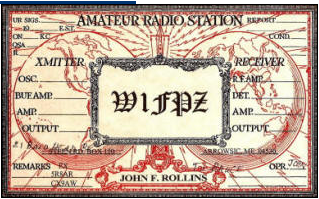
Homebrew Hero: John Rollins, W1FPZ

Ted, AJ8T, alerted me to the life and work of John Rollins, W1FPZ. As you can see from the text below, John was definitely part of the International Brotherhood of Electronic Wizards. I especially like the bit about his taking license exams in foreign languages, and about winding his own transformers in Madagascar. Great stuff. The videos about John and his workshop are really encouraging and inspirational. I laughed out loud when I heard John admit that he was surprised when one of his rigs worked the first time he fired it up. He said that he usually had to spend 3-4 months struggling to get his creations to work! Be sure to listen to the story about how John caught a Navy helicopter with his Vee beam. Thanks Ted, and thanks to Bruce, W1UJR, who took the time to make these wonderful videos.

Here are videos:

http://youtu.be/EV9ljdHLqLg

From John’s QRZ listing. This was written by Tim, W1GIG. (Thanks Tim!):

John passed away on March 18, 2008. It was 11 years ago that Bruce Kelly asked John to take over the Amateur Radio column in the OTB as Bruce himself was winding down. John was a man of many talents and had a most interesting life. Because he was always so busy helping others, he rarely took time to talk about himself, so I am going to take this opportunity to tell you a bit more about him.

John was born in Guatemala of American parents where his father worked for United Fruit Company (think bananas). At an early age, his father died of malaria and his mother moved the family back to New England. He also lived with an Aunt and later with his much older brother, an airline pilot, who lived on Long Island. As a teenager John discovered radio and his brother bought him a $5.00 two tube regenerative radio kit to build. John built the kit, but it was another 6 months before he got another kit for the power supply. With the help of a ham who lived nearby, he got the radio working which opened up a whole new world for him. John was in High School when his brother went with him into NYC to test for a ham license at the FCC Field Office. For the next couple of years he was active on 40 M. CW using the regen receiver and a Hartley oscillator.

At this point, WW II got in the way. John enlisted in the Army and was trained in radio repair, shipped off to New Guinea, and assigned to be a telephone lineman. The Army moved John steadily North to the Philippines and then to Japan where he was finally sent back to the States for discharge. John enrolled at the University of New Hampshire where he discovered his love of geology. He liked it so much he went on to get a Masters at the University of Nebraska and several years later, a Doctorate also from the University of Nebraska. He continued to work for Chevron exploring for oil in Africa, Madagascar, Spain, Denmark and many other countries including the US.

While he was in college, John remembered his love of radio, but unfortunately his ham license had expired, so he went back in 1954 to test again receiving the call W1FPZ which he held ever since. Later, he tested for his ham license in Madagascar (in French) and in Uruguay (in Spanish). Not many of us have tested for our licenses in three languages! While he was in Madagascar he built many of the transmitters that are still in use at his home. He even wound his own power and filament transformers to get the voltages he wanted.

John also discovered that he was an excellent pistol marksman, but that his results could be substantially improved by reworking the guns themselves, so he taught himself to be a gunsmith. His skills at woodworking, carving, machining, precision casting of bullets and loading target shells were such that this became a major hobby business for him which he pursued right up to recent months.

John was a survivor. While in the Army he survived a major brush with a 3,300 volt power line and later a plane crash while in Africa. Since small planes were the only way for John to get to his job sites, he decided that he’d rather trust his own skills as a pilot than rely on the brush pilots that the oil company had hired. Back in the States, recuperating from his injuries, he got a private pilot’s license, then went on to a multi-engine commercial license with full instrument ratings. Just before he retired, he was working out of Denver and flying his own twin engine Queen Air to Maine to work on his retirement home. He even flew from Maine to the AWA conference one year picking up Marshall Etter, W2ER from Long Island on the way.

Preparing for retirement, John and his wife Liz doubled the size of their new home in Maine. As part of the project, John wanted reliable ham communications with his friends around the world. Limited by normal power regulations, he decided to build a BIG antenna. His final choice was a horizontal V beam aimed at the Southeast. The beam legs were 1,100 feet long and supported on three 100 foot towers. Looking for wire strong enough to span the distance he ran across an ad for #6 phosphor bronze wire run by Marshall, W2ER who had salvaged the wire when he was closing the RCA site at Rocky Point. The two men became fast friends and co-conspirators. Marshall provided quality parts left over from RCA and John, using his metal and woodworking skills, customized the parts to suit his projects. The result was a long series of radio projects that he gave to friends with the caveat that they were required to use them on the air in AWA events.

John always had a fascination with the products of Jerry Gross of NYC. He built a Gross replica transmitter for Marshall who used it for many years. Parker Heinemann, W1YG found an original Gross and had John restore it along with the receiver, station monitor and antenna tuner. They set up an entry in the 1991 AWA contest that exactly duplicated a Gross add from the 30’s and took first place. After the conference, John got a call from Bill Orr who offered John his Gross if John would restore it. That transmitter is part of John’s home station.

Not satisfied with the Hartley oscillator, John discovered that if he used the Colpitts circuit with a split stator condenser and grounded rotor, he could eliminate the hand capacity effect. One of his last projects was to set up the tuned circuit for me and share several of his other construction secrets. The circuit is rock stable on 40 meters.

Thanks for the opportunity to fill you in on some of the less well known aspects of John’s life. It was an honor to know him and he will be missed by all.
Our book: “SolderSmoke — Global Adventures in Wireless Electronics”http://soldersmoke.com/book.htmOur coffee mugs, T-Shirts, bumper stickers: http://www.cafepress.com/SolderSmokeOur Book Store: http://astore.amazon.com/contracross-20

Climbing a REALLY Tall Tower

This is the kind of thing that causes me to stick with sling shots and wire antennas. The comments added to the YouTube video were kind of funny — most were in the vein of “Dude, not for a billion dollars!”

Our book: “SolderSmoke — Global Adventures in Wireless Electronics”http://soldersmoke.com/book.htmOur coffee mugs, T-Shirts, bumper stickers: http://www.cafepress.com/SolderSmokeOur Book Store: http://astore.amazon.com/contracross-20

The Dish

Our man in Dayton, Bob Crane, W8SX, sent us a really beautiful picture of my favorite antenna (not the one above). Check it out: http://apod.nasa.gov/apod/ap110721.html

We talk about “The Dish” from time to time on SolderSmoke. That’s the name of the movie about the role of this antenna in the reception of the TV signals for the Apollo 11 moon landing. This is — without a doubt — the best movie ever made about an antenna.

You can get the movie at the Gadgeteer Book Store:
http://astore.amazon.com/contracross-20?_encoding=UTF8&node=8

Check out “SolderSmoke — Global Adventures in Wireless Electronics”
http://soldersmoke.com/book.htm

Australian Antarctic Antenna Archeology

Macquarie Island

Bill,

I caught half of a report on “The 7:30 Report” on Australia’s public broadcaster ABC TV. Not knowing the full Mawson expedition story, I found this interesting. A conservation group is working to conserve the old halfway point radio repeater mast and whatever other bits have survived on Macquarie Island.

The links are to the transcript and the actual report video.

Story Transcript:

http://www.abc.net.au/7.30/content/2011/s3268909.htm

Vodcast videos. They are about 26MB in size. Theyr’e both the same video. Just two different formats.

http://mpegmedia.abc.net.au/730report/video/podcast/r799754_7027600.m4v

http://mpegmedia.abc.net.au/730report/video/podcast/r799754_7027588.wmv

John Dowdell

Yet to do the test

Sydney Australia

Excellent AT&T Video on SWR

Ken, KG6PO, sent us this gem:

http://techchannel.att.com/play-video.cfm/2011/3/7/AT&T-Archives-Similarities-of-Wave-Behavior

I really like the way Dr. Shive brings together mechanical and electrical phenomena. You get the sense that he had “The Knack” — note the twinkle in his eye when he explains a particularly intriguing point.

Warning: I think the AT&T archive of which this is part will become another enormous (but worthwhile) time sink for many of us. Thanks Ken. Thanks Dr. Shive.

“100 Feet Up In A Pine Tree, Soldering Iron Clinched In His Teeth”

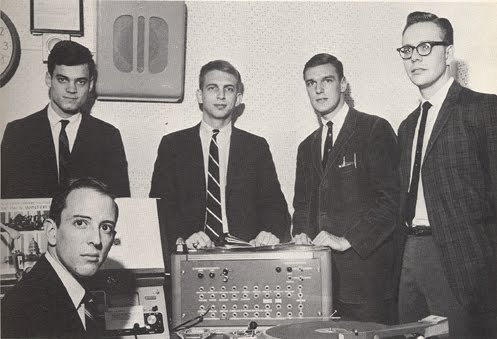
Radio Guys at University of Virginia, 1966

Hi Bill.

I emailed you once to the Yahoo! address, but thought I’d send an updated email to your soldersmoke address, in a desperate attempt to be mentioned in the gonging “SolderSmoke Mailbag”!

I learned of the podcast at May’s Hamvention. I wish I had known of the Four Days in May event, but this was the first Dayton I’ve ever been to.

I thought I’d mention that the ham club I’m involved with here in central Virginia, the University of Virginia club, is putting together a rhombic antenna out in the woods. Although more sweat (and hornet stings) than solder smoke is expected to come from this effort, I still thought it would be worthy of note within the realm of homebrew activity. I hope to have some photographs from our slingshot-and-fishing-line event. With a large crop of able-bodied 20-somethings at our disposal, we should be able to get this thing put together in short order (one of our new members even has extensive tree-climbing skills and a battery-powered soldering iron! If I can get a shot of him 100ft up a pine with the iron in his teeth, I will be sure to pass along). It is hoped that our new monster antenna will help us compete with our cross-state rivals, the Hokies of Virginia Tech. I will be sure to sacrifice a few chickens to Papa Legba prior to our outing.

There are definitely still young people interested in homebrew radio and I work everyday alongside many victims of “The Knack“. I’m working on spreading the SolderSmoke gospel to as many of them as possible, and letting them know of our library of “Sacred Texts”: EMRFD, Solid State Design, and Electronics of Radio, among others. And of course, some of our “Prophets” of the faith: Ashhar Farhan, the Haywards, and the late Doug DeMaw.

I also wanted to say that since I have a lengthy commute to and from the university, I’ve been listening to ALL of the soldersmoke podcasts, starting from the first one. I’m up to the summer of 2007 now. I found it very sad to hear of Mike KL7R’s death in Jan 2007 and I find that I do miss the back and forth banter the two of your shared on the podcasts. However, it is still a lot of fun to listen to and I’ve kept a small logbook of ideas from the episodes, building up a list of projects I hope to soon embark upon.

Best 73 and thank you for your podcasts.

Bert WF7I

Quiz Question for Knack Victims

Hey Bill,

I know you have the knack . . . so I’m coming to you.
I’ve got 31 years of ham radio experience, on top of 16 years experience in the Wireless Telecom industry, that said I have a tech question that has really got me stumped. Maybe the answer is just too obvious.

Here it is: About 2 years ago an electrical engineer/ham radio operator/nuclear engineer threw the following question by me (I’ve yet to get back to him with my answer). Maybe you, or some of your listeners know the answer.

Knack Question: For yagi antennas only one (yes, sometimes two) element is electrically driven/xmit. Instead, why aren’t all of the elements (simultaneously) electrically driven/xmit (vs parasitically driven)? Now the stumper – according to the engineer supposedly the answer excludes the following as the answer(s):

  • Impact to antenna gain,
  • The need to have any type of phasing harness
  • Impact to transmit horizontal beam width (directivity).

Any idea what the answer might be? What am I missing?

VK6ADF: Echolink, WSPR, 6 Meter Yagi

From London I used to talk to Phil, VK6ADF, on Echolink. We have a lot of interests in common. This may be due to the fact that we were both born in the International Geophysical Year. Phil is now reading “SolderSmoke — The Book,” so we will probably discover other areas in which we have crossed paths. This week, I decided to get back onto Echolink, and in my first session I was looking for OM Phil. He wasn’t on, but, IN A VERY MYSTERIOUS TWIST, that morning he sent me an e-mail. Spooky, eh? Anyway, yesterday we got on Echolink and covered our usual wide-range of tech topics. Phil alerted me to a web site called Real Flight that provides an on-line simulator for Radio Controlled airplane pilots. Obviously Billy and I could use some time in the simulator!
Phil is also into WSPR and as we spoke I fired up my 20 mW DSB WSPR rig. I was immediately heard by an Irish station, and Phil almost instantly saw the report on the WSPR database. I noticed that the EI station was reporting that I was on 40 meters, when in fact I was rock-bound on 30. Again, as Phil and I talked, I went to the WSPR chat section and asked about the freq discrepancy. Another VK6 (a friend of Phil’s!) answered my question (a simple set-up problem). Small world.
Phil and I have similar curmudgeon-like thoughts on Surface Mount Soldering, and he seemed sympathetic when I said that I think I am more of a “Hardware Defined Radio” guy. Again, this may be an IGY thing. Oh yea, almost forgot: We’re not crazy about LINUX either. We are only a few short steps away from the “SPARK FOREVER” mentality and full-fledged Luddite status.
One interest that Phil and I DO NOT share is Six Meters. Phil is now addicted to the Magic Band (which I still consider to be a white noise generator). Check out his video on his six meter yagi.

New antenna for the HW 8 station


Now that my HW 8 station has been moved indoors (good thing — there was snow on the hilltops this week!) I had to put up a new antenna. I decided to go with the same design that I had earlier: a dipole fed with TV twin-lead. I knew I needed a bit more wire than I had used in the original — I had trouble getting that antenna to tune up on 80. So I went to the local hardware store and asked for 20 meters of AC line cord. That cost me 8 Euros. Not bad.
We had a nice sunny afternoon on Sunday — Billy and I took the line cord out into the olive grove and pulled apart the two wires. (Hint: Start from the center, and pull slowly, or else the cord will get all twisted and a two minute job will turn into a twenty minute exercise in untangling.) I got to use some of those Radio Shack “solder strips” — I just wrapped a few around the connection points and applied heat from a cigarette lighter.
I put some parachute cord (550 cord) over a conveniently placed tree branch using the venerable rock and rope method. One throw was all that it took. The radio gods were smiling on this project.
Success! With the Trastevere flea market Pi network, the thing tunes up nicely on 80, 40, 20, and 15. I notice that the cheap CB SWR meter that also I picked up at the flea market doesn’t seem to sample much RF at 80 meters. I’m guessing that the designers were very focused on 27 MHz.
I quickly worked stations all over Europe, and even worked one station in Israel. I worked G4OEC in Somerset — I immediately thought of Tim Walford, and asked OM OEC if he knew the wizard of the Somerset farm. Mac said his village was far from Tim’s QTH.
It is nice to once again get familiar with the daily routine of the bands. 80 is hopping when I turn the rig on at 6 am local time. 40 seems to be active too. 20 opens a bit later, and I can hear stateside stations starting around noon local time. I really like hearing KZ1H up there in the high end of the 20 meter band — I can hear him almost every day.
Check out the ad for the HW 8 in a 1978 catalog. This must be a non-U.S. catalog because the ad brags of the HW-8’s ability to “work the States.”
Not much astronomy this weekend — Sabina and most of the rest of Italy fell under clouds on Sunday night. But I did catch a glimpse of Capella and the Kids.

Weekend QSOs from Ponticelli on 40, 20, AND 15

When we returned to the Ponticelli site on Saturday I found that one end of my new doublet antenna had fallen down. No problem. One throw of the old rock-and-string and we were back in business. On Sunday I fired up the solar-powered HW8 and worked four stations on three bands: OZ8SW and US7IVW on 20, S59DDR on 40, and –icing on the cake– OY1CT in the Faeroe Islands on 15 meters (the picture above is of his QTH). I haven’t had a contact on 15 in a long time. I really like the frequency flexibility of the twin-lead doublet antenna.

Ponticelli QRP Station Gets New Antenna

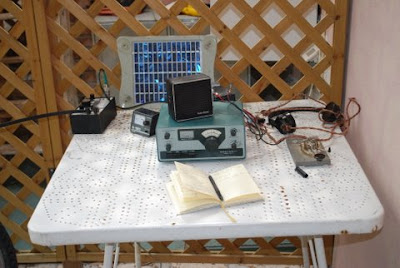
At the country place I now have a table on the front porch for the HW-8 and assorted gear. In the picture above you can see the Trastevere Flea Market Pi section antenna tuner (upper left), a Japanese SWR meter (also from the flea market) , HW8 and Radio Shack speaker, Volkswagen Solar Cell, 12 Volt gel cell, key and cans…
I had been using a piece of wire just thrown up in the trees, but I decided to do a bit better. I had some TV twin lead in the shack, and there was this useful-looking center connector… I had some AC line cord. Next thing you know I had a sorta-doublet antenna supported by a Roman Pine in Sabina (pictures below).
And it gets out! Worked IT0ULN in Sicily on 40 meters. Then I spoke to another QRP station, 2W0NNN in Wales on 20. Also UU4JDD/P on Tuzla Island. Finally E53AX in Estonia.
Ioan, 2WONNN, sent this report:

Hi Bill, thanks for the email, I look forward to seeing the pics on your blog too. Very interesting reading, same goes for your QRZ page too. I had to laugh at your DX with an astronaut on Mir!!!
Your HW-8 and doublet is certainly working well; I remember you were completely readable with a good signal about 90% of the time, it was only the QSB that made it difficult. To be honest I was surprised to have a QRP QSO with someone in Italy. I was using my FT-817 with a new Par End Fedz that I’d catapulted over a tree. The top was about 15m high but oriented as a sloper to the north west. I’ve had a fair number of QSOs with East coast US stations so I thought I’d go for an over-the-pole route to the West coast… there in Italy you’re pretty much spot on the opposite direction so I’m not sure it’s all that directional!
73 and hopefully speak to you again for more QRP/QRP!
Ioan,
2W0NNN

Ponticelli QRP Station Gets New Antenna

At the country place I now have a table on the front porch for the HW-8 and assorted gear. In the picture above you can see the Trastevere Flea Market Pi Section antenna tuner (upper left), a Japanese SWR meter (also from the flea market) , HW8 and Radio Shack speaker, Volkswagen Solar Cell, 12 Volt gel cell, key and cans…
I had been using a piece of wire just thrown up in the trees, but I thought I could do a bit better. I had some TV twin lead in the shack, and there was this useful-looking center connector… I had some AC line cord. Next thing you know I had a sorta-doublet antenna supported by a Roman Pine in Sabina (pictures below).
And it gets out! Worked IT0ULN in Sicily on 40 meters. Then I spoke to another QRP station, 2W0NNN in Wales, on 20. Also UU4JDD/P on Tuzla Island. Finally E53AX in Estonia.
Ioan, 2WONNN, sent this report:

Hi Bill, thanks for the email, I look forward to seeing the pics on your blog too. Very interesting reading, same goes for your QRZ page too. I had to laugh at your DX with an astronaut on Mir!!!
Your HW-8 and doublet is certainly working well; I remember you were completely readable with a good signal about 90% of the time, it was only the QSB that made it difficult. To be honest I was surprised to have a QRP QSO with someone in Italy. I was using my FT-817 with a new Par End Fedz that I’d catapulted over a tree. The top was about 15m high but oriented as a sloper to the north west. I’ve had a fair number of QSOs with East coast US stations so I thought I’d go for an over-the-pole route to the West coast… there in Italy you’re pretty much spot on the opposite direction so I’m not sure it’s all that directional!
73 and hopefully speak to you again for more QRP/QRP!
Ioan,
2W0NNN

Sonya’s Rig

Stewart, G3YSX, provided us with Part II of his article on the espionage radio work of the Soviet spy Sonya (who had the Knack).

Sonja Continued

A few days after my article on Sonja the Spy was published in the September 2004 edition of the CARC newsletter, I received a letter from club member Eddie Ramm
DK3UZ filling in a few additional details.

The Fuchs antenna that Sonja used was first described by Dr Josef Fuchs, OE1JF, in 1928 and is a half-wave end-fed design.

End-fed half-wave antennas are very efficient and do not need a particularly good ground, but they are very high impedance and need a suitable matching circuit. For a spy the use of a simple, but efficient, antenna of this type would have its attractions.

Eddie then pointed out that the design is of current interest to the QRP community by pointing me to the following URL: http://www.qrpproject.de/UK/fuchs_ant_.htm. This describes a 5 band portable QRP antenna designed by Frank, DL7AQT, based on the Fuchs design. The antenna is a 40m to 42m length of wire and the ATU is a parallel tuned circuit using a pair of toroids and a 200pf variable capacitor. It is worth reading the English version of the manual, which discusses the issue of self-resonance in these high impedance matching circuits. Matching circuits of this type only function correctly below the self-resonant frequency. Frank used of a two toroid arrangement to the move the self-resonance from 18MHz to 60MHz, thereby producing an ATU that operated correctly from 80m to 10m.

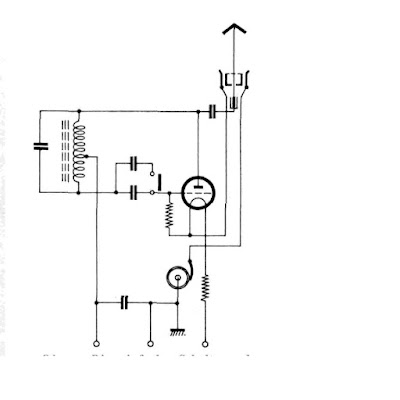
The second point that Eddie raised was the term “Three Point Oscillator” that Ruth used to describe her (Sonja’s) transmitter. The German term is “Dripunktsender” (three point sender), which Eddie tells me is the term was used to describe both the Hartely and the Colpitts based transmitters. Both oscillator designs are similar in the way that they use the reactive components in the tuned circuit as an impedance transformer to provide the coupling between the tuned circuit and the amplifier, so the use of the common term makes sense. He included an article dated January 1939, which shows a 3W automatic transmitter for maritime use, which is of the Hartley design and is described as a Dripunktsender. The article can be found at http://www.radiomuseum.org/funkschau/1939/funkschau_12jg_0339_1v2.pdf and the Hartley transmitter circuit is shown above.

We have no way of knowing which type Sonja actually used, although, as I suggested before I would suspect that it was the Hartley. This is likely because the Hartley was popular in the amateur radio world at the time and we know that she improved here spy transmitter by using amateur radio techniques. Secondly, because her transmitter had to fabricated, without raising suspicion, using material found in the field, a Hartley would seem to be the preferred design. A Hartley has no critical capacitors, just a coil which can be fabricated out of an “innocent” piece of wire or metal, and adjusted to give both the right inductance and the right feedback.

Stewart G3YSX

Flea Market Find — Pi Net Tuner — With a Mystery

Last Sunday’s “Flea at Trastevere” (I’m the only one who calls it that) was a huge success for me. Minutes after arriving, amidst all the junk, Billy and I found this homebrew Pi network antenna tuner. The guy who sold it to me told me he had built it himself. The workmanship is top-notch. The quality of the parts is superb. There’s a built in SWR meter and a 10 db attenuator.

When I started drawing out the schematic I noticed something weird: As the front panel indicates, it is a Pi -network, but for some reason the builder has the input variable cap floating. The physical connection to the chassis is via insulators. The other variable cap has the standard mechanical and electrical connection to chassis ground. That input cap needs to be grounded too, correct? Why would this builder — who obviously knows his way around a soldering iron — go to the trouble of allowing that input cap to float?