K.P.S. Kang’s Speech Processor and Antenna Tuner for the BITX (and other rigs)

Check out the blog of homebrew wizard K.P.S. Kang. OM has a nice speech processor based on the LM386. He also has a very simple antenna tuner and SWR bridge. FB OM.

http://smallwonderqrp.blogspot.com/2017/08/two-essential-add-ons-for-bitx-and.html

Audio Clips from N2CQR/HI8 Contacts with MIR Space Station (now in mp3)


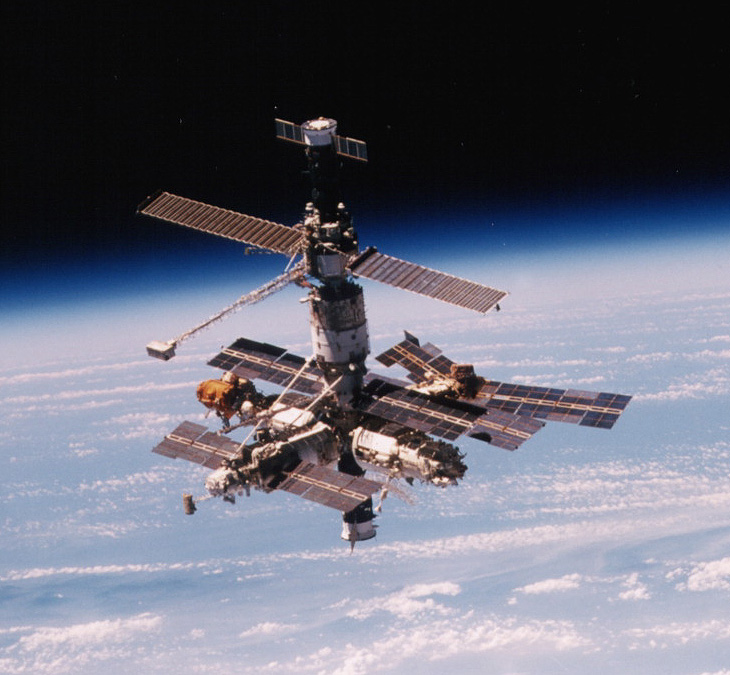
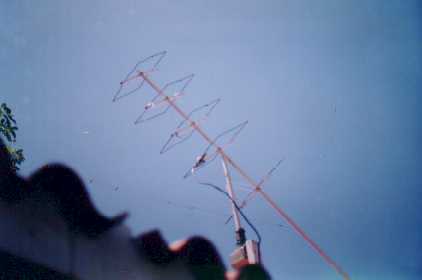
Back in 1995 I was in the Dominican Republic. I used an old 2 meter rig and a homebrew 5 element quad (see below) to talk to U.S. Astronaut Norm Thagard on the MIR space station. (You may have heard me bragging about this before.) I made a bunch of audio clips from the contacts. They’d been in the now defunct RealAudio format, but I have been able to convert them to mp3. You can listen here:

http://www.gadgeteer.us/CLIPS.HTM

Wonderful “QSO Today” Interview with Ian Keyser G3ROO

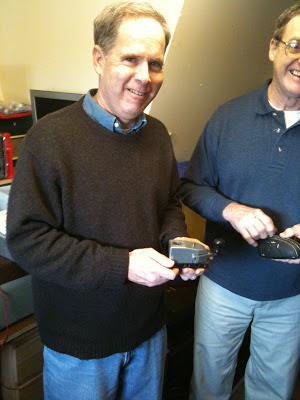
N2CQR and G3ROO
I knew it was going to be a good Sunday morning in the shack when I saw that Eric 4Z1UG had posted an interview with Ian Keyser G3ROO. This wonderful interview brought back memories of my visit to G3ROO’s amazing facility in Dover. (Thanks to Tony Fishpool who brought me out there.)

In this interview, you will hear Ian state — in a very nonchalant English way — that he built his first receiver at age 8. And I really loved the story of how Ian got his call sign. FB Ian.

Ian is a very prominent member of the G-QRP club. I was oddly relieved to learn that he is working on a LEGAL LIMIT LINEAR AMPLIFIER. I hope he has special dispensation from Rev. George Dobbs. I intend to cite this project if we ever have to defend Pete Juliano from charges of QROism.

Listen to the interview here:


That is a key designed for use aboard a hydrogen balloon. This is the kind of thing that Ian has in his shack.

This is Ian’s variometer — mentioned in the interview.

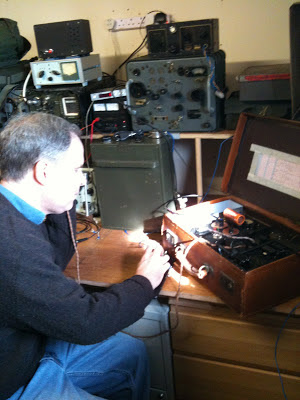
That’s me using one of Ian’s spy sets.
Ian’s antenna book:
Here are the SolderSmoke Daily News posts about Ian and the Dover Construction Club:


The Invention of the Reflectometer: Naval Research Lab Report #3538

Dennis Klipa N8ERF has been doing great work exploring the technical intricacies of the humble SWR meter (and believe me, there are intricacies). He’s also been looking at the history of this invention.

This summer, Dennis and I came across the April 1964 issue of Popular Electronics. On pages 74 and 75 of that issue we found a clue that seemed to point to the origins of the device: the article referred to Naval Research Lab Report #3538 by O. Norgorden, published on September 15, 1949. This may be the paper that led to the widespread use of SWR meters by radio amateurs.

Surprisingly, this important paper was not to be found on the internet. Exhibiting an admirable dedication to the preservation of an important element of the radio art, Dennis wrote to Naval Research Lab and purchased from them a copy of the report. Unfortunately, the version Dennis got had been copied and recopied so many times that it was hard to read. So he went the extra mile and re-typed it.

With his permission, I am giving this article its internet debut by posting it here:

http://soldersmoke.com/SWR N8ERF.pdf

Three cheers for Dennis Klipa for unearthing this important piece of radio history.

The NAA VLF Station (NOT QRP!) and Brad’s Receiver

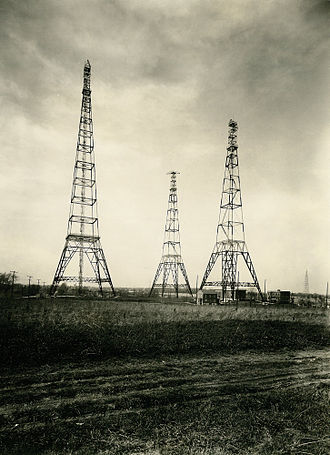
NAA Towers — Arlington Va. 1913
Brad WA8WDQ wrote to us about a VLF (24 kHz) his receiver project (see below). This led to some Googling about the VLF station NAA. Wow, there is some important radio history associated with that call sign. The station’s original location was just a few miles from I where I live now. From Wikipedia (https://en.wikipedia.org/wiki/VLF_Transmitter_Cutler):

The station began operations in 1913 as a radio telegraphy station call sign NAA in Arlington, Virginia, at a facility next to Fort Myer. Although its broadcasts occasionally included band concerts and speeches, it was most famous for its nightly time signals. The three towers known then as “The Three Sisters” stood 600 feet, 450 feet and 200 feet (183, 137, and 61 m) above the ground. The site was referred to as “Radio”, Virginia. The towers were the second largest man-made structure in the world behind only the Eiffel Tower. The word “Radio” was first used instead of “Wireless,” in the name of this Naval Communications facility. The First Trans-Atlantic voice communication was made between this station and the Eiffel Tower in 1915. The Nation set its clocks by the signal and listened for its broadcast weather reports. The Towers were dismantled in 1941 as a menace to aircraft approaching the new Washington National Airport. The towers stand today at United States Naval Academy in Maryland, on the edge of the Chesapeake Bay.

Be sure to read about the de-icing system for the antenna. It uses more power than the actual transmitter!

From Brad:

Bill, Pete,
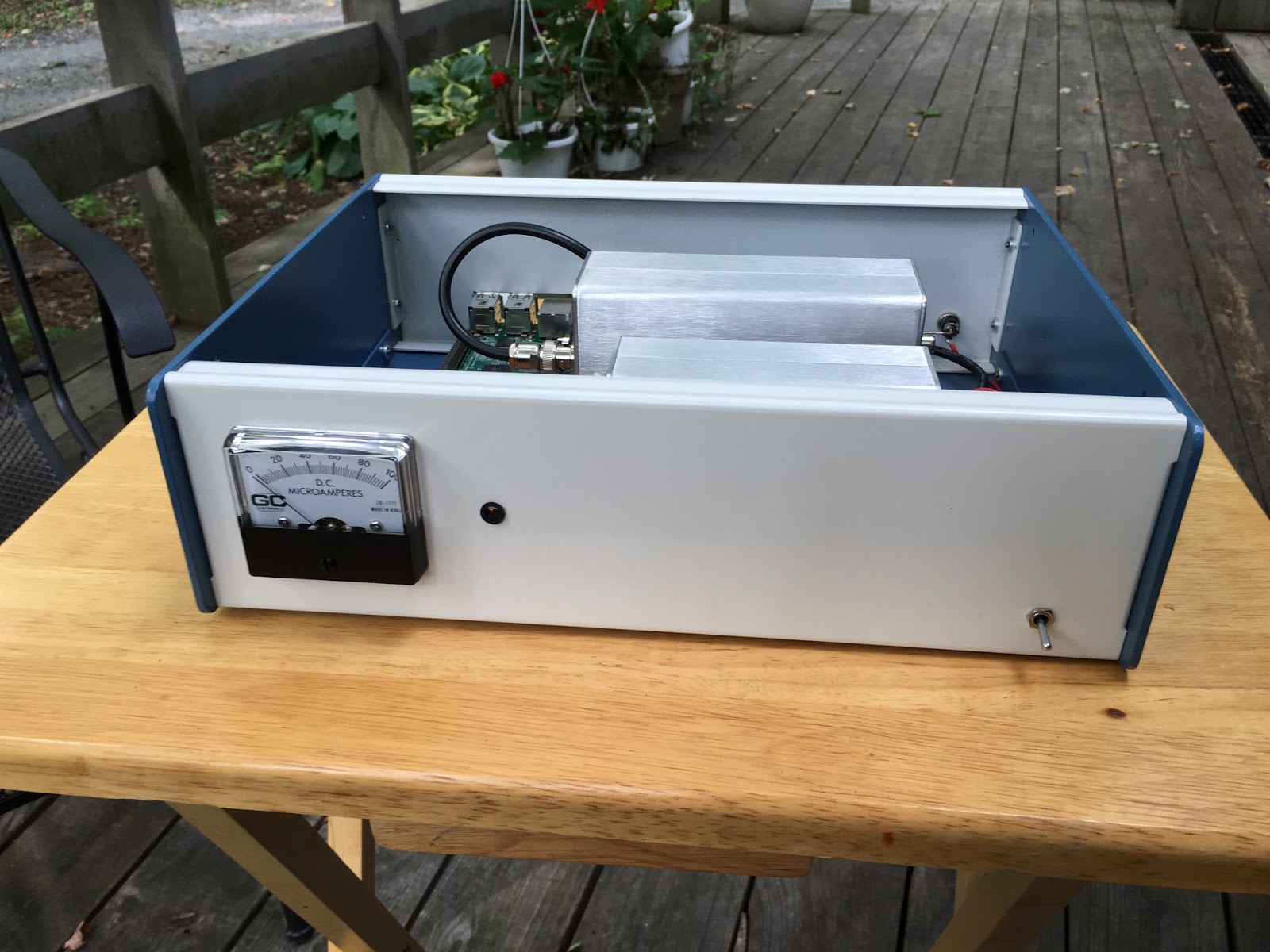
Here’s the current status of the 24 KHz NAA SID receiver. All the major sub-assemblies are mounted in the chassis and power is hooked up. For convenience, I’ve been using the PowerWerx USBbuddy switching DC-DC converter to supply +5V power to the Raspberry Pi from the +12V input. I’ve found them extremely RF quiet, clean and stable; capable of supplying 3A though this project will only need about 1.5A @ +5V. At this point, I’m just waiting for Adafruit to send the A/D chip I’ll wire up to the Pi on that empty protoboard just under the meter. Speaking of the meter, it’s not really needed as the Pi records and broadcasts over Wi-Fi the received signal level. However, I like my projects to have some sort of physical human interface so I added the signal level meter and an LED for SID event alarms :).
As previously mentioned, my bench test of the receiver using my signal generator was successful. Once everything is wired, I’ll do an actual on-air signal test receiving NAA.
Brad WA8WDQ

Some Really BIG Coils

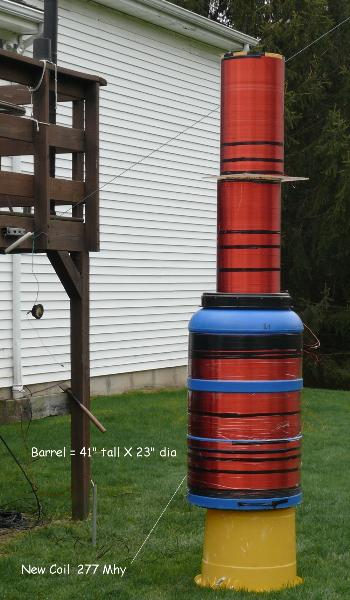
I met W1VLF on 40 meters last week. “VLF” was a hint. And indeed, Paul has been experimenting in the 10 kHz range. His antenna loading coil is seen above.
More info here: http://rescueelectronics.com/9-Kilohertz.html
Very cool that Mike was working with Jay Rusgrove, W1VD, on this project. Jay designed the 6 watt VXO rig that was my first homebrew transmitter.

And additional VLF info here:
http://n3cxv.com/WH2XND_station_1.pdf

Antennas and National Monuments

We started SolderSmoke 185 with a brief description of my recent ascent to the top of the Washington Monument. A few days later I was visiting George K9GDT’s wonderful web site
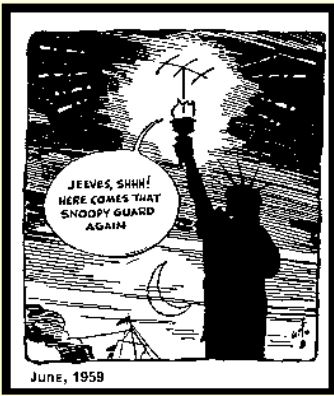
http://www.qsl.net/k9gdt/radio/radio.htm and in the humor section came across the above Gil cartoon from 1959. That is the general idea.

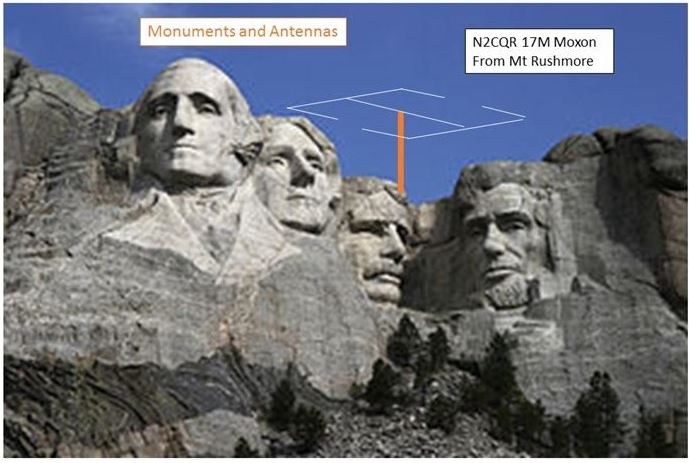
Pete then sent me this:

Pete originally had a three element Yagi coming out of Teddy Roosevelt’s head, but that just wasn’t right. I asked that it be changed to a 17 meter Moxon. Thanks Pete.

I would like to note for the record that I have no intention of using the Washington Monument, the Statue of Liberty, Mount Rushmore or any other national monuments as supports for any Yagis, Moxons, Cubical Quads, Ray Guns, Lazy H’s, Inverted L’s or any other type of electromagnetic wave launcher.

SolderSmoke Podcast 185 — SPECIAL FEBRUARY ANTENNA SHOW

SolderSmoke Podcast #185 is available

22 Feb 2016

http://soldersmoke.com/soldersmoke185.mp3

Travelogue: 550 feet above Washington DC

Bench reports
Pete: Simpleceiver update. Adventures in Raspberry Pi SDR.
Bill: A daring but failed attempt at divide by 2 I&Q.
Audio Mods on the Hammarlund HQ-100.
Dual Digital Readout for the AM station.

SPECIAL FEBRUARY ANTENNA DISCUSSION
Why we build antennas in February.
Why hams should concentrate on antennas.
The importance of noodling.
Pete’s beam project.
Pete’s Lazy H.
The pernicious influence of automatic antenna tuners.
Bill’s Ray Gun Antenna.
Bill’s Moxon and his 160 inverted L.

MAILBAG
Tom Gallagher NY2RF (new ARRL Exec VP).
Mike Rainey AA1TJ on the air with a unijunction transistor.
Dale W9DKB sends me 160 meter book.
Alan Wolke W2AEW builds a Mighty Mite.
Daniel HK4DEI builds a DSB rig in Medellin.
Chris KD4PBJ modulates an AD9850.
Charlie ZL2CTM Builds a Teensy Superhet.
Jim W8NSA — a Tek 465 goes toes up.
Thomas KK6AHT has roof, needs antenna!
Grayson TA2ZGE homebrewing crystal filters in Ankara.
Ian G3ROO and I had QRP QSO in 2001!
Steven G7VFy sent me a box of VALVES.
Frank KM4AXA repairs a rig and thus adds SOUL to the machine.

Blizzard Prep Priorities: Protecting the 160 meter L network!

I’d been meaning to build a proper cover for my improvised 160 meter L network. The approach of Winter Storm Jonas pushed me into action yesterday afternoon.

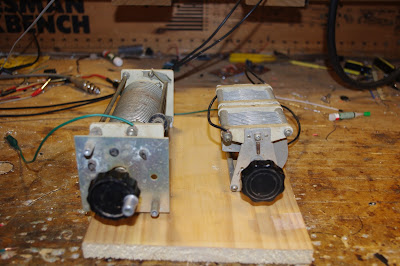
First I mounted the variable cap (from an old Johnson rig) and the roller inductor on a suitably sized piece of wood:


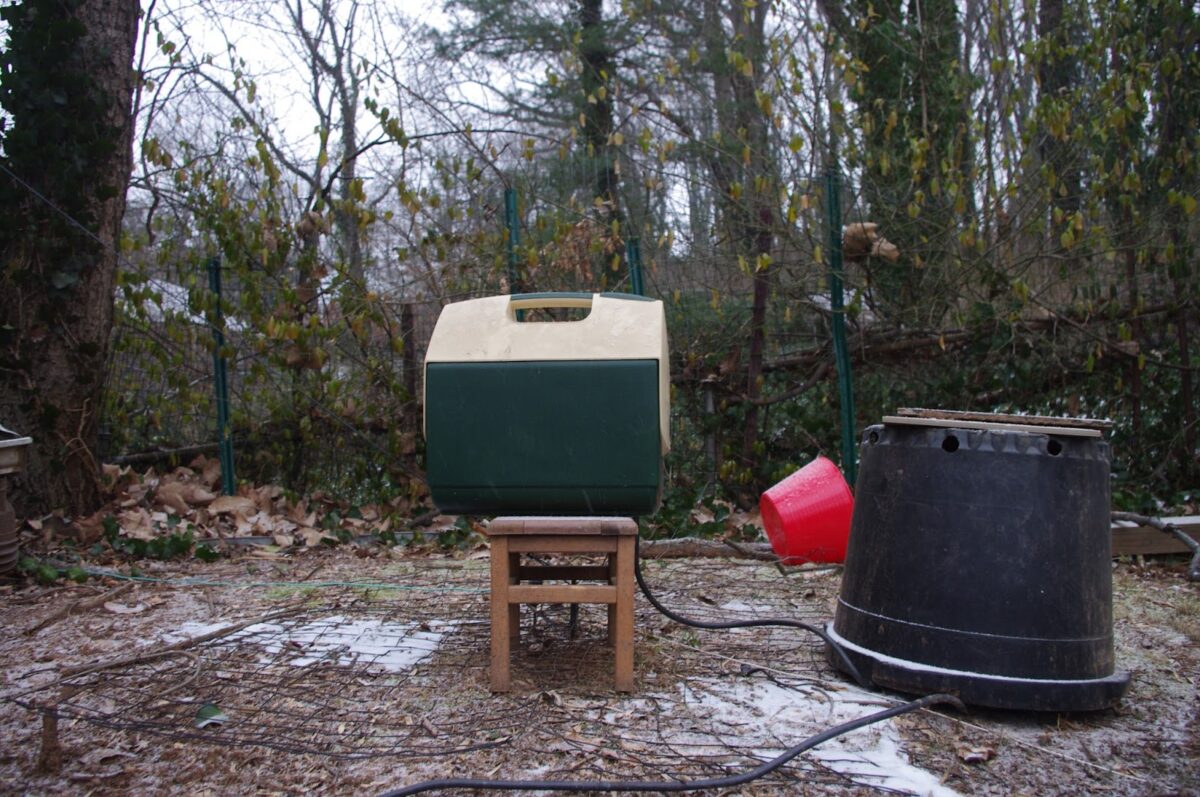
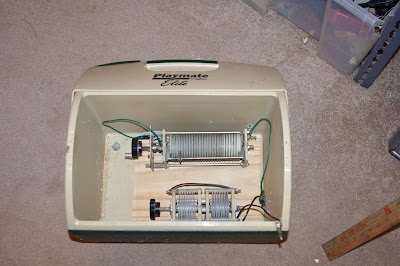
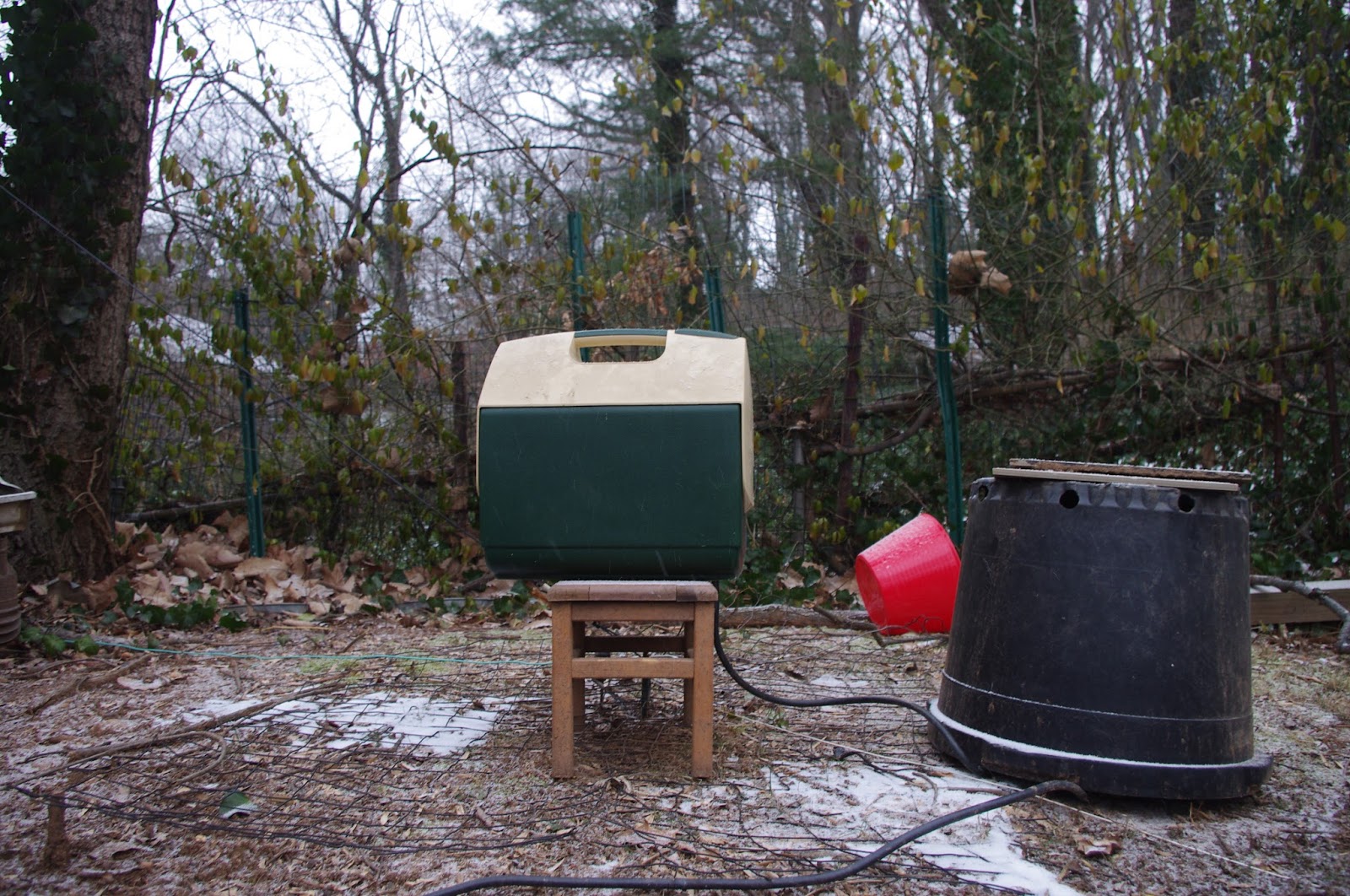
Then I put the tuner inside an old cooler. I drilled holes in the bottom for the coax and the antenna wire and the ground.

Here it is at the feed point. Pretty cool, don’t you think?


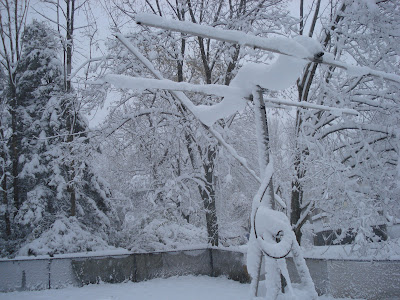
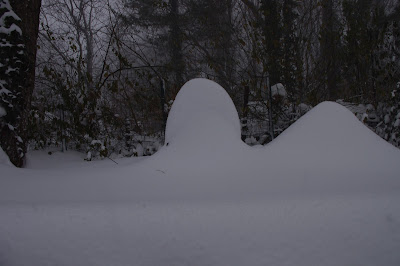
And here it is 24 hours later:

The blizzard has been quite impressive. Early this morning it featured lightning and thunder!

Happy New Year! Straight Key Night on 160 Meters

A while back, when I first mentioned getting on 160 meters by year’s end, Pete suggested I shoot for Straight Key Night. As many of you know, suggestions from Pete somehow seem to have a way of becoming ham radio MORAL IMPERATIVES. He seems to be a prophet of sorts, a prophet of THE RADIO GODS. So following the guidance of the oracle of Newbury Park, I found myself in front of my DX-100/HQ-100 on New Year’s Eve, on 160 meter CW for the first time in my 42 years as a radio amateur.
It was great. A couple hours prior to the official 0000Z start of Straight Key Night I had my first 160CW QSO. It was with John WA2MUA up in Summit, NY. John’s QRZ page includes this: Years ago–as a teenager– in an attempt to get enough wire for 160 I wrapped a quarter wave of wire around a pvc pipe, strapped it to a wooden gutter—-burned a large notch in the gutter and could have burned my parents’ house down!” That, my friends, is 160 meter KNACK!

Then, just minutes after SKN kick-off, I worked John W3LR in Eastern Pennsylvania. It was also John’s first SKN contact.

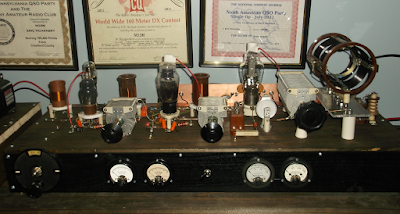
Next up was Eric NO3M. Wow, this one was amazing. Eric was running the homebrew rig pictured above. On his blog Eric describes the rig: “The transmitter is running a 89 Clapp oscillator, 802 buffer, 811 final… Output power is approximately 75W. “
Eric’s antenna is even more amazing: it is a 160 meter four square featuring FOUR aluminum tubing vertical elements with capacity hats and –GET THIS — a radial field consisting of 22,000 feet of bare copper wire. TWENTY TWO THOUSAND FEET OF BARE COPPER WIRE. Wow, you just don’t run into stations like that on 20 meter sideband. Eric’s blog: http://no3m.net/ But Eric — a Vibroplex Champion? On SKN?
I then worked KC2LSD and K1EEE. FB!

My last contact of the evening (and the year) was K1WHS, Dave in Maine. On his QRZ.com page, Dave reports:
On 160 meters, I have a small setup right at my house. I use a K3 with a homebrew 3-1000 amplifier that runs at 1300 watts. The antenna is an 80 ft Rohn 25 in my backyard with some top loading and shunt feeding. I laid out a bunch of radials in an effort to get the efficiency up. At last count I had about 107 1/4 wave radials strung out. 160 is the only band where my feedline is not big fat hardline. I use a run of RG-213. For receive, I have several beverages running in the woods. I use this setup often in the winter as many times, the hilltop shack is not accessible due to heavy snow. I have nothing up for any of the bands between 160 and 10 meters”.
Thanks to all of my SKN contacts! And Happy New Year to all SolderSmoke readers and listeners!

“Receiver Here is My SWR meter OM…”

Santa managed to include in his delivery some of the materials that I needed to build my 160 meter inverted L antenna. You see, Steve Silverman, Pete Juliano and I have collectively more than 150 years in ham radio, but none of us have ever operated on Top Band. The three of us have taken A SOLEMN OATH to correct this horrendous deficiency. I am in the vanguard, partly due to a weather pattern that is perfect for antenna building.

Armed with a new elastic band for my Wrist-Rocket sling shot and some perfectly shaped lead sinkers, yesterday — with the obvious cooperation of The Radio Gods — I managed to get two ropes over some 70 foot trees. Soon — with minimal gnashing of teeth — I had 185 feet of wire in the air.

This morning I was messing around with L networks at the base of the antenna. I took a coffee break, leaving the 185 foot wire and the ground system connected to the coax. I had the transmitter off, so I was surprised to see the SWR meter jumping around a bit, up significantly from zero. What could that be? It wasn’t coming from my station, so it had to be coming from some other transmitter. And the slight bit of jumping that I saw on the SWR meter had the familiar pattern of the human voice. Some radio sleuthing ensued.

I flipped the station antenna switch to the “bench” position, and connected my scope to the coax. Wow! I immediately saw a big strong AM signal with modulation, at about 5 or 6 volts peak to peak. The Rigol ‘scope gave the frequency: 1220 kHz.

I tuned the HQ-100 to that frequency. As I listened to Gospel broadcast, I could follow the voice peaks on the ‘scope.

Some Googling ID’s the station: WFAX 1220 AM. 5 kilowatts in the daytime. 1.5 miles from my house. The vertical portion of the inverted L is obviously picking up a LOT of energy from the WFAX tower. And the horizontal portion of my antenna is broadside to the WFAX tower.

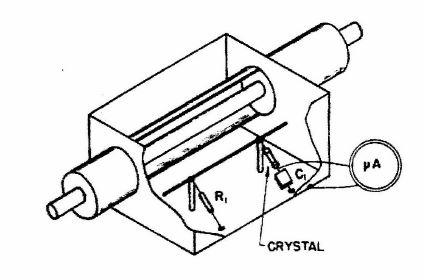
Of course this all made me think about throwing together a crystal radio, but then I realized I’d already listened to WFAX with simple diode — the one in my SWR meter. That little SWR meter was acting like a crystal radio with a visual output!

SolderSmoke Podcast #181 Of Dongles and DX-100s — SDR vs. HDR, Music & Art, 2B, HB2HB, Noise, The Martian, VK3YE’s New Book

Two RTL SDR Dongles in front of a DX-100 Transmitter

SolderSmoke Podcast #181 is available:

17 October 2015

— Our audience IGNORES Pete’s guitar intro!
— Pete on QSO Today Podcast.
— Part 97, The Radio Art and International Goodwill.
BENCH REPORTS:
— Pete connects his new beam to the KX3.
— Pete puts the Bell-thorn on 20.
— Simple-ceiver update.
— Pete’s new drum machine: http://makezine.com/2015/10/15/learn-electronics-worlds-oldest-drum-machine/
— Bill fights noise in the DIGI-TIA.
— Bill fights power-line noise (and wins!).
— Drake 2B, skirts, reduction drives, and tuning rates.
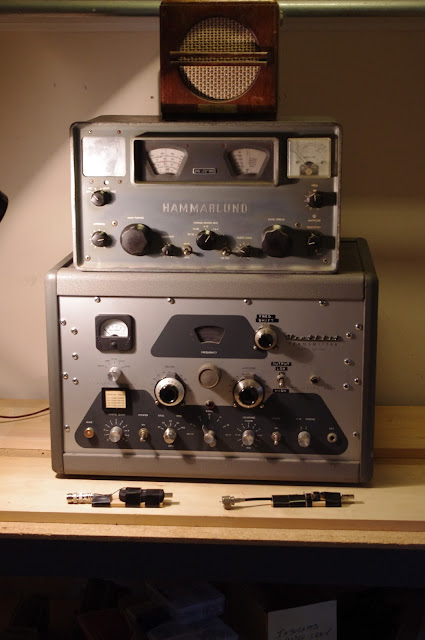
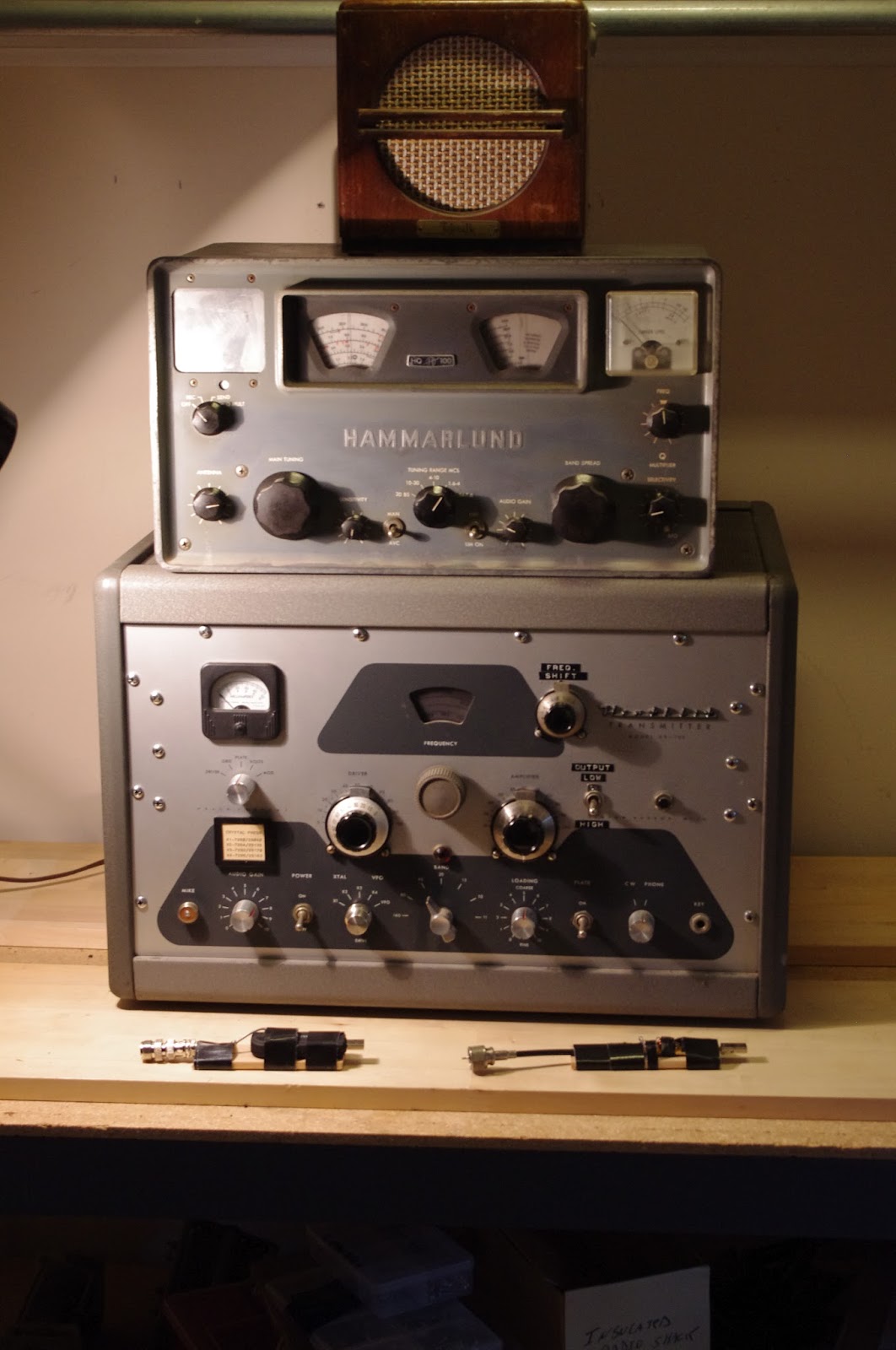
— Warming up (with!) the DX-100.

— N2CQR — N6QW First Ever HB2HB QSO.

— On 40 AM with an HT-37
— Listening to Chinese CubeSats.
— SDR Dongle as a bandwidth checker.

— SDR and the Future of Homebrew Radio.

— Bryan’s LBS Receiver.
— Dean’s First Ever QSO with his HB rig.

— 32 Mighty Mites Completed

— The Martian — Did Mark Watney REALLY have the Knack?

— MAILBAG:
Peter Parker’s New Book
Sparks from Ron Sparks
Armand’s 1Watter
Rogier’s pyro machine
BIG boxes from Tim KI6BGE
Mikele’s ZIA and N6QW rig collection
SPRAT 141 and SPRAT 164

SolderSmoke Podcast #181 Of Dongles and DX-100s — SDR vs. HDR, Music & Art, 2B, HB2HB, Noise, The Martian, VK3YE’s New Book

Two RTL SDR Dongles in front of a DX-100 Transmitter

SolderSmoke Podcast #181 is available:

17 October 2015

— Our audience IGNORES Pete’s guitar intro!
— Pete on QSO Today Podcast.
— Part 97, The Radio Art and International Goodwill.
BENCH REPORTS:
— Pete connects his new beam to the KX3.
— Pete puts the Bell-thorn on 20.
— Simple-ceiver update.
— Pete’s new drum machine: http://makezine.com/2015/10/15/learn-electronics-worlds-oldest-drum-machine/
— Bill fights noise in the DIGI-TIA.
— Bill fights power-line noise (and wins!).
— Drake 2B, skirts, reduction drives, and tuning rates.
— Warming up (with!) the DX-100.

— N2CQR — N6QW First Ever HB2HB QSO.

— On 40 AM with an HT-37
— Listening to Chinese CubeSats.
— SDR Dongle as a bandwidth checker.

— SDR and the Future of Homebrew Radio.

— Bryan’s LBS Receiver.
— Dean’s First Ever QSO with his HB rig.

— 32 Mighty Mites Completed

— The Martian — Did Mark Watney REALLY have the Knack?

— MAILBAG:
Peter Parker’s New Book
Sparks from Ron Sparks
Armand’s 1Watter
Rogier’s pyro machine
BIG boxes from Tim KI6BGE
Mikele’s ZIA and N6QW rig collection
SPRAT 141 and SPRAT 164

SatNOGS: 3D Printed Az-El Rotators! Ray-Gun PVC Helical Antennas! Arduinos! Dongle Receivers!

Wow, this project is very appealing. Finally, a 3D printer project that seems truly useful. They are using one of the Dongle receivers we’ve been playing with, and, of course, Arduinos. You could really geek-out with this stuff. Check out the hardware side of this effort here:
https://satnogs.org/documentation/hardware/

SolderSmoke Podcast #180 Pete’s Beam, Simple-ceiver, 2-B, Noodling, Homebrew and SDR?, “The Martian”, Mailbag

SolderSmoke Podcast #180 is available:

http://soldersmoke.com/soldersmoke180.mp3

19 September 2015

PROJECT REPORT:
Pete’s Antenna Project: The Joy of Rotation!
Simple-ceiver
Bill fixes Digi-Tia (after breaking it)
Shack Configured for Winter (DX-100)
Working (a little) on the Drake 2-B

SolderSmoke words we forgot to mention:
Noodling
The Radio Gods
The Radio Art
The Grand Poobah
Magic Smoke
Lud(d)ite Curmudgeonism

SDR and the Homebrewer

“QSO Today” Interviews
Lady Ada interviews Paul Horowitz of “Art of Electronics”

SHAMELESS COMMERCE: Book still free!
Start your Amazon purchases at our blog page.

Book Review: “The Martian”

Great QSOs with W5NDS and AE5RM

MAILBAG

Inspiring Stuff on “QSO Today”

Eric 4Z1UG is doing some really great interviews on his “QSO Today” podcast. I found the last three to be especially informative and inspirational.

Chuck Adams K7QO dispensed a lot of useful information about Muppet boards and construction techniques, but more importantly he put out a lot of wisdom about the hobby, especially on the importance of teaching and sharing knowledge.

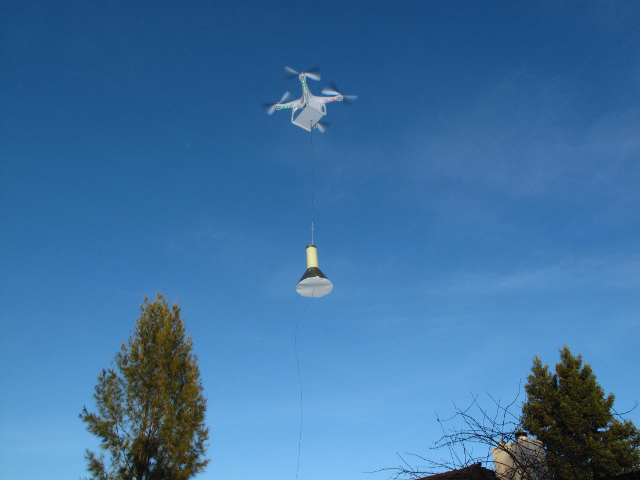
The interview with Glenn Elmore N6GN presented many interesting technical ideas, including using WSPR on VHF and UHF, and using aircraft reflections as a Sporadic-E like propagation mode. He also mentioned “wing vortex” propagation. Glenn talked about how to use a drone and a special light-weight transmission line to get your VHF/UHF (or cell phone) antenna above the trees. (See above).

I found the conversation with Gerald Youngblood K5SDR both fascinating and a bit worrisome. Gerald is obviously a great guy, and he does a wonderful job of describing the technology behind SDR radios, linking it to the phasing techniques that hams have been using since the dawn of single sideband. He makes a strong case for the new SDR rigs, noting the absence of receiver-produced noise, the advantage of band-wide visual waterfall displays (even while noting that they tend to “make every ham an Official Observer”), and “brick wall filters that don’t ring.” But I got and uneasy feeling when he referred to non-SDR rigs as “legacy rigs.” I found myself wondering how long it will be before all our rigs are required to be noise-less and all our filters skirt-less. Will there come a time when our beloved legacy rigs will be deemed unacceptable? (You can already hear this sentiment on the bands.) And how much room is there in this SDR world for the kind of homebrewing we do? ( I know, I know. I admit to feeling the presence of Ned Lud as I type these words.)

Great job Eric! And thanks to all the interviewees. We look forward to the interview with Pete N6QW.

Eric’s QSO Today podcast can be found here: http://www.qsotoday.com/

Our book: “SolderSmoke — Global Adventures in Wireless Electronics” http://soldersmoke.com/book.htm Our coffee mugs, T-Shirts, bumper stickers: http://www.cafepress.com/SolderSmoke Our Book Store: http://astore.amazon.com/contracross-20