Even when describing something as simple and basic as snow, Mr. Carlson is electronically awesome. This video made me realize that in the event of an EMP, his will probably be the only lab to survive.
The SolderSmoke Daily News took up the topic of snow static back in 2011. Be sure to read the comments, especially the one from KC7IT about the QUARTER INCH ARCS that woke him up in the dorm at MIT. Check it out:
https://soldersmoke.blogspot.com/2011/10/snow-static.html#comment-form
I’ve got to get one of Mr. Carlson’s 2020 calendars!
Category: antennas
Mr. Carlson’s Lab Attacked by Dangerous Canadian Snow Static! (Video)
Even when describing something as simple and basic as snow, Mr. Carlson is electronically awesome. This video made me realize that in the event of an EMP, his will probably be the only lab to survive.
The SolderSmoke Daily News took up the topic of snow static back in 2011. Be sure to read the comments, especially the one from KC7IT about the QUARTER INCH ARCS that woke him up in the dorm at MIT. Check it out:
https://soldersmoke.blogspot.com/2011/10/snow-static.html#comment-form
I’ve got to get one of Mr. Carlson’s 2020 calendars!
The End Fed Half Wave Antenna and EFHW Tuners
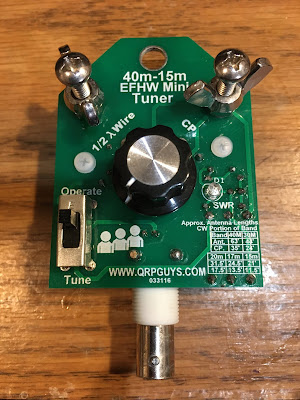
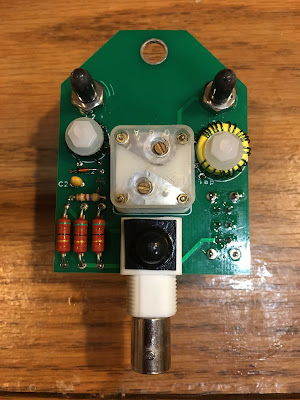
In the SPRAT 179 (Summer 2019) article describing their Peregrino (Pilgrim) transceiver, Joan EA3FXF and Eduardo EA3GHS recommend the use of an End Fed Half Wave (EFHW) antenna. Their circuit incorporates an EFHW tuner and an SWR indicator. As I planned my trip to the Dominican Republic with a uBITX, I had this antenna system idea in mind. I was attracted by the possibility of avoiding having to carry coax with me. And it seemed that an EFHW antenna would be easier to get up in the air than a coax-fed dipole.
When searching for schematics for EFHW tuners I came across the QRPguys tuner kits.
https://qrpguys.com/end-fed-half-wave-sota-antenna-tuner
This looked like just what I needed, so I ordered one. But I placed my order kind of late, and I started to worry that I might not get the tuner kit in time. So I decided to homebrew my own (just in case!)
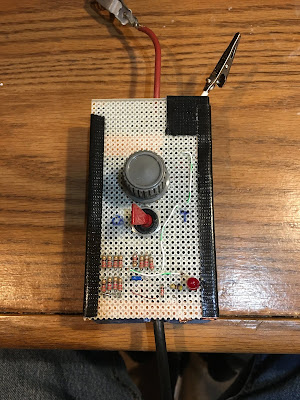
As it turned out, QRPguys got the kit to me in plenty of time. It went together very quickly and is a really useful piece of gear. My homebrew version works fine, but I prefer the QRPguys device.
You can check out the manual here:
https://qrpguys.com/wp-content/uploads/2019/09/efhw_40m_tuner_assy_090119.pdf
The circuits are interesting. The EFHW antennas present an impedance not of 50-70 ohms, but of 3000-5000 ohms. The Peregrino and the the QRPguys circuits use a matching transformer to change the high impedance to 50 ohms. In both circuits polivaricon capacitors are used to tune for resonance. The QRPguys circuit uses an N7VE LED absorption bridge — I found it very satisfying to put the circuit into “tune” mode and then just adjust the capacitor until the LED went out. That means the antenna system is presenting 50 ohms to the transmitter.
SOTA beams has a good explanation of the EFHW antenna here: http://sotabeams.co.uk/efhw/
I did use a counterpoise.
N2CQR Portable with uBITX in the Dominican Republic (video)
More to follow…
4 Elements on 40 Meters at VU2OT (video)
SolderSmoke Podcast #207 — 15 mtrs, 60 mtrs, Giants of Radio, Cubesats, Pete’s rigs, SDR MAILBAG
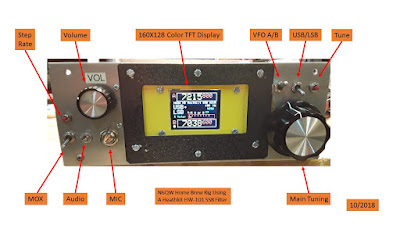
SolderSmoke Podcast #207 is available:
http://soldersmoke.com/soldersmoke207.mp3
— Giants of Radio
— Pete on 15 Meters
— Bill on 60 Meters with the uBITX
— Pete’s Sudden and Heath Filter Transceivers
— Cubesats to orbit! To the moon! And to Mars!
— Bill rebuilds his 2 meter “Ray-Gun” Quad (for Farhan’s Cubesat)
— Homebrewing Variable caps and stockpiling NP0
— My “by ear” Minimal Discernible Signal Technique
— Thoughts on Direct Sampling SDR and the Radio Art
MAILBAG
— A request for feedback from GQRP
— G4WIF reports G3ROO on UK TV with spysets
— VU3XVR builds FB rig from EMRFD
— M0KOV Charter member of the 3 Scratch-built BITX club
–KD4PBJ’s PTO Turtle DC Receiver
— AB1OP builds Pete’s LBS receiver and gives us a new acronym: SITB
— KD4EBM — Thanks for the scanner Bob!
— A possible sponsor from California…
— Pete’s dream neighborhood…
N2CQR Wins a Contest AGAIN!
Pete N6QW suggested I do a blog post on this.
This past weekend I dusted off my old scratch-built, all-analog, no-chips BITX20. (THREE CHEERS FOR FARHAN AND HIS BITX DESIGN!) I hooked it up to my trusty CCI .1KW (note decimal point) amplifier and my new 135 foot store-bought doublet. This all happened just as the Worked All Europe DX contest was kicking off, with lots of activity on 20. TRGHS. I was in. My contest operating style was in the category of “relaxed-casual-noncompetitive.” I took a lot of breaks. In fact there were more breaks than non-breaks. You have to pace yourself in the contest world.
My results:
8 SEPT: DF0HQ, SN7D, GM6X, DP6A, S51A, DL0HN, DB0HX, OZ5E, DJ5MW, HG7T, IK4UPB, VY2ZM, G6XX, EF1A, LZ5R, 9A5W, YP0C, F6HQP, DL7ON, HB9DQL, ON6NL, DA0WRTC, 9 SEPT: EI7M, P3X, RU1A, DP7D, SP2KPD, DL0WW.
P3X might not count because, you see, Cyprus is considered to be in ASIA. Really?
Anyway, I ‘m assuming that I am the winner in the homebrew, discrete component , all-analog transceiver category. Woo Hoo!
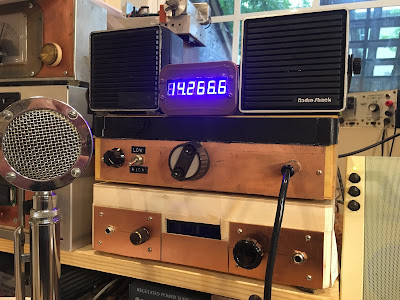
The contest rig is pictured above. Before you point to the glowing numerals and cry foul, realize that the little Altoids box between the two speakers holds a San Jian frequency counter that was deliberately kept OUTSIDE the BITX box. So it is more of an outboard accessory. I can run the BITX 20 without the digital assist — I have an old fashioned non-digital dial pointer to indicate frequency. The “Low – High” switch you see switches the VFO from the low portion of the 20 meter phone band to the higher part of the band. The box below the BITX 20 holds the uBITX.
Seriously though, I was quite pleased with the performance of the doublet.

The CHIME Radio Telescope and Fast Radio Bursts
The new Canadian radio telescope is very interesting. It has a great name for a radio telescope: CHIME
And it it always nice to come across a reference to the Parkes Radio Telescope.
More info here:
https://www.theregister.co.uk/2018/08/03/fast_radio_burst/
And here:
https://en.wikipedia.org/wiki/Fast_radio_burst
Good luck on getting a QSL from the FRB station.
Homebrew Tuner for Doublet Antenna
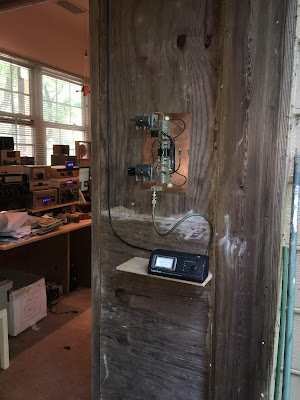
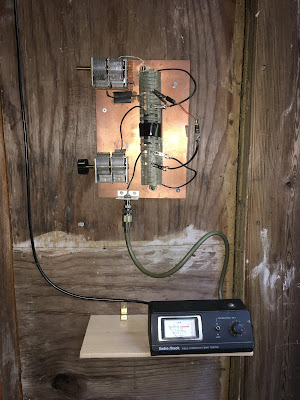
For now, I’ve put the Moxon project on the back burner. I will take it up again once Old Sol starts showing some spots. In its place a 135 foot doublet is going up. I got at a hamfest a while back. (It is the only HF antenna that I ever bought!) It is the SPI-RO Manufacturing Company’s Model A-10. It came with 100 feet of 450 ohm window line. It will be up on the roof soon.
Today I put the tuner on the wall in the car port right outside the shack. I even built a little shelf for the SWR meter (used one of those Whole Food grilling planks!). I put a 25 ohm resistor where the feed line will connect. I was able to tune it up on the two bands I tried: 40 and 17.
There is a smaller coil inside the big one — the smaller coil resonates with the lower variable cap.
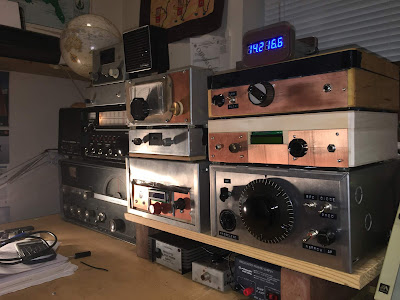
You can see all the homebrew rigs in the background — waiting patiently for the antenna.
I actually built the tuner back in 2012, but never used it. Description here:
I will try to provide a schematic and more details soon.
The Moxon Files from L.B. Cebik W4RNL
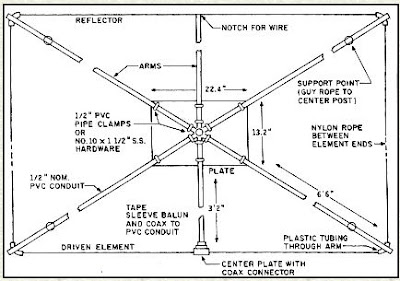
I had thought that the Cebik files were lost to us in some sort of legal copyright struggle. But in my effort to better understand the Moxon antenna, I found a real treasure trove of Cebik’s writing. These should all be saved somewhere safe.
I especially liked his description of the evolution of the Moxon antenna. Les Moxon was apparently very unAmerican in his emphasis on reception (not transmit gain) as the main benefit of the beam antenna. He also sought to avoid superfluous luxuries like rotators, but Cebik hints that rotators have become an important part of our American way of life. Indeed.
Before I found these files I had been on the verge of giving up on efforts to replace my storm-damaged Moxon. After all, solar minimum is still ahead of us. But after reading OM Cebik’s articles I have decided to build a 20 meter version and place it above the center point of a 130 foot doublet. I will have the best of both worlds.
http://www.antentop.org/w4rnl.001/mu0.html
http://www.antentop.org/w4rnl.001/mu2a.html
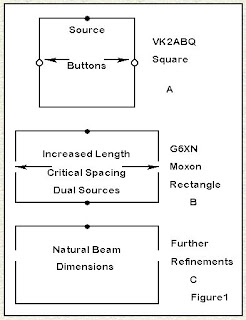
L. A. Moxon, in his HF Antennas for All Locations, provides the essential clue: “the main benefit [of a beam] accrues from the reduction of interference during reception, though the 4 to 6 dB gain provided by typical amateur beams is an important bonus and probably the reason which carries the most weight with the majority of amateurs.”(2)Here is a theory of beam operation quite unAmerican is style: instead of gain, Moxon strives for front-to-back ratio as the most crucial aid to ham operation. His statement is an affirmation of the “good ears” theory of operation. Even more, it forms the basis for his rectangular improvement upon the VK2ABQ square.
…
Moxon prefers matched elements, tuning each of them to optimum performance remotely. That way, he can reverse the beam and do away with expensive and maintenance-intensive rotators. However, rotators are a way of life in the U.S. (a TV rotator will likely handle a 3-band Moxon beam), and there are many uses for portable beams that are hand-rotated or fixed in the field. Thus, I decided to continue the exercise in unequal element lengths.
http://www.antentop.org/w4rnl.001/mox20.html
Finally, a treasure trove of Cebik’s writing:
http://www.antentop.org/w4rnl.001/radio.html
On Field Day: The Marine Corps Antenna Manual

Don’t let it be said that SolderSmoke made no contribution to Field Day! Here is the USMC Antenna Manual. Looks like there is lot of good info in there.
https://www.marines.mil/Portals/59/Publications/MCRP%208-10B.11.pdf?ver=2017-03-15-092827-423
SolderSmoke #205 Solstice, Mars, Antennas, Displays, Phasing Fix, VFOs, Lexicon, MAILBAG
June 23, 2018
SolderSmoke Podcast #205 is available:
http://soldersmoke.com/soldersmoke205.mp3
— Summer solstice. Mars Observations. Graduations. Internships. Fathers Day.
— Antenna Angst: Pete’s tribander and Bill’s Moxon. Insulation and resonance?
— Pete’s work on color displays.
— Bill goes back to fix up older projects:
— Fixing the Frankenstein Phasing RX. Found an open choke!
— Tightening up the HRO Dial.
— Achieving Juliano Criteria stability on a BITX20 VFO.
— Lexicon additions: “Scratch Built” “Hardrock Radio”
https://english.stackexchange.com/questions/39551/where-does-the-saying-made-from-scratch-originate
— PastaPete: http://www.pastapete.com/
MAILBAG:
Bob Crane W8SX Corrspondent at FDIM
Ralph AB1OP Building LBS
Bruce KC1FSZ Digital Pot
Jason W5IPA uBITX in Juliano Blue
Rogier KJ6ETL ON THE AIR WITH A uBITX
Special thanks to Tim Walford for 25 years of Hot Iron.
Understanding Antenna Directivity — Help from Canada
I am in the process of repairing my beloved 17 meter fishing-pole Moxon. It was taken out of service by the last Nor’easter of the winter. This repair has caused me to review the theory behind antenna directivity. I find there is a lot of “hand waving” in the explanations of how directivity happens: “You put a reflector element next to the antenna. And it REFLECTS!” You are left wondering how that reflection happens.
The Royal Canadian Air Force made a video that does a pretty good job of explaining how the reflector reflects. See above. Thanks Canada!
While we are talking about antennas, I wanted to alert readers to a really nice antenna modeling program that is available for free. It is called 4nec2. You can find it here:
http://www.qsl.net/4nec2/ There is a bit of a learning curve, and I am still climbing it, but I can see how this software would be very useful. It has an optimization feature that runs the antenna through many versions and tells you how to optimize for F/B, gain, SWR, or whatever you want to prioritize.
I have discovered that my Moxon was resonant below the 17 meter band. In other words, the antenna elements were too big. About 3.6% too big according to my calculations. This may be the result of my using insulated wire for the antenna elements. Apparently the MOXGEN software assumes the use of uninsulated wire. I’m thinking that an easy way to deal with this would be to use the frequency 3.6% above my target frequency and then use the dimensions given my the MOXGEN program. Any thoughts on this plan?
What a shame that Cebik’s web sites have all disappeared.
An Epic Evening on 40 Meters
I had a good night on 40 meters last night. The Radio Gods were obviously with me.
First I called CQ and VP2EIH on Anguilla responded. Nice to start with a whiff of DX.
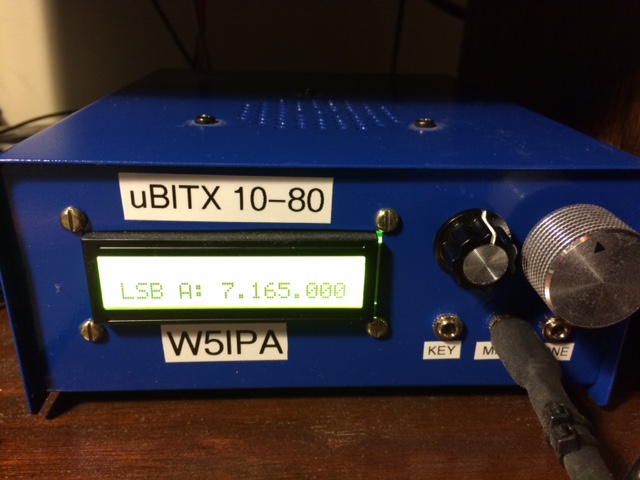
Then Jason W5IPA called in and said he wanted to try out his uBITX! See the pictures below. FB!
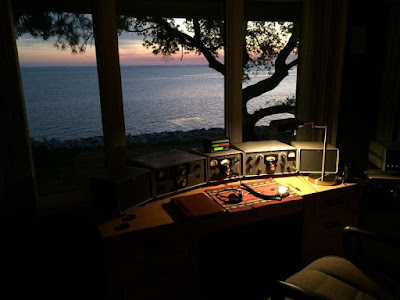
Then I got a call from K5WDW on Hilton Head Island — Dexter runs Collins gear from an ocean-front shack (see above). Check out his QRZ page.
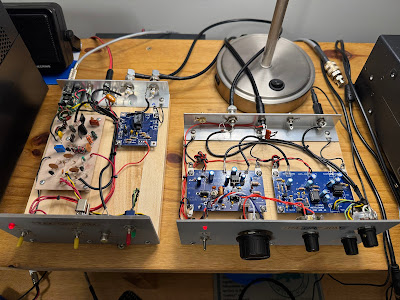
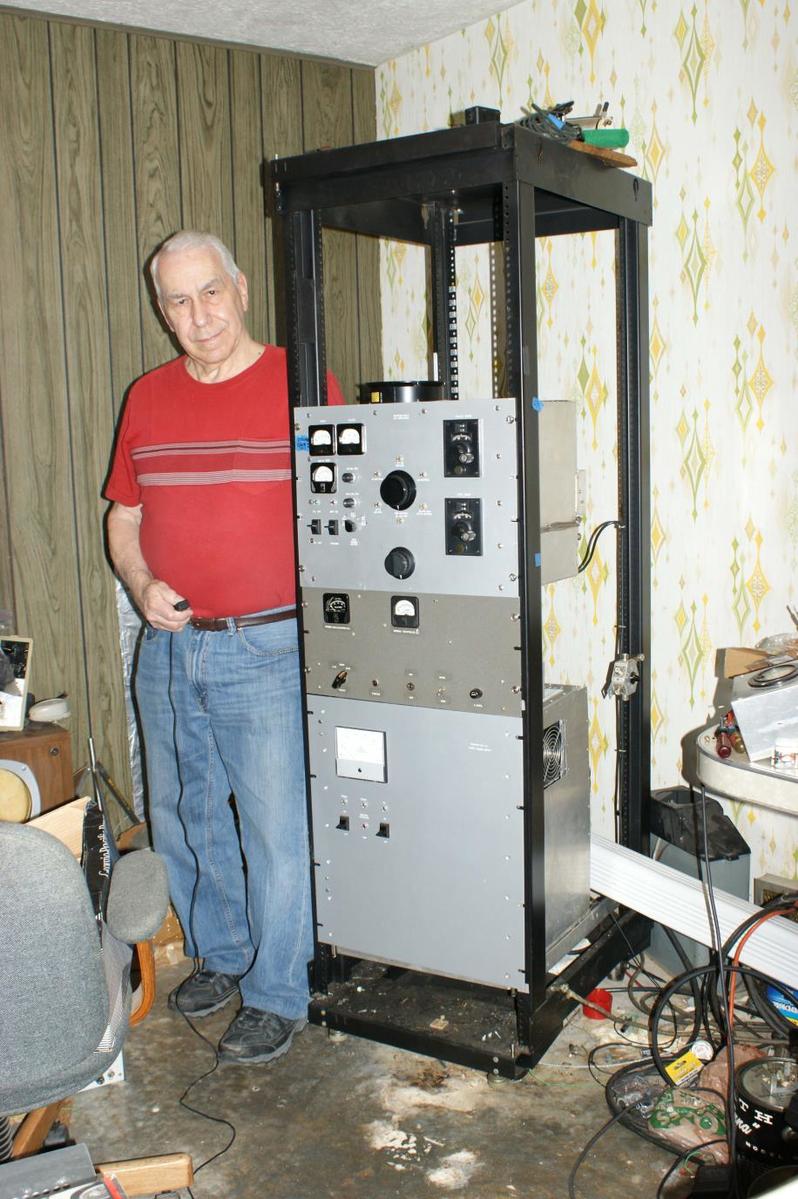
Then WA4PUB called in. Dave has been on the air since 1948 and was a student of legendary ham and radio astronomer John Kraus. Dave has directional antennas on 40 — when he switched the pattern he went from LOUD to barely detectable. FB. Check out Dave’s homebrew rig below.
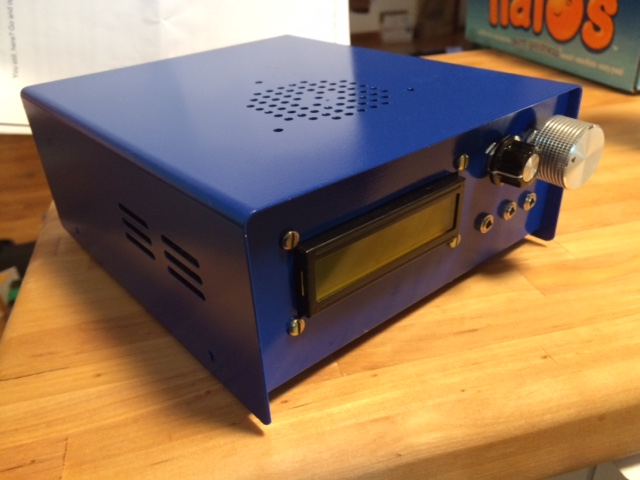
Finally Gary W7DO joined us. He has a big 4 Square on 40 that also has some really impressive directional properties. See below for a look at his 80 meter 4 Square.
TRGH
 |
| WA$PUB |
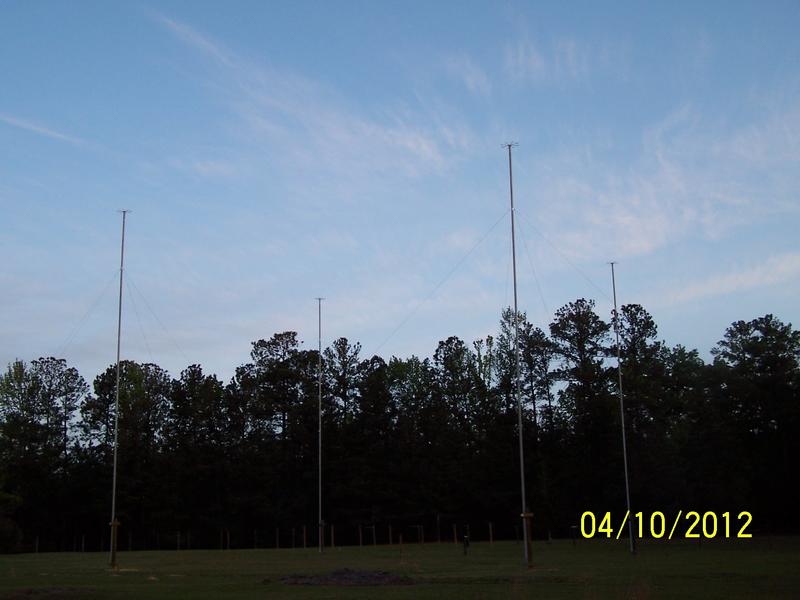 |
| W7DO 80 meter 4 Square |
SolderSmoke Podcast #203 Winter, Transceivers, Antennas, DC RX, uBITX, Mixers, ‘fests, MAILBAG
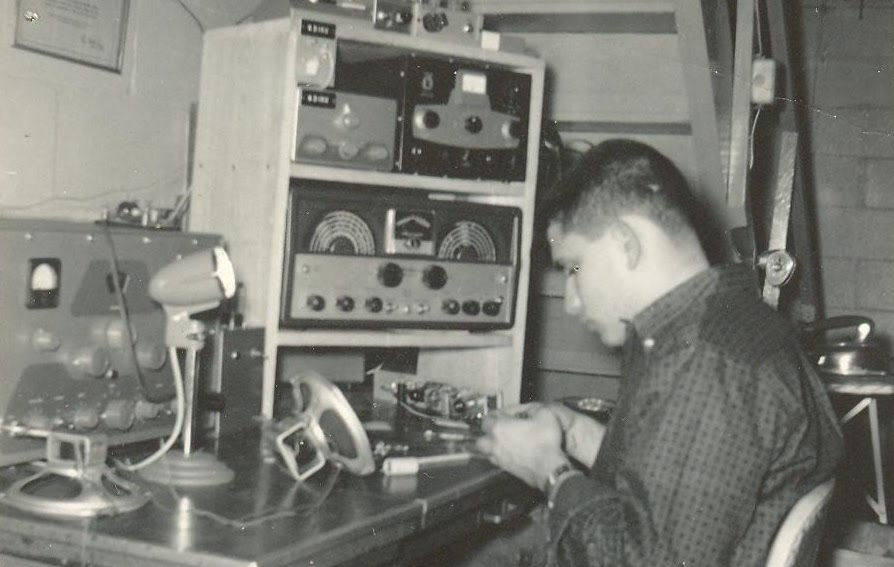 |
| N6QW in 1959. Building an SSB transceiver |
SolderSmoke Pocast #203 is (FINALLY!) available:
http://soldersmoke.com/soldersmoke203.mp3
24 March 2018
–The reasons for our delay.
Winter, Computers, College, Family Trees, Lawyers….
— Winterfest 2018
— Pete launches 2018 THE YEAR OF THE TRANSCEIVER
http://n6qw.blogspot.com/
— SDR – Satan’s Digital Radio?
— Direct Conversion Receiver Projects
— Mixer Musings
— A Thailand Troubleshoot
— Nor’Easter knocks out Bill’s Moxon — An appliance replacement?
— Homebrew Electret Mics. Seriously.
— uBITX Build with Rogier
— Civilized Crystal Testing
— Baofeng!
— DRAGNET
— MAILBAG
KD4PBJ’s REGEN
N6ORS’s SDR rig
Mike Rainey’s DX-100
Towers and Antennas in Church Steeples and on Mt. Washington (VIDEO)
Listening for Your Own Signals on the Long Long Long Path
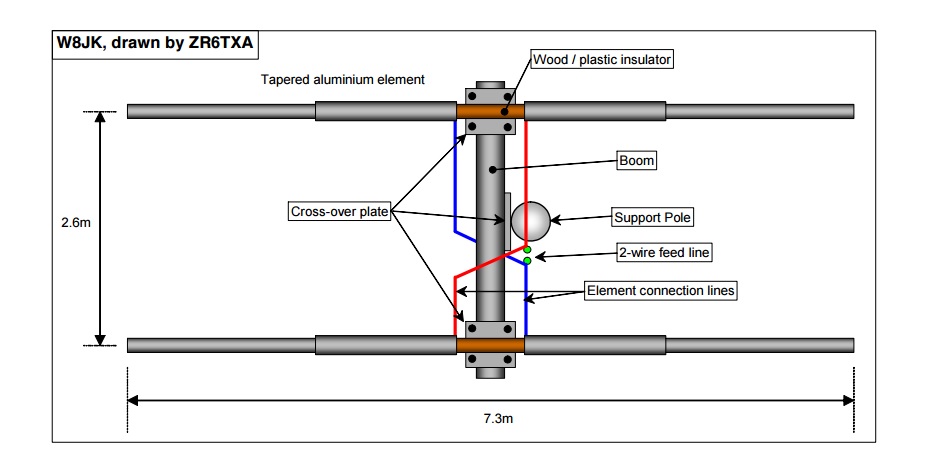
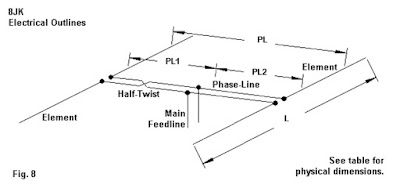
I heard some guys talking about this on 40 SSB last night. A very cool use of the bidirectional pattern of the W8JK beam.
From: http://qrznow.com/the-w8jk-is-a-famous-and-effective-dx-antenna/
Round-the-world paths The bi-directional nature of this antenna makes it possible to discover open round-the-world paths, something not possible with a normal beam antenna. The technique used by Kraus is to rotate the beam slowly, sending short Morse code dots, with a full-break-in or QSK transceiver
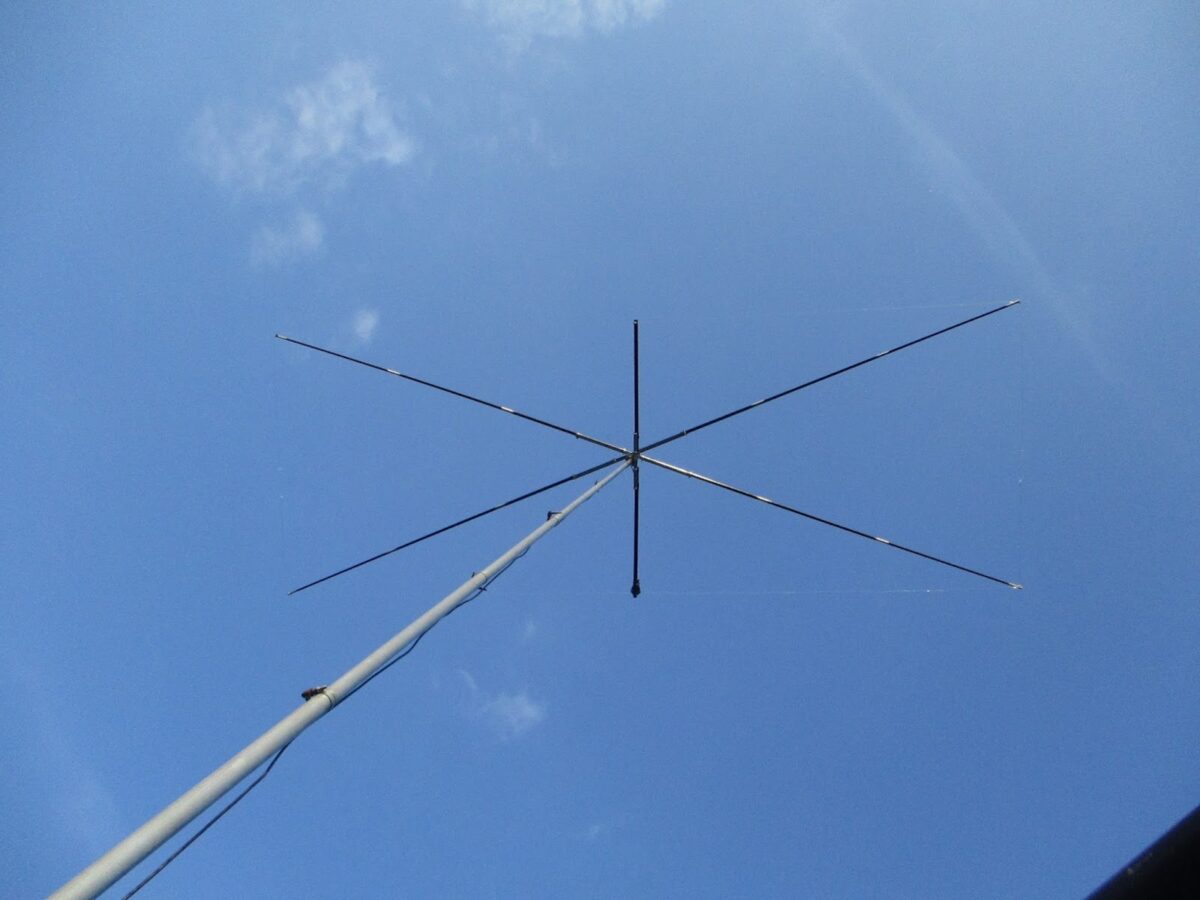
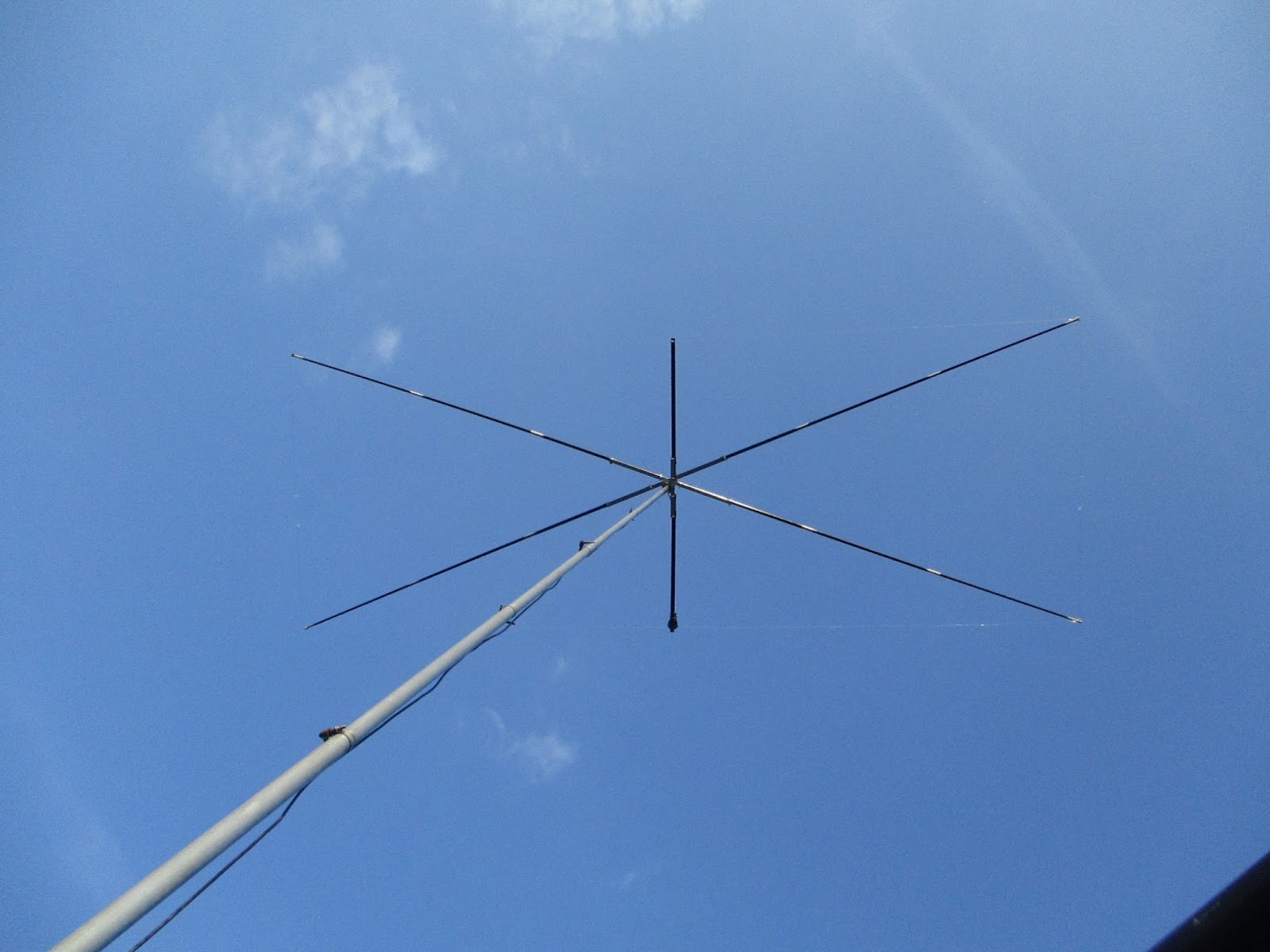
DL1YC’s Flat Moxon with Armstrong Rotation
 |
| DL1YC Moxon |
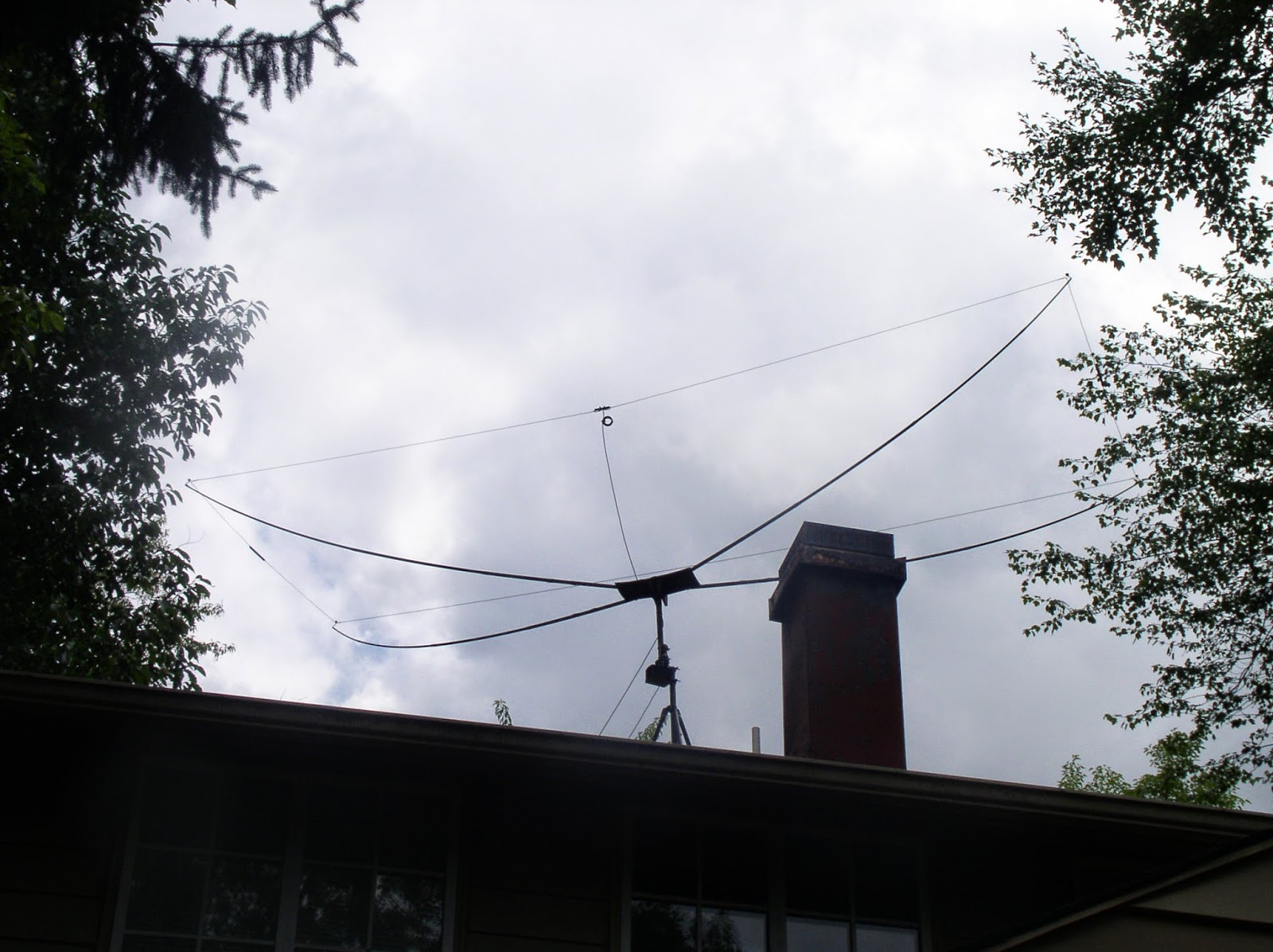
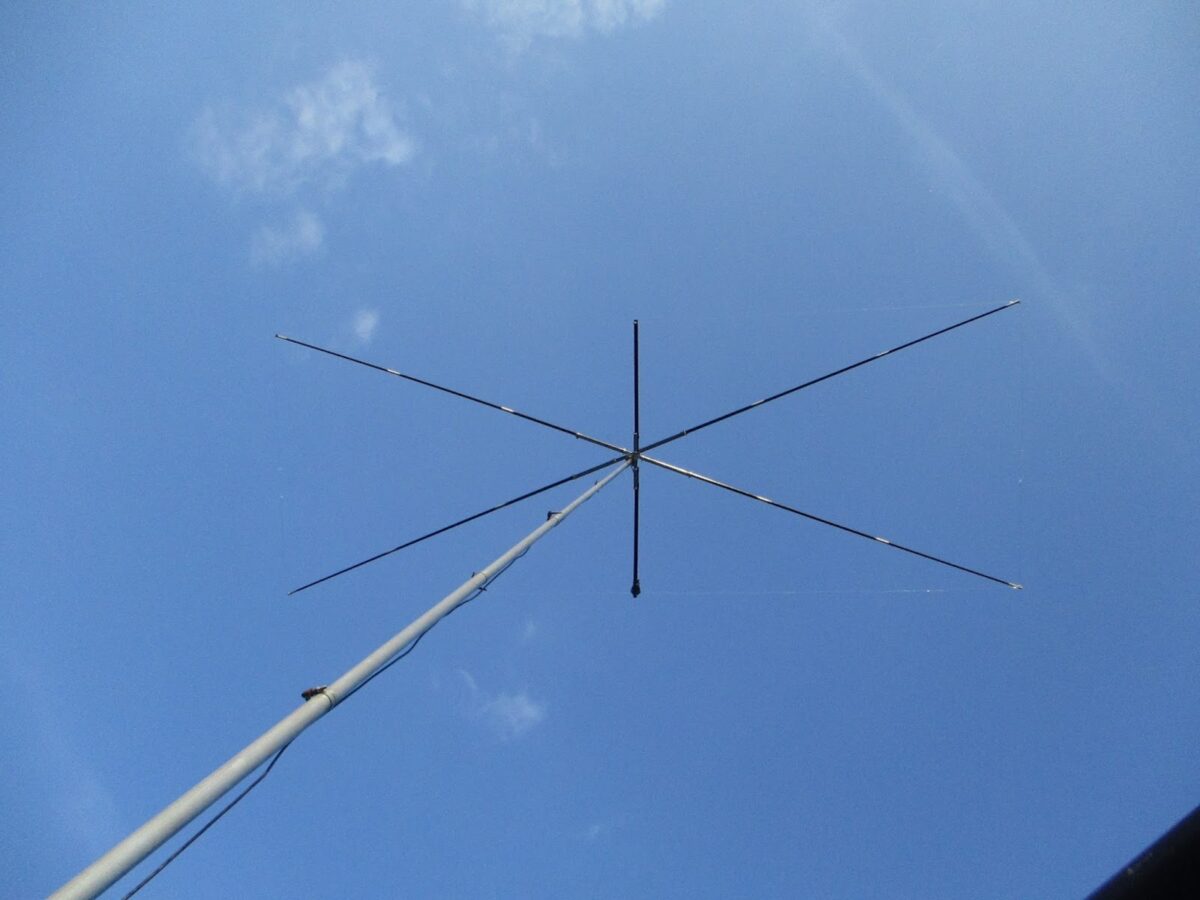
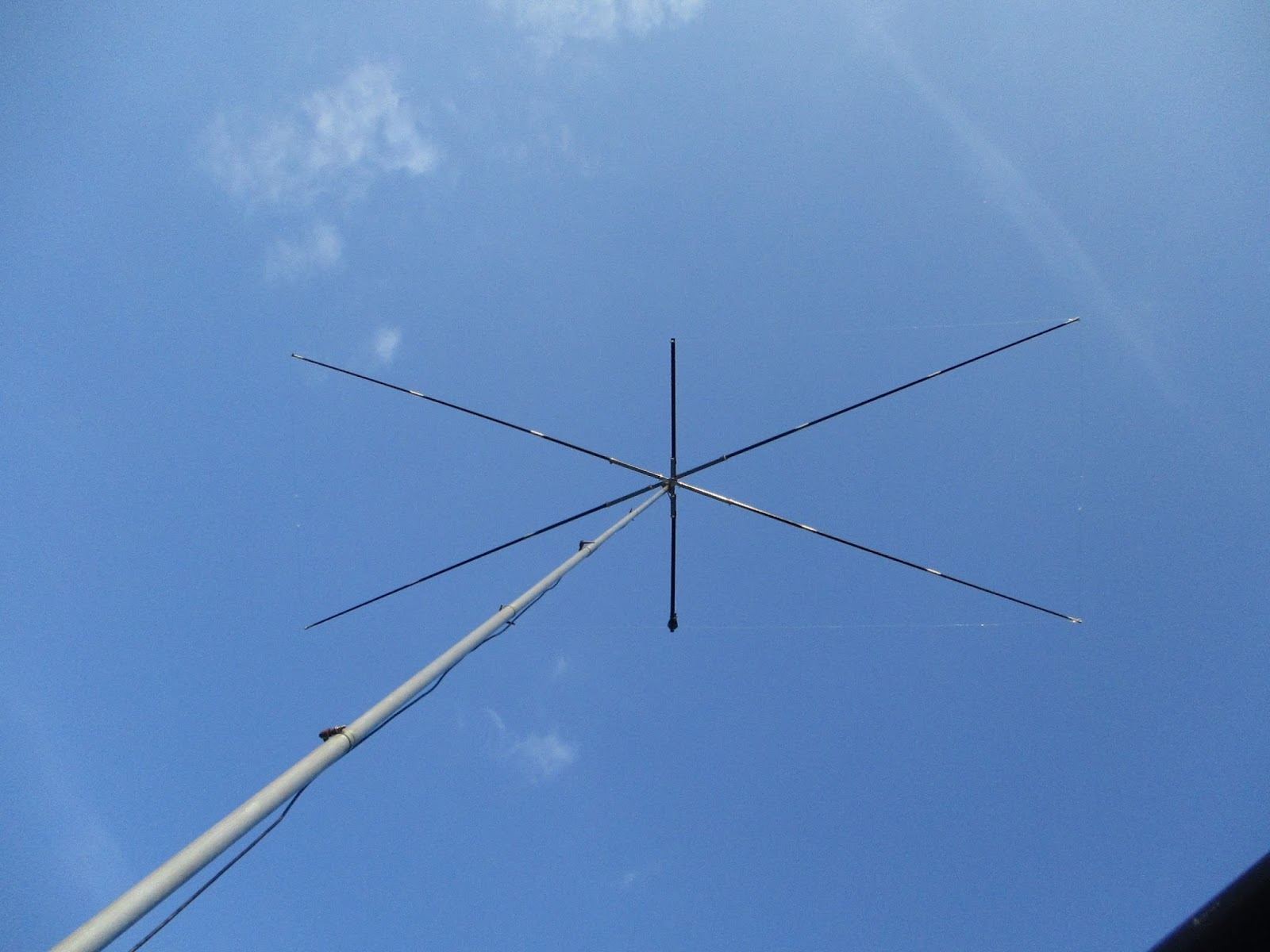
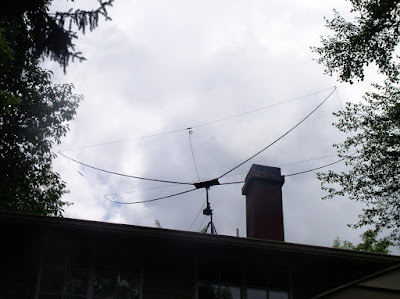
I had a very nice contact on 17 meters yesterday with Jan DL1YC. It was a rare Moxon-to-Moxon contact, with homebrew 17 meter Moxons on either end. Jan’s is a bit cooler than mine: His is flat, without the “blownout umbrella” support that we see in mine (below) and in the Hex Beams. Jans told me that he achieved this flatness by starting out with very long telescoping fishing poles — he discarded the the thin portions of the pole and used only the more rigid pieces. (I used 16 foot, 5 piece Shakespeare Wonderpoles from Amazon.) I think he also used thin wire for the elements. The crossbar that you see in the picture above is there to support a balun at the feed point — without the cross bar the balun and the feedline would cause the balun to droop.
I couldn’t resist a little front to back testing. Jan’s antenna does not have a rotator — he used the “Armstrong” method of antenna pointing. I didn’t want to make him go outside to spin the thing around by hand, so I just turned mine and asked him to take note of the difference front to back. He saw 3 S units. 18 db. Not bad.
Jan said his antenna weighs about 8 pounds — mine is very similar at 9 pounds. Jan expressed some concern about UV deterioration of the fishing pole fiberglass. Mine has been up there three years without any problems.
Like me, Jan had considered “nesting” an element for another ban (perhaps 20 or 12) but — like me– had concluded that this would be too difficult.
 |
| N2CQR Moxon |
DL1YC’s Flat Moxon with Armstrong Rotation
 |
| DL1YC Moxon |
I had a very nice contact on 17 meters yesterday with Jan DL1YC. It was a rare Moxon-to-Moxon contact, with homebrew 17 meter Moxons on either end. Jan’s is a bit cooler than mine: His is flat, without the “blownout umbrella” support that we see in mine (below) and in the Hex Beams. Jans told me that he achieved this flatness by starting out with very long telescoping fishing poles — he discarded the the thin portions of the pole and used only the more rigid pieces. (I used 16 foot, 5 piece Shakespeare Wonderpoles from Amazon.) I think he also used thin wire for the elements. The crossbar that you see in the picture above is there to support a balun at the feed point — without the cross bar the balun and the feedline would cause the balun to droop.
I couldn’t resist a little front to back testing. Jan’s antenna does not have a rotator — he used the “Armstrong” method of antenna pointing. I didn’t want to make him go outside to spin the thing around by hand, so I just turned mine and asked him to take note of the difference front to back. He saw 3 S units. 18 db. Not bad.
Jan said his antenna weighs about 8 pounds — mine is very similar at 9 pounds. Jan expressed some concern about UV deterioration of the fishing pole fiberglass. Mine has been up there three years without any problems.
Like me, Jan had considered “nesting” an element for another ban (perhaps 20 or 12) but — like me– had concluded that this would be too difficult.
 |
| N2CQR Moxon |