Category: 40 meters
Pine Boards, Analog VFOs, and Homebrew BITX Transceivers — AG5VG’s Magnificent Creations
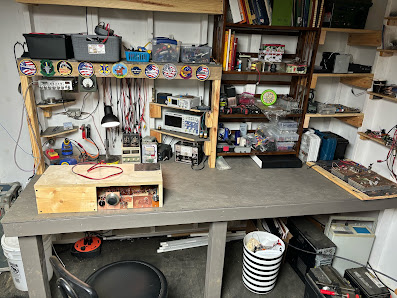
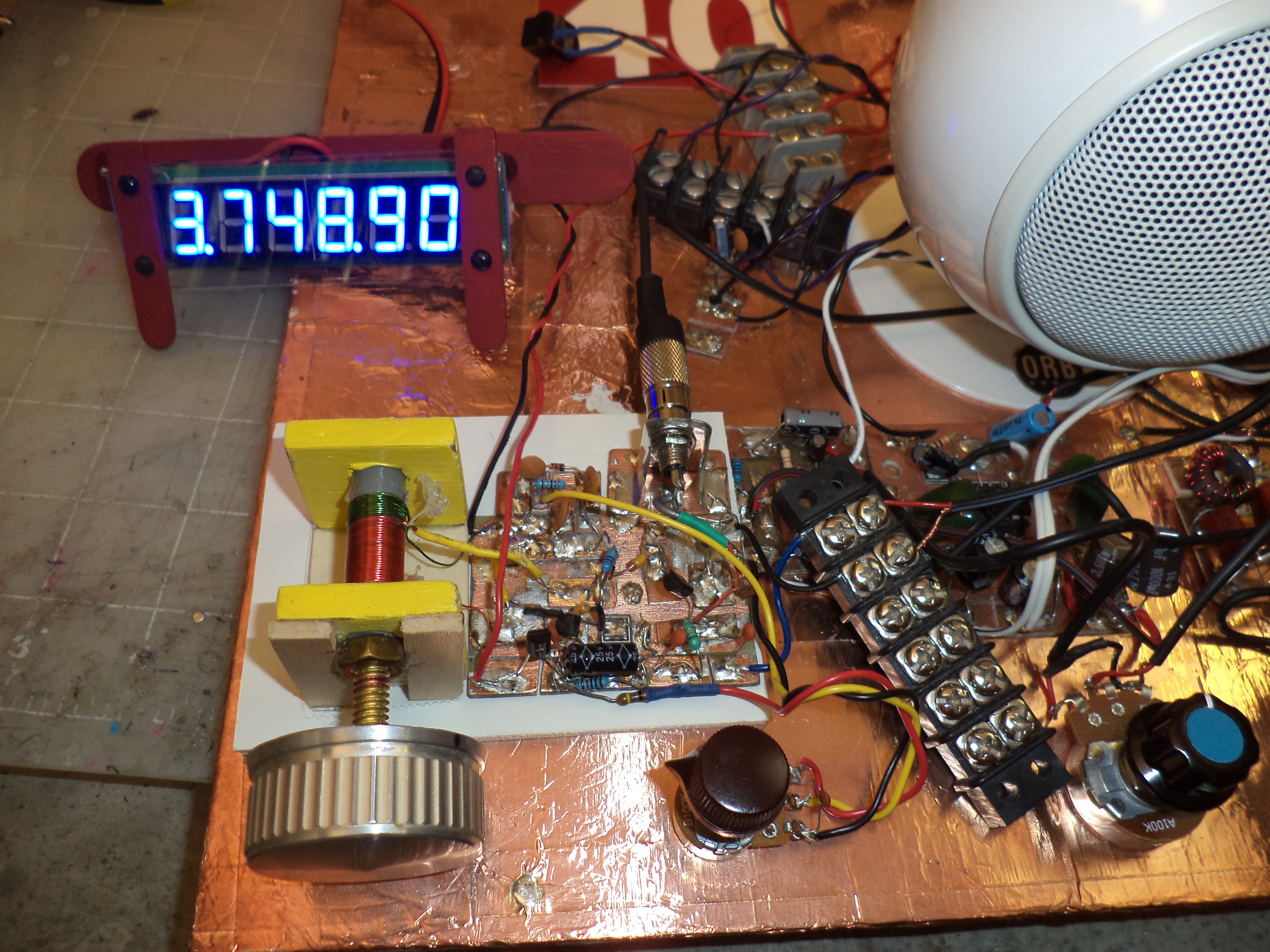
This is amazingly cool. WE ARE NOT ALONE! There are others out there breaking the tyranny of the Si5351, building BITXs with analog LC VFOs. And using copper clad boards affixed to pine boards. Plywood cabinetry! And medicine bottle coil forms. Really great. And what a wonderful workshop. Thanks Michael.
Good Afternoon Bill,
Scott KQ4AOP Successfully BUILDS a Receiver (Video) — This is the Homebrew Spirit at its Maximum
This is just so cool. Scott KQ4AOP has successfully homebrewed a ham radio receiver. He used the circuit Dean and I developed (with a lot of input from Farhan and others) for the High School receiver project. But Scott has had more success than any of our students. And I think he has had — in a certain sense — more success than any of us. After all, how many of us can say — as Scott can — that he used a homebrew receiver that he made to listen — for the very first time — to amateur radio signals? Scott writes: “Those first sounds were my first time ever hearing any Amateur Radio first hand!”
In the video above you can watch Scott tune the entire 40 meter band and a bit beyond. You hear CW at the low end. Then FT-8. Then SSB. Up just above the top of the band I think you can hear our old nemesis Radio Marti. And this powerful broadcaster is NOT breaking through on the rest of the band. FB Scott. Congratulations.
———————————————-
Bill,
Thank you for the quick response, direction, and pointers. I won’t give up, and I am not in a rush.
Bill and Dean – Thank you for sharing and documenting this receiver. I greatly appreciate you publishing the circuit, class notes, and build videos. That got me 75% to completion.
I feel blessed that both of you chipped in and encouraged me through the troubleshooting to finally getting the receiver to start “breathing RF”.
Those first sounds were my first time ever hearing any Amateur Radio first hand!
Happy New Year! Straight Key Night at N2CQR (video)
Happy New Year to all. May you make good progress on your homebrew projects, and may the radio gods act favorably on your behalf.
73 es HNY de N2CQR
South African Homebrew: ZS4L’s “Griffin” 40 Meter SSB Transceiver
——————-
From William’s QRZ.com page (https://www.qrz.com/db/ZS4L):
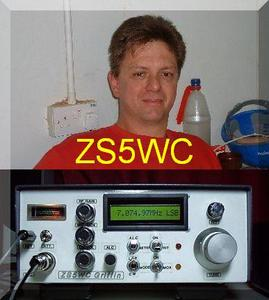
I have always wanted to build a homebrew transceiver-and recently I completed my pride and joy-a 40m SSB/MCW transceiver-I call it the ZS5WC “Griffin”..
“Griffin”..-well –if you know greek mythology you will find that it defeated much greater adversaries in battle.(to cut a long story short..)
The parallel I am getting at is..Big commercial rigs can be taken on by a rig constructed at home-and with great success!.
Sure, it does not have the bells and whistles of a 1000mp-but the TX audio is good, the RX is great , and the SMILE factor-even with all the little quirks is off the scale!..
Basically it is a single conversion superhet-4 tuned BPF stages,ATT, Gain control stage ahead of 1st Rec. Mixer/Bal. mod (NE612) , Xtal 10mhz homebrew filter,2 transistor feedback amp, second gain control stage,2nd mixer/BFO (NE612)-On TX to PA board-4 transistor pre-amp, IRF510 mosfet PA, LPF and RX /TX relay. ON RX to TL072 audio pre-amp, Spits to AGC/S-meter amp-(741 and BC107’s) and audio amp TBA820m.
ALC is done on AGC board as well with BC107 back to back to AGC bc107.
The S-meter drive is developed in the emitter leg of the AGC BC107-simple series pot to calibrate-no zero pot is required..(Works great!)
There is a volt control PCB too, with RX/TX switching.
On the main PCB there is a phase shift osc. for MCW and sidetone. Alc is adjustable from front panel from 1/2 watt to 5 watt.Rit is included in the Hartley osc. circuit and readout is done with a pic and two line LCD disp.(from AADE.com..)
Freq. drift from warm is 200Hz down in frequency then swings round and stabilises close to start freq.
Rit is good for around 5Khz swing.
Amp keying is available on the back panel, as well as an aux. 12 supply-(To run a homebrew noise squasher and amp..)
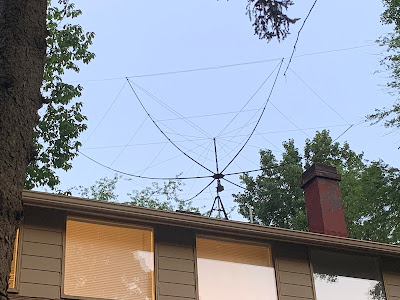
An Antenna for the High-School Direct Conversion Receiver (and Next Steps in the Project)
The Islander — A Homebrew DSB Rig from Cuba
Remembering
Next 2019 will be the 30th anniversary of the first convention of radio amateurs in the province of Villa Clara, in Campismo de Ganuza, municipality of Corralillo, on the North coast, about 100 kilometers from Santa Clara, the provincial capital.
This convention was held on a national basis and colleagues from all the country’s provinces participated at that time. We did not reach a thousand members throughout the national territory and most of the radio amateurs worked in the 40-meter Band in Amplitude Modulation Then the Lateral Side Band (SSB) was the privilege of a few and the 2 meters was something rare, which did not yet exist in our environment.
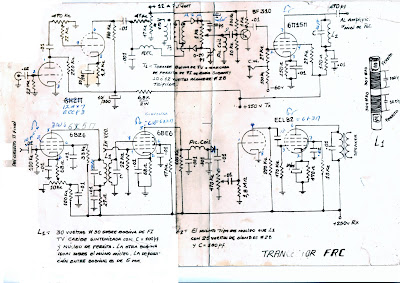
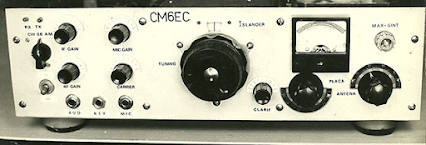
At that meeting, a project for a Tube Transceiver was presented, quite simple, with just six vacuum tubes and a BF310 transistor. It was possible to work in HF in Double Sideband, achieving a greater efficiency than the transmission in Modulated Amplitude (AM). This project became known as the Islander.
In only two printed plates, one for the VFO and another for the TX and RX part, which by the way were printed for distribution, in a company in Villa Clara, due to their easy construction and acquisition of the components (almost all of them came out of a Krin-218 TV), a large number of such equipment were manufactured by radio amateurs from all over the country. Like everything made at home, it always comes up with a little problem that later is necessary with tinkering, correcting it.
I remember listening to an old radio amateur from Havana (whose callsign I don’t remember) in a pleasant QSO with another colleague, who jokingly said, “… some “Bugs” have now appeared in the band, called Islander, which is worse than the invasion of the Vikings…”, which gives an idea of how many were built at that time, when if you wanted to make radio, you had to manufacture it, something unusual in these times.
As soon as we saw the project we decided to build it, because at that time we had an AM “transmitter” with modulation by “Carrier control” with four tubes, a 12AX7 preamplifier; an ECL82, as a modulator, with cathode output to the final tube Screen grid, a 6DQ6 and a 6BH6 as VFO; and to receive, an old Russian receiver from World War II.
We got involved in the construction and improvements of the project and we managed, with some changes, to improve its performance and quality, because among the modifications to the original, we added:
-A switch, with which you could change the transmission mode to DSB -CW-AM.
-A “Pi” Filter at the input of the RX, which considerably improved its quality.
-An automatic volume control, because since it did not have AGC (Automatic Gain Control), when someone nearby came on, it would break your speaker.
-A filter for the microphone input, which improved the quality of the modulation.
-A final power stage, with a 6146B, with 750 V on the board, for about 70 W of output, taking advantage of the 6P15P as Driver.
-The chassis was built from scratch using aluminum trays that were sold at the hardware store for “four pesos” each and that were special for making cabinets for these purposes.
After the construction was completed in one afternoon, with Reinaldo Martínez Domínguez (CO6UK), from Manicaragua, the balanced modulator was adjusted, since the good transmission of this type of equipment depends on the relationship between the amount of RF and audio that are mixed At that stage, it took us a long time to adjust, until Reinaldo with his expert ear told me, “leave it there, don’t touch it, it’s 99% complete”.
There were many international contacts that I was able to make with this very simple equipment, with very good reports, many of them with Europe, the American continent, that was very normal, since the propagation conditions in those years had nothing to do with the today, you could do half the world in AM, with about 100 W.
Many colleagues at that time asked me what equipment I was using. When I told them it was an Islander, they asked me to send them the plans of the improvements made, they were many modified plans, mimeographed.
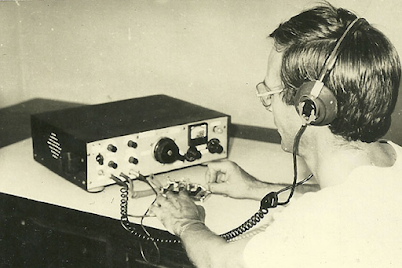
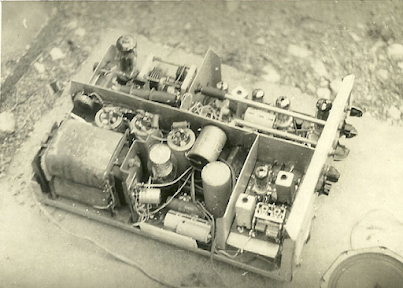
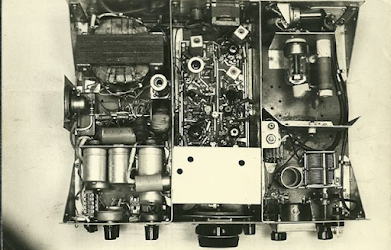
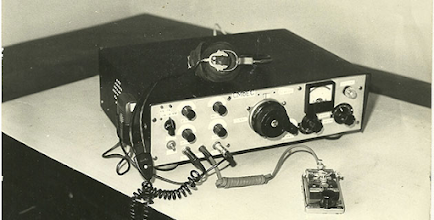
Perhaps the youngest do not know what that was and the photos taken by colleague Joel (CO6JC) that helped to illustrate the distribution of the components in the chassis, were sent to radio amateurs from the different provinces, in the interest of contributing modestly to migrate from AM to the Double Side Band, today it is a rarity to listen to someone on AM, there are already few who appear in Double Side Band, which shows that we have developed in these almost 30 years, despite the difficulties, which We went from just under a thousand to about 8,000 throughout the country today.
From time to time, a colleague in the 40 meter Band, from another province, has told me that he still keeps the plans and photos that were sent to him at that time, or as “Kike” (CO6GO) that he still has a Islander as a relic.
Ours passed away a long time ago and part of its components went to other projects, thanks to Joel (CO6JC) there is a graphic record of it, and that at that time I had hair, which I have lost in these bustles.
With this brief comment, we only want the new generations to know what radio amateurs were like in those days and the older ones to remember it.
Nothing, to remember is to live again.
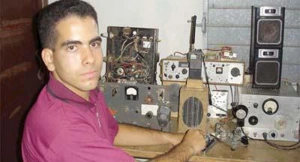
Here he left you some images.
Needed: More Info on the Cuban Islander or Jaguey DSB Transceivers
https://www.paara.org/newsletter/2000/graph200007.pdf
Date: Mon, 22 Mar 2004 17:48:59 -0500 From: "Prof. Arnaldo Coro Antich"Subject: Re: GB> 6EH7 vs. 6EJ7 as RF Amplifier
Dear amigo Chris: You are absolutely right ! EF184 is the best pentode for RF amplifier duty... But, let me ask you something... have you thought about the ECC88 and the even better ECC189 dual triodes that were designed for TV tuner work, and that incidentally were also about the last vacuum tubes ever designed from ""scratch"" until Phillips and other European manufacturers stopped from making receiving type vacuum tubes. The ECC189 is simply wonderful for a front end !!! I am sure that you are aware of our limitations here at my QTH regarding the possibility of obtaining solid state modern devices... so we still make ""new"" ham radio rigs using mostly vacuum tubes... We even still make a version of "" The Islander"" a DSB transceiver with direct conversion vacuum tube receiver... Tube lineup is EF184 RF amp ECH81 product detector ECH81 triode section not used ECL82 triode audio preamp ECL82 pentode audio output 6AH6 VFO ( Russian equivalent 6*5P ) Audio filter provided by good working brain of operator !!! Keep up the good work amigo !!! 73 and DX YOur friend in Havana Arnie Coro
CO2KK
http://ibiblio.org/modena/GLOWBUGSpiobaire/glowbugs.piobaire.weekly.html
Today’s first question came from a long time listener in India. Rajiv tells me that at this moment he is not able to pick up our station on the shortwave bands, and he rightly assumes that this is because of the very low solar activity… but Rajiv who lives in the garden city of India, Bangalore, the home of the nation’s electronic and other high tech industries, is able to read the scripts of the program that are made available to several short wave listeners clubs e-mail distribution lists. Rajiv tells me that he wants to obtain the electronic files of the Super Islander amateur radio transceiver to compare the circuit diagrams and design philosophy with a similar project that is becoming very popular among Indian radio amateurs. Ok amigo Rajiv… I have already sent you all the files including some nice digital photos of the first prototype of the Super Islander, that as you will see, has two final amplifier options , one built using NPN RF power transistors, and the other one using two vacuum tubes that are very easy to find here in Cuba from recycled TV sets. The Super Islander is a single band transceiver that can be built for the 160, 80 or 40 meter bands. Here in Cuba amigo Rajiv, the most popular amateur band nowadays is two meters, using the FM narrowband mode, and the second most popular band among Cuban radio amateurs is 40 meters, that’s why most of the Super Islanders are built for operating between 7.000 and 7.150 kiloHertz. The double sideband signal generated by the Super Islander simple circuit is very stable, and very few if any radio amateurs that contact stations using the Super Islander are able to detect that it is a double side band and not a single side band signal what they are hearing. One of the most outstanding features of the Super Islander single band amateur radio transceiver is that it is modular, so those who want to build it, are able to build and test each module as a single project, and after all the modules are fully tested, then they are easily wired together . The parts count, that is the number of components required to build a Super Islander was kept intentionally as low as possible, both to simplify its construction and to increase the reliability. I hope that amigo Rajiv in Bangolore , India will be able to make good use of the Super Islander’s files, and maybe even go ahead and build one , as the parts required are almost universally available, because that was one of the design requirements that I set when starting the Super Islander project more than fifteen years ago….You can learn more about this simple amateur band transceiver by sending a request for the Super Islander files to arnie@xxxxxx … I will send it as a dot zip file and you will be able to see circuit diagrams, photos and full descriptions of the different modules of this nice little rig, that has proven itself under the most difficult circumstances, like handling emergency communications links during tropical storms.
http://www.hard-core-dx.com/hard-core-dx/2007/msg02587.html
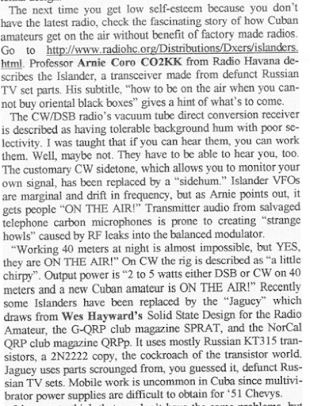
Beginners generally build one of two radios; the vacuum tube Islander or the solid state Jaguey. The Islander is a DSB/CW Cuban design using a very clever low parts count circuit and a direct conversion receiver. The Jaguey, named for the Jaguey Grande Radio Club in Matanzas province, is a generic design, with a DC receiver, DSB and CW, using solid-state components. Many of its ideas are from Wes Hayward's W7ZOI's Solid State Design for the Radio Amateur. The lack of mechanical filters or quartz crystals to homebrew SSB filters made Cuban designers CO5GV, CO2JA and CO2KK choose a DSB and CW rig. Fitted with good quality capacitors for the VFO, it works quite well from a 12-volt car battery in hurricane emergencies.
Direct Conversion Receiver Bandscan — 40 Meters early on a Thursday Morning — With W1AW/4
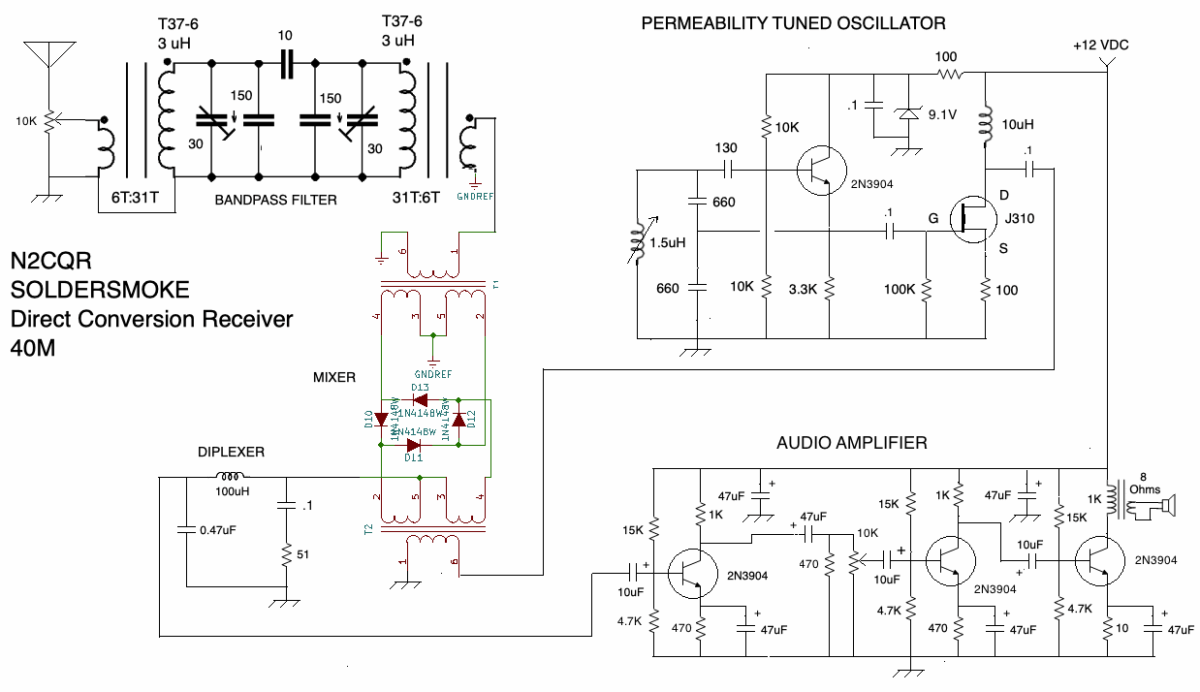
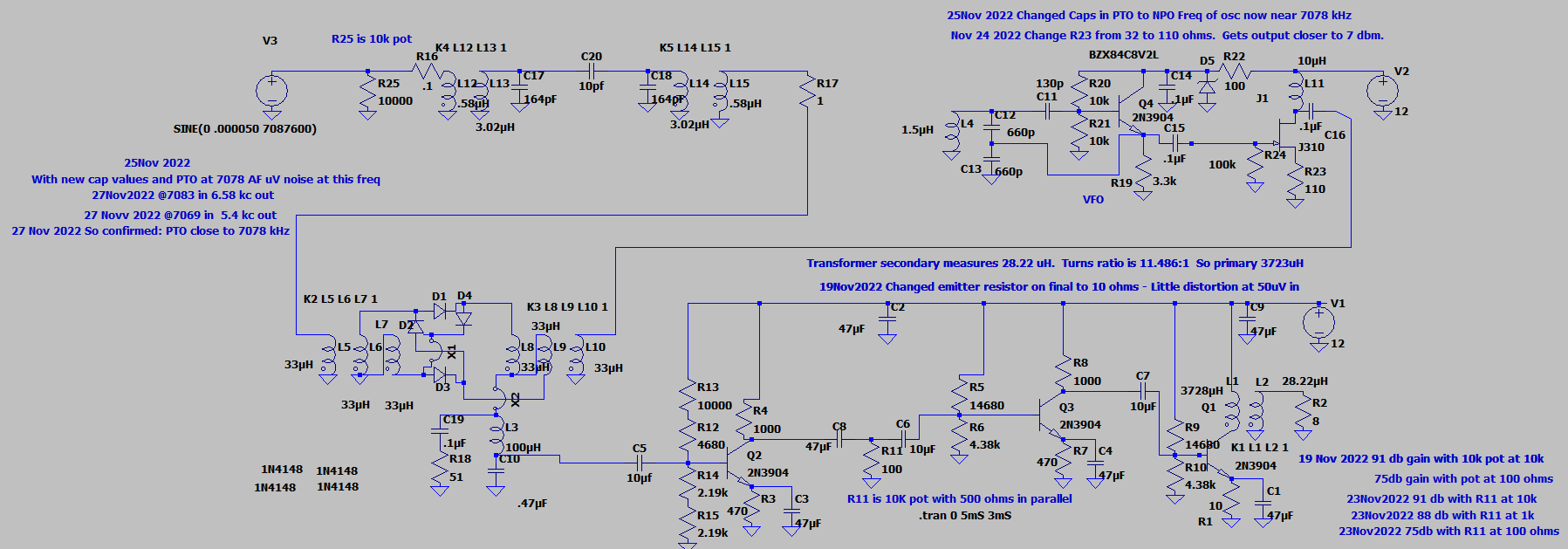
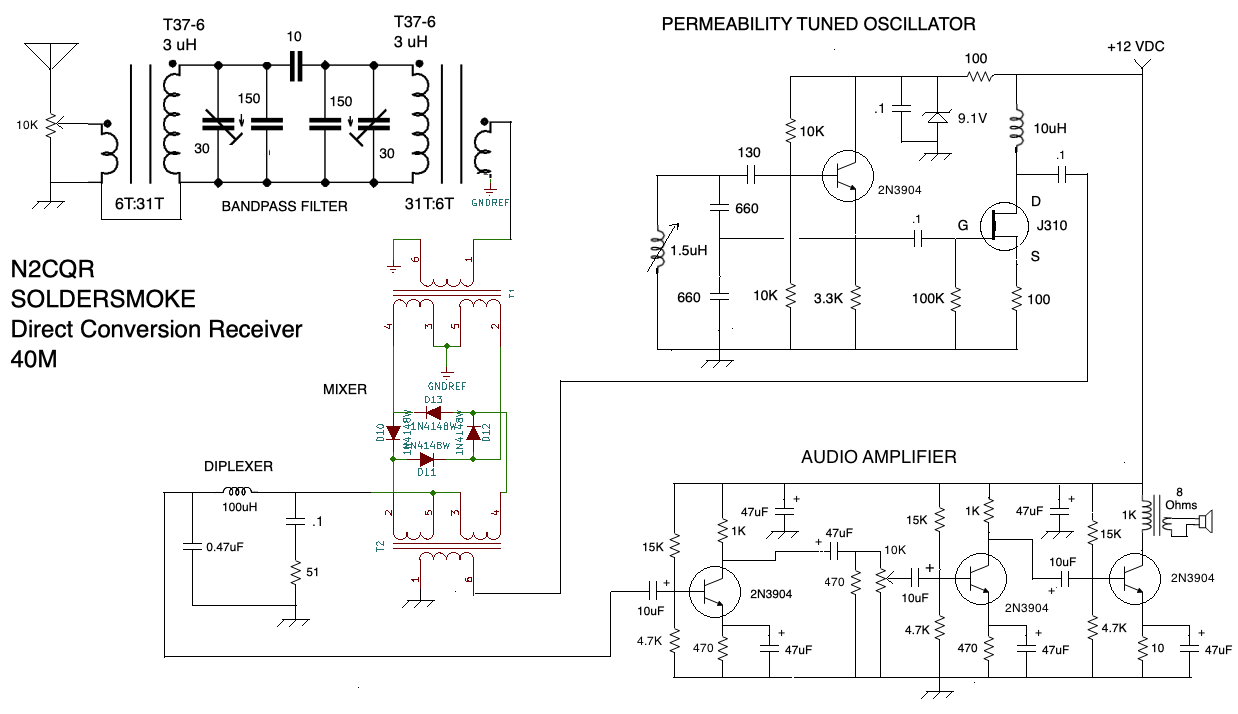
The 40 Meter Direct Conversion Receiver We Have Been Working On — Comments Welcome
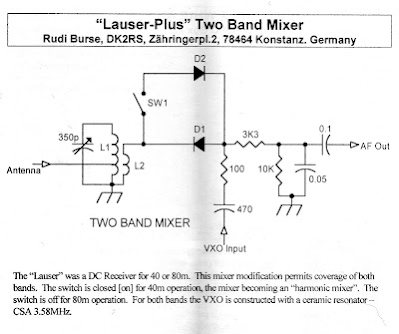
Here is a larger image of the schematic (click for a full view):
Watching Shortwave Broadcast Stations on the TinySA Spectrum Analyser
This reminds me of a cool project I have not yet done: modifying the TinySA to allow the user to listen to the station: https://soldersmoke.blogspot.com/2021/10/how-to-listen-with-your-tinysa.html I notice that Dean KK4DAS (my colleague in DC receiver design) was the only commenter on the blog post describing the TinySA mod. TRGHS. We need to to do this.
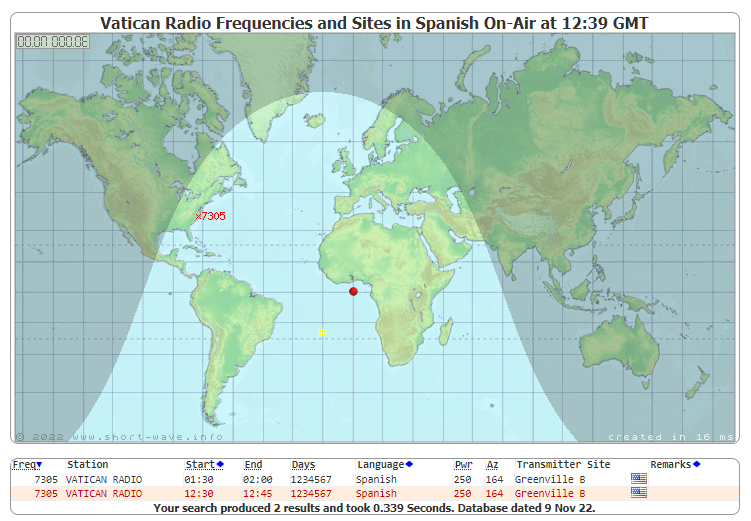
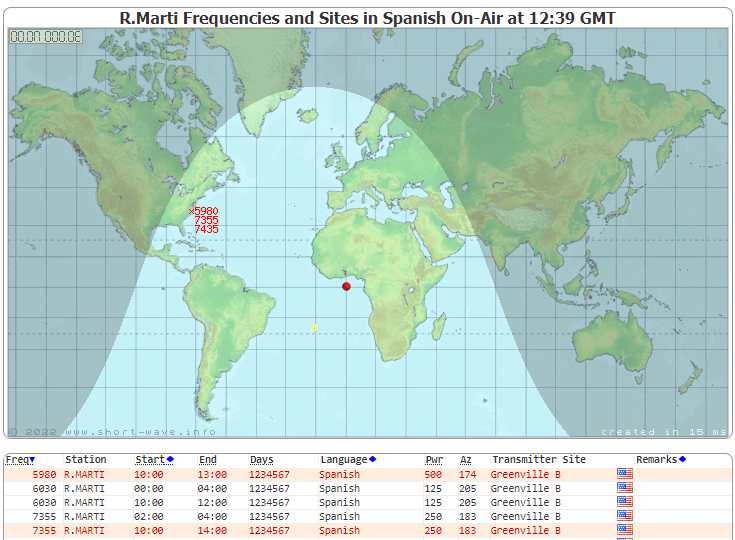
Here are the reports showing when Vatican Radio and Radio Marti were on the air on November 18, 2022:
DC Receiver: 100db Gain? Diplexer? VFO in a box?
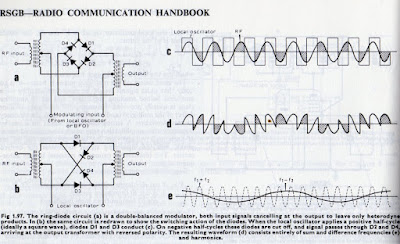
How the Diode Ring Multiplies by 1 and -1 — “The Secrets of the Diode Ring” — Plus another Bandsweep with the DC RX
Bandsweep with the New Homebrew 40 meter Direct Conversion Receiver
— The mixer is singly balanced using one trifilar toroid and two diodes. We have found out that even with these three simple devices, there is significant variation in how people connect them to VFO, RF in and audio out. I think we have found the best way to do this: Be sure to put the VFO on the primary of the transformer, and let this signal turn the diodes on and off.
— For the AF amplification, I have one FET, followed by two BJTs. I have a small audio transformer between the speaker and the final AF amp. There is plenty of audio.
You may wonder why, after all the SSB superhet transceivers, I am building a simple Direct Conversion receiver. Well, we hope to help a bunch of high school kids build one, so we need to be really familiar with how it works. And I find that as simple as it is, there is still a lot to learn in a project like this.
Daylight Again on the Sunrise Net! Walter KA4KXX Builds a PTO
Dear Bill:
SolderSmoke Podcast #239: Hex DX, VFO Temp Comp, DC RX, Polyakov!, DX-100, Wireless Set, Farhan’s “Daylight Again” HDR rig, MAILBAG
SolderSmoke #239 is available for download:
http://soldersmoke.com/soldersmoke239.mp3
TRAVELOGUE:
James Webb Space Telescope. Mars returning to opposition in early December.
BILL’S BENCH
Hex Beam K4KIO – on roof – TV Rotor – 20-17-12 Lots of fun. Working Japan regularly, Australia, South Africa on long path 17,000 miles. 52 countries SSB since July 11.
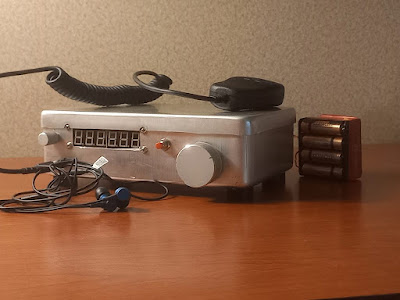
VFOs and Temp stabilization. Dean KK4DAS found my ceramic resonator VFO for DC receiver drifty. He was right. So I built a real LC Colpitts VFO. Got me into temp stabilization. A new hobby! An obsession. HT-37 and Ht-32 parts. Ovens? WU2D’s second VFO video. Understanding thermal drift and how to address it. Split stator caps. Cut and try.
Built a Polyakov DC Receiver. https://soldersmoke.blogspot.com/2010/03/polyakov-plus-dual-band-receiver-with.html Lauser Plus. Lauser = Imp or Young Rascal! DK2RS. He used a ceramic Resonator VXO at 3.58 MHz. Mine works great on 40 with VFO running 3.5 — 3.65 MHz. See schematic below.
On 40 AM with DX-100 and MMMRX. DX-100 died. 12BY7 VFO buffer went bad. How common is failure in this tube type? Nice QSO with Tim WA1HLR about the DX-100.
Got my Dominican license: HI7/N2CQR! SSSS on the way. Thanks to Radio Club Dominicano and INDOTEL.
Getting more active in the Vienna Wireless Society.
BOOK REVIEW:
“The History of the Universe in 21 Stars” by Giles Sparrow. Written during the pandemic. Published by Welbeck, in London. https://www.amazon.com/History-Universe-21-Stars-imposters/dp/1787394654 Also: From “Atoms to Amperes” by F.A. Wilson available for download. See blog.
SHAMELESS COMMERCE DIVISION:
Todd K7TFC getting ready to launch “Mostly DIY RF.” I used his TIA boards in my 1712 rig. He will have boards like this and much more. Stay tuned.
I need more viewers on YouTube. They want 4,000 hours IN A CALENDAR YEAR! Please watch!
FARHAN’S NEW “DAYLIGHT AGAIN” RIG. Analog. VFO. Comments, observations. We need to get him on the podcast. Maybe two shows: SDR and HDR.
PETE’S BENCH
Time very limited. But still sharing lots of tribal wisdom.
Wireless set with tubes!
Tool recommendation – Air compressor
Farhan VU2ESE – Speaking of big antennas “Whenever I look at the huge construction cranes in Hyderabad, I always think how one could make 160m, 4 element yagi using it as a boom..”
Todd K7TFC in Spain, spotting Log Periodics in Madrid.
Andreas DL1AJG: Can Biologists fix Radios?
Janis AB2RA Wireless Girl. Expert on Hammarlunds. And was my first contact with the Tuna Tin 2. She too was HB!
Peter Parker VK3YE on Owen Duffy VK1OD
Lex PH2LB on homebrew radio
Would this really be homebrew? Mail from H-A-D article on FM receiver
F4IET a DSB rig from France
Ciprian got his ticket YO6DXE
Josh G3MOT sent us a good video about the Vanguard satellite and IGY.
Dave Wilcox K8WPE bought Chuck Penson’s Heathkit book.
Rogier — So many great articles and links from PA1ZZ
Bill AH6FC Aloha. Retiring. Wants to build. Mahalo!
Grayson KJ7UM Working on an Si5351. Gasp.
Mike KE0TPE viewing YouTube while monitoring 6 meters. He will have a lot of time to watch!
Chris KD4PBJ spotted Don KM4UDX from VWS FB
Mark WB8YMV building a superhet. Having trouble with 455 kc IF can filter.
Walter KA4KXX Great comment on the Daylight Again rig.
Ramakrishnan Now VU2JXN was VU3RDD. Found lost Kindle with SolderSmoke book on it. Building SDR rig from junk box. Trouble with the LM386.
Pete, Farhan and Tony: Shelves of Shame
Farhan Takes us Back into the Daylight — An Analog Rig with a Homebrew Crystal Filter and an LC VFO
Pete N6QW’s Hybrid Wireless Set — A Thing of Beauty, with Thermatrons
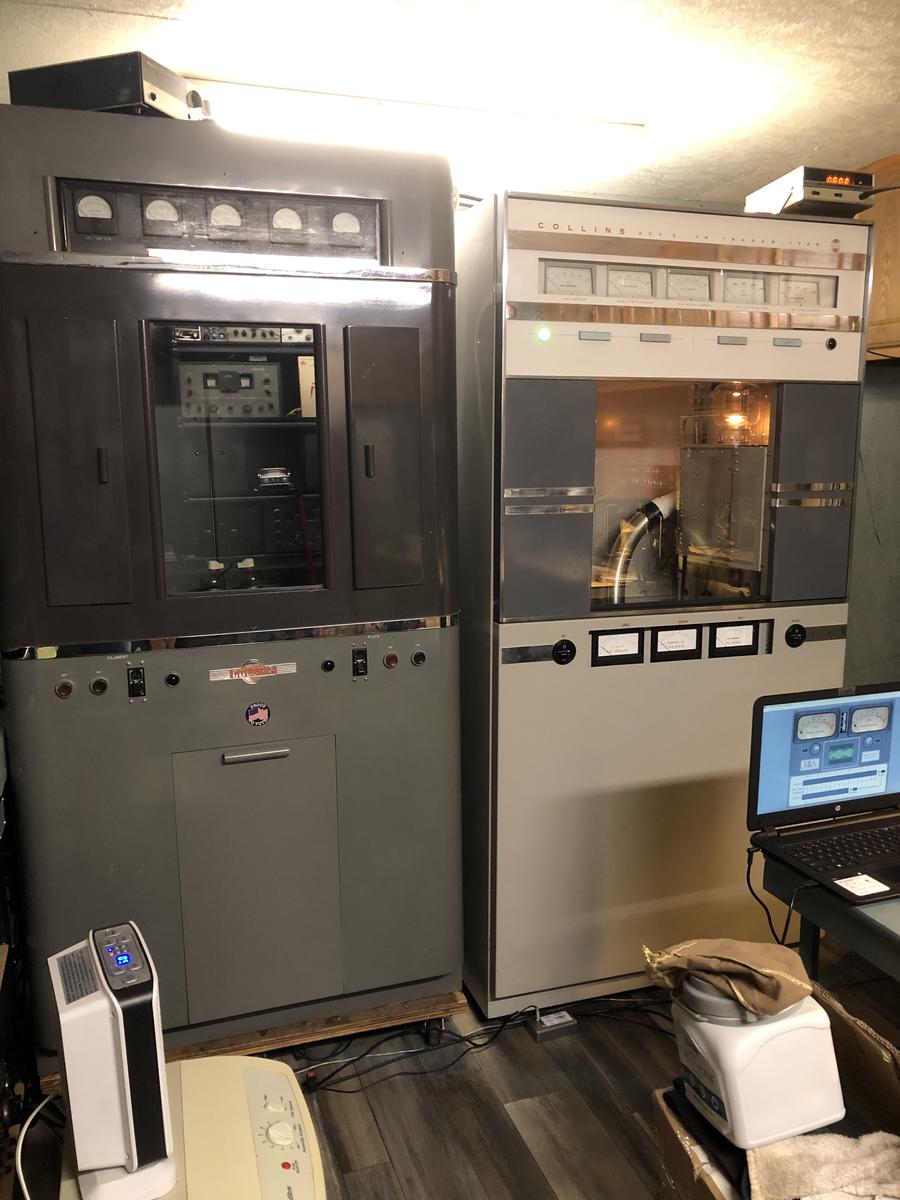
W8ZAP on 40 AM with a Collins 20V3 Broadcast Transmitter
Farhan’s New Rig: Daylight Again! Analog!
In 10 seconds,
-
A high performance, 7MHz, 5 watt SSB rig
-
Draws just 24 mA of current
-
90 dB dynamic range, 80 dB close-in dynamic range
-
3D printed rock stable, slow tuning PTO with zero backlash.
-
3D printed toroids
-
You have all the parts in the junk box or you can buy them tonight at the vendor night.
-
Very stable, slow tuning VFO with no backlash
-
Costs less than 20 dollars to build, even in new parts.


(co6ec) Jose de Jesus Enriquez Campos
The first Image was the prototype presented at the Ganuza meeting, the rest of the photos were the ones we built with the improvements, and the photos and plans were sent to many colleagues, the colleagues who went to that meeting will remember, well, they still have to there are many left, because that was almost 30 years ago,
greetings CO6EC
(co8zz) Raul Verdecie
Magnificent photographs!!!… They seem to have been taken today with some digital “super camera”!!!
Really, from what I can see now, the CO6EC Islander was the perfect example… mine (my first radio and built by me) was also made like this, with the plates that the FRC sold and it was good, but very ugly …HI… The AGC worked wonderfully as it came, I don’t know if Jose’s improvements were later! With it I made my first hundred or so entities only in 40 meters / CW (between 7,100 and 7,150) when it was CL8ZZ. I gave it away so that someone would have their license and now I regret not having kept it… I would have liked to show it now to those who regret not having a radio!!!
(co8zz) Raul Verdecie
Ah, I can never forget those headphones!!!… my external hearing aids (read ears) are much smaller today thanks to them, they exerted tons of force on the operators’ skulls!!!
(cm6vml) Vidal
Very good article, I hope that one day, with a good teacher, I can build my own team, congratulations Jose, regards Vidal.
(co7wt) Pavel Milanes (CO7WT)
Sure…
My first radio and with which I got my CL7WT license back in the 90’s an ISLANDER, like that in capital letters.
I remember that the CL only had a small 40m segment (like now) and that it was full of broadcasts as soon as the afternoon fell, it was an odyssey to speak on the radio… you had to find a “little hole” between the Broadcastings where it wouldn’t bother you ” a lot” to be able to talk.
I remember that the old CO7OC (he is no longer a radio amateur) and CL7HU (now AC7HU) helped me build it with a board I bought at the radio club. I took almost all the valves from the deceased KRIM 218, then I found a store in Camagüey that sold idle things from the workshops…
Turns out they had such a large inventory of “idle” tubes that they couldn’t put it on the counter…they let me through to the warehouse…huge…stack of tubes, if I remember correctly I ended up with Chinese or Japanese tubes that they were more sensitive in the receiver… the driver went from a 6P14P to a more robust 6P9, by the end that was a humble 6P44 it became two 6P7s that were a Russian version of the RCA 607 if I remember correctly… in the end it had like 80W.
It goes without saying that when I said on the radio that there were valves in that place “they flew”….
The VFO was the one from the Jagüey, not the original from the Islander, I never knew about the AGC modifications.
I would like if someone has the plans with the modifications to send them to me, just for nostalgia…
My email pavelmc@gmail.com
(co2jc) Carlos Alberto Santamaría González
Brother, your article is very good, because of the nostalgia and also because it talks about what we radio amateurs like: tinkering. I didn’t have an Islander because what I started with in 2000 was a Polosa to which two colleagues helped me adapt it with VFO for 40 and 80 m. But I talked a lot with colleagues who did it with an Islander or a Jagüey and participated in the Rueda del Behique that I started in the 80 m. Others in the Hurricane Wheel that started a little later and were heard well. As you well say, the propagation at that time had nothing to do with what it is now, but it was very good to listen to the colleagues who came out with the equipment they had built. Thank you once again for your article. CO2JC