Colin M1BUU’s Homebrew Manhattan SST

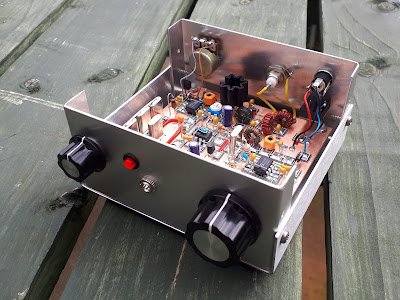
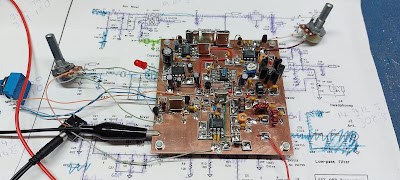
Wow, especially on St. Patrick’s day I think it is appropriate to say ” ’tis a thing of beauty. “

Colin did a great job on his homebrew version of the SST transceiver. It looks like his is on 30 meters. I especially liked his description of the troubleshooting that followed the construction. the assist provided by AA7EE’s blog was especially cool, and demonstrates the long-lasting power of internet-shared tribal knowledge.

Colin wrote (on Facebook):

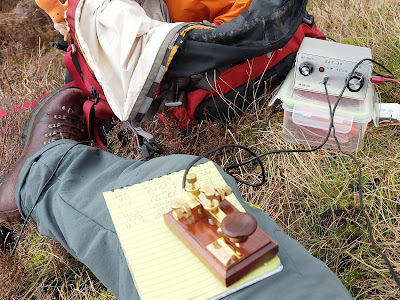
I was inspired by Bill and his adventure with the SST-20, so I started gathering a few parts last year to build a Manhattan SST. I did a joint SOTA activation with a fellow homebrewer ham at the end of January and we started talking about classic portable CW rigs, it turned out that we both had an SST build on our ‘list’. I was challenged to build the SST for the next joint SOTA activation!
It took a lot of effort and a few late nights but I did manage to produce a rig capable of making QSOs for a joint SOTA activation of Fair Snape Fell, G/SP-007. I’d done a solo activation of Pendle Hill G/SP-005 a few days before with the rig for a trial run and I discovered that the AF was very low. After some troubleshooting I noticed that I’d soldered the LM386 gain set capacitor to an incorrect pad. Doh! I fixed my error and the rig had much more gain.
I found that with the improved AF gain, the rig would squeal if the gain was turned up. I was ready to give up really, but after a cool off period, I began researching the issue and it turns out that it’s very common and indeed I found posts from 1997 about it! It seems as though my recreation was so faithful to the original, I’d included the original flaws too! I added in a 0.1uF cap and resistor connected to pin 5 of the AF amp chip as per the suggestion on Dave AA7EE’s blog and now the squealing has stopped.
I’d made 14 QSOs during the joint SOTA activation, so I considered my challenge to have been met! It’s been a bit of an epic build!
73, Colin, M1BUU
N8NM’s SAVED VFO 30 Meter Rig

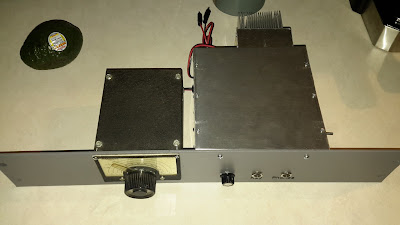
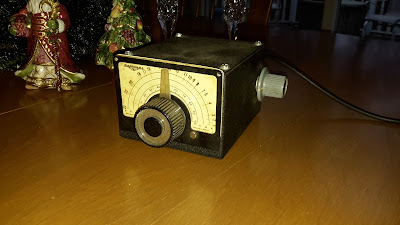
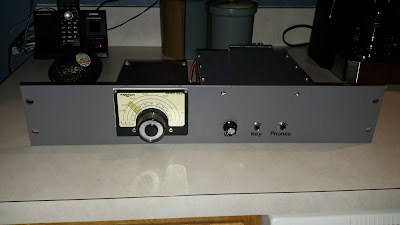
In early December Steve Murphy N8NM picked up this “mystery box” at a hamfest. Dr. Juliano identified it as an old CB VFO. Even though Steve is deeply committed to the dark side of frequency generation (digital synthesis) I was able to convince him to put this VFO to legitimate and proper amateur radio use AS AN ANALOG VFO. I mean just look at that dial! It would be a sin to connect that beautiful mechanism to a rotary encoder. We see the results below.

Bill:

The 30m rig that I had hoped to have QRV for SKN is finally ready to hit the airwaves! I still have a few odds and ends to tidy up, but it’s essentially done.

Where I ran into problems was my original choice of IF and VFO frequencies: I’d gone with a 13.51 MHz IF because I had the rocks, but that put the 3rd harmonic of the VFO right in the middle of the band. Oops.
Moving the IF to 13.56 fixed that problem, but I still had a spur from that harmonic that needed to be filtered. At first, it looked like a trap on the output of the VFO would squish it, but it ended up requiring a few extra poles of bandpass filtering to get it below -40 dB/c. Now we’re legal.
Anyway, here’s a few pics. The chassis are bent from 22 ga aluminum on my trusty Harbor Freight brake. They’re almost square, they look cockeyed because I still need to make brackets to hold the top and bottom together. The heat sink is overkill for 5 watts, but it was cheap 🙂
Electronically, almost everything between the audio and power amps is straight-up Bitx. The power amp uses a RD16HHF1 driven by my spin on Farhan’s RF-386, and the audio is an LM380 driven by an LM324, with gating between CW and digital mode input handled by a CD4066. The CW tone generator is based on WB0RIO’s “clickless” sidetone circuit, which, while a little complicated, creates perfectly formed CW elements that really sound nice.
I’m still amazed at the stability of the LC VFO; I was monitoring JT65 signals over the weekend and noticed zero drift after warm-up. To keep it ready to rock, it’s powered from the “hot” side of the on/off switch, as is the CW oscillator.
I can’t think of much else to say about it… It is what it is 🙂
73 – Steve N8NM