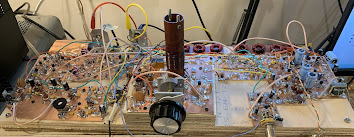
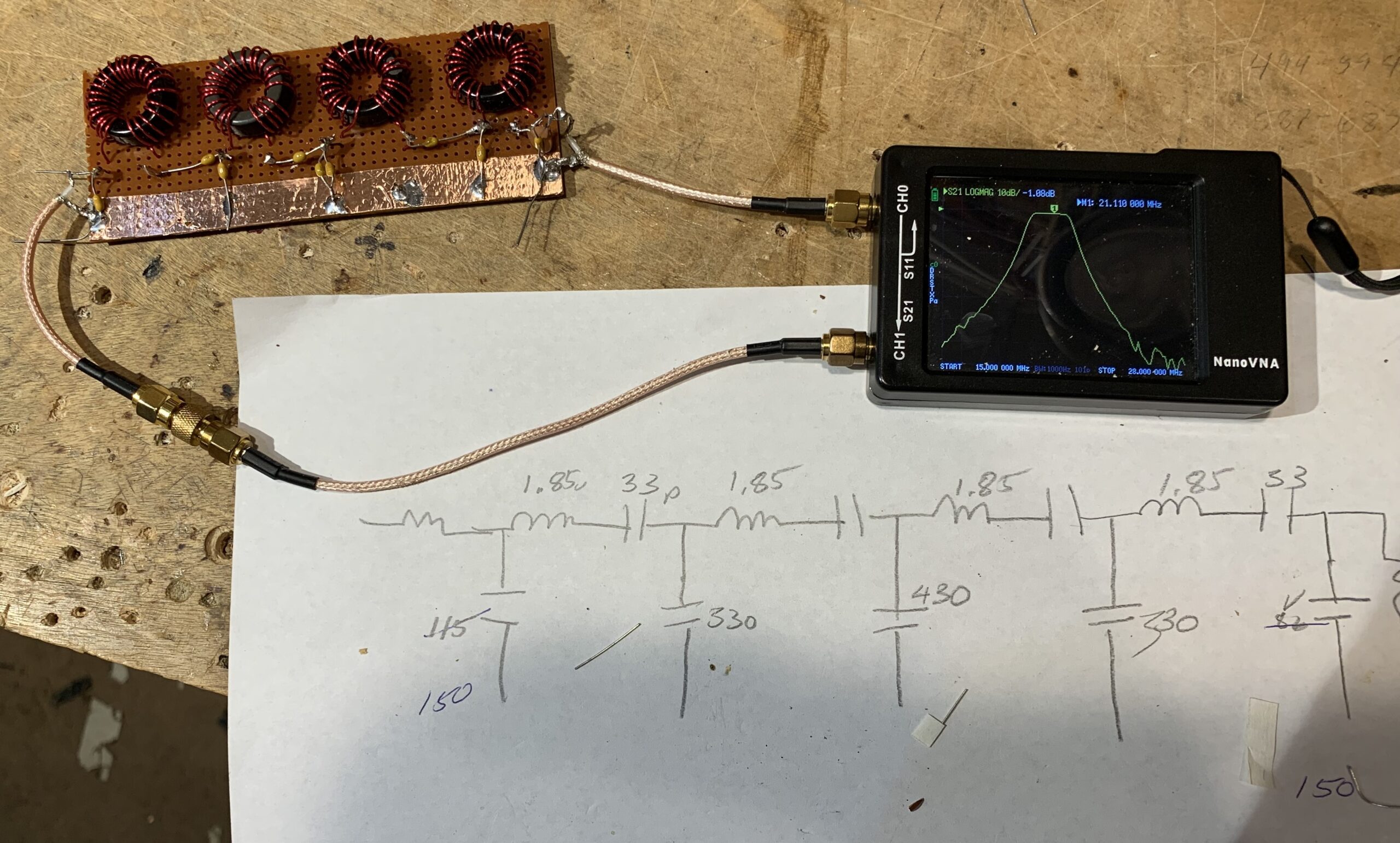
Above you can see the really nice 15 meter filter that I built using data provided by Martein PA3AKE.
https://martein.home.xs4all.nl/pa3ake/hmode/bpf_all.html
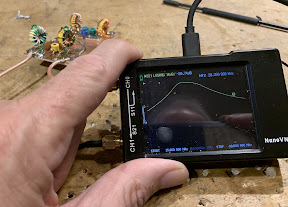
Before I built Martein’s filter, my bandpass had been inadequate. Looking at the signals coming out of the diode ring mixer in my 15-10 rig, I realized that when I was on 15, there would also be an output on 10. And vice-versa. These outputs would have to be knocked down by the bandpass filters. I had been using simple dual tuned circuit filters. But when I looked at the filter shapes of these filters in NanoVNA, I could see that On 15 the 10 meter signal was only down about 20 db. And on 10 the 15 MHz output was also down only by about 20 db. That’s not enough. Take a look:
Before, with the dual tuned circuit filter
After with Martein’s Filter 21.5 Mhz
AFTER with Martien’s filter 21.1 MHz
While the earlier filter had provided only about 20 db of attenuation at 28 MHz, Martein’s filter provided at least 68 db of attenuation. That is really nice. And the passband is nearly flat at 1 db attenuation.
I built mine using some of the guidance provided on Martiens site. I did use T80-10 toroids (I got them from kitsandparts.com). And I did not use copper clad boards.
One of the charming features if Martein’s filters is the total lack of trimmer caps: Martein recommends tuning the filters by simple squeezing the coils (to increase inductance and decrease frequency) or by spreading out the turns a bit (to decease inductance and increase frequency). I did the later when NanoVNA showed that I didn’t quite have all of the 15 meter phone band on the flat portion of the curve.
I also like the way Martein provides the values for BP filters for all of the HF ham bands. Very useful.
Next I will build one for 10 meters. And I will probably go back to my Mythbuster and 17-12 rigs and build Martein’s filters for these rigs.
Thanks Martein!