Our book: “SolderSmoke — Global Adventures in Wireless Electronics” http://soldersmoke.com/book.htm Our coffee mugs, T-Shirts, bumper stickers: http://www.cafepress.com/SolderSmoke Our Book Store: http://astore.amazon.com/contracross-20
Author: Peter Marks
Arduino Repaired (well, sort of)
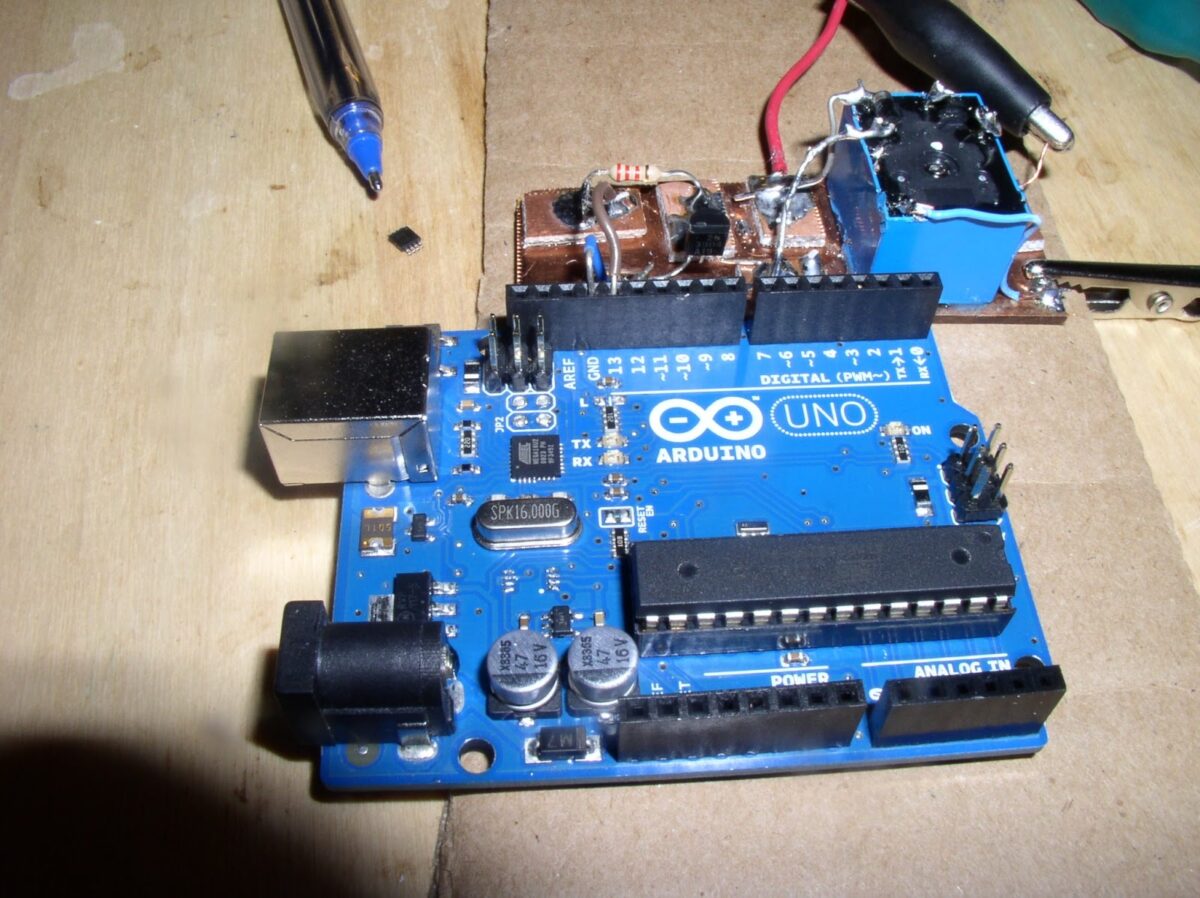
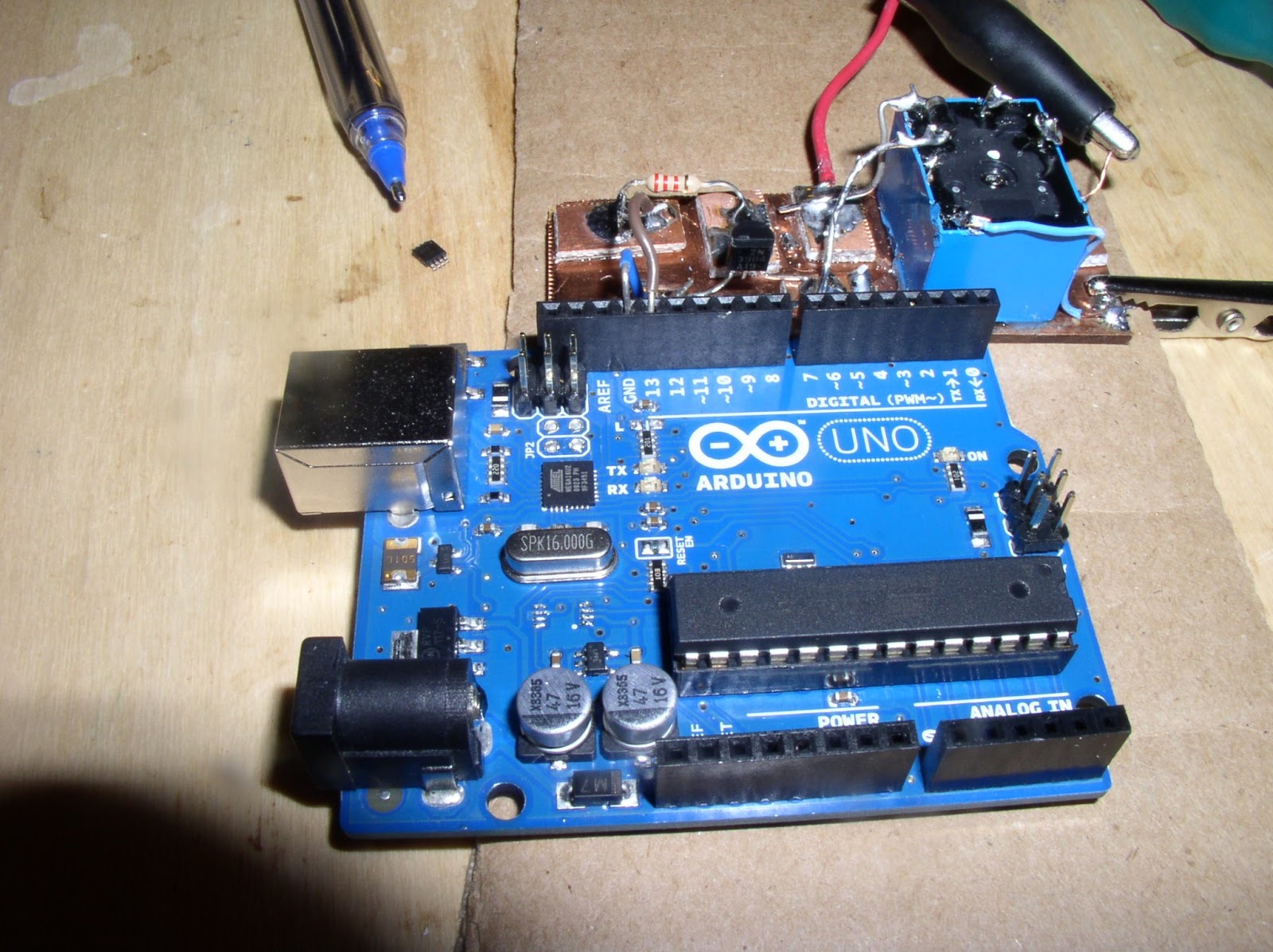
Thanks to info from Leif, KC8RWR, about the purpose of the chip that was heating up on my Arduino board (an LM386 used to determine which socket was supplying voltage for the board) I decided to try just taking the hot chip off the board. This afternoon I fired up my reflow station and blew some 466 degree F air on that chip. It came right off and the Arduino appears to work just fine without it.
This was only a semi-satisfying repair. It would have been much better if I’d really known what I was doing, and if I’d really known what was going on with that chip.
The removed chip is up by the tip of the pen (TOO SMALL!). The transistor and the relay that keys the transmitter are on a piece of PC board above the Arduino.
That Arduino called CQ for me on 20 meters tonight — Mel, K4JFF, in Georgia responded. Thanks Leif! And thanks again to Mark, K6HX, for the code.
Our book: “SolderSmoke — Global Adventures in Wireless Electronics” http://soldersmoke.com/book.htm Our coffee mugs, T-Shirts, bumper stickers: http://www.cafepress.com/SolderSmoke Our Book Store: http://astore.amazon.com/contracross-20
Adventures with Small Computers
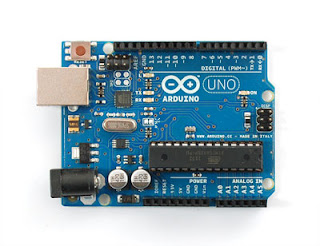
I’ve succumbed to the lure of the tiny computers and microprocessors. This weekend I was playing with the Arduino that I bought (supposedly) for Billy. You see, I have a little microprocessor-based keyer in my ten meter beacon rig (Demaw’s “Lil’Slugger”) . It works fine once you get the desired Morse sequence into it, but getting that done is difficult and frustrating for someone (like me) unaccustomed to an iambic keyer. So I was thinking that this would be easier just to replace the keyer with an Arduino. I was right. With some help and advice from Billy, I got the Arduino going, and got the little LED blinking. Then I took some code from Mark K6HX, modified it for my call-sign, and loaded it into the Arduino. No problem at all. Kind of fun. And it opens your eyes to all the possible applications of this little board.
Unfortunately, in the course of fooling around with the interface between the board and my rig I think I did damage to my Arduino. I managed to blow out the blinking (pin 13) LED on the board. I could live without that, but now the ICs get very hot (especially the little surface mount chip just below the 16 MHz crystal). Anyone hope of fixing this? (I’ve already ordered a replacement board, but I feel guilty about this.)
Here’s a good article describing the pros and cons of Arduino, Raspberry Pi and Beagle Bone:
http://blog.makezine.com/2013/04/15/arduino-uno-vs-beaglebone-vs-raspberry-pi/
Our book: “SolderSmoke — Global Adventures in Wireless Electronics” http://soldersmoke.com/book.htm Our coffee mugs, T-Shirts, bumper stickers: http://www.cafepress.com/SolderSmoke Our Book Store: http://astore.amazon.com/contracross-20
French Knack: F8ATA, F8KE, F8CKH, and K3DY
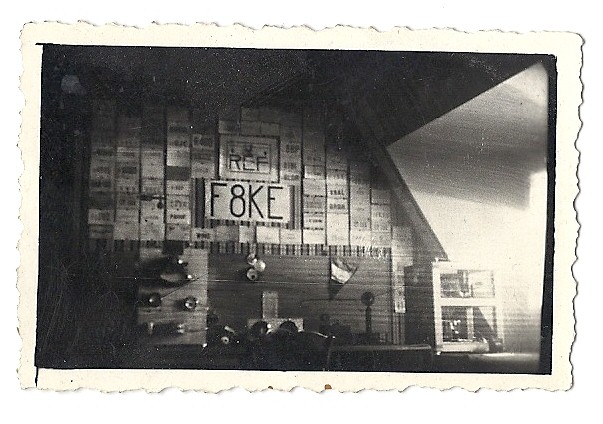
Hello Bill, It has been a while! I don’t know if you remember but I emailed you back in September 2010, introducing myself as a fellow amateur listening to your podcasts. I had just moved from France and received back then my FCC vanity callsign K3DY.
It took me a while to get my ham shack back together but finally I was on the bands again! Recently, I started re reading your book, very inspirational. Since my very first license (as F8CKH) at 16, my interests have always been into the design / homebrew as well as QRP & CW. Why on earth would a teenager do that? I think I have the knack. My motto is: “Don’t turn it on, take it apart!!!”.
Anyway, it has been a lot of fun to work on some various projects (the one in progress now is a LC meter using a LCD display and a PIC 16F627). It took longer than expected to get to that point as I had to work on a PIC programmer interface as well as refresh my C language programming skills! I recently discovered that mouser is offering some nice project enclosures. In the past, my finished products were kind of “ugly” (to the average Joe not us of course!) so I am trying to work on that.
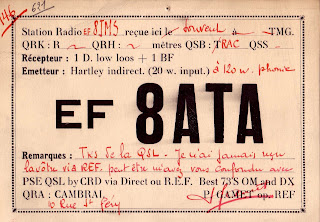
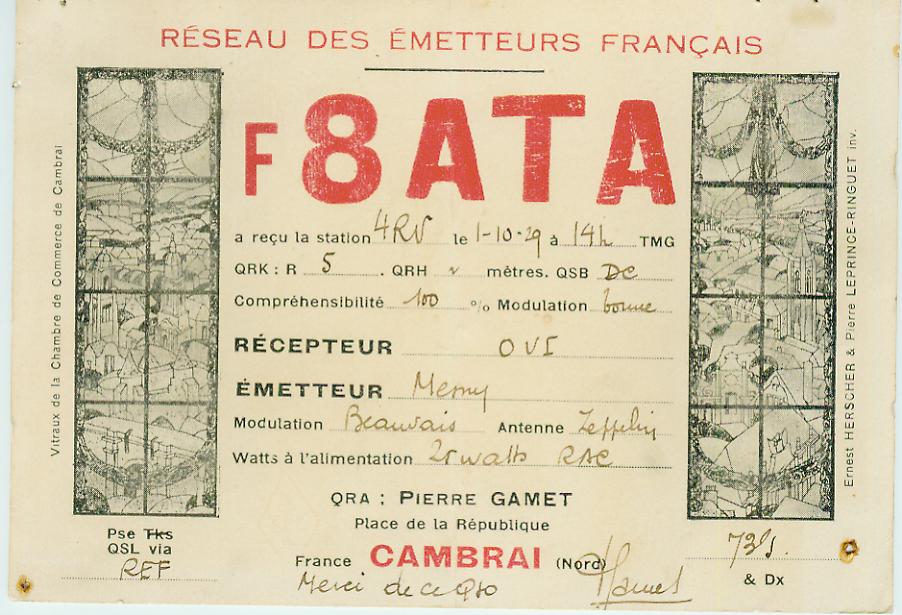
Oh also, last time I emailed you, I talked about my grand father EF8ETA, F8ATA then F8KE in the late 20s and how seeing his electronic lab and radios when I was 7 or 8 inevitably changed my life! After all this, I – had – to get my license and get involved! My father, also a ham, emailed me a picture of F8KE’s shack in 1929/1930. My grand father was at the time 19 years old. Also attached to the email are two scans of his QSL cards dated as well 1929 or so. He was using a classic design for the era, based on a Hartley Oscillator. I am trying to imagine how it was to get the knowledge back then on how to build a station (TX, RX, antenna) but also how to get the parts! When people now complain that they can’t finish up a homebrew project because they can’t find a FT50-3 core, well they should think of how it must have been almost 100 years ago.
Have a great weekend! 73, K3DY Antoine
Our book: “SolderSmoke — Global Adventures in Wireless Electronics” http://soldersmoke.com/book.htm Our coffee mugs, T-Shirts, bumper stickers: http://www.cafepress.com/SolderSmoke Our Book Store: http://astore.amazon.com/contracross-20
Happy World Cosmonautics Day!
Our book: “SolderSmoke — Global Adventures in Wireless Electronics” http://soldersmoke.com/book.htm Our coffee mugs, T-Shirts, bumper stickers: http://www.cafepress.com/SolderSmoke Our Book Store: http://astore.amazon.com/contracross-20
Arduino and Bugs (real bugs! billions of them!)
http://blog.makezine.com/2013/04/10/swarmageddon-cicadas-helping-crowdsource-citizen-science/
Our book: “SolderSmoke — Global Adventures in Wireless Electronics” http://soldersmoke.com/book.htm Our coffee mugs, T-Shirts, bumper stickers: http://www.cafepress.com/SolderSmoke Our Book Store: http://astore.amazon.com/contracross-20
Imaging Across the EM Spectrum
Amazing images here:
http://blog.makezine.com/2013/04/09/somewhere-outside-the-rainbow-imaging-across-the-em-spectrum/
Our book: “SolderSmoke — Global Adventures in Wireless Electronics” http://soldersmoke.com/book.htm Our coffee mugs, T-Shirts, bumper stickers: http://www.cafepress.com/SolderSmoke Our Book Store: http://astore.amazon.com/contracross-20
A Nice Workshop in Germany
Wannabe-Choppers from Thorsten Indra on Vimeo.
Our book: “SolderSmoke — Global Adventures in Wireless Electronics” http://soldersmoke.com/book.htm Our coffee mugs, T-Shirts, bumper stickers: http://www.cafepress.com/SolderSmoke Our Book Store: http://astore.amazon.com/contracross-20
Sputnik Schematic Found!
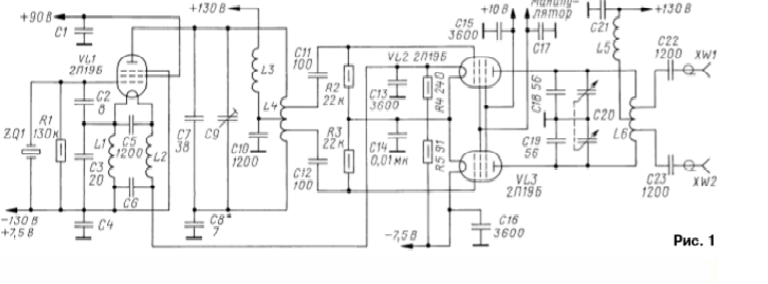
We were searching for this last year. Oleg, RV3GM, finally found the schematic for the transmitter in the Sputnik satellite.
ftp://ftp.radio.ru/pub/2013/04/55.pdf
Our book: “SolderSmoke — Global Adventures in Wireless Electronics” http://soldersmoke.com/book.htm Our coffee mugs, T-Shirts, bumper stickers: http://www.cafepress.com/SolderSmoke Our Book Store: http://astore.amazon.com/contracross-20
SolderSmoke Podcast #151
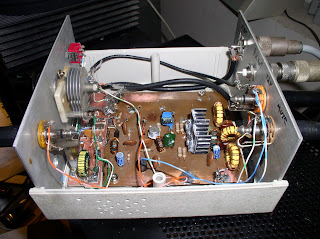
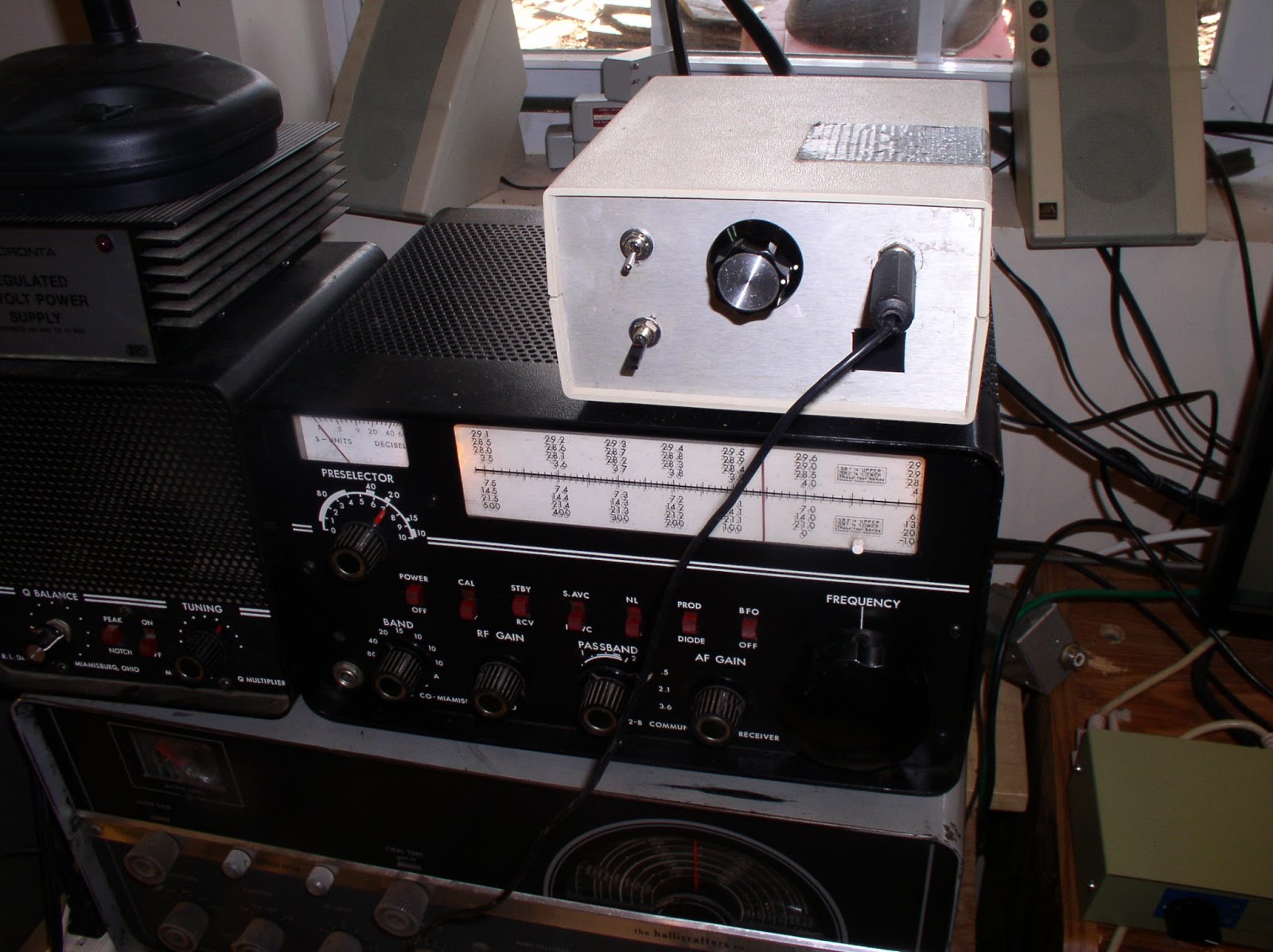
SolderSmoke Podcast #151 is available.
http://soldersmoke.com/soldersmoke151.mp3
April 1, 2013
Topics:
— Spring not yet sprung
— Dominican nostalgia wave hits SolderSmoke HQ
— Rebuild of my first transmitter
— Dusting off the Barebones Superhet
— SolderSmoke Book Corner:
Ben Franklin by Walter Issacson
How Arthur C. Clarke handled his Mailbag
“The New Cool” Dean Kamen’s house/shack
Transistor Radios by Ronald Quan
— New SolderSmoke Advertising Campaign
— QRP vs. QRO:
Put 40 milliwatt “Shark Fin” QRSS rig on the air
Being lured into QRO amp construction projects
— Reverse Beacon Network
— Looking for my Elmer (or his son)
— MAILBAG
Our book: “SolderSmoke — Global Adventures in Wireless Electronics” http://soldersmoke.com/book.htm Our coffee mugs, T-Shirts, bumper stickers: http://www.cafepress.com/SolderSmoke Our Book Store: http://astore.amazon.com/contracross-20
An update from Yi Yao, VA3YAO
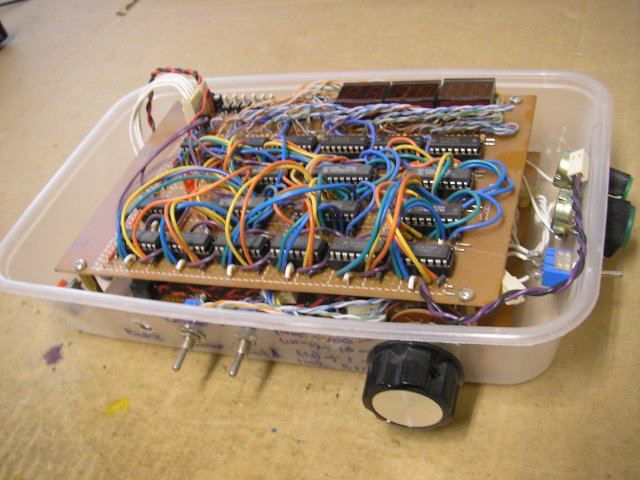
We did a short article on Yi Yao a while back, noting that he definitely has The Knack. His homebrew frequency counter (above) confirms that he does. In a recent e-mail from him I also detect an inclination toward poetry. April is Poetry Month, so I thought I should share the latest from Yi:
Hi Bill,
I haven’t gotten around to making my first rig yet. But, after
listening to SolderSmoke since the beginning, it seems like the universal rule
of homebrewing has been to avoid regens!
I’ve been focusing on mechanical design for the last while. Having
spent 2 years in a heavily electrical engineering oriented
environment, I decided to try something new. Most of the smoke that
I inhale these days is from cutting oil vaporizing as I turn something
on the lathe. Chips mean bits of metal that are created from cutting
metal. Soldering is done with a torch. The common thread with
electronics is the knackish pursuit of elegant design and beautiful
construction.
I’ve been thinking about getting myself a copy of SSDRA, but even
looking at online used book stores, this is costing in the
neighbourhood of some of my university textbooks. There’s no shortage
of good information and ideas for homebrewing online though. I think
that’s what I will use.
Cheers,
Yi
Our book: “SolderSmoke — Global Adventures in Wireless Electronics” http://soldersmoke.com/book.htm Our coffee mugs, T-Shirts, bumper stickers: http://www.cafepress.com/SolderSmoke Our Book Store: http://astore.amazon.com/contracross-20
Wow! Great Article on the Wow SETI Signal
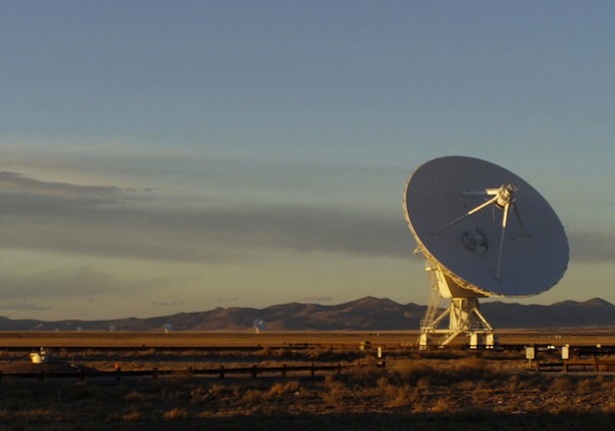
Thanks to David Umbaugh (and his son!) for alerting me to this really great article in The Atlantic on one intrepid amateur who has chosen to follow-up on the famous (and possibly extraterrestrial) “Wow” signal. You will like this article.
http://m.theatlantic.com/technology/archive/2012/02/the-wow-signal-one-mans-search-for-setis-most-tantalizing-trace-of-alien-life/253093/
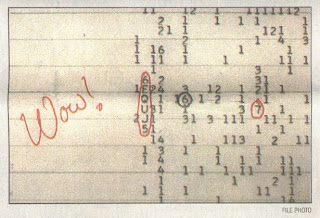
Robert Gray’s book is available here:
Our book: “SolderSmoke — Global Adventures in Wireless Electronics” http://soldersmoke.com/book.htm Our coffee mugs, T-Shirts, bumper stickers: http://www.cafepress.com/SolderSmoke Our Book Store: http://astore.amazon.com/contracross-20
Good time to Buy Book: 20% off at Lulu
http://www.lulu.com/spotlight/soldersmoke
Use Coupon Code VERNUM through March 31 and get 20% off.
Our book: “SolderSmoke — Global Adventures in Wireless Electronics” http://soldersmoke.com/book.htm Our coffee mugs, T-Shirts, bumper stickers: http://www.cafepress.com/SolderSmoke Our Book Store: http://astore.amazon.com/contracross-20
Edgy Skimmer Antenna

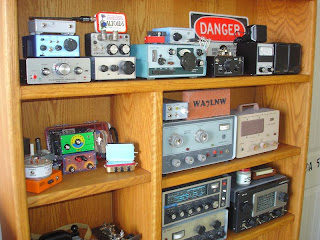
For the last few days I’ve been hanging out on 20 meter CW, 14.050 – 14.060 MHz, using my re-built W1VD/Barbados rig. I’ve had some great contacts, but almost as much fun is watching the Reverse Beacon Network to see who is hearing my calls. WA7LNW is one of the “skimmers” that most consistently picks up my signal. One look at the picture above explains this. The receive antenna for his skimmer rig IS ON THE EDGE OF THIS CLIFF! Jack has one of those dream jobs for a radio amateur: he works at that amazing location, testing ejection seats for jet aircraft. More great pictures here:
http://www.dxwatch.com/qrz/lookup.php?c=rbn/WA7LNW
Thanks for the reports Jack!
Our book: “SolderSmoke — Global Adventures in Wireless Electronics” http://soldersmoke.com/book.htm Our coffee mugs, T-Shirts, bumper stickers: http://www.cafepress.com/SolderSmoke Our Book Store: http://astore.amazon.com/contracross-20
AA1TJ’s Latest QRPp Rig
From Mike, AA1TJ:
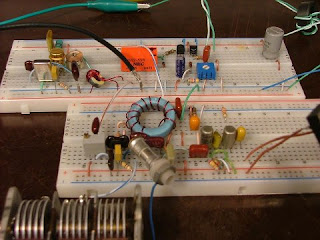
I called CQ on 20m CW for a couple of hours yesterday afternoon with no response. With the cadence of my own Morse tugging at my eyelids, I was suddenly shaken awake by a brisk signal returning my call and signing CU2BV. I snapped out a 579 report and turned it over. The dits and dahs in my headphones told me it was Fernando; operating from São Miguel island in the Azores. He reported a weak but solid copy (529) of my fifty milliwatt signal.
Here’s the radio that I used yesterday. The one-transistor transmitter is to the left of the red relay on the top board. The single transistor is a germanium surface-barrier device made by Philco in August of 1958. To the right of the relay is a two-transistor time-delay circuit used to switch the antenna between the transmitter and the receiver. My receiver on the lower proto-board is a reproduction of my first shortwave receiver: a $7 Japanese kit that I bought at Radio Shack when I was 13 years-old.
Fifty milliwatts is some twenty-four times less power than was used by an old double D-cell flashlight. I later learned that my signal was nearly simultaneously picked up by an automated receiver located just west of Dusseldorf, Germany.
Snowy Vermont to the lush Azores – some 1500miles off the coast of Portugal – with less power than is consumed by a beeswax candle…is it any wonder that I love radio? 😉
Our book: “SolderSmoke — Global Adventures in Wireless Electronics” http://soldersmoke.com/book.htm Our coffee mugs, T-Shirts, bumper stickers: http://www.cafepress.com/SolderSmoke Our Book Store: http://astore.amazon.com/contracross-20
Sunblock! Earth-Sun-Mars Alignment Affects Communications

Something to be considered by those hoping to win the Elser-Mathes Cup.
http://www.jpl.nasa.gov/news/news.php?release=2013-108
Our book: “SolderSmoke — Global Adventures in Wireless Electronics” http://soldersmoke.com/book.htm Our coffee mugs, T-Shirts, bumper stickers: http://www.cafepress.com/SolderSmoke Our Book Store: http://astore.amazon.com/contracross-20
Video of my Barebones Superhet
I literally blew the dust off this thing last week. I posted the schematic a few days ago (scroll down). This morning I finished re-building the CW transmitter that went with it. I am running out of rigs to re-build, so I suppose I will now have to start building some new ones. Maybe a BITX-20? Or a BITX-75/20?
Our book: “SolderSmoke — Global Adventures in Wireless Electronics” http://soldersmoke.com/book.htm Our coffee mugs, T-Shirts, bumper stickers: http://www.cafepress.com/SolderSmoke Our Book Store: http://astore.amazon.com/contracross-20
The Southern Appalachian Radio Museum
Chris, KD4PBJ, of SMT Solutions, sent us a thumb drive with pictures and videos of his visit to the Southern Appalachian Radio Museum. What a great collection of radios! I saw many old friends on those shelves.
There is a lot of radio history in that museum, and much of it is conveyed by the photos and videos that Chris took. Here they are, all 111 files:
https://picasaweb.google.com/116927941005026017464/SARM#
The museum is in Asheville, N.C. http://www.saradiomuseum.org
Thanks Chris. And thanks to the curators of this fine museum.
Our book: “SolderSmoke — Global Adventures in Wireless Electronics” http://soldersmoke.com/book.htm Our coffee mugs, T-Shirts, bumper stickers: http://www.cafepress.com/SolderSmoke Our Book Store: http://astore.amazon.com/contracross-20
A Beautiful Receiver by W1DN
I wish my prototypes (or final products!) looked this good. I like the way Lee puts the switches onto the prototype board. Very nice.
Our book: “SolderSmoke — Global Adventures in Wireless Electronics” http://soldersmoke.com/book.htm Our coffee mugs, T-Shirts, bumper stickers: http://www.cafepress.com/SolderSmoke Our Book Store: http://astore.amazon.com/contracross-20
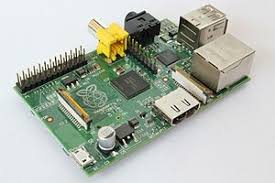
Wow! Raspberry Pi as an RF Transmitter
https://github.com/threeme3/WsprryPi
This site shows you how to use a $35 Raspberry Pi Computer as an RF transmitter for the WSPR (Weak Signal Propagation Reporting) System. All you need is a simple low pass filter and an antenna. (Oh yea, and a ham radio license.) The site says you can get 10 milliwatts out. That’s enough for WSPR! Very cool.
This looks like a real international effort:
Credits goes to Oliver Mattos and Oskar Weigl who implemented PiFM [1] based on the idea of exploiting RPi DPLL as FM transmitter. Dan MD1CLV combined this effort with WSPR encoding algorithm from F8CHK, resulting in WsprryPi a WSPR beacon for LF and MF bands. Guido PE1NNZ extended this effort with DMA based PWM modulation of fractional divider that was part of PiFM, allowing to operate the WSPR beacon also on HF and VHF bands.
For more info on WSPR: http://soldersmoke.blogspot.com/search/label/WSPR
Our book: “SolderSmoke — Global Adventures in Wireless Electronics” http://soldersmoke.com/book.htm Our coffee mugs, T-Shirts, bumper stickers: http://www.cafepress.com/SolderSmoke Our Book Store: http://astore.amazon.com/contracross-20