
Author: Peter Marks
From Wayne and Garth in San Diego: EMRFD Joy of Oscillation Part 2
THE JOY OF RADIATION (perhaps my favorite)
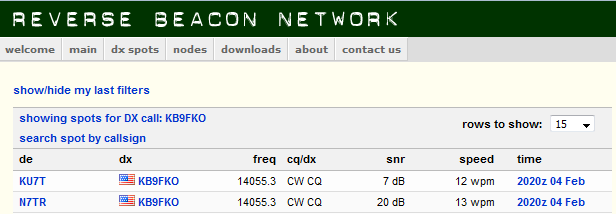
THE JOY OF RECEPTION (picked up by RBN, yeah!)
last on the list is to experience
THE JOY OF COMMUNICATION
for that, we’ll try out a number of different receivers. Cheap SW
portable. Softrock Lite. websdr.org.
Does one try to count all the joys? 🙂
Here’s a few snaps:
0.jpg – RBN evidence
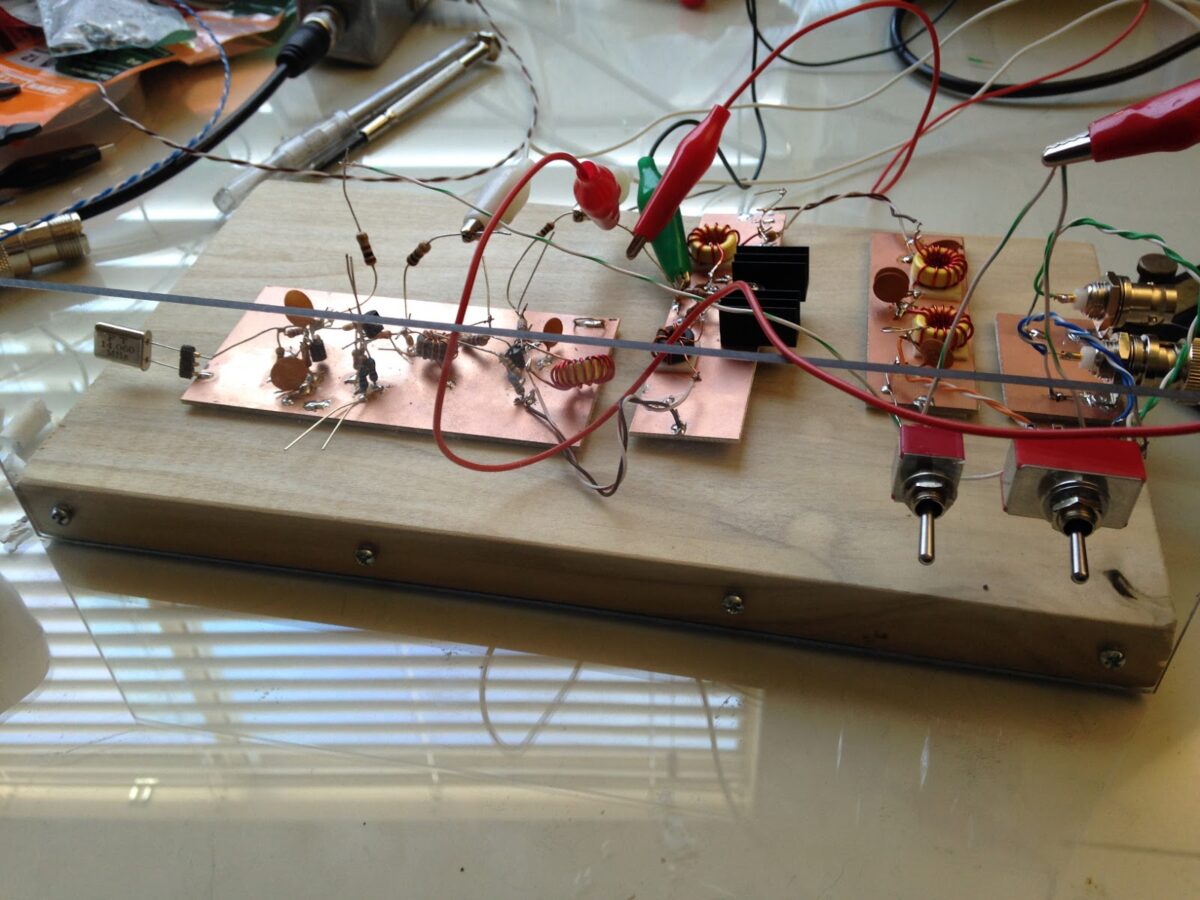
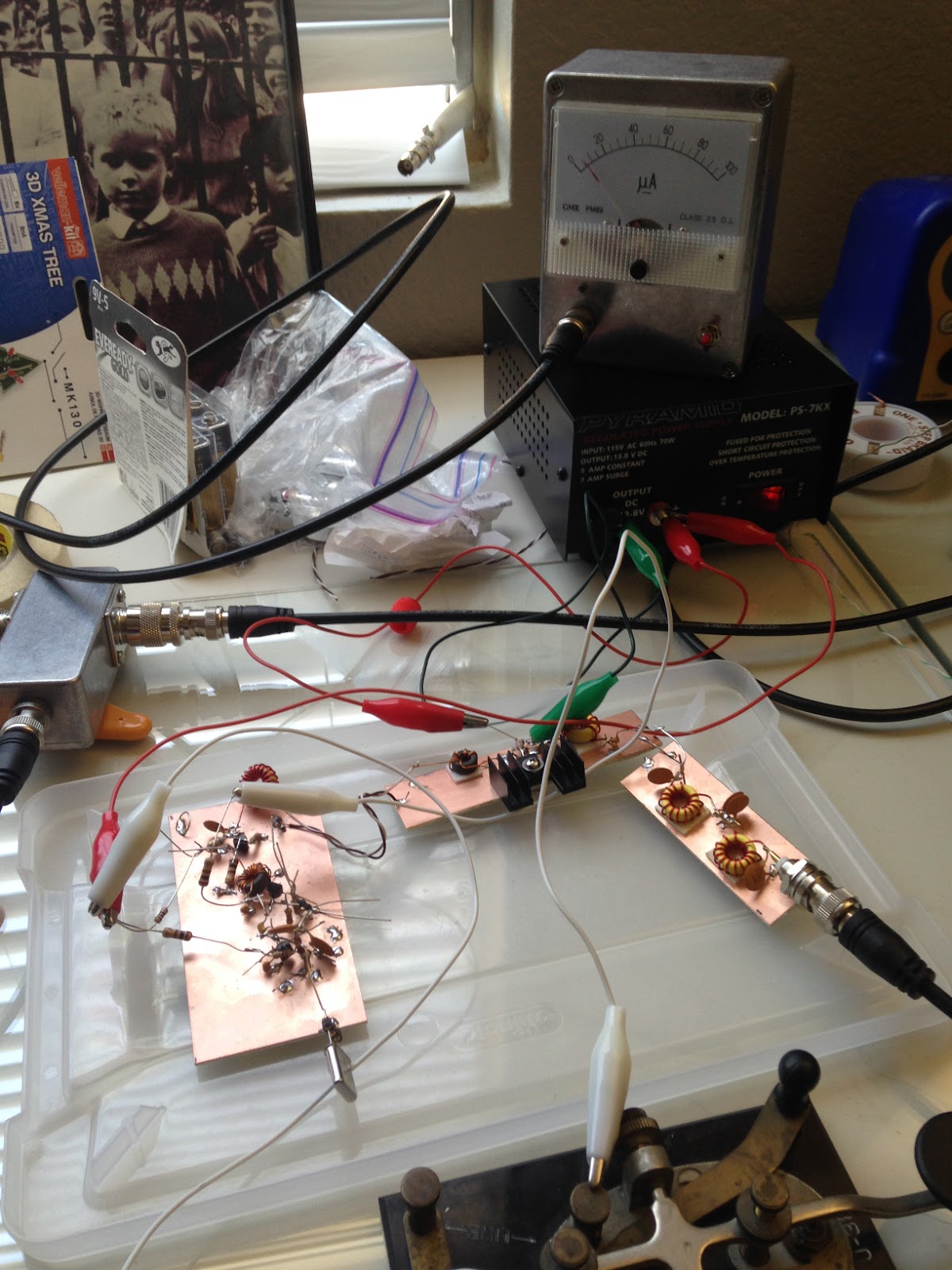
1.jpg – lashup on the lid of a tupperware container
This worked great for throwing the work in progress in a backback for
our build session meetups.
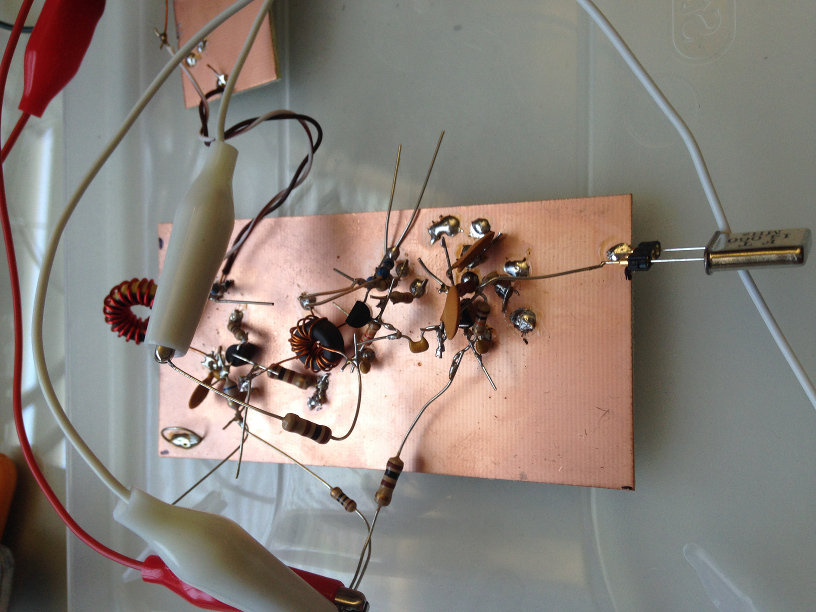
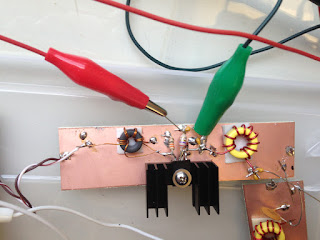
2.jpg – Fig 1.34 less output LPF.
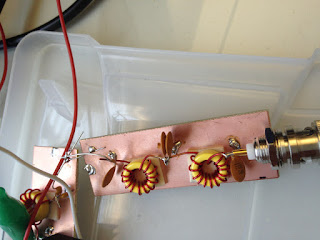
3.jpg – The missing LPF. THE JOY OF FILTRATION (OK, that’s taking it too far.)

4.jpg – Fig 1.35 amp with BD139 transistor.
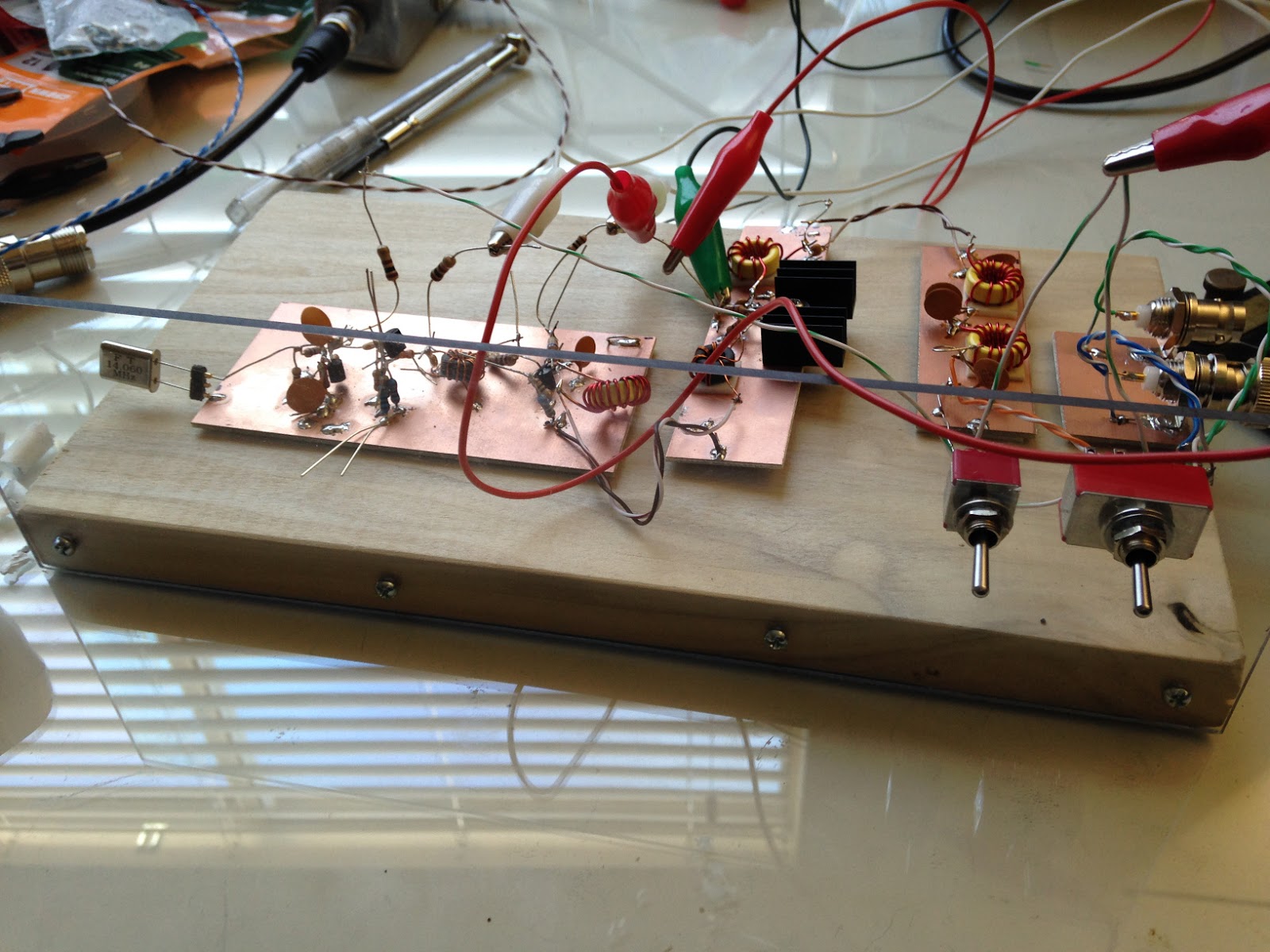
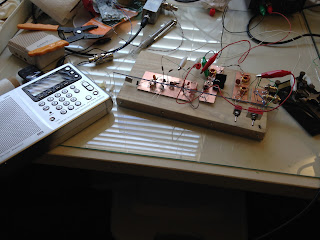
5.jpg – “breadboard” and a front panel to hold the T/R switch. Key
and cheap SW portable for RX. Waiting for DX contest to end, so I
have a chance. 🙂

6.jpg – simple breadboard chassis
Our fun has certainly been cheap. The parts cost, including PCB and 1
BNC jack, was about $13 in low quantity from Mouser (and Diz) for all
but the amp. The amp portion was $4 in low quantity from Mouser (and
Diz), and most of that was the expensive heatsink. The “chassis” was
just a piece of cheap 3/4″ hardwood and lexan from home depot. I
drilled and tapped the holes in the wood for the #4 screws. (Seems to
hold quite nicely. I thought I might have to harden the threads with
CA adhesive as is done sometimes with balsa.)
If there are any of those air variable caps left that you are meting
out to the worthy, well, like Wayne and Garth, “we are not worthy.”
If you do have between 1 and 4 and find it in your heart, we’d be very
grateful.
Best regards,
Drew
kb9fko
San Diego
Renewed Hope for Divide by 2 I and Q
An anonymous reader posted this interesting message in the comments section yesterday. Very interesting. A potentially important tip that may help in the quest for 90 degree phase shift with divide by 2 Flip Flop circuits. What do you guys think? And who is that masked man?
I wanted to make a comment regarding your Frankenstein R2 Clock divider, but did not come around to do it until now and fear if I were to put it below the appropriate post, it would be so many pages away nobody sees it. Please forgive me for posting this here if my assumption is wrong. I had a play with two edge-triggered JK – Flip Flops (74HC109 & HC107) and tied the J and K to the appropriate rails to use them as T- Flip Flops. Because of one being positive, the other one being negative edge triggered, this behaves as a divide by 2 IQ clock generator. The HC107 has an inverting clock input, so as with the other design, some kind of inverter is involved. And as Bill has reported, I initially measured the Phase shift on the scope to be off. But while playing around, I realized this was a function of the signal level. I could tune the phase shift by adjusting the signal level of the driving clock! When the clock and power supply levels were almost equal, the phase shift was very close to 90° and pretty stable with frequency (tested with 1-10Mhz). Later I thought about it some more and suspect it might have to do with the exact time the inverter “flips” on different signal levels in relation to supply voltage level. Aside from the exact cause, I believe one could vary the supply voltage of the gates with the same effect on the phase shift as with varying the signal level. I hope my observation helps to somewhat make the advantages of divide by 2 IQ clock generators more accessible.
Grayson Evans TA2ZGE on “QSO Today”

Eric 4Z1UG has a really great interview with Grayson Evans TA2ZGE. I’m writing this as I listen.
My reactions:
I sympathized completely with his reaction to EE professors who insisted that current flows from positive to negative. Indeed. Let’s turn those arrows in the diode and transistor symbols around!
I too stripped down a Heathkit VFO and rebuilt it from scratch.
I share Grayson’s aversion to metal work. Viva Manhattan!
Here is the interview:
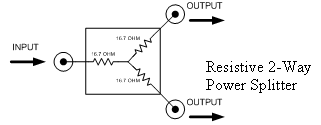
Switching to a Resistive Splitter on the Frankenstein R2
KK7B’s Thoughts on Notebooks, Experiments, and Building
Hi All,
Enjoy the experiments, and if you have self-identified as a builder, as have many of the denizens of this site, then enjoy making sketches, developing designs, and taking risks that either pay off or end up as learning experiences.
Be afraid! Be VERY afraid! Digital Audio on 20 Meters (video)
Here is a very interesting comparison between digital audio, and plain old SSB audio (from a Collins rig!).
I don’t know. I may be prejudiced here, but that digi audio just doesn’t sound too good to me. And I ask myself: “How could it?” They are restricting the transmit bandwidth to 1.2 kHz. Can the error correcting elements of the software help them get around the bandwidth limits of Shannon’s communications theory?
The digi audio sounds quite robotic to me. Even Siri sounds better. Is this because — as the receiving station noted — they were only getting “80 percent decode”? Would the digi audio have sounded better if signal strength had been better?
Again, I don’t know. But remember. I am a Ludite (with a single d — the ORIGINAL spelling!).
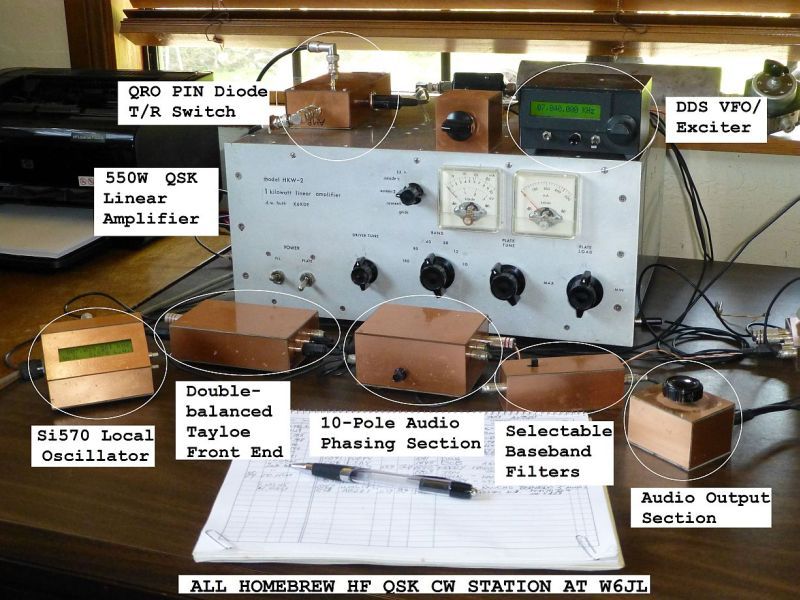
W6JL’s Amazing Phasing Station
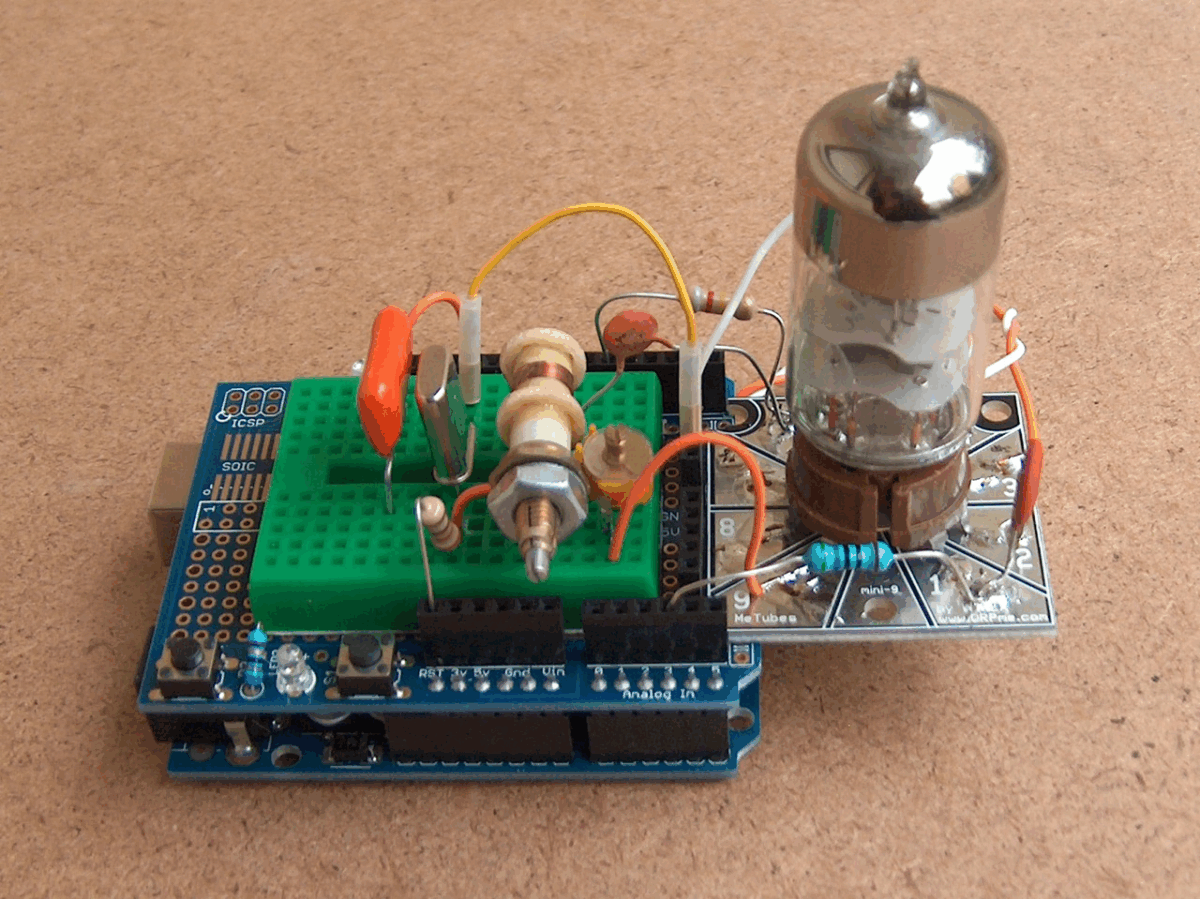
Could Grayson’s Arduino Thermatron Shield Protect Us From Digi Domination?
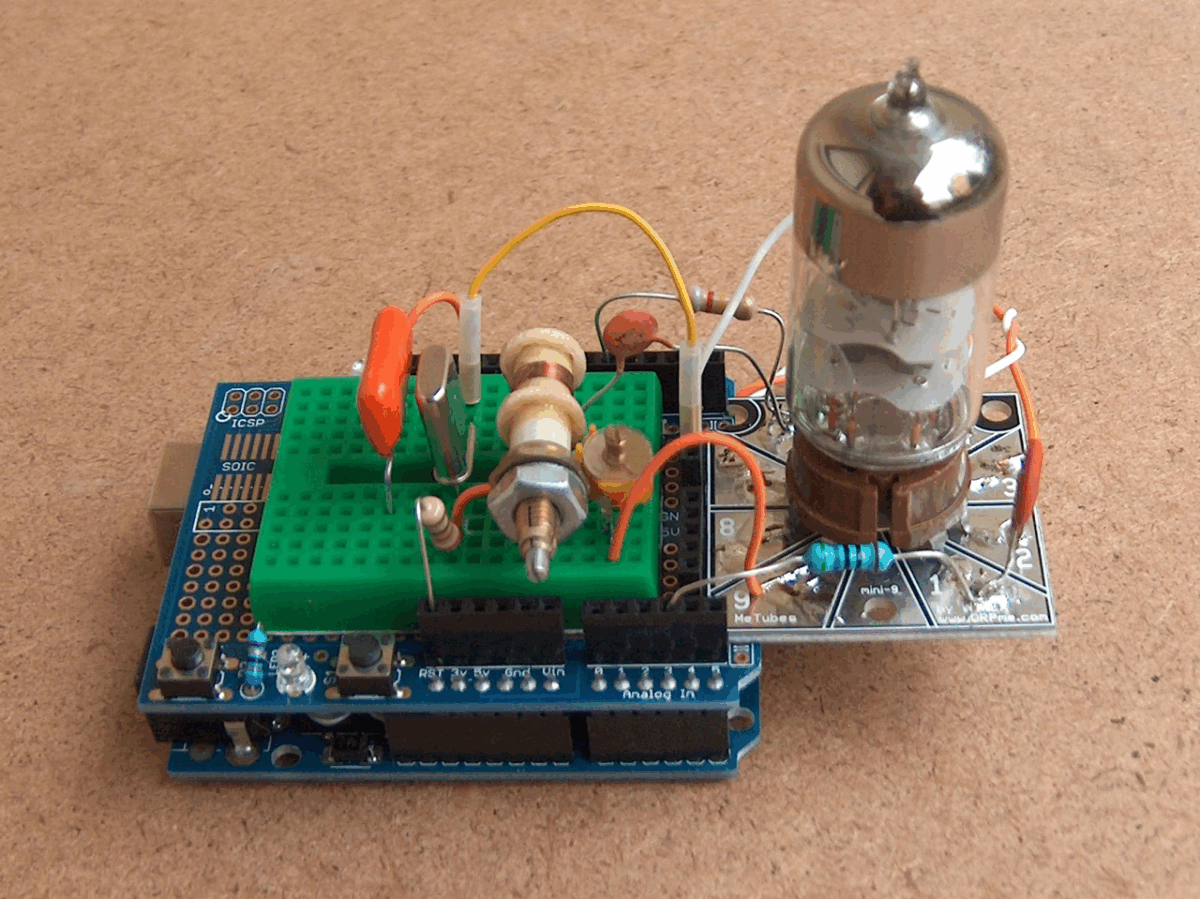
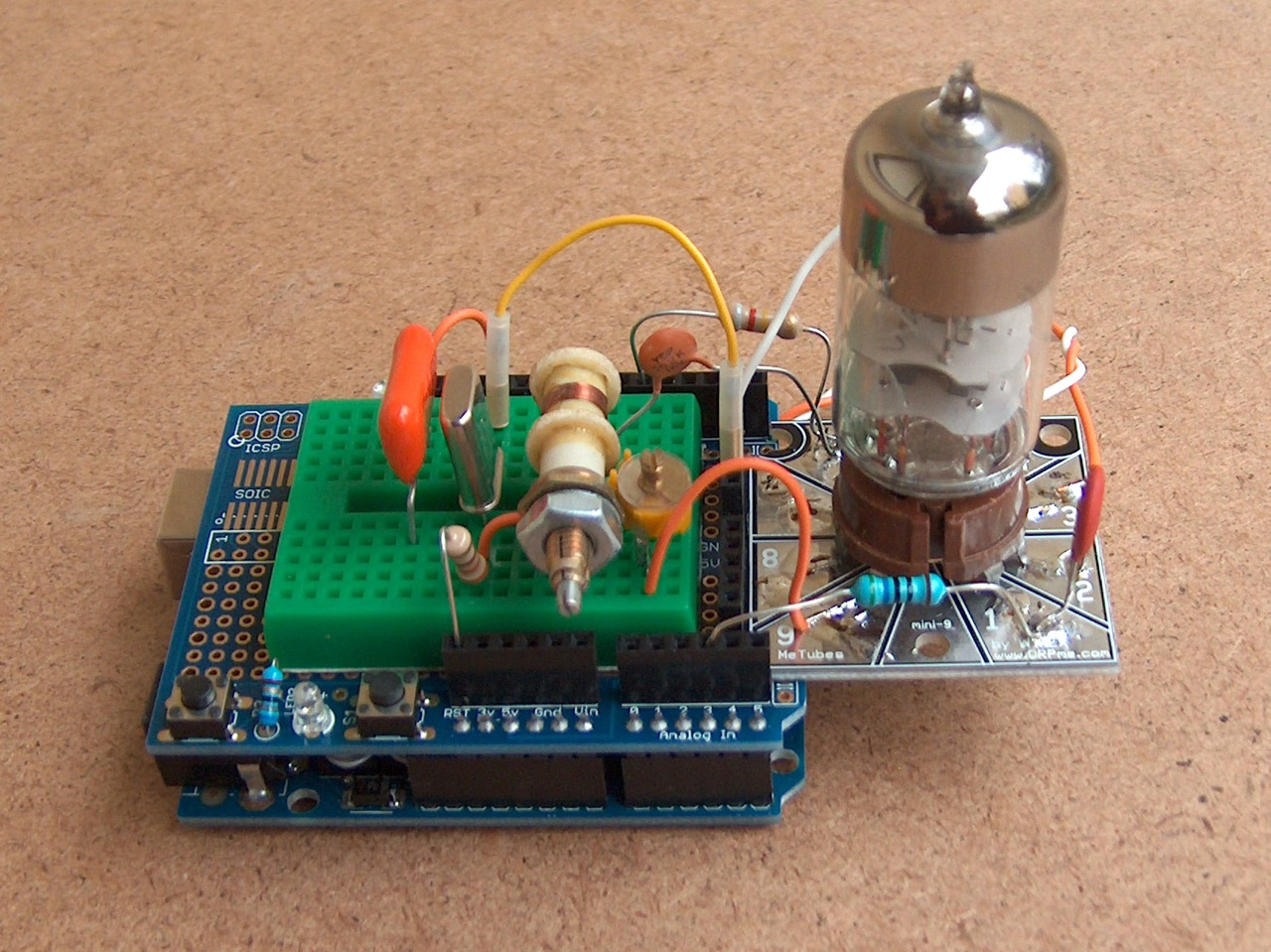
Something old, something new, eh Grayson? The author of “Hollow State Design” is engaged in an (I suppose) admirable effort to bridge the gap between our beloved Thermatrons and those new-fangled Arduinos. Here Grayson tries to explain and justify his flirtation with the dark side:
I want to do some experimenting with Thermatrons and Arduino. Sound weird? Maybe not.
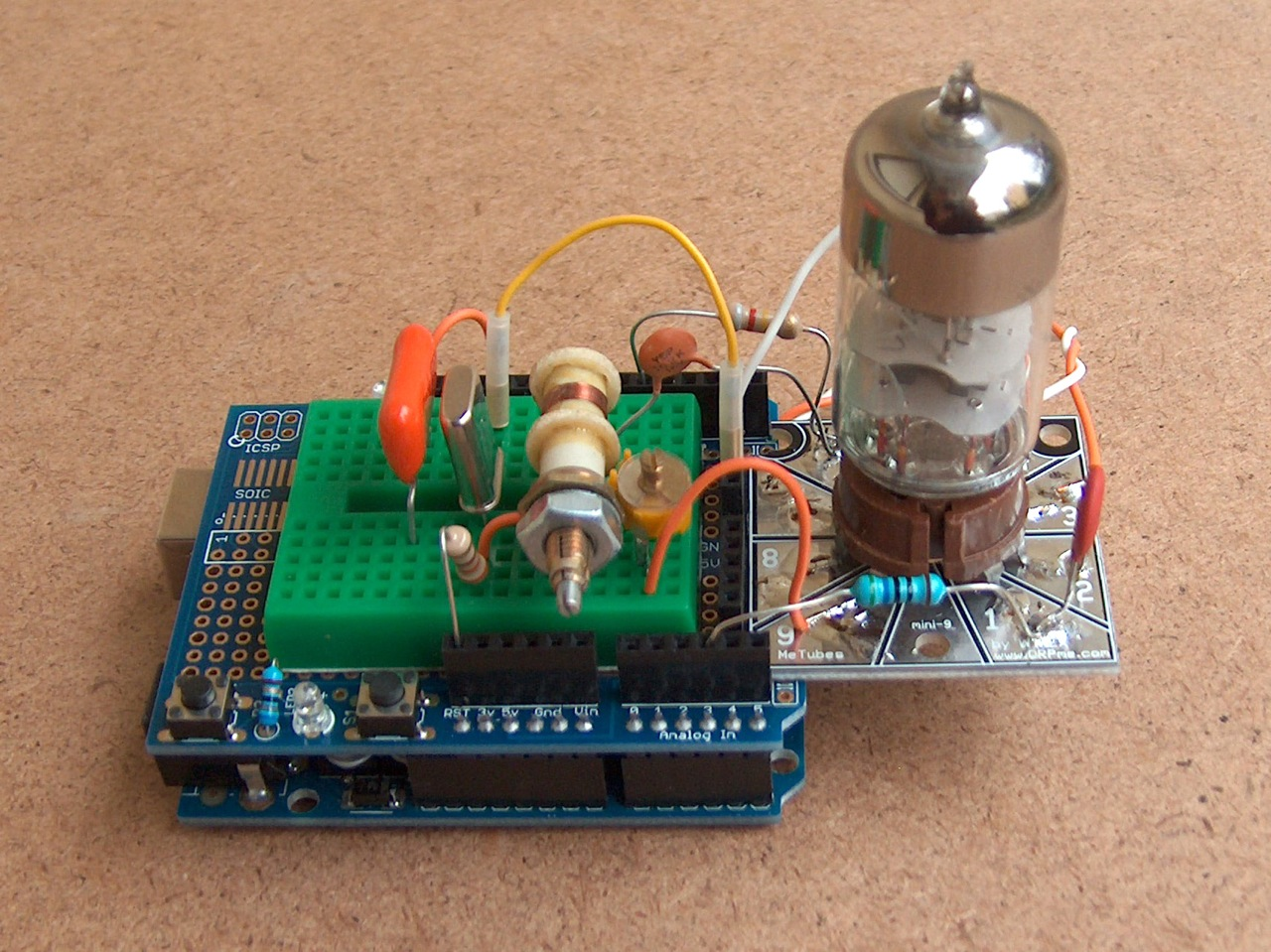
Could Grayson’s Arduino Thermatron Shield Protect Us From Digi Domination?
Something old, something new, eh Grayson? The author of “Hollow State Design” is engaged in an (I suppose) admirable effort to bridge the gap between our beloved Thermatrons and those new-fangled Arduinos. Here Grayson tries to explain and justify his flirtation with the dark side:
I want to do some experimenting with Thermatrons and Arduino. Sound weird? Maybe not.
Winterfest Hamfest with Armand WA1UQO
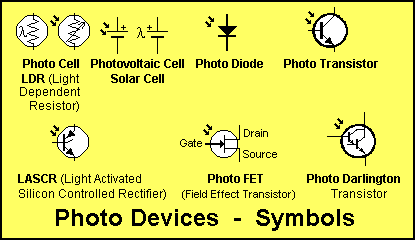
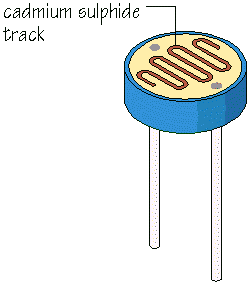
I had a great time at the Vienna Wireless Society’s Winterfest Hamfest. As I have done for several years now, I joined forces with Armand, WA1UQO. A prediction of cold rain caused many of the tailgaters to stay home, but there was still a lot of good stuff to be found at the ‘fest. I came home with a large stock of potentiometers, a 130 foot doublet with open wire line, TWO copies of SSDRA (one given to me by Armand) and various other bits and bobs (including some Cadmium Sulphide light sensitive resistors….) I successfully resisted the siren calls of several old Hallicrafters receivers. After the ‘fest Armand came with me for a visit to SolderSmoke HQ. Armand always brings along some part to be used to help members of the International Brotherhood in their radio endeavors. This year, that included several 80 meter crystals suitable for Michigan Mighty Mites and the ColorBurst Liberation Army. Thanks Armand! And thanks to the Vienna Wireless Society.
Great Video on Mixers
You know that you are sinking deep into The Knack when you watch a video like this one and find yourself thinking: “FANTASTIC! WOW! Now I know why square waves are better!” I really liked this one. In the beginning I was kind of concerned about his refusal to explain how non-linear, non-switching mixers work. He actually used the dismissive non-explanation that I’ve always found so disappointing: “Blah, blah, blah… it’s in the trig.” And he actually said, “Blah, blah, blah.” But he more than made up for it when he got into the switching mixers. Note that his drawing (at the start) of “Mixing by Switching” attempts to show the waveform that results from an LO “chopping up” an incoming RF signal. I always find that picture worth a thousand trig equations.
I also really liked his explanation of the benefits of rapid rise time in switching mixers, and how slow switching causes the diodes to spend some time in the non-linear part of their curves, giving rise (!) to IMD products (I’m paraphrasing). You can really see why they say it is better to drive diode rings with square waves. So stop trying to put low pass filters between your LO and the diode ring. Square waves are your friends here.
Mr. Marki seems to be one very cool EE. And I’d like to hear more about his dad. Here is some more about the Marki engineers:
http://mwexpert.typepad.com/markimicrowave/
GREAT Video on Mixers
You know that you are sinking deep into The Knack when you watch a video like this one and find yourself thinking: “FANTASTIC! WOW! Now I know why square waves are better!”
I really liked this one. In the beginning I was kind of concerned about his refusal to explain how non-linear, non-switching mixers work. He actually used the dismissive non-explanation that I’ve always found so disappointing: “Blah, blah, blah… it’s in the trig.” And he actually said, “Blah, blah, blah.” But he more than made up for it when he got into the switching mixers. Note that his drawing (at the start) of “Mixing by Switching” attempts to show the waveform that results from an LO “chopping up” an incoming RF signal. I always find that picture worth a thousand trig equations.
I also really liked his explanation of the benefits of rapid rise time in switching mixers, and how slow switching causes the diodes to spend some time in the non-linear part of their curves, giving rise (!) to IMD products (I’m paraphrasing). You can really see why they say it is better to drive diode rings with square waves. So stop trying to put low pass filters between your LO and the diode ring. Square waves are your friends here.
Mr. Marki seems to be one very cool EE. And I’d like to hear more about his dad. Here is some more about the Marki engineers:
KiwiSDR
QRPi WSPR with a Raspberry Pi Shield from Hungary via Tuscon
VA2NM’s Michigan Mighty Mite (with Tuna Tin LPF!) (video)
Here is my contribution… After managing to somehow get my hand wound transformer to melt a pill container, I used my Dad’s hand made, circa 1950 transformer and got it working on a 1.4 MHz xtal and also on 3.58 MHz with a colour burst xtal. A re wound coil on the remaining unmelted pill container worked on 40 meters. I succeeded in getting my Mighty Mite working on three bands. My father would have been pleased, as this was kept aside all this time and now has been put to use. He had built the coil while working part time in post World War II England at the GEC labs in U.K.
Thanks for the motivation! I’m going to move forward and clean up the 80 meter signal and see how far it goes on the reverse beacon website.
The coil form was about 80 turns on a 1 inch diameter with a 20 turn secondary that I used for the center tap portion by joining both bottom ends. Then I wound an 10 trim secondary, loaded up with a 50 ohm resistor to tune up (capacitor fully opened up) on 3.58 MHz in the video, and the audio coming from my receiver tuned to the 3.58 MHz signal.
Nigel Maund
A Great Knack Story: Peter Parker Interviewed on “QSO TODAY” by 4Z1UG
I really liked Eric’s interview with the Peter “The Wizard of Melbourne Beach” Parker aka VK3YE. What a great Knack story! There he was, trolling the garbage dumps of Western Australia, looking for discarded electronics. Using the LO of one broadcast receiver to demodulate SSB signals coming in on another… Great stuff! Check it out:
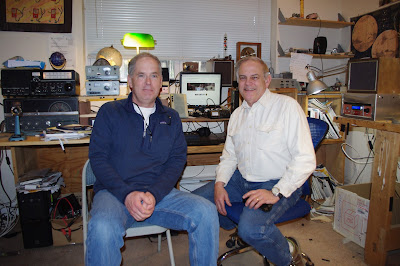
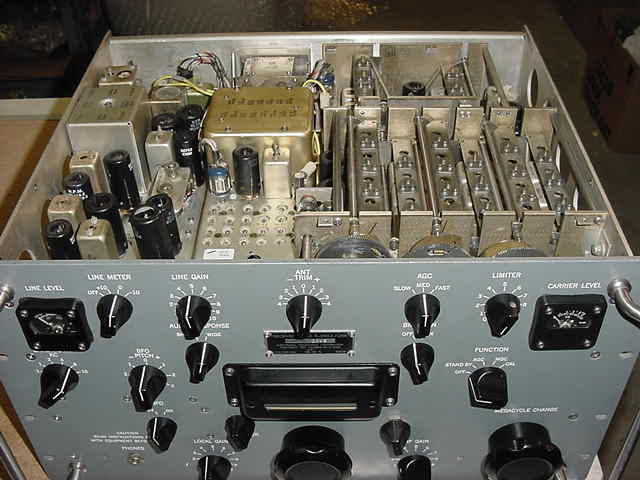
HEAVY METAL! How to Handle HEAVY Boatanchors — And Which is Heavier: R390 or DX-100?

Another Lightwave Communication Knack Story from the UK

Hi Bill,
I’ve been following your podcast since you started and enjoy every episode. I’ve been licensed here in Scotland since 1970 as GM8EUG.
I thought you/others might be interested in how I got into radio/electronics and how I feel I may have the ‘Knack’.
The above reference reminded me of some experiments I carried out in 1967 as a schoolboy. There were no ready sources of parts locally for me.. I lived in a rural area so the nearest electronics parts shop was 50 miles away so it was all done by letter and mail order.
My first audio link was driven by a tube broadcast receiver with a 3 volt torch bulb connected instead of the loudspeaker. (I hadn’t heard of impedance matching!) This flickered nicely on speech/music peaks. The bulb was positioned at the focal point of a parabolic car headlamp reflector from a scrap car. I now had a beam of light with audio on it.
Next step was the receive side…I didnt have access to a photo cell but had a Cadmium Sulphide photo resistor. Connecting a pair of low impedance headphone in series with this cell and a 1.5 volt battery gave me recognisable audio when the cell was in the beam…no amplifier needed!
Next step was greater range…this was achieved with a 6 inch shaving mirror to focus the beam onto the photo resistor. This gave me the length of the street (100 yards when it was dark outside )with the flickering beam shone out of my schoolboy bedroom window resulting in puzzled looks from passers by.
Next problem was the frequency response.. all bass and no treble. Some research indicated that the photo resistor had a slow response so that was part of the problem but I had a hunch… How fast does a filament bulb react to audio? Biasing the bulb with a 1.5 volt cell so that it glowed dimly with no audio improved the audio response greatly.
So what got me into radio…my father was a Chief Radio Officer in the Merchant Navy during WWII and my schoolboy bedtime reading (the only technical stuff I could find ) was his textbook …the 1939 edition of the Admiralty Handbook of Wireless Telegraphy. Capacitors were called condensers and they were measured in ‘jars’!
That was the start of a career. I’ve now moved through testing international telephone exchanges, installing 2 way radio for the whole of Scotland for British Rail (paid for my hobby!) and finally 32 years in IBM writing manufacturing test software from the original IBM PC to Thinkpads.
Now retired I am active on WSPR and am writing Android apps to keep my brain in gear.
I just can’t leave this stuff alone!
Hope this of interest/amusement.
73s
Neil Roberson GM8EUG

EMRFD Joy of Oscillation (Part 1)
Guys:
I have been catching up on the last few SolderSmoke podcasts after
that little QSO Today diversion. I wonder how many others did the
same thing? I have really enjoyed these recent ‘casts. Lots of
fantastic HB content. Funniest moment was when Bill described his
post-project workshop as looking like the aftermath from an electronic
barfight.
I took a new ham up on a SOTA activation last year. Then about a
month ago, he said that he wanted to do HF HB. He said he had been
googling and found so much that he didn’t know where to start. I told
him that I’d be interesting in doing a beginner HF HB project with
him.
I could have pointed him to LBS, et al. I could have pointed him to
the Michigan Mighty Mite. I did neither. I pointed him to:http://web.cecs.pdx.edu/~
the document. I pointed him also to:http://www.arrl.org/files/
(Did you guys know that chapter was online and free?) We scaled to 20m and
kitted parts for this. And parts for a 4th transistor PA for serious
QRO. 🙂
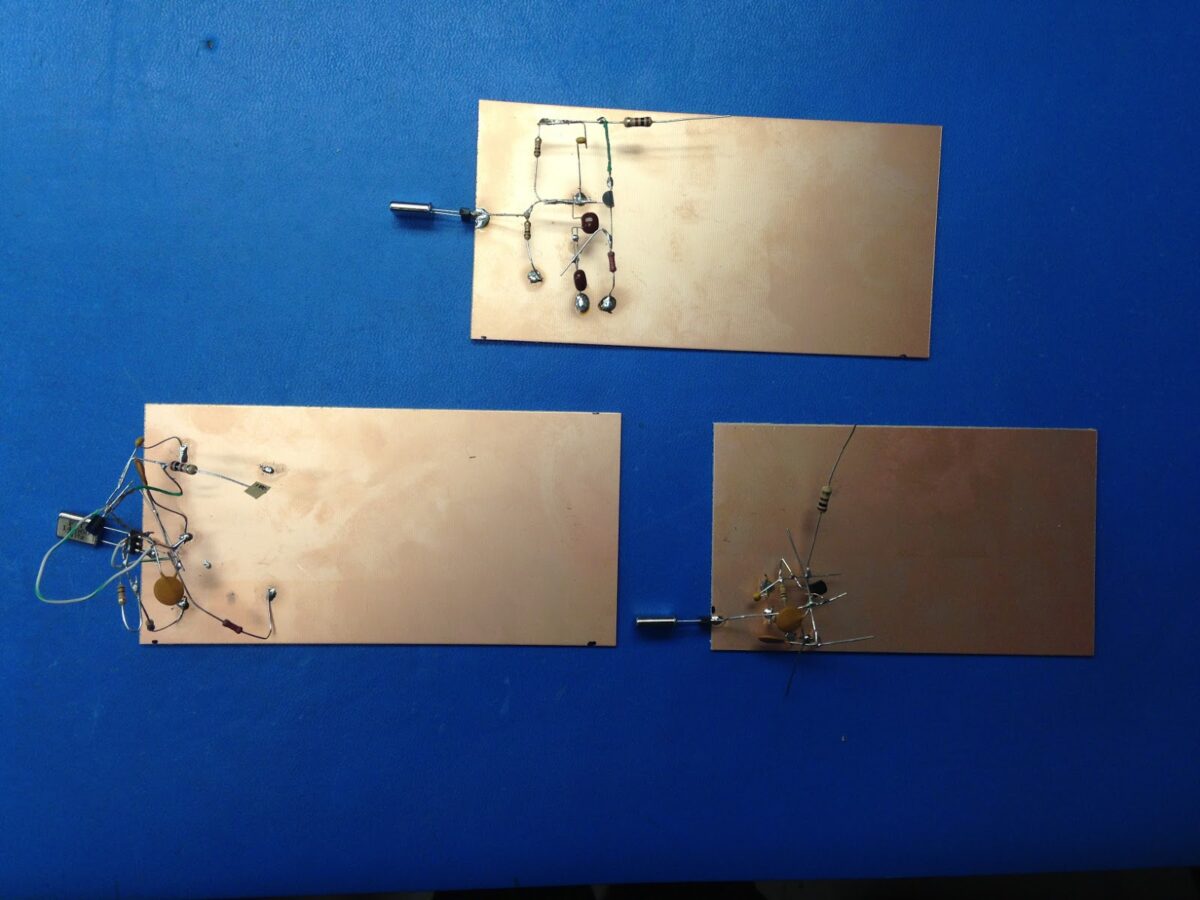
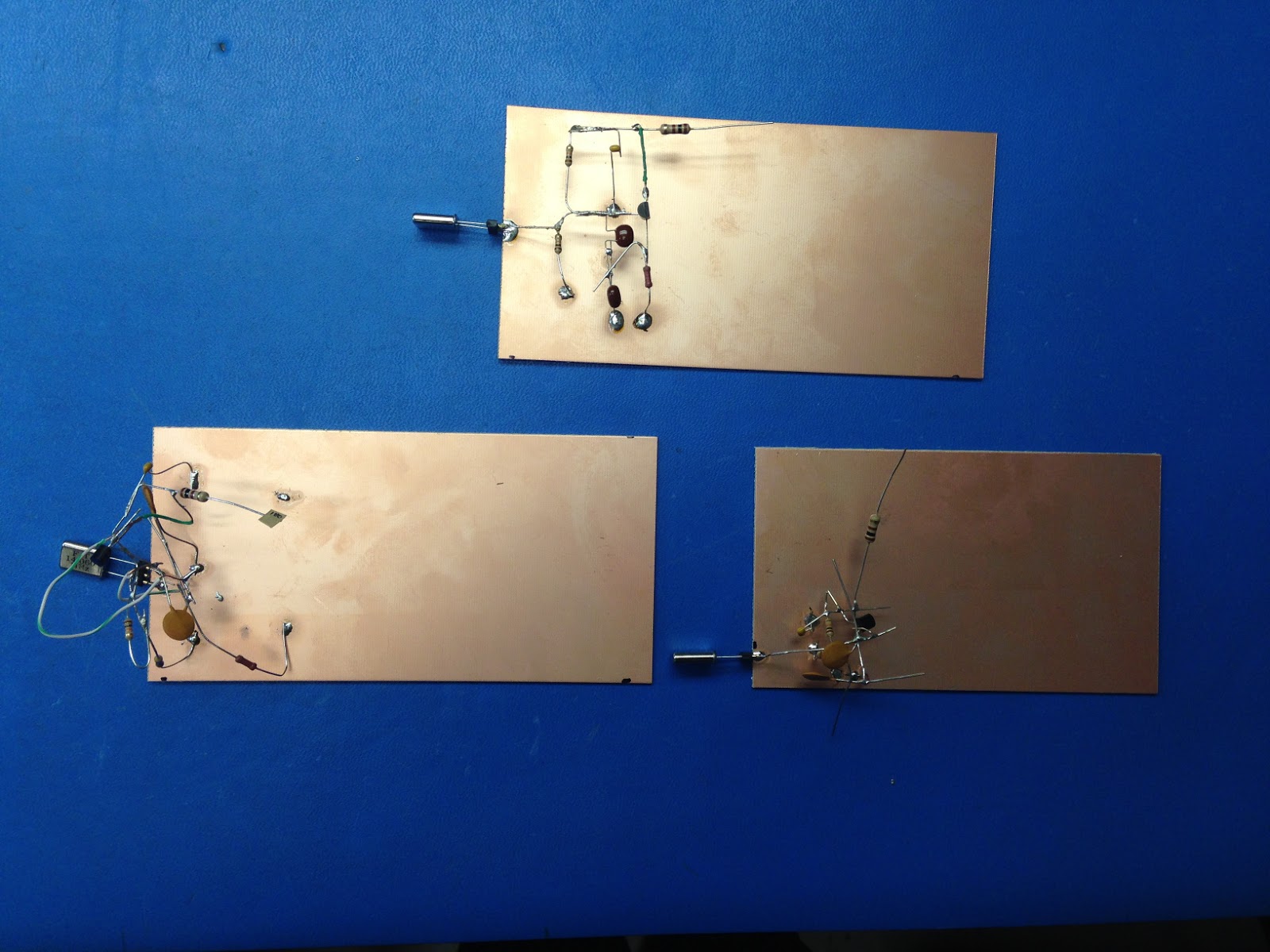
Two others joined us building for 40m. Check out the attached photos
of the first 3. The joy of oscillation was experienced by all.
After testing each oscillator, and borrowing from an article KK7B ran
in CQ VHF, I told each that he had to ID every 10 minutes. Even
though nobody was going to hear these signals a few hundred yards
away. (But it sounds loud on a shortwave portable a few inches away!)
I even wrote out the dots and dashes for a couple of them.
Next stop: to have everyone find a curbside TV discard, rip out some
parts, and get on 5 meters! Haven’t we gotten it back now, after the
transition to digital TV? 🙂
OK, maybe the next stop is to add some gain stages and experience the
joy of communication. The joy of QSO-ification? The joy of
EM-radiation? 🙂
Best regards,
Drew
kb9fko