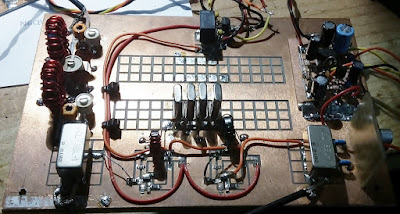
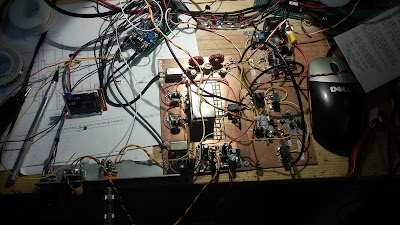
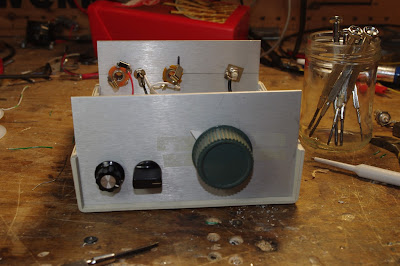
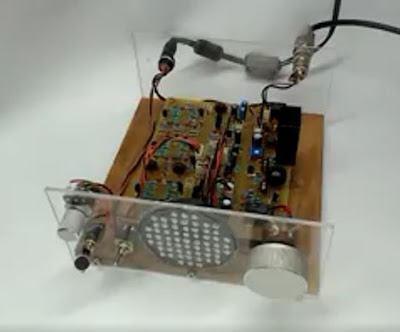
Jun JH8SST made this nice video about his version of Pete Juliano’s Simpleceiver. I like the approach of putting the stages on separate boards, but perhaps Jun could have made things easier by using Manhattan-style construction on those boards. And of course I like the breadboard-style aluminum sheet. FB Jun.
Jun writes:
Author: Peter Marks
NP0 Is the Way to Go!
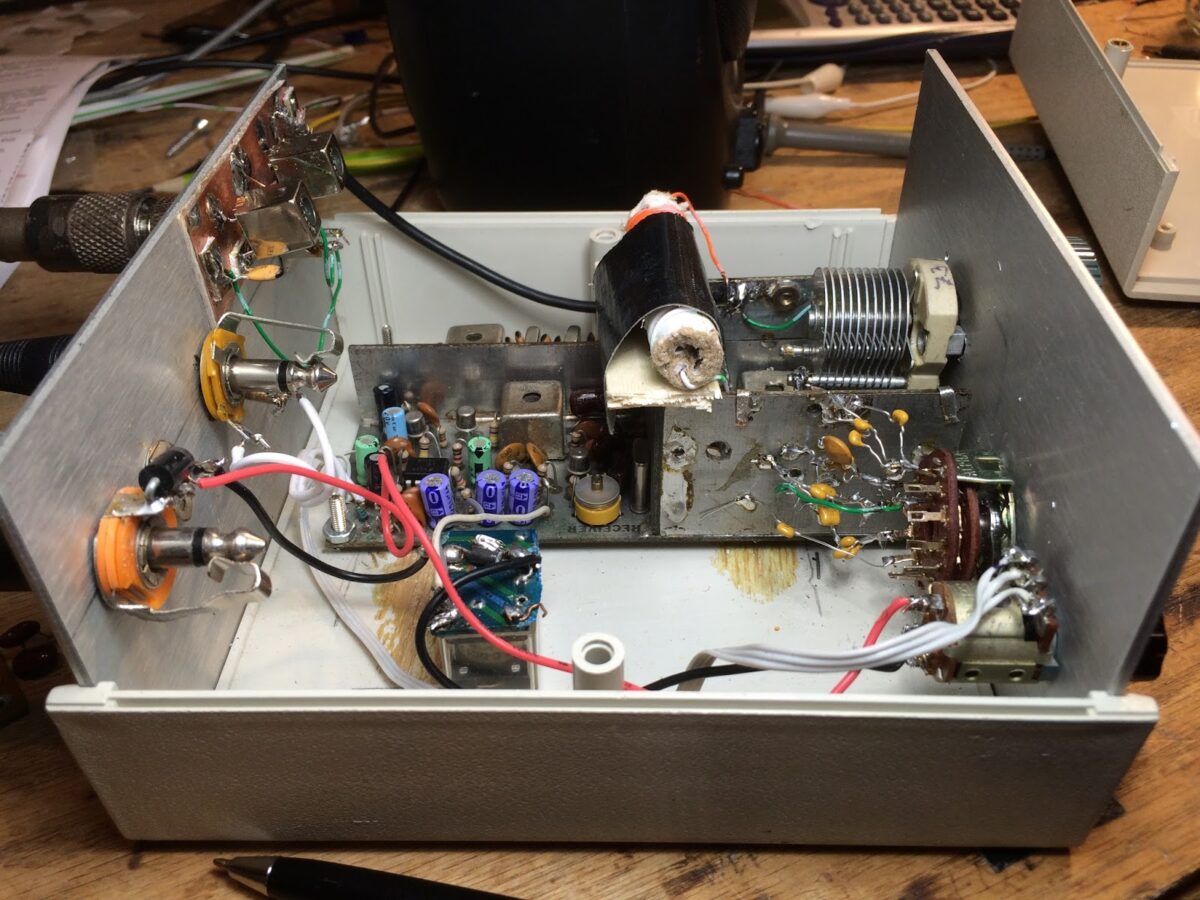
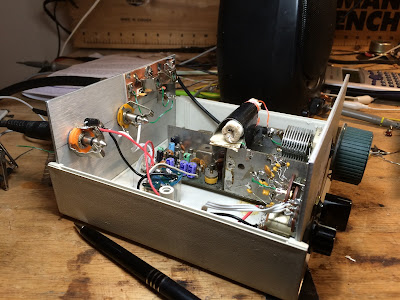
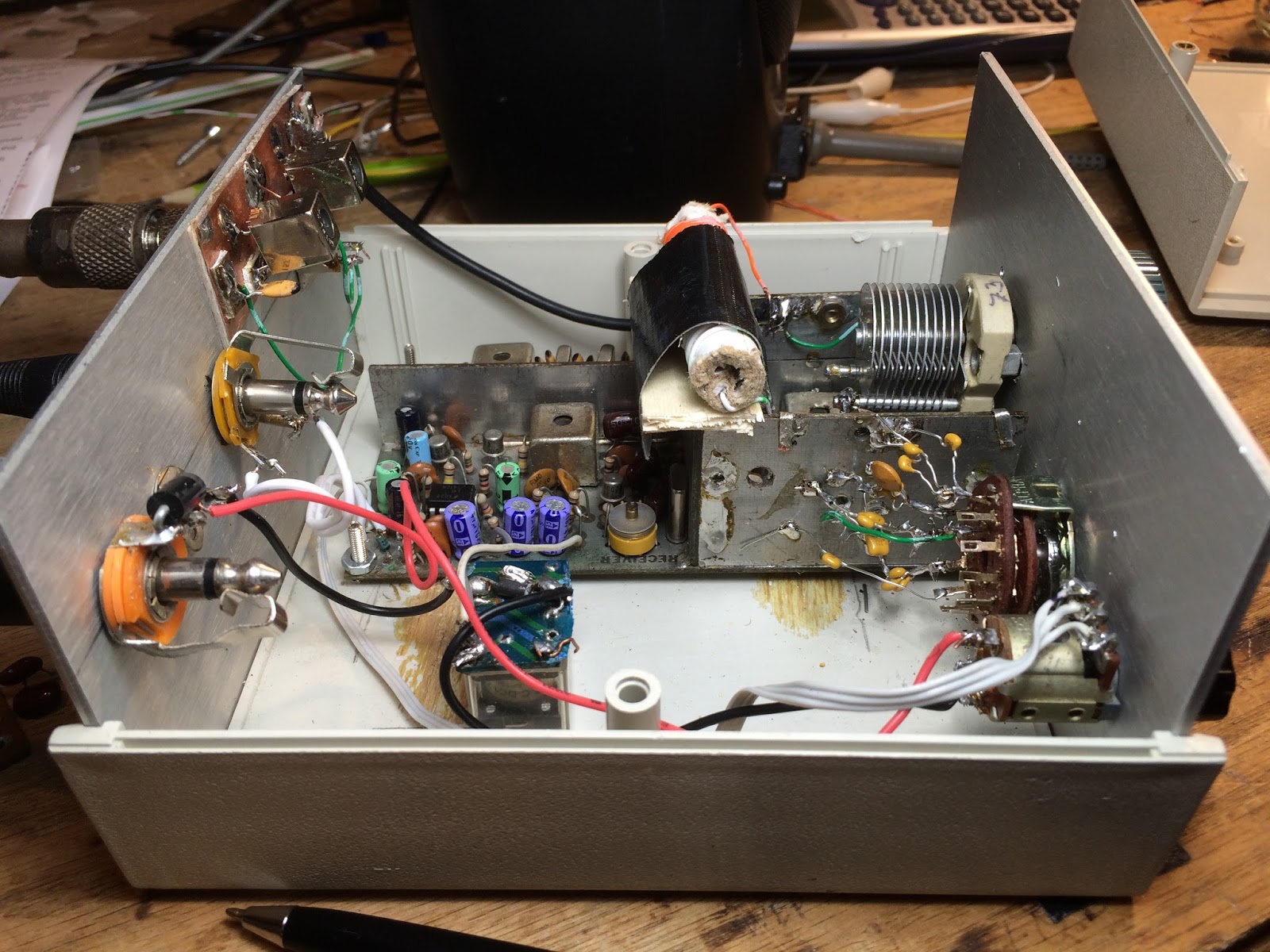
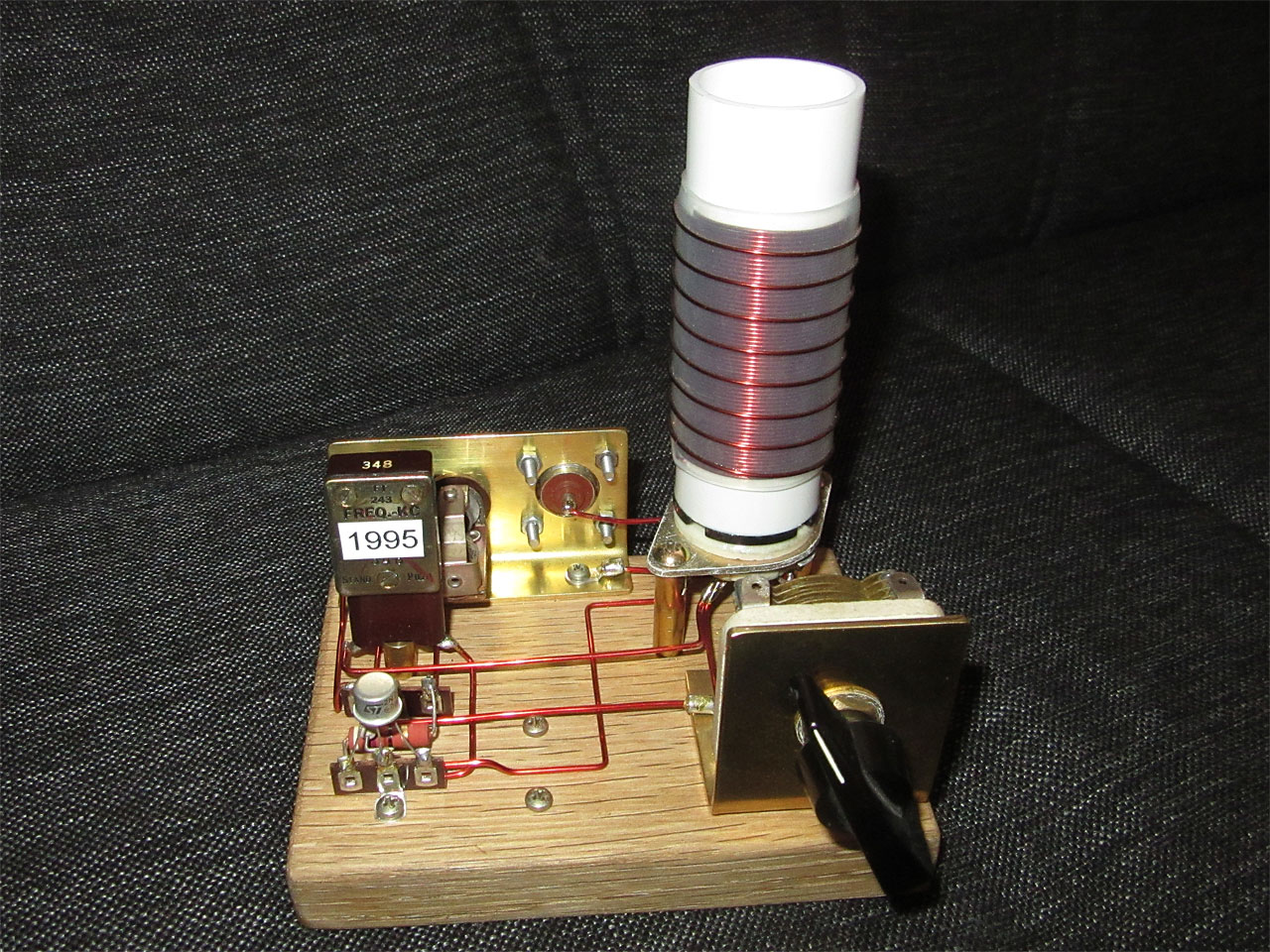
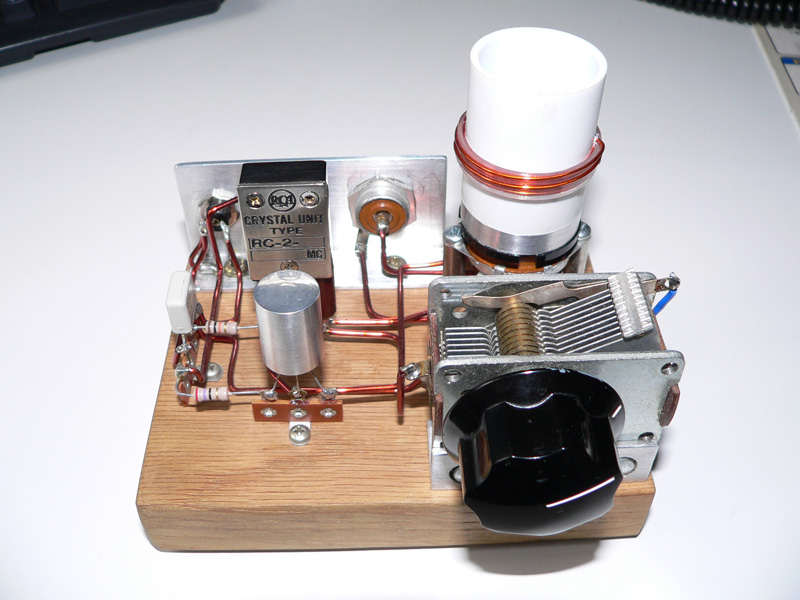
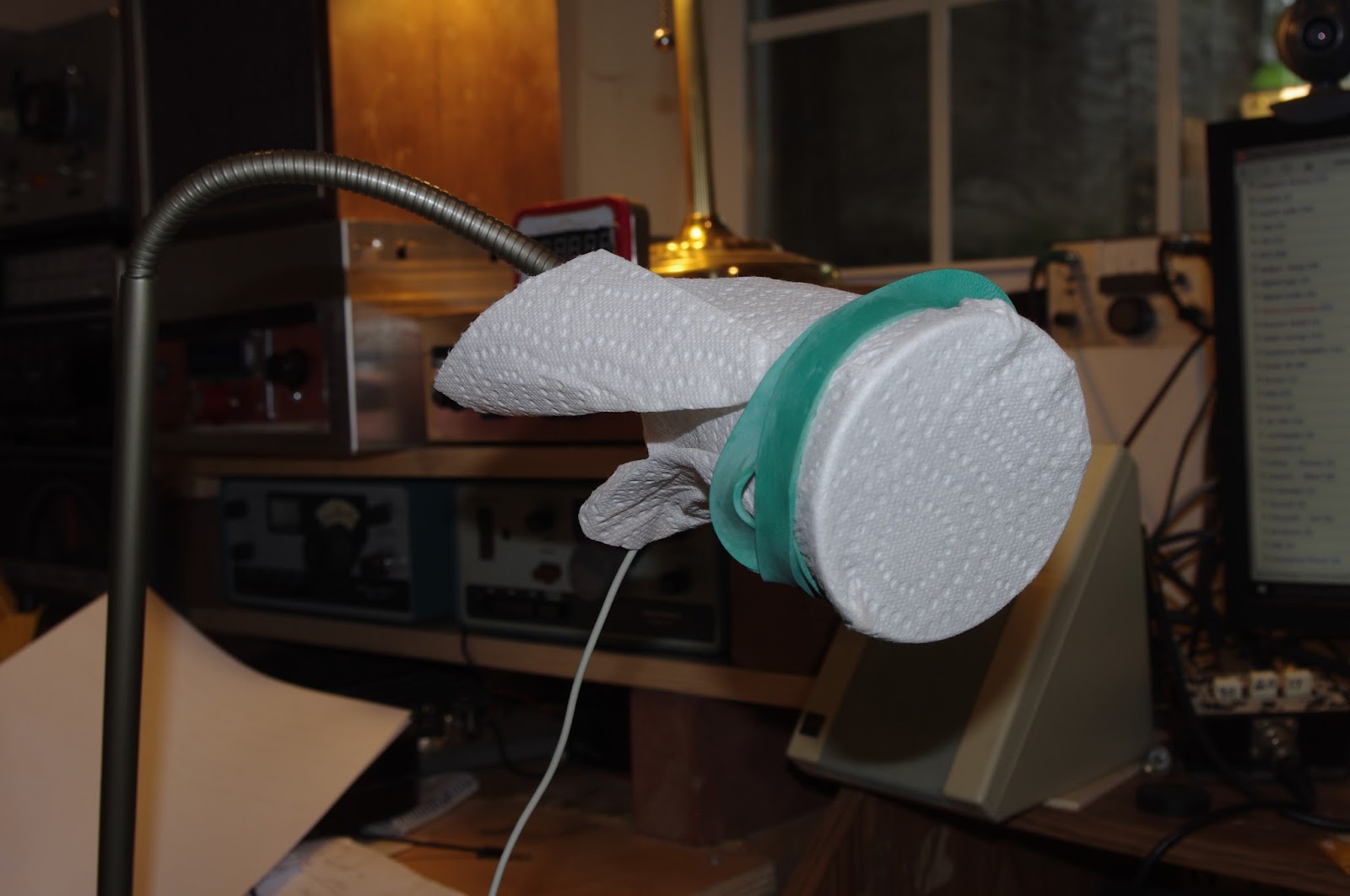
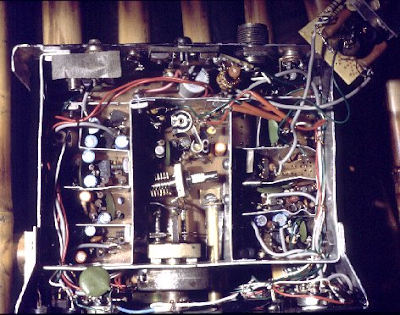
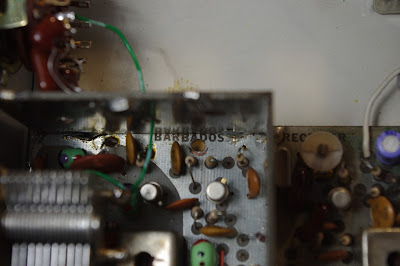
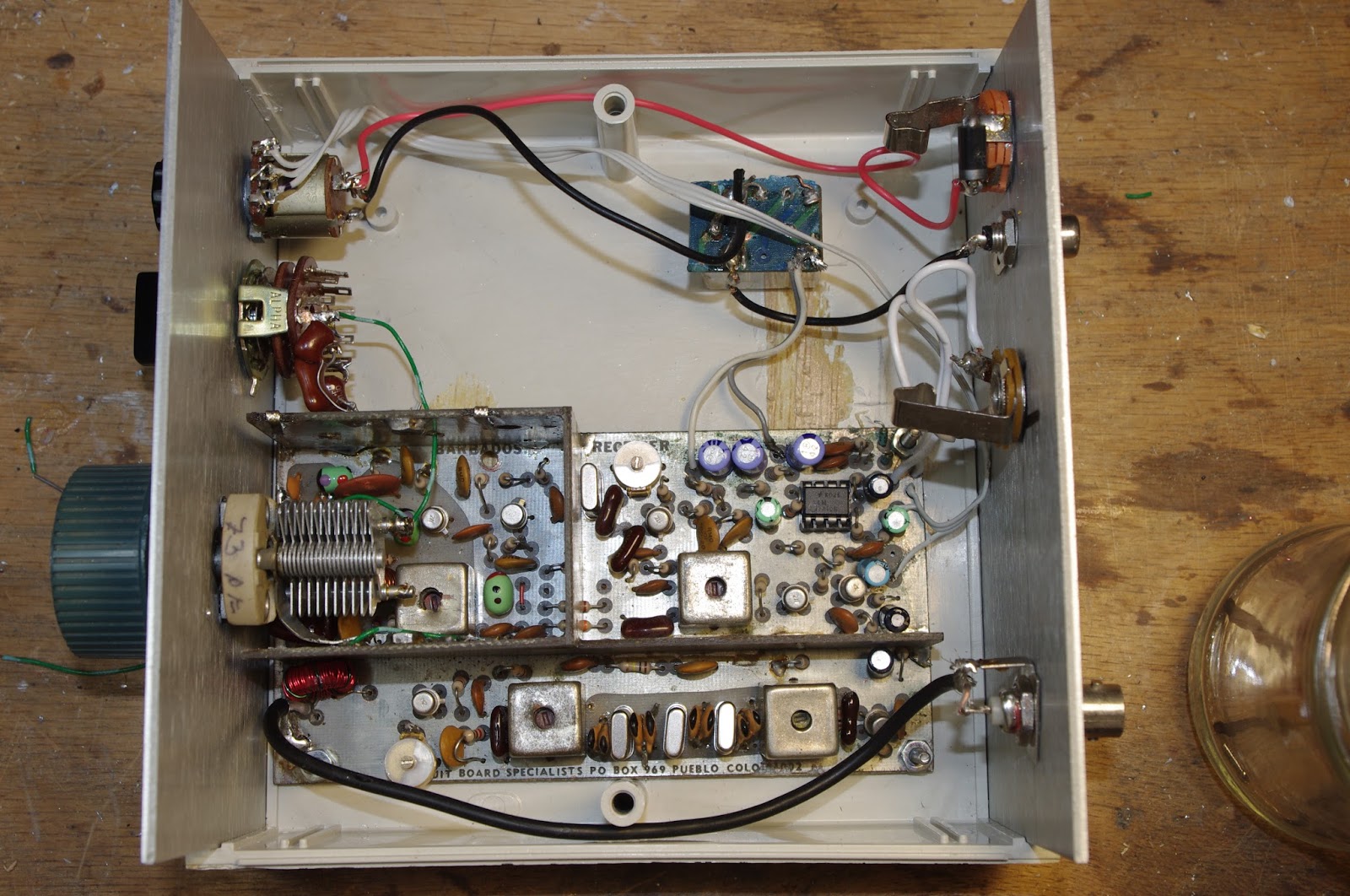
Much to the consternation of Pete “Digi” Juliano, I have been working on analog LC VFOs for simple superhet receivers. As described in earlier posts, I recently converted an old Barebones CW superhet to 40 meter SSB. At first, the VFO (2 -2.3 MHz) was not stable enough — it would slowly drift in frequency. (“We have a solution for that,” chuckled Pete.) My first effort at stabilization involved replacing the toroidal coil. The material in the core is sensitive to temperature changes and this can lead to instability. I found my traditional cardboard tube from a coat hanger, and made a coil of the needed inductance (you can see it in the pictures). This yielded some improvement in stability, but it was still drifting.
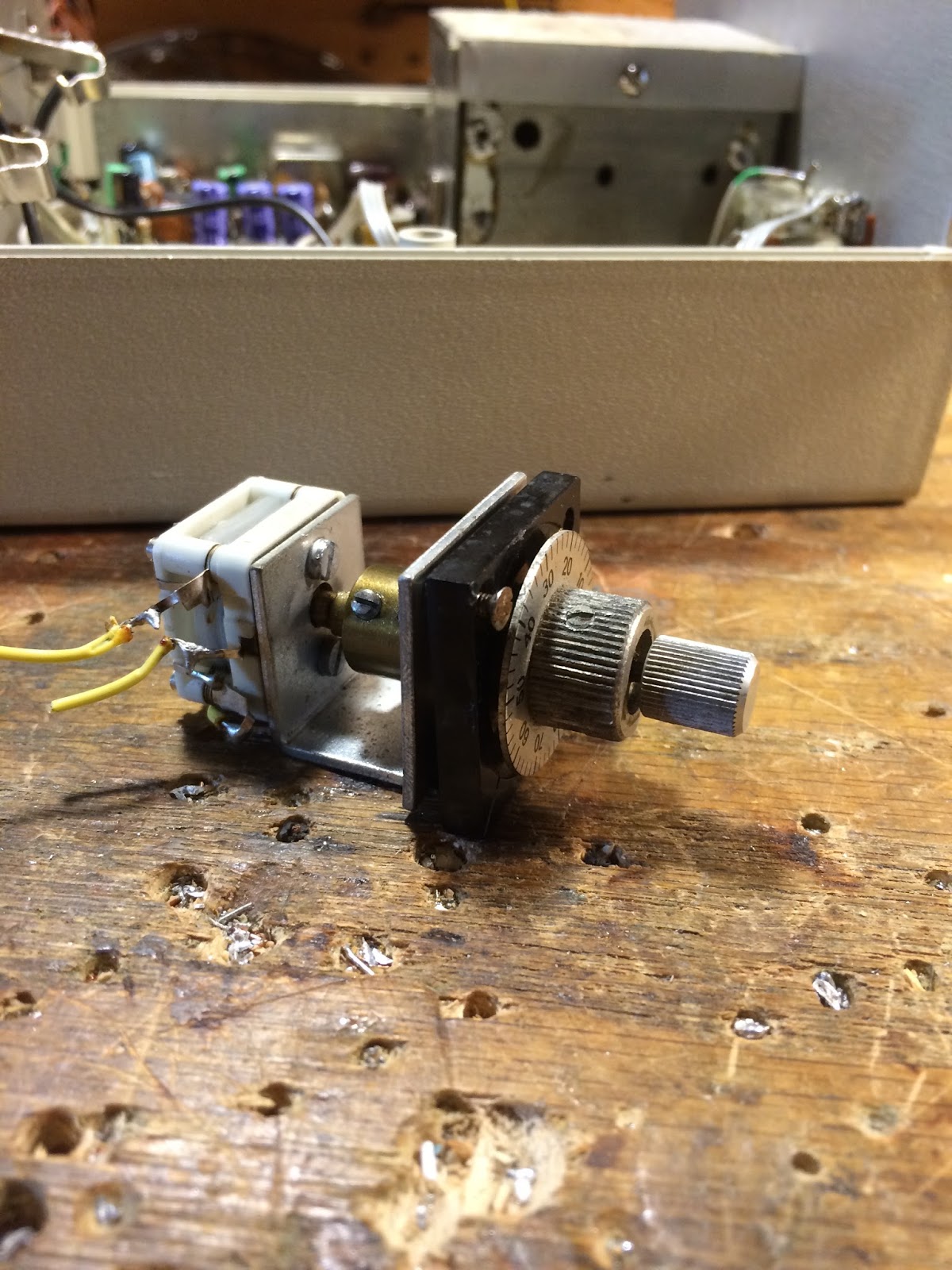
Next I tried taking out all the silver mica and disc ceramic caps in the LC circuit of the oscillator and replacing them with NP0 ceramic caps. The feedback caps are in the box below the tuning cap, but you can see some of the little NP0s on the outside of the box, connected to a rotary switch. This serves as the equivalent of variable “Bandset” variable cap, with the tuning cap serving as the “Bandspread.” I have seven switch positions, each covering about 40 KHz (with some overlap). This gives me all of the phone band and the bottom 30 kHz of the CW band.
Switching to NP0 caps really did the trick. The receiver is now very stable. When I told Farhan about my VFO woes, he mentioned that he’d had very good stability results with surface mount caps. I wonder if this success has more to do with those caps being NP0 than with their surface mount configuration.
Here is a good description of NP0:
NP0 stands for negative-positive 0 ppm/°C, meaning that for negative or positive shifts in temperature, the capacitance changes 0 part per million, meaning that it has a flat response across a wide range of temperatures; the capacitance of the NP0 capacitor stays constant (at the same value) despite variations in temperature.
From: http://www.learningaboutelectronics.com/Articles/What-is-a-NPO-ceramic-capacitor
But I think it is a stretch to claim that these marvelous caps do not “age with time!” That would be a really astounding property of the titanium dielectric. That would be a Negative-Positive Zero FLUX capacitor, right?
Movie Review: “The Man Who Knew Infinity” FIVE SOLDERING IRONS
My wife and I went to see this flick about the mathematician Srinivasa Ramanujan. It was filmed at Trinity College, Cambridge — if you look at the dedication to “SolderSmoke — Global Adventures in Wireless Electronics” you will see a picture of my kids at Cambridge. Alas, that picture was taken at Kings College, not Trinity; nonetheless, the Cambridge connection got us interested. Then there was the Indian aspect of the story, which is very intriguing. There was also the “amateur makes good” angle that all of us should, I think, find very encouraging.
The movie did not disappoint. We really liked it. The presentation of the cultural clash was very well done. Elisa told me that as she watched Ramanujan struggle with England, she found herself wanting to tell him, “You are just going through culture shock. Be patient! I’ve been through this many times!” They included just enough math to give the viewer a sense of what Ramanujan was working on.
I got a real kick out of one scene in which old Professor Hardy, seeking to motivate young Ramanujan, took him into the Wren Library and showed him the manuscript of Newton’s Principia. I had seen the same manuscript in the library of the Royal Society in London — they had take it out on the occasion of the visit to the library of Stephen Hawking and NASA Director Mike Griffin. They also had on the table the reflecting telescope that Newton himself had made. That was quite a day.
Great movie. I give it the coveted rating of five soldering irons.
More about Ramanujan here:
https://en.wikipedia.org/wiki/Srinivasa_Ramanujan
Great “QSO Today” Interview with H.P. Friedrichs AC7ZL — “My nature is to build.”

I sat in the shack this morning with a cup of coffee, mesmerized by the things Pete was saying. I actually took notes. Some highlights:
— In describing his zeal to avoid the use of store-bought components, Pete acknowledged that there are limits to this. But then he revealed that his limits are different than those of even the most fundamentalist of homebrew fundamentalists: “Well, I’m not going to mine my own copper.” Don’t worry Pete — no one will call you an appliance operator if you use store bought wire.
— On the same subject, when describing his homebrew diodes for crystal radios, Eric asked Pete why he didn’t just go out and buy a Germanium Diode. “That would be cheating,” replied Pete. Indeed.
— “Obsolete technology often gets short shrift.”
–“My nature is to build.”
http://www.qsotoday.com/podcasts/ac7zl
HOMEBREW HERO: REX HARPER W1REX AND THE WORLD’S BIGGEST BUILD-A-THON
![]() |
| Rex, shortly before questioning by authorities |
Wow, Rex Harper W1REX deserves some sort of big award. I hereby grant him the coveted Brass Figlagee with Bronze Oak Leaf Palm, but that is clearly not enough. Rex spent a month of 20 hour days putting together kits for the Four Days in May QRP event at the Dayton Hamvention. The results were spectacular: 246 hams succeeded in building QRP transmitters, and they all did it in under 70 minutes.
Just as impressive as the results were the ways in which Rex overcame the technical and organizational hurdles prior to the event. You can read all about this in Rex’s excellent write up:
http://www.qrpme.com/docs/FDIM%202016%20Report.pdf
The OFFICIAL SolderSmoke Correspondent at Dayton was once again our friend Bob Crane, W8SX. Bob caught up with Rex and somehow managed to get him to stand still long enough to do this interview:
http://soldersmoke.com/W1REXDaytonInterview.mp3
And it was very nice that Rex did this as a tribute to Dave Ingram K4WTJ whose magazine articles about simple QRP rigs inspired many of us. Years ago, right after completing a homebrew QRP transceiver, I talked to Dave on 30 meter CW and told him that his articles had helped motivate me to build.
Finally, no SolderSmoke post about Rex would be complete without a repetition of the video showing him transferring the prodigious mojo of the original Tuna Tin Two into my BITX-17 transceiver.
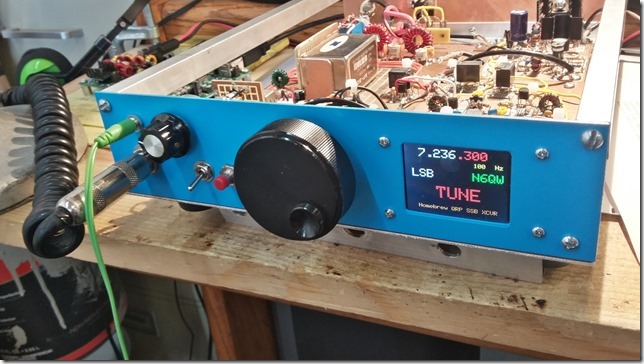
Pete’s Beautiful New Blue Rig
A thing of beauty.
Read about it here: http://n6qw.blogspot.com/
Listening to New Zealand on the Barbados RX via the Gray Line (40 meter CW)
For the last couple of mornings you have been coming in quite strong on 40 meters around dawn here. Attached is a short video from today. I am listening with a homebrew superhet receiver:
Swedish Michigan Mighty Mite Beacon Project
sTef DL1FDF/VY1QRP alerted us to this multi-band Michigan Mighty Mite beacon project out of Sweden. They certainly have some fine looking rigs!
Check out the reports:
http://www.radiorud.se/fyren.php
Audiophoolery
Hi Bill:
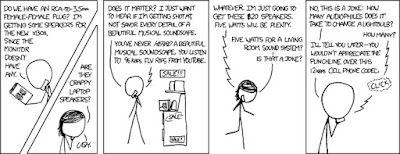
An engineer (and I hope a ham!) wrote in to observe that this was indeed correct, but helpfully noted that the phase error could be corrected by moving one of the speakers about a half inch farther away from the listener. That’s noodling! 🙂
…Some audio scams are so blatant you wonder how anyone could fall for them, like a replacement volume control knob that sells for $485. The ad copy proclaims, “The new knobs are custom made with beech wood and bronze … How can this make a difference??? Well, hearing is believing as we always say. The sound becomes much more open and free flowing with a nice improvement in resolution. Dynamics are better and overall naturalness is improved.” …
73,
SolderSmoke Podcast 187: 2nd Anniversary N6QW. Dayton. Bench Reports. Mailbag
SolderSmoke Podcast #187 is available:
http://soldersmoke.com/soldersmoke187.mp3
Second Anniversary of Pete Juliano’s arrival on the SolderSmoke Podcast.
Dayton and FDIM underway
Bench Reports:
Pete:
— Repurposing old Circuitry
— Pete’s small Display
— New Transmitter
— LBS in Japan and at Dayton
Bill:
— S38-E The lipstick has worn off.
— Reduction drive for the Mighty Midget’s Mate
— Back to the Barbados Barebones Receiver:
Which LO to use for 40 Meters with a 5 MHz IF?
Sideband Inversion and “Lower Sideband” filters.
Eradicating WWV with parts from AA1TJ
Improving VFO stability
A bandspread/bandset arrangement with fixed caps
Soul in the Old Machine
“The Amateur is FRIENDLY…”
MAILBAG

XQ6FOD — A GREAT Knack Story from Chile
Greg VK1VXG sent me this link. I had a blog entry on this a few years ago, but I didn’t do it justice. This is a truly amazing and inspirational knack story, the story of Manfred, XQ6FOD. So many lines from this page resonated with me. For example:
I always regretted having disassembled this radio. It was so nice, so compact… Everything was hand made, there was not a single right angle in it… I felt like a murderer after destroying it. But, I needed the parts…
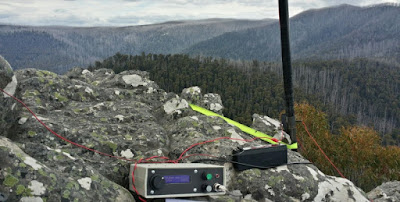
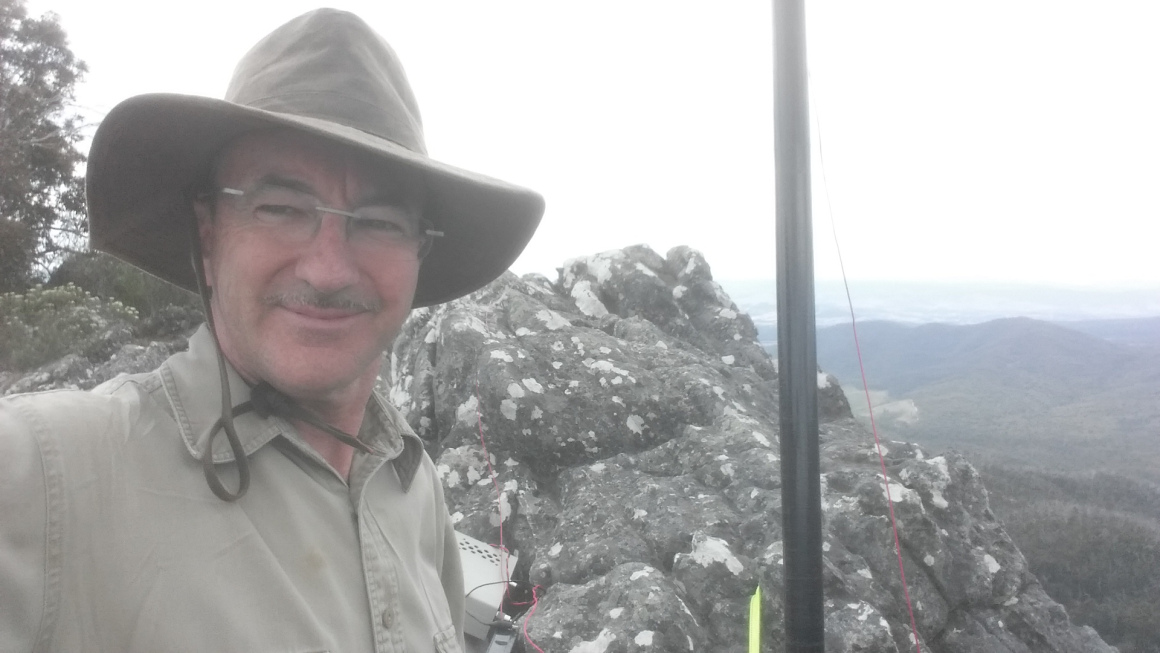
Oz QRP2QRP From Mt. Bullfight, Pyramid Hill, and Melbourne’s Chelsea Pier
I would like to claim an entry in the SolderSmoke Homebrew To Homebrew
(HB2HB) log. Here’s the story. On Sunday 24th April 2016 I drove two
and a half hours north east of Melbourne into the edge of the Great
Australian Dividing Range, to climb two summits, for the fun of
operating my 40 meter SSB QRP (5 watt) rig in a beautiful, RF-quiet
setting, and to activate two Summits Of The Air (SOTA) peaks.
My first summit was Mount Bullfight
(http://www.sotawatch.org/summits.php?summit=VK3/VN-002), in the
Rubicon Ranges, at 1,490 meters ASL not high by American or European
standards but a good heart-racing climb through thick Australian bush.
After a successful activation with good signal reports into Tasmania
(VK7), around Victoria (VK3) and New South Wales (VK2), I descended,
and drove about 2 miles up the valley to an adjacent SOTA summit,
Pyramid Hill (1,314 meters) where the activation also went well. Just
as I was finishing up with the chasers, Peter Parker VK3YE called me,
operating portable from his beloved Chelsea Pier, and we had a very
pleasant beach-to-summit ragchew QSO. The RF path is about 62 miles.
Peter was running his MDT double sideband rig, with 2 watts. I was
using my MST400, with 5 watts SSB. Both rigs are kit radios from OzQrp
(http://www.ozqrp.com/). Both are assembled by hams — I built my
MST400 18 months ago and Peter was using the MDT rig that OzQrp
founder Leon, VK2DOB designed, built and kitted, the one he sent to
Peter for a YouTube review. So it was built by a ham, just not by
Peter.
Now, I know that there may be some, possibly even you Bill, who may
question the legitimacy of my claim on a coveted HB2HB log entry in
this particular case. I can assure you that we did experience the Joy
of QRP/P operation, Peter basking in the late afternoon Australian sun
on a beach and I on the mountain top. And to further add authenticity
to my HB2HB claim we discussed QRP, aerial experiments, and ‘whats on
your bench’ topics for a full 20 minutes.
However, I would not want to risk disturbing the wrath of the Radio
Gods with a dubious claim.
I admit that neither radio was scratch-built, on copper board
ugly-style, or had the form of a wild birds-nest of separate modules
and interconnections, with parts loosely screwed onto an Italian
chopping board or a discarded lump of wood. Indeed, neither can it be
claimed that both operators built their rigs. So I will take a
rejection of my request with acceptance and dignity, acknowledging
that you are duty-bound to maintain the highest of standards, and that
entry into the SolderSmoke HB2HB log is not to be granted without
proper consideration.
I do understand that you may feel that accepting this QSO could set a
dangerous precedent and risk opening the flood gates to a tsunami of
dubious HB2HB QSO claims from hams using minimal assembly rigs, like
some of the Elecrafts. Who knows, some individuals might even be
tempted to claim HB2HB QSOs from VHF FM hand-helds after managing to
screw on the rubber-ducky antenna. Even unboxing a shiny new
Yae-com-Wood is, to some, a form of ‘handiwork’.
Bill, the decision is yours. Peter VK3YE and I look forward to your
decision. Judge wisely.
73 from down under, Paul VK3HN, with agreement to this claim from Peter VK3YE.
Details of this day of activations are on my blog at:https://vk3hn.wordpress.com/
Peter’s MDT review is at: https://www.youtube.com/watch?v=2OtZeFkb1xw
A Lot of Soul in the Barbados Receiver
The Solder Is Smoking at N6QW!
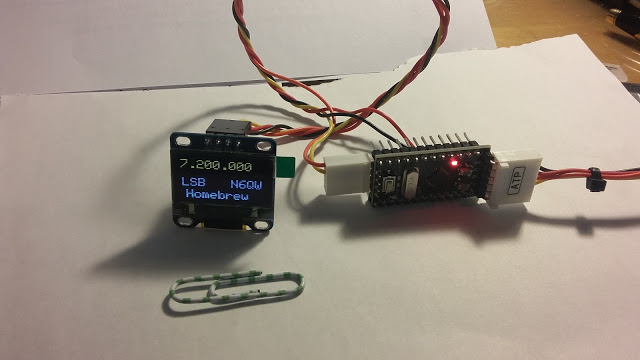
It is very good to see the solder flowing again in the Newbury Park Laboratories of Pete Juliano, N6QW. Check out that postage stamp-sized display.
More details on Pete’s newest rig can be found on his blog:
http://n6qw.blogspot.com/2016/05/a-new-ssb-transceiver-from-n6qw-with.html
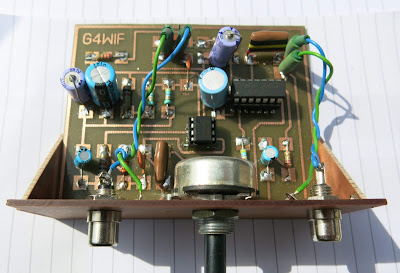
Putting Junk Mail to Excellent Use: Tony G4WIF’s Proto-boards
![]() |
| Tony’s Version of Audio Section of N6QW’s LBS Receiver |
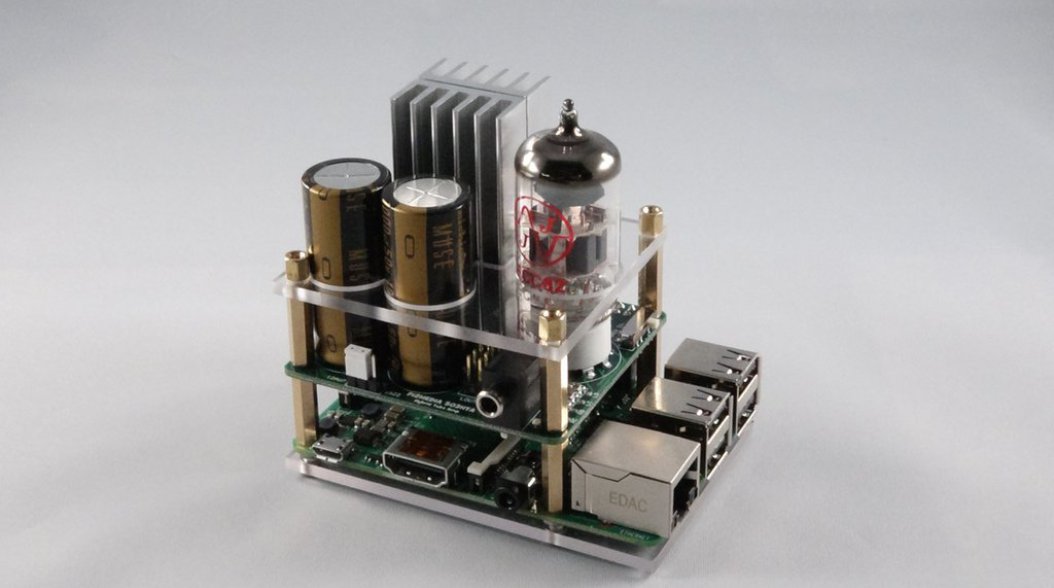
A 12AU7 Atop a Raspberry Pi
http://makezine.com/2016/05/06/warm-tube-tone-is-just-what-the-raspberry-pi-has-always-been-missing/
I don’t know what to say. One moment I find myself thinking that this could represent “the best of both worlds.” A minute later I’m thinking that this thing is a horrible chimera. And it has a whiff of audio fool-ism about it, don’t you think? Will it work better with oxygen-free cables and gold-plated fuses?
Still, overall — pretty cool.
Polyvaricon Reduction Drive
Farhan’s Cool BITX 40 (video)
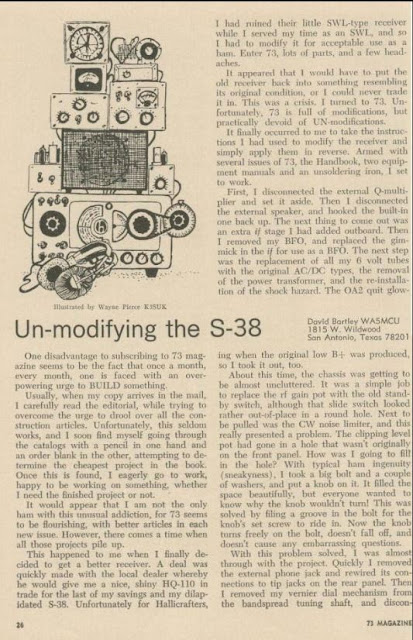
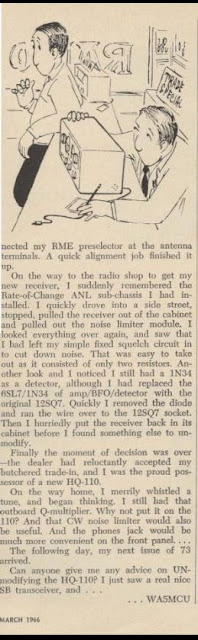
Un-modifying an S-38 in 1966, and the Urge to Build
Hallicrafters S38-E Saved! it is not a “Pig with Lipstick.” It Sounds Good! (Video) (And Radio Moscow recordings)
That’s what happened to me this weekend with the Hallicrafters S38-E. I hooked up the isolation transformer and put a fuse in the primary. I checked the wiring of my rewound antenna coil primary and found that I had connected it wrong. Duh. I then found that the antenna tuned circuit tracks fairly well with the tuned circuits in the local oscillator.
I hooked it up to my 40 meter dipole and fired it up. As evening rolled around the shortwave bands started to perk up. The Chinese Broadcast stations were there, as was that fire and brimstone preacher Brother so-and-so. But then I tuned into Radio Havana Cuba and the guy was talking about homebrew shortwave antennas. Could it be? Yes indeed. It was Arnie Coro CO2KK. The Radio Gods had spoken! They clearly had wanted me to get this old rig going.
I still have a few things to do: I need to fix the front panel light. I want to put in a three-wire (with ground) AC cord. Perhaps a real BFO (the original circuit seems to run out of steam with strong SSB signals). And I need to spruce up the alignment on the 1.7-5 Mc and 13-30 Mc bands.