Author: Peter Marks
“The Dish” Turns 60
Part of Wright Brothers’ Airplane Now On Mars with Ingenuity Helicopter
Double Sideband Transmitter using Vacuum Tubes — From Sweden
My Hodgepodged Morse: Audio Tone into the Mic Jack Creates J2A not A1A. BASTA!
In SolderSmoke podcast #229 Pete and I were discussing my rather flaky effort to turn the Hodgepodge BITX40 Module into a CW rig by injecting keyed 700 Hz audio into the mic jack (see video below). We got some very helpful responses from ND6T and VK2EMU:
Don, ND6T
————————————————–
Hi Bill and Pete,
With putting an audio oscillator into you hodgepodge radio, your transmission is not the same as a standard CW rig.
If we have a transmitter as described in the ARRL handbooks from the 1940’s or 1950’s, (or even the Michigan Mighty Mite) it is a crystal oscillator and maybe a PA tube. By keying either the oscillator and/or the final PA on and off, then we can send Morse code as ICW Interrupted Continues Wave. If we check the list of emission designators, we have A1A.
However, if we feed a tone into a SSB transmitter, then we have J2A.
At the other end it may sound the same, but because it is created in a different way, it has a different designation.
A quick look at Part 97 shows that J2A and J2B are classed as CW, so you are in the clear. However, if you put a tone oscillator into an AM signal to send CW, then that would be classed as A2A and not classed as CW, but as MCW. MCW can be used on 6 meters and above, but not HF.
SITS.
73 de Peter VK2EMU
———————————————————–
So I say BASTA with the J2A! If I want to go CW, it’s all A1A for me. I dusted off my Fish Soup 10 and am now back on 40 CW with 200 mW…. A1A all the way!
SolderSmoke Podcast #229 — G2NJ Trophy, SDR, HDR, CW! Mailbag
http://soldersmoke.com/soldersmoke229.mp3
— G2NJ Trophy is awarded to Pete Juliano, N6QW.
— Get your vaccine shot as soon as you can!
— More from “Conquering the Electron” by Derek Cheung.
— Bad fire in the chip factory. Such a shame. Sad! I had NOTHING to do with it. I was home that day. I can prove it.
— Bezos is not such a bad guy. Turns out he is a space-geek.
— Perseverance was the big space news. Very cool.
Pete’s bench:
Raspberry Pi vs. Microcontrollers
Treedix display
Conversion of the Dentron Scout
CW rigs?
6L6 on a wooden chassis
SHAMELESS COMMERCE DIVISION-
I NEED TO BUILD UP TIME VIEWERS VIEW MY VIDEOS: So please watch!
https://www.youtube.com/channel/UC20TcdWSSFliMhg3k2A1a5w
— Our Patreon sponsors get an early look at our YouTube content. So please, consider
becoming a Patreon sponsor.
— Please continue to use the Amazon search engine on the blog page (upper right).
Bill’s bench:
Hodgepodge:
— BITX40 Module.
— Ramseykit Amp.
— San Jian counter,
— CW using 750 Hz oscillator.
— RF-actuated piezo buzzer.
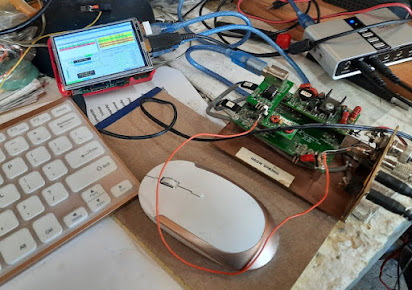
— SDR! SDR using PC and tablet.
— Checking the output with SDR.
— Moving the carrier osc frequency.
Also, I put the Fish Soup 10 back on the air. Nice contacts under 200 mw.
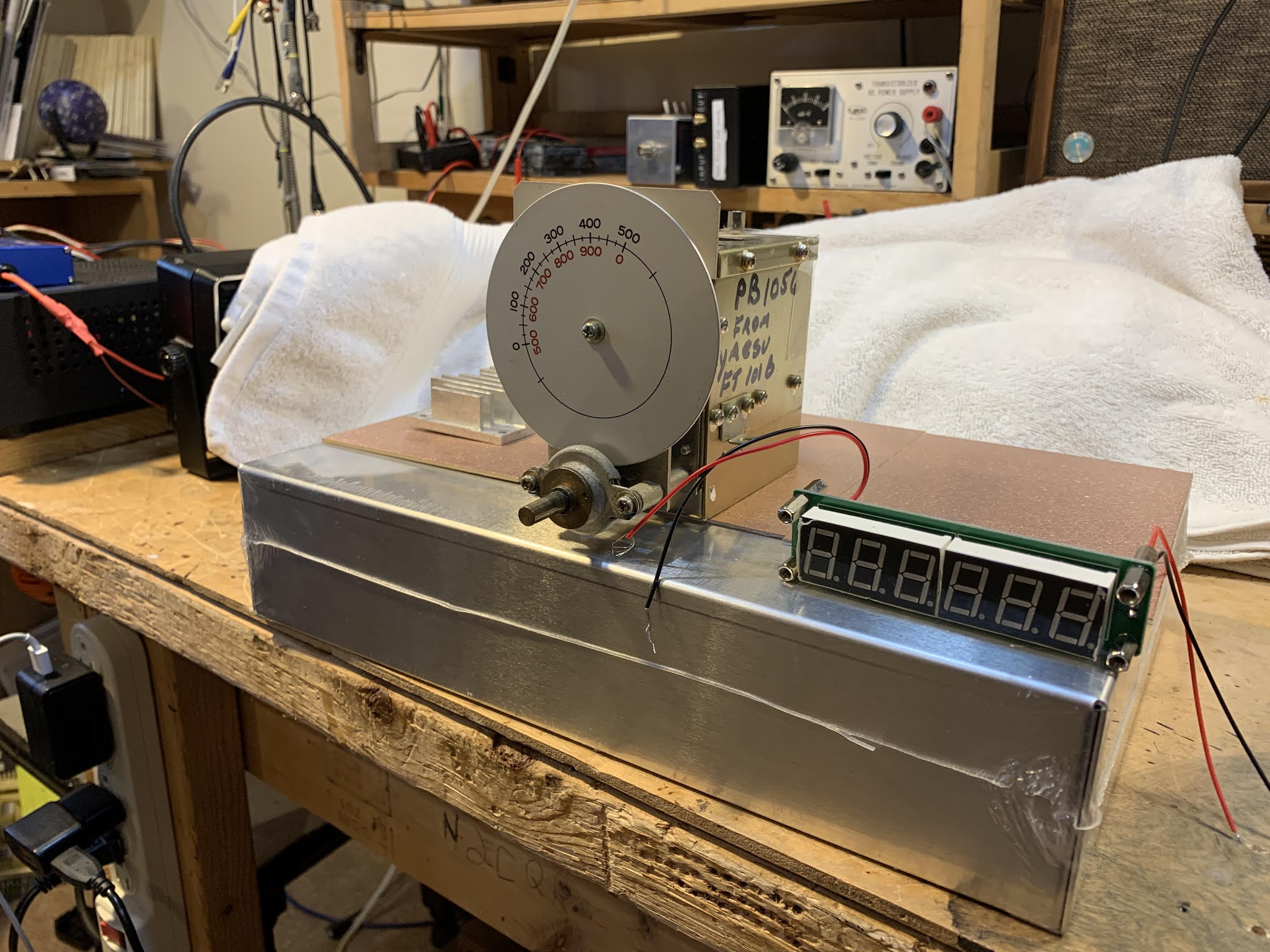
Up next: A rig for 80/75 and 20 meters. Single Conversion. Using VFO from a Yaesu FT101 that runs 8.7 – 9.2 Mhz. Quiz question: What IF should I use?
MAILBAG
Mark Zelesky sent me wood tokens with power and Ohm’s law formulae. Thanks!
Scott WA9WFA Built a really nice Mate for Mighty Midget RX – getting it going!
Tryg EI7CLB found board of his George Dobbs Ladybird RX. Rebuild it OM!
Tom WX2J – We talked about “No lids, no kids, no space cadets” nastiness.
Nick M0NTV about sideband inversion. I like the simple rule about subtraction.
Jonathan M0JGH – Always listen to Pete. Got married, has mixing product. Leo?
Mike AE0IH. Dad used a BC-348 in the service. Looking for one. FB.
Adam N0ZIB – “Silent Shep” site — with some ham radio shows I had not seen.
Walter KA4KXX in Orlando has a similar subtraction problem with San Jian counter.
Bill N5ALO sent me a really nice KLH speaker. I’m using it now.
Jason N2NLY – interested in building SSB transceiver. One step at a time OM…
Trevor in Annapolis sent xcsd cartoon that really hit home.
Farhan is doing OK in India, diligently protecting his family from the virus.
Peter VK2EMU also doing well.
Dave AA7EE Casually killed a DC receiver in Hollywood, and disposed of the remains.
Charlie ZL2CTM doing great things with simple SSB. Blogpost.
Phil VK8MC in Darwin sends article on “Mend not End” battle against planned obsolescence.
Bob KY3R re my SDR adventures, asked if I’ve had a recent medical/psychiatric evaluation.
Hodgepodge: Tablet SDR with a Bluetooth Mouse (video)
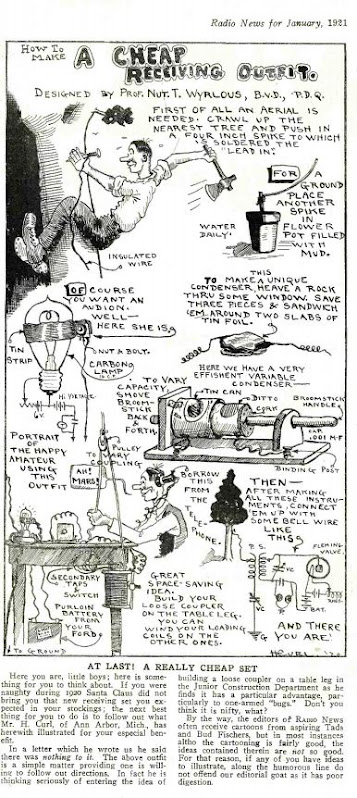
A REALLY Cheap Receiving Rig
Wow, lots of ingenuity in this 1921 receiver.
— Has anyone actually made a diode out of a light bulb in the way described?
— The antenna coupler on the table leg is not much different from the tuner that I have attached to the wall of my car port.
— Note that when our hero finishes the receiver, he is able to pick up signals from Mars! FB OM.
Who will be the first to recreate this 1921 receiver?
Aladdin’s Lamp == The Vacuum Tube (aka The Thermatron) (Video)
A Homebrewer
Making Transistors in 1957
The Secret Life of LEDs — A new Tim Hunkins Video
Hodgepodge: Moving the Carrier Oscillator Frequency (and a Flashback to 2002) (Video)
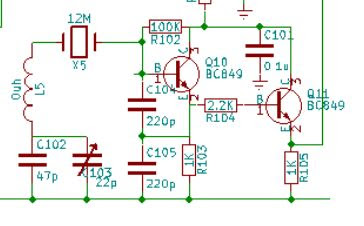
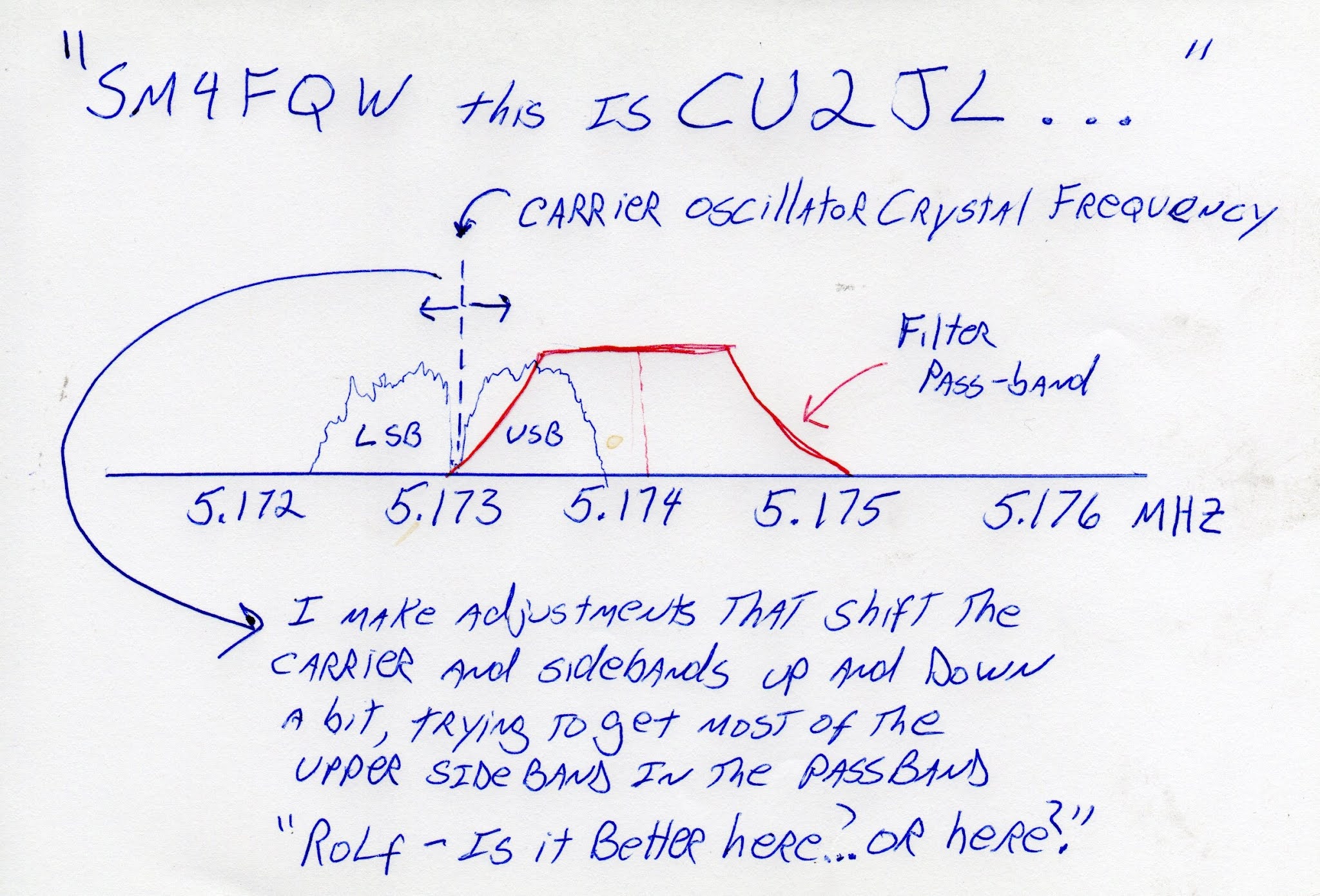
Now it was time for some debugging and fine tuning. I needed to make sure that the frequency of the carrier oscillator was in the right spot relative to the passband of the crystal filter. If it was set too high, the filter would be chopping off high notes in my voice that were needed for communications clarity, and it would allow too much of what remained of the carrier (residuals from the balance modulator) through. If it was set too low, the voice signal transmitted would be lacking needed base notes. I didn’t have the test gear needed to perform this adjustment properly, but my friend Rolf, SM4FQW, up in
One night, during a conversation with Rolf, I explained my problem and he offered to help me make the adjustments… by ear. Performing an electronic version of open-heart surgery, with power on and Rolf on frequency, I opened the case of the new transmitter. The carrier oscillator has a small capacitor that allows the frequency of the crystal to be moved slightly. With Rolf listening carefully, I would take my screwdriver and give that little capacitor a quarter turn to the right. “Better or worse?” I would ask.
I think this little adjustment session captures much of the allure of ham radio. There I was, out in the
Straight Key Night 2021 at SA2CLC in Sweden
Taking Care of an Old Analog Machine — The Scanimate
AA7EE Casually Kills a Direct Conversion Receiver, then Coldly Discards a Diode Ring Mixer
I was really glad to see that Dave AA7EE has — after a long absence — posted another article on his blog. The article has some great personal reminiscences about his involvement with direct conversion receivers. Here is one passage:
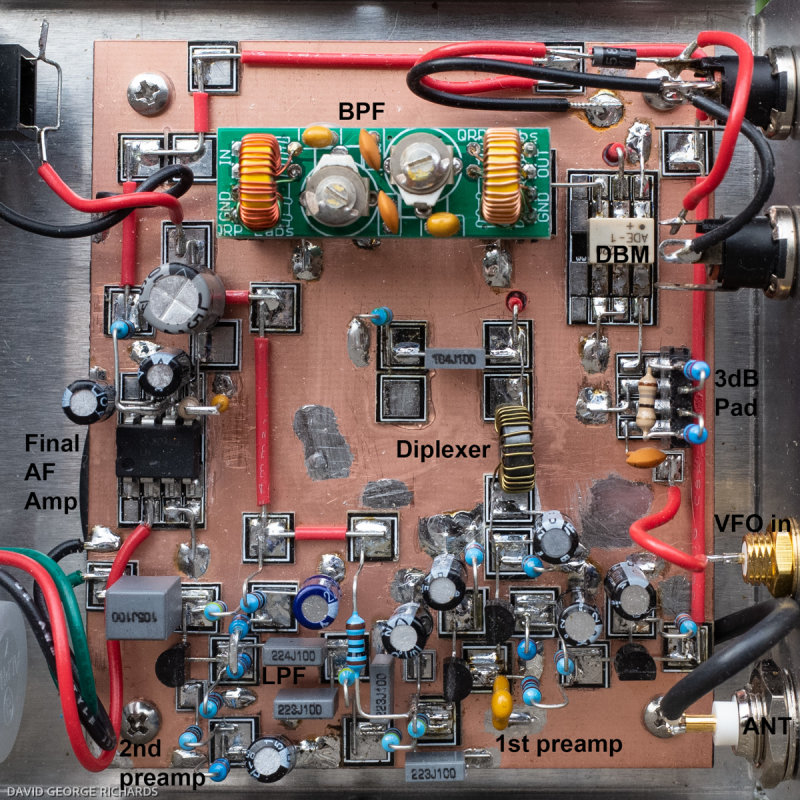
I spent many happy hours tuning around and listening on 80M with the DSB80. It was this first experience that cemented my affinity for direct conversion receivers built with commercially available diode ring mixer packages. It just seemed so simple – you squirt RF into one port, a VFO into the other, and (after passing the result through a diplexer) amplify the heck out of the result. The seeming simplicity of the process of converting RF directly to baseband audio has held great appeal for me ever since. Unfortunately, that project didn’t survive. One day, in later adulthood, in my apartment in Hollywood, I reversed the polarity of the 12V DC supply and, discouraged at it’s subsequent refusal to work, tossed the whole thing away. Now, I cannot quite believe that I did that, but it was during a long period of inactivity on the ham bands, and complete lack of interest. If only I could go back, and not have thrown it into the dumpster of my apartment building! Hollywood is ridden with recent notable history. My little double sideband transceiver met it’s unfortunate end just 100 feet from the spot where Bobby Fuller, of The Bobby Fuller Four, was found dead in his car, in 1966, the subject of a still unsolved mystery to this day. The death of my little DSB rig was a lot less mysterious. To think that I heartlessly tossed an SBL-1 mixer into a dumpster, is a mark of how far I had strayed from my homebrewing roots, forged in a little village in England. Now, a few years later, in a city known for it’s sin and excess, I had cruelly ended the life of a stout and honest diode ring mixer. I suppose I should spare a thought for the polyvaricon but, well, you know – it was a polyvaricon!
https://aa7ee.wordpress.com/2021/03/04/the-ve7bpo-direct-conversion-receiver-mainframe/
EXORCISM! 40 Meter RFI Problem Resolved
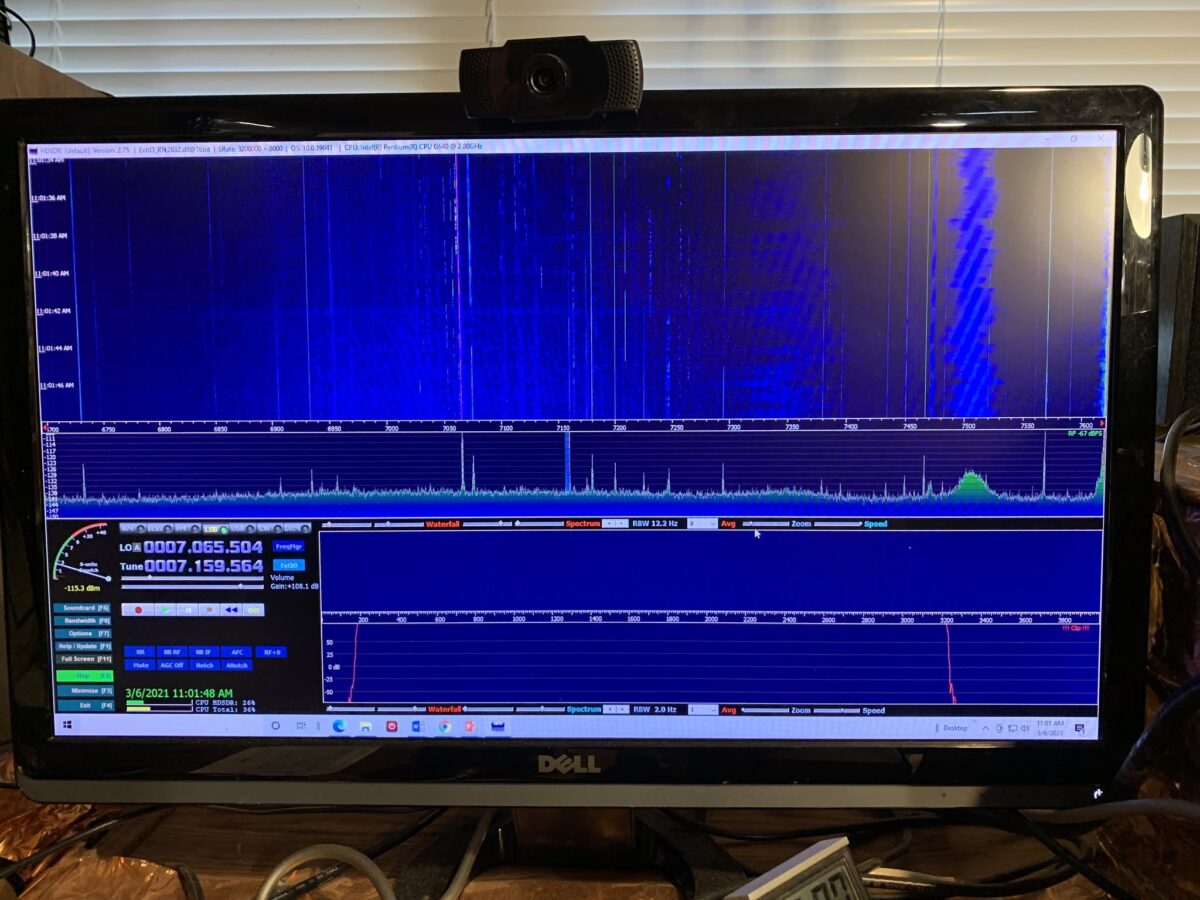
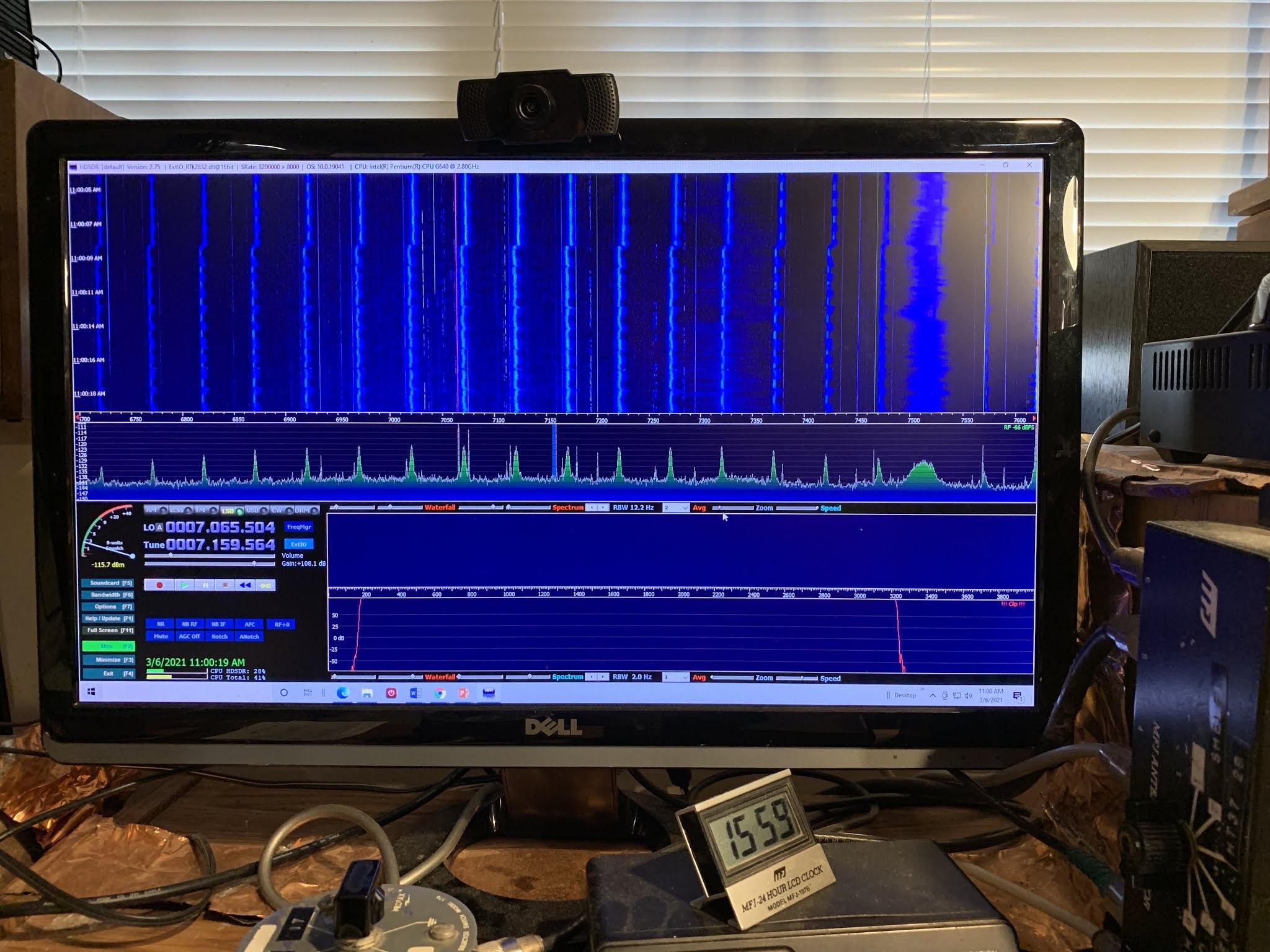
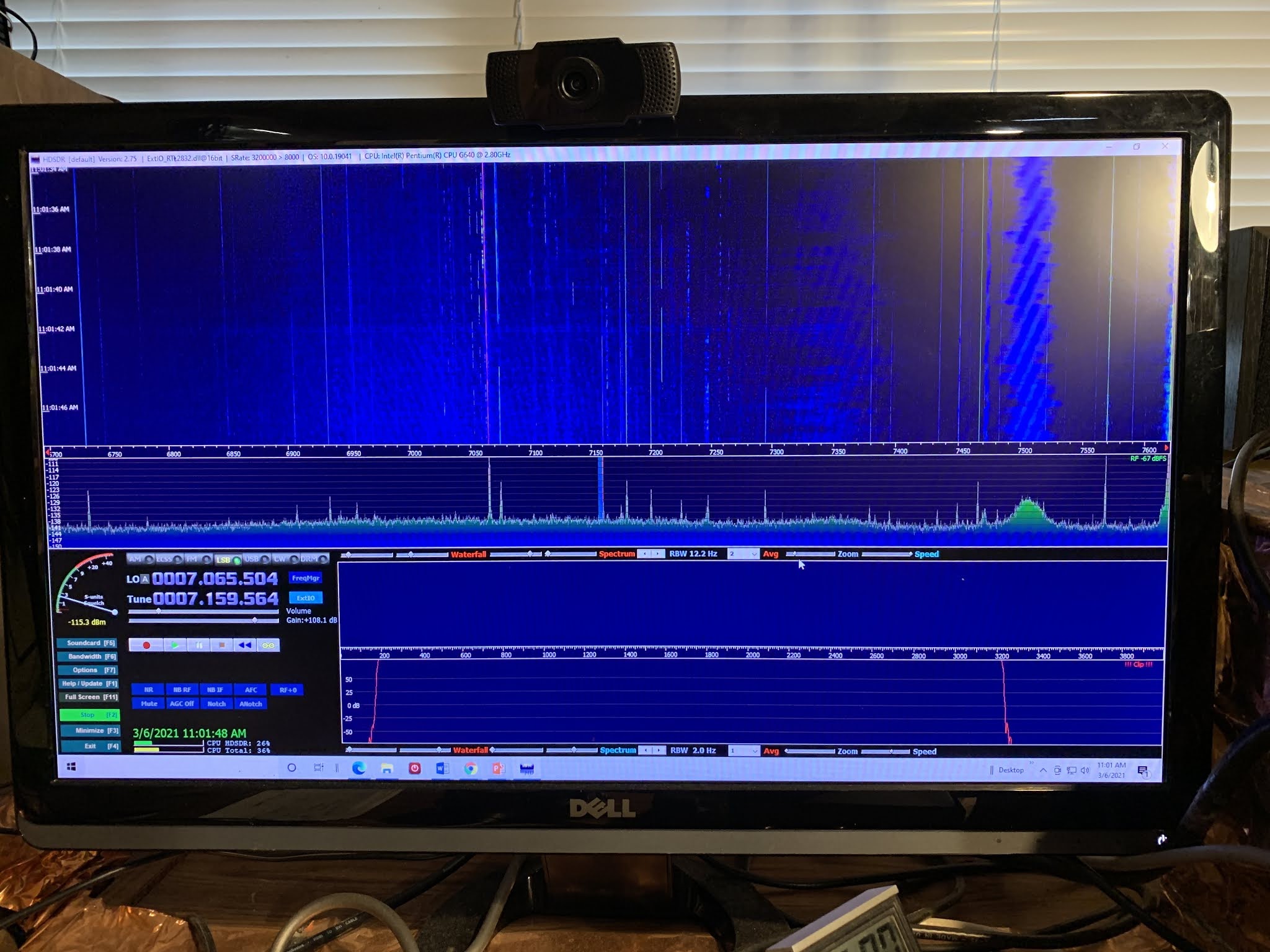
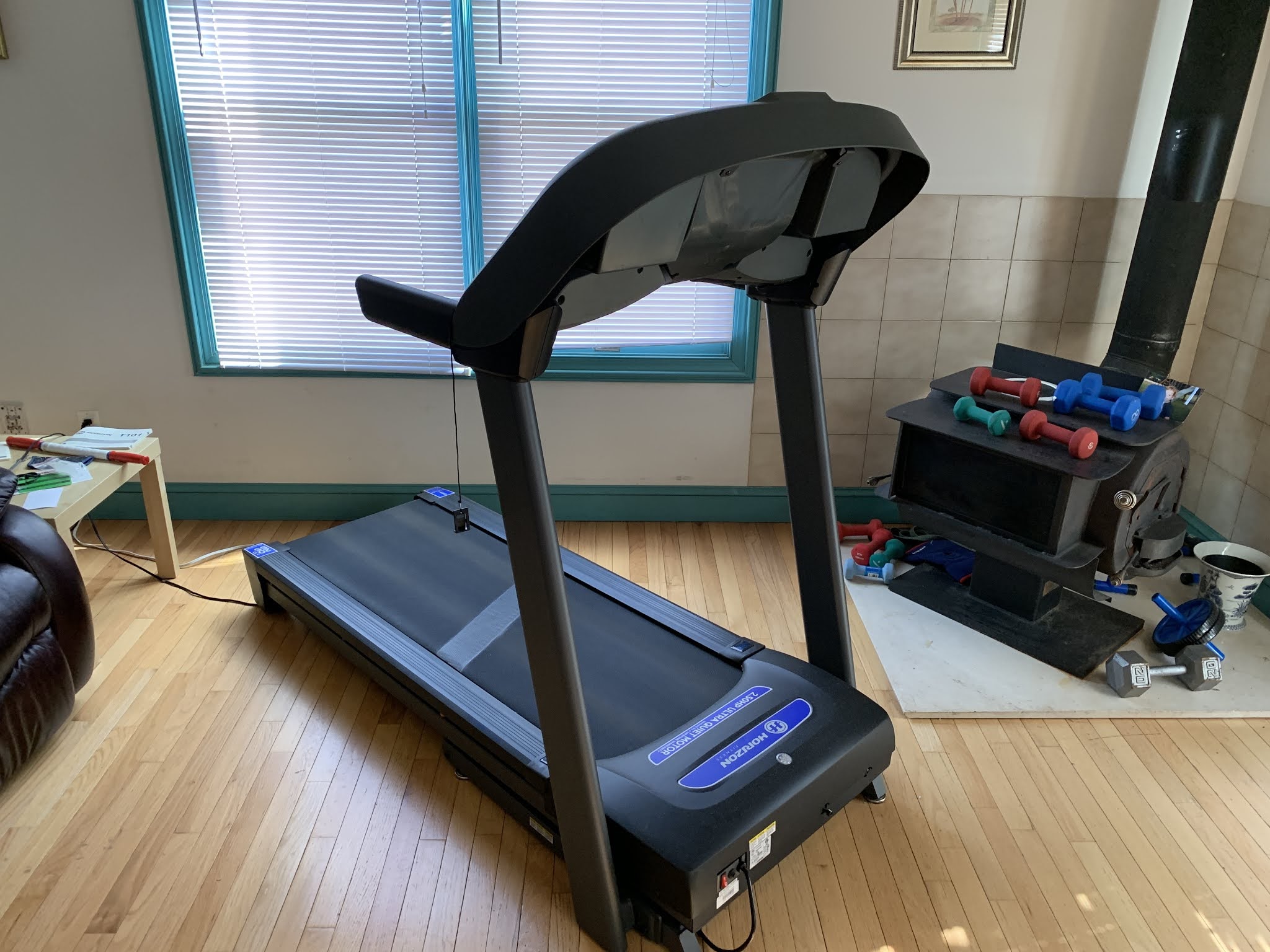
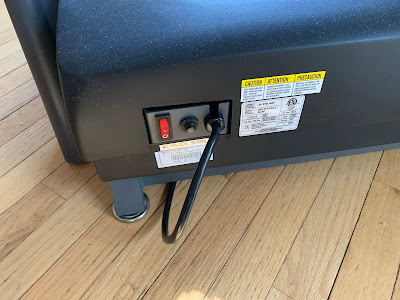
David W. suggested I use my RTL-SDR dongle to look for the source of the 40 meter RFI that I have been mentioning. (It appears as an ugly stipe in the waterfall of my Hodgepodge transceiver.) So I fired up the RTL-SDR — there were the tell-tale spikes, spaced neatly every 50 kHz. The ARRL Handbook says this is typical of a switched power supply. Before I started patrolling the neighborhood with a tin-foil hat and a portable receiver, I decided to check my own house for any recently installed electronic devices. It didn’t take long — when I unplugged the new (mid-pandemic) treadmill the spikes disappeared. This treadmill was located about ten feet above my rigs, and between the rigs and the antenna. Duh. I should have thought of this earlier. Mystery solved. Thanks David.