
https://soundcloud.com/radioromaniainternational/the-dx-mailbag-22062018
Author: Peter Marks
The Moxon Files from L.B. Cebik W4RNL
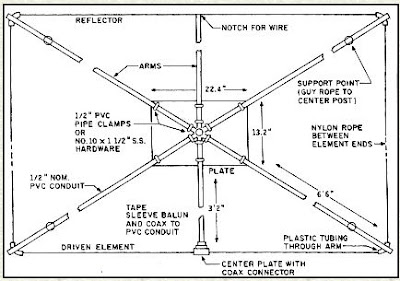
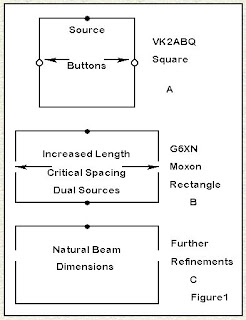
I had thought that the Cebik files were lost to us in some sort of legal copyright struggle. But in my effort to better understand the Moxon antenna, I found a real treasure trove of Cebik’s writing. These should all be saved somewhere safe.
I especially liked his description of the evolution of the Moxon antenna. Les Moxon was apparently very unAmerican in his emphasis on reception (not transmit gain) as the main benefit of the beam antenna. He also sought to avoid superfluous luxuries like rotators, but Cebik hints that rotators have become an important part of our American way of life. Indeed.
Before I found these files I had been on the verge of giving up on efforts to replace my storm-damaged Moxon. After all, solar minimum is still ahead of us. But after reading OM Cebik’s articles I have decided to build a 20 meter version and place it above the center point of a 130 foot doublet. I will have the best of both worlds.
http://www.antentop.org/w4rnl.001/mu0.html
http://www.antentop.org/w4rnl.001/mu2a.html
L. A. Moxon, in his HF Antennas for All Locations, provides the essential clue: “the main benefit [of a beam] accrues from the reduction of interference during reception, though the 4 to 6 dB gain provided by typical amateur beams is an important bonus and probably the reason which carries the most weight with the majority of amateurs.”(2)Here is a theory of beam operation quite unAmerican is style: instead of gain, Moxon strives for front-to-back ratio as the most crucial aid to ham operation. His statement is an affirmation of the “good ears” theory of operation. Even more, it forms the basis for his rectangular improvement upon the VK2ABQ square.
…
Moxon prefers matched elements, tuning each of them to optimum performance remotely. That way, he can reverse the beam and do away with expensive and maintenance-intensive rotators. However, rotators are a way of life in the U.S. (a TV rotator will likely handle a 3-band Moxon beam), and there are many uses for portable beams that are hand-rotated or fixed in the field. Thus, I decided to continue the exercise in unequal element lengths.
http://www.antentop.org/w4rnl.001/mox20.html
Finally, a treasure trove of Cebik’s writing:
http://www.antentop.org/w4rnl.001/radio.html
VU3XVR’s Assembly Language 1K AtTiny-Si5351 VFO
Although Ram VU3XVR’s project is in the digital realm, his barebones approach to the bits and bytes is, for me, very appealing. He takes a Si5351 and runs it with ATtiny13 with only 1k of space. He makes intelligent use of every bit of that space. He reveals his overall approach to rigs when he states in the video that his VFO will NOT have the traditional glowing numeral frequency readout because those bright lights can be so annoying and distracting. I’m with your Ram! Well done OM. Simplicity is a virtue. No more trouble with the Arduino and its fickle IDE. No more agonizing visits to the Si5351 library.
I see lots of applications for this little circuit. Ram mentions beacon transmitters.
He provides details here:
https://vu3xvr.blogspot.com/2018/07/si5351-dds-clock-generator-using.html
Tom Swift had The Knack
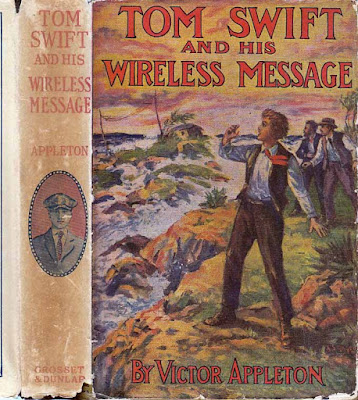
Thanks to Richard for alerting us this important piece of Knack history. Not bad for 1910. You can see Tom’s shack and antenna in the cover image (above). I don’t think he was going for a fan dipole. He built the kind of multi-wire antenna that was in fashion in the early days of radio.
The full text of the book is avaialble free on-line. The radio fun begins in Chapter 20:
Bless my door knob, this was a lot of fun!
Bill,
I am certain I missed the origin of “the knack” as used on your blog. I, wonder, however, if in your youth you read Tom Swift novels? Although now they seem somewhat politically incorrect, I feel that the word may have, for our purposes, evolved there.
In the first novel, “Tom Swift and His Motor-Cycle” (sic) Tom repairs a butter churn’s “system of cogs and handles.” When praised for his abilities he declares, “It’s just a knack.” Stick with me.
In a later novel, written around 1910, “Tom Swift and His Wireless Message” Tom is shipwrecked on an ebbing volcanic island. He saves the day by constructing a transmitter and receiver from the wreckage of his plane, even though he “did not have the magnets, carbons, coherers and needles” needed. He strings “ wires from the top of the dead treed, to a smaller one, some distance away, using five wires, set parallel, and attached to a wooden spreader, or stay. (Fan dipole?) The wires were then run to the dynamo, and the receiving coil, and the necessary ground wires were installed.” Then,”once the impulses, or electric currents, are sent out into space, all that is necessary to do is to break, or interrupt them at certain intervals to make dots, dated and spaces.” He sent “C.Q.D. (come quick—danger) even though a “new code has been instituted for them, but I am going to rely on the old one, as, in this part of the world, the new one may not be so well understood.” Needless to say, a ship hears, responds and rescues the crew.
That”s “the knack”, alright!
Never give up, and 73.
Richard, KD0NPM

Two Videos from Other Kinds of Workshops — Dobson Makes a Telescope, Peter Builds an Airplane
Above you can watch a video showing the legendary John Dobson making a big telescope. Born in Beijing, Dobson is the former Hindu monk who left the monastery to show people how to make big telescopes out of shipping tubes and port-hole glass. Think of it as the BITX of amateur astronomy. Dobson is the founder of the “sidewalk astronomy” movement — that’s when you set up your ‘scope on an urban sidewalk and show the wonders of the universe (or at least the solar system) to passers-by. We did this in London with Saturn. (Some of the cynical Londoners couldn’t believe it was real — they thought I had a transparency in the scope tube.) Dobson developed a very simple and popular method of mounting telescope tubes — the “Dobsonian” method.
More on Dobson here: https://en.wikipedia.org/wiki/John_Dobson_(amateur_astronomer)
Below you can see a short update on Peter’s homebrew airplane.
Dust Storm on Mars
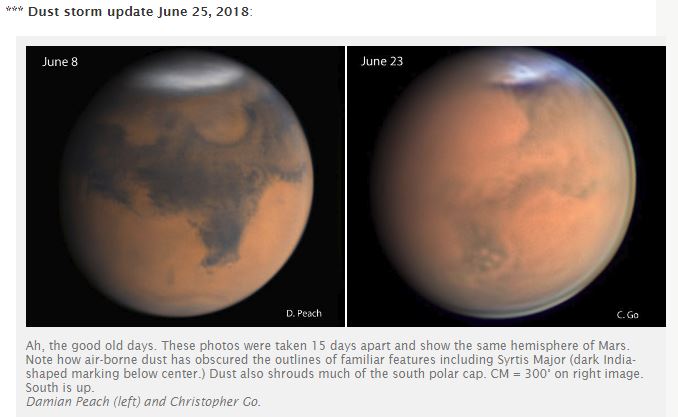
Damn. Just as Mars gets close enough for me to see something with my 6 inch reflector telescope, a massive dust storm hits. I was out there this morning at 0430 local. Mars was bright and red in the southern sky, but when I got it in the telescope’s field of view it was like looking at a red version of Venus — just the disk, with no surface features visible. The before-and-after pictures above (taken with far better equipment than mine) shows the extent to which the dust has obscured things on Mars.
But Sky and Telescope reports that the Martian skies may soon be clearing. Hooray!
On Field Day: The Marine Corps Antenna Manual

Don’t let it be said that SolderSmoke made no contribution to Field Day! Here is the USMC Antenna Manual. Looks like there is lot of good info in there.
https://www.marines.mil/Portals/59/Publications/MCRP%208-10B.11.pdf?ver=2017-03-15-092827-423
SolderSmoke #205 Solstice, Mars, Antennas, Displays, Phasing Fix, VFOs, Lexicon, MAILBAG
June 23, 2018
SolderSmoke Podcast #205 is available:
http://soldersmoke.com/soldersmoke205.mp3
— Summer solstice. Mars Observations. Graduations. Internships. Fathers Day.
— Antenna Angst: Pete’s tribander and Bill’s Moxon. Insulation and resonance?
— Pete’s work on color displays.
— Bill goes back to fix up older projects:
— Fixing the Frankenstein Phasing RX. Found an open choke!
— Tightening up the HRO Dial.
— Achieving Juliano Criteria stability on a BITX20 VFO.
— Lexicon additions: “Scratch Built” “Hardrock Radio”
https://english.stackexchange.com/questions/39551/where-does-the-saying-made-from-scratch-originate
— PastaPete: http://www.pastapete.com/
MAILBAG:
Bob Crane W8SX Corrspondent at FDIM
Ralph AB1OP Building LBS
Bruce KC1FSZ Digital Pot
Jason W5IPA uBITX in Juliano Blue
Rogier KJ6ETL ON THE AIR WITH A uBITX
Special thanks to Tim Walford for 25 years of Hot Iron.
“Hot Iron” #100 — Thanks Tim Walford!
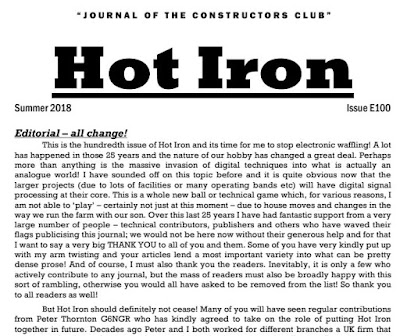
Tim Walford, G3PCJ has put out issue #100 of Hot Iron, the Journal of the Constructors Club. That my friends is a long time publishing a quarterly. 25 years! And it is a wonderful publication, filled with ideas and inspiration.
Tim tells us in #100 that he is passing the baton (the Hot Iron?) to Peter Thornton, G6NGR who will keep the iron hot from here on out. Peter is looking for contributions for issue #101. Please try to help him out.
Thanks again to Tim. Good luck with the farm and the house moves.
Rockets and a Microcontroller — Videos
Digital Pot
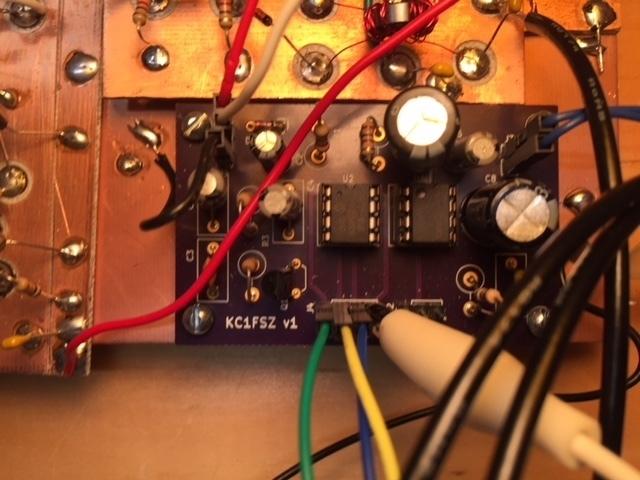
No, this is not some on-line mail order thing. Bruce KC1FSZ has done something that I find both amazing and horrifying: he using a “digital potentiometer” as the AF gain control in his BITX. Remember when pots were simple and pure, when they were just a metal wiper that ran across a crescent of carbon of increasing resistance? Well, those happy days are apparently behind us my friends. What now? Will we have endless discussions about where to find the driver for the 10k pot? Will Facebook or Amazon or Microsoft secretly seize control of the data on our AF gain, perhaps to sell us hearing aids? But enough of my ludism. Good going Bruce. AGC beckons.
Hi:
I’ve built a few BITX rigs from scratch now and I’m starting to move to a modular approach using fabricated PCBs to make it easier/faster to build/mix/match the stages. My audio amplifier module is based on the LM386. I know others have moved away from this chip, but it still works for me.
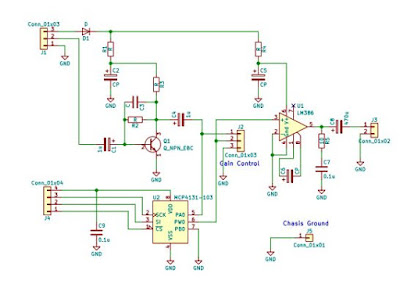
I’ve added one feature to my audio amp stage that opens up some good possibilities. Instead of the traditional potentiometer between the AF preamp and the LM386, I’ve inserted a digital potentiometer (MCP4131-103) that is controlled by three extra pins on the microcontroller. The digital pot lists for $0.81 on Mouser so it’s no more expensive than a physical pot and it’s way more versatile.
Why do this?
- The module is quick to make if you’re building a lot of rigs.
- AF gain can be controlled via the CAT port.
- AGC control can be done in software. This enables all kinds of fancy AGC “attack” and “release” controls that can be seen in the docs for commercial rigs.
- This is an enabling feature for remote ops, which is why I did this in the first place.
- AF gain can be controlled using the same encoder (different mode) as is used to control frequency, etc. if you wanted to build a more compact rig.
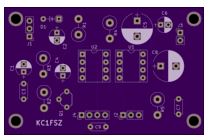
The board is shown below. This is one of my first forays into KiCAD/PCBs/etc. so it’s probably not as “tight” as it could be. Also, I’m using through-hole components so it’s old-school building. But the board only costs $7 on OSHPark and it’s pretty quick to wire up. Anyone who wants to order one from them drop me a line and I’ll send you the link.
Schematic below.
73s,
Bruce KC1FSZ
Peter’s New Airplane
Again. Amazing. What a great workshop. Note his comments on the importance of DESIGNING FIRST, THEN BUILDING. Words to live by my friends, words to live by. Read and heed.
Video on PCB Factory in China
This factory is a LONG way from Manhattan — both from the island and from the technique.
How about some Juliano Blue PC Boards?
The machine that automatically checks for bad connections was especially amazing.
And the boards are made in 24 hours, with 3 day shipping to the U.S.
“First Man” Neil Armstrong Movie Trailer
I think Ryan Gosling is a good choice to play Neil Armstrong. It looks like this movie will deal with the “right stuff,” a concept somewhat related to “the knack.”
Another Wood Box BITX! KC1FSZ Abandons Al-Fresco but Continues with Wood
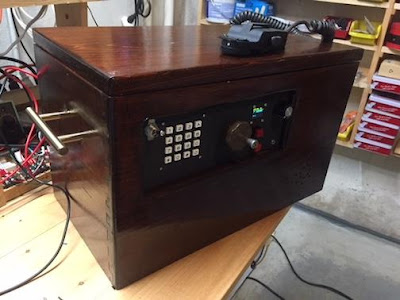
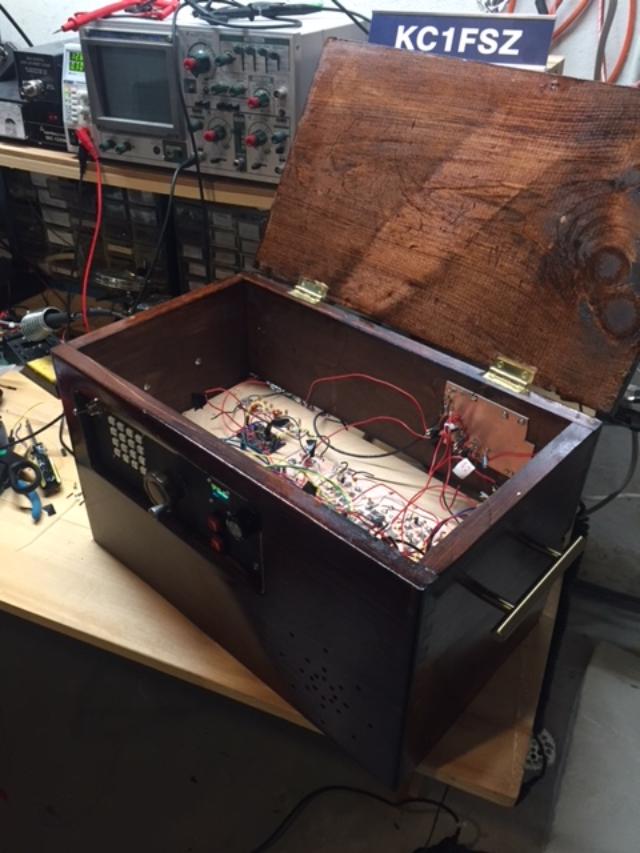
‘Tis a thing of beauty. I like the wood. And I like the hood. The handles are a nice touch. A fitting follow-up to its al fresco organic origins.
Hi Guys:
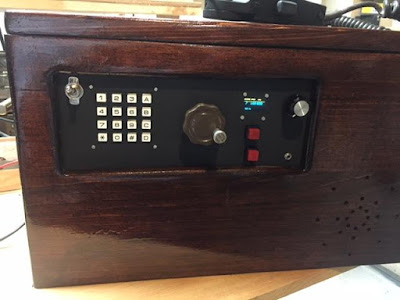
I know there was a view that my giant BITX was supposed to be left out in the open, but I’m going to try to attend my local club’s Field Day festivities this year and the 4 foot long “planker” was pressing the limits of portability. So I moved from the shack to the wood shop and built myself some custom cabinetry. I think it looks a bit like an IC-73000 now don’t you think? OK, maybe not.
There is a hinged door at the top and shelf levels inside for the different parts of the circuit. The power supply and PA section are mounted on the bottom which can be removed for accessibility/serviceability. The whole thing weighs about 10 pounds!!
73s,
Bruce KC1FSZ
Understanding Antenna Directivity — Help from Canada
I am in the process of repairing my beloved 17 meter fishing-pole Moxon. It was taken out of service by the last Nor’easter of the winter. This repair has caused me to review the theory behind antenna directivity. I find there is a lot of “hand waving” in the explanations of how directivity happens: “You put a reflector element next to the antenna. And it REFLECTS!” You are left wondering how that reflection happens.
The Royal Canadian Air Force made a video that does a pretty good job of explaining how the reflector reflects. See above. Thanks Canada!
While we are talking about antennas, I wanted to alert readers to a really nice antenna modeling program that is available for free. It is called 4nec2. You can find it here:
http://www.qsl.net/4nec2/ There is a bit of a learning curve, and I am still climbing it, but I can see how this software would be very useful. It has an optimization feature that runs the antenna through many versions and tells you how to optimize for F/B, gain, SWR, or whatever you want to prioritize.
I have discovered that my Moxon was resonant below the 17 meter band. In other words, the antenna elements were too big. About 3.6% too big according to my calculations. This may be the result of my using insulated wire for the antenna elements. Apparently the MOXGEN software assumes the use of uninsulated wire. I’m thinking that an easy way to deal with this would be to use the frequency 3.6% above my target frequency and then use the dimensions given my the MOXGEN program. Any thoughts on this plan?
What a shame that Cebik’s web sites have all disappeared.
INTERVIEW: Bob Crane Talks to Jack Purdum W8TEE at FDIM. Definition of “Homebrew.”
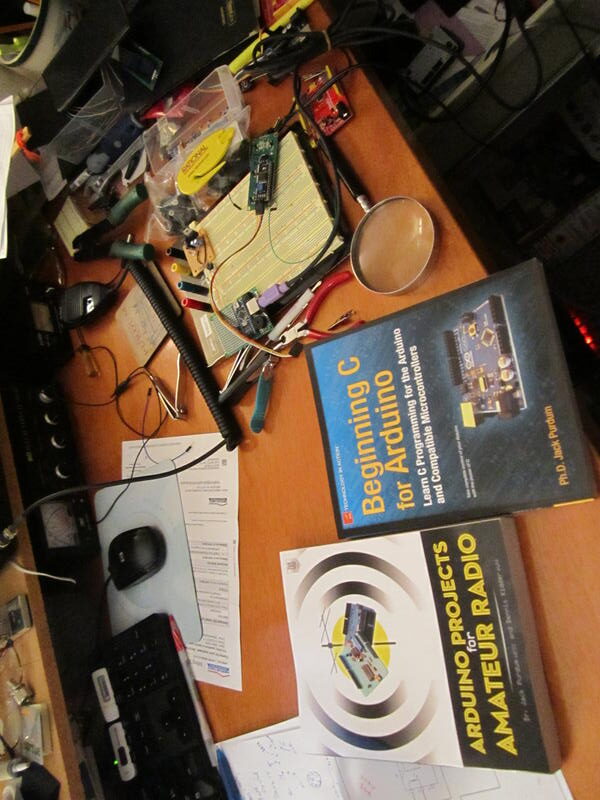
Jack Purdum has been making enormous contributions to the radio art. His background with digital technology has opened many doors for homebrewers, especially through his books on the use of the Arduino microcontroller. I think his new “JackAl board” is really going to shake things up. I was glad that our correspondent in Ohio, Bob Crane W8SX, caught up with Jack and interviewed him for soldersmoke:
But I have one small disagreement with Jack. It has to do with the definition of “homebrew.” Jack seems to define true homebrew as “designing and building your own rig from scratch.” My problem is with the “designing” part. By this definition, those intrepid heroes of days-gone- by who saw a schematic in QST, ripped apart some old broadcast radios, and used the parts to build a 50 watt CW transmitter with a regen receiver were not true homebrewers. I would maintain that they were. I agree with Jack that kit building is a bit different, and of course designing the rig yourself earns you the coveted “designer” designation. But for me, if you start with a schematic and an article, gather the parts and build the thing yourself, that is a homebrew project and you are a homebrewer. After all, even the designers are very often making use of standard blocks of circuitry (Colpitts oscillators, common emitter amplifiers, power supply circuits, etc.)
I think we will have to turn to our lexicon expert Steve Silverman for a ruling.
In any case, thanks to Bob Crane and to Jack Purdum.
Hans Summers and his QCX — G0UPL Cracks the Code on Si5351A Quadrature

Pete, Brad WA8WDQ and I were recently e-mailing about our admiration for what Hans G0UPL has achieved with his QCX rig. I cc’d Hans — we got this nice and very informative e-mail. Be sure to click on the link provided by Hans, and from there go to the link to his FDIM proceedings article. I think that article is a real masterpiece — there is a lot of very valuable information in there. For a long time, getting quadrature output from the Si5351 seemed like an impossible dream. But Hans has obviously figured out how to do this, opening the door to much better and simpler single-signal phasing receivers. Thanks Hans!
Hi all
Thanks for the nice feedback on the QCX and the FDIM conference proceedings a article, which I have published on QRP Labs web page along with other Dayton trip miscellany. See
My seminar presentation audio was recorded by Ham Radio Workbench podcast and they will be publishing it on 5th June.
The QCX kit has indeed been unbelievably popular, almost 5,000 kits have been sold since the launch on 21st August. It seems to have itched an itch that needed itching, in the QRP world. Sales continue to be strong and I’m currently preparing another batch of 1000 more.
I’m very proud of my 90-degree quadrature Si5351A and it helped me towards my low cost, high performance target for QCX. Abandoning the 74AC74 saves a part, reduces cost, reduces complexity, reduces board area (and hence more cost) and even seems to provide better performance (higher unwanted sideband rejection when using the Si5351A in quadrature mode). Getting the Si5351A to do this is one of those things which look easy afterwards. But at the time, and faced with SiLabs un-useful documentation, it took an awful lot of headscratching, trial and error!
I’m not sure of the answer to the question about noise figure. Certainly radios such as QCX and the NC2030 which use the QSD architecture seem to have very high sensitivity without an RF amplifier ahead of them. This must indicate a low noise figure.
73 Hans G0UPL
VK2BLQ’s Beautiful uBITX in a Wooden Box
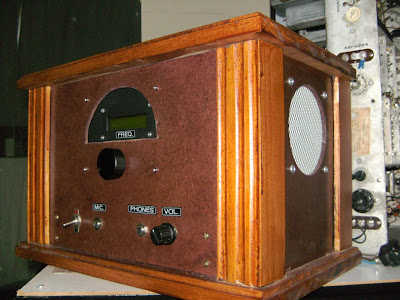
Now that, my friends, is a BEAUTIFUL uBITX. Stephen VK2BLQ put that one together. Peter VK2TPM helped him get the KD8CEC software into his Raduino (Stephen had trouble getting it to compile on his Raspberry Pi).
For me there is good news and bad news here. The bad news is that I can no longer tell people that mine is the only “wooden box” rig that they will ever work. The good news is that I am no longer alone.
INTERVIEW: Four Days in May 2018 — G0UPL Hans Summers talks to Bob Crane
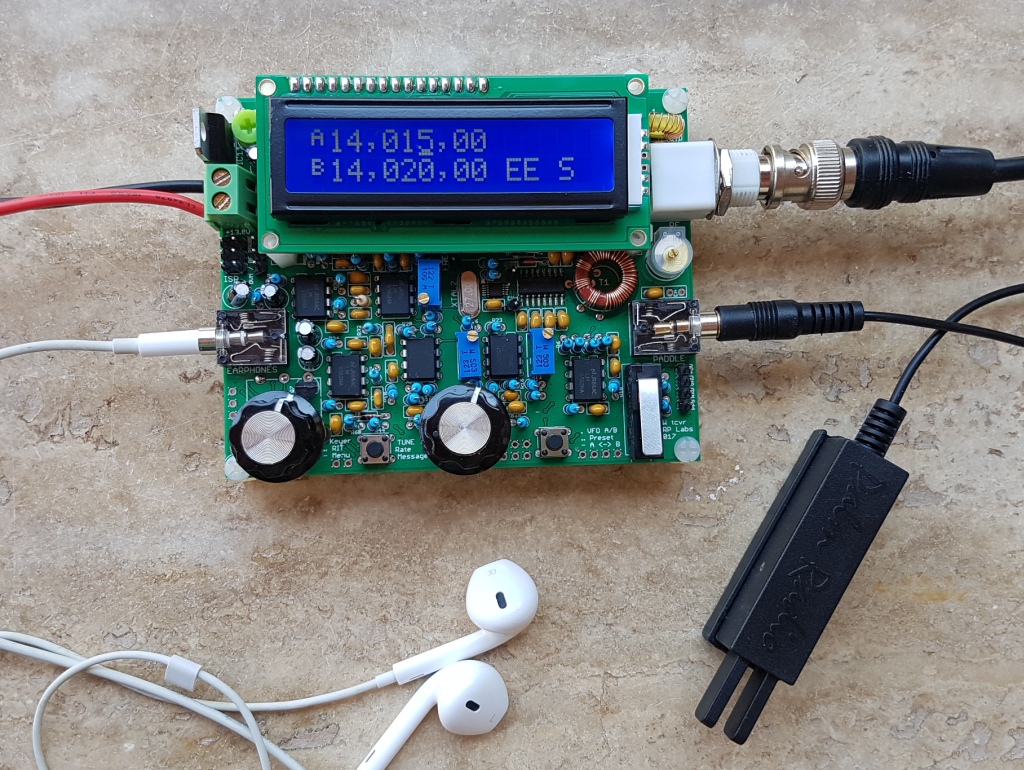
Once again, our correspondent Bob Crane W8SX has gone to the Four Days in May event and has sent back some really great inteviews with those who made presentations there.
First on the list was Hans Summers G0UPL. Hans is a justifiably famous Homebrew Hero, and a member of the QRP Hall of Fame. The latest of his many contributions to the hobby is his amazing QCX transceiver. Like the BITX rigs, the QCX refutes the idea that hams need to spend kilobucks to get on the air with a decent rig. Priced at around $50, the QCX offers excellent performance. And it comes with built in test gear: the signal generator you need to align the rig COMES IN THE RIG! FB Hans.
I think it was Pete who noted that the price range for rigs like the QCX, the BITX, and the uBITX is in the $50 to $110 dollar range, meaning that “One hundred bucks is the new three thousand bucks.” We owe a lot gratitude to Hans and Farhan for this very positive paradigm shift.
Listen here for Bob Crane’s 2018 FDIM interview with Hans:
http://soldersmoke.com/G0UPL-18.mp3
We all also owe a debt of gratitude to the QRP ARCI folks who did all the hard work that goes into organizing Four Days in May. Special thanks to QRP ARCI Preston Douglas WJ2V, and to FDIM Chair Norm Schklar WA4ZXV. FDIM is one of the most important events on the Homebrew/QRP calendar.
More info on the QCX (and order yours) here: https://qrp-labs.com/qcx.html