Springtime on Mars (as seen from the Sabine hills)

Ian Sharp in Britain took this image at 0:54 UT January 4, 2010. The North Polar Cap is huge and obvious. The slightly bright region on the southern limb (top) is the dusty Hellas basin.

After months of looking at Jupiter, we now have a good view of Mars. On Saturday night we had a “Mars-rise” over Monte Calvo shortly after sunset. Mars is really bright now (explained below) and the distinctive red color really jumps out.

I didn’t take the picture, but the shot above gives you a good idea of what I was looking at on Saturday night. The Northern polar cap was very apparent in my six inch Newtonian Dobsonian. It looked like it had a dark border around it. Martian North is at the bottom in this shot. It is Spring in the Northern hemisphere of Mars now.

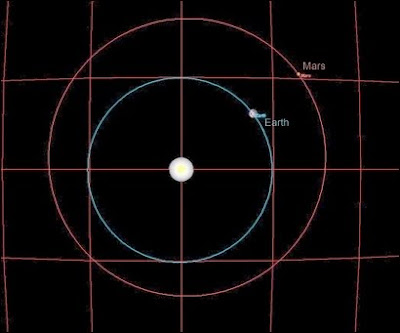
Mars is now in a very good position for observation from Earth. On January 27, it will be in full opposition:

So hey, this is the time for those of you who are hoping to win the Elser-Mathes Trophy! Aim those Yagis and be sure to tune UP!

No smoke but Mars, Andromeda, and QRP

No podcast today because we are out in the Sabine hills.But here is a
report on activities here; RC plane was a flop. Advice from WA6ARA and
others helped, but wings are now really messed up. Big success in
astronomy: clear skies and no moon on Saturday. We had a really
beautiful “Mars rise” and were able to see the polar ice cap. Then we
spotted Andromeda galaxy naked eye, and then viewed it in the scope.
Awesome. I’m on the HW8 now. There is a contest but I’ve managed a few
real QSOs. Back to Rome tonight.

5X7JD: Tuna-Tin To… Uganda

SolderSmoke listeners might recall that Jack Dunigan e-mailed me prior to his move to Uganda. Jack had been listening to our stories about QRSS and WSPR and was thinking about setting up an East African beacon. Jack in now in Uganda and on the air as 5X7JD. He has a beautiful and very interesting blog. Check it out:

http://hamradiosafari.com/

(Jack: Maybe run WSPR using your computer and the Icom at low power, and then use the Tuna-Tin-Two for a separate QRSS beacon. You need an SSB rig for WSPR, but a simple K1EL keyer hooked up to the Tuna-Tin is all you would need for visual QRSS. The TT may need some modification to put it on 30 meters. Let us know if you need help, parts, crystals, etc. It would be a real hoot to have a Tuna Tin beacon from Uganda!)

Jack’s blog is filled not only with tales of ham radio in Africa and Jack’s personal radio roots (in his Dad’s TV repair shop), but there is also information about the work that took Jack and his wife to Africa. Here is his description of it:

Aidchild, the organization for whom I work here in Uganda, cares for orphans living with Aids. There are two homes filled with kids for whom we care completely. This means we provide complete care because they are in every respect our own children. We also provide clinical and laboratory services for about 3000 more children. All of this costs money, lots of it. You can check us out at www.aidchild.org

We raise money through donations, but we also have started businesses here in Uganda to provide funds. We have an art gallery and shop at the Sheraton Hotel in Kampala, a gallery and cafe on the Equator, and a restaurant here in Masaka called Ten Tables (any guess as to how many tables there are?). But caring for Aids children is not inexpensive. So we can always use more funds.

From Jack’s postings you also get a sense of the personal sacrifices and hardships that come with his kind of work: scroll down to his posting about malaria and you will see what I mean. As we all watch the suffering in Haiti, it is a good time to think about the many good people like Jack and his wife who are working hard to help our fellow human beings in difficult third-world areas.

Speaking of Haiti, of course the situation is unspeakably bad. We feel real connections to it: My wife is from the same island (from the Dominican Republic). When I was stationed in Santo Domingo, I traveled to Port-au-Prince, and went to many of the places that you now see (crumbled) on TV. Here in Rome, the principal at our kids’ school is Haitian. And I have friends in our embassy there. As a kid, one of my first DX contacts was with HH2JT — Jules Tomar (I still remember getting his QSL). I see that the good fellows at G-QRP have made a contribution to the relief efforts. We should all follow their lead. Graham, G3MFJ, reports that the club made their donation to :
http://www.dec.org.uk/donate_now/

VK6ADF: Echolink, WSPR, 6 Meter Yagi

From London I used to talk to Phil, VK6ADF, on Echolink. We have a lot of interests in common. This may be due to the fact that we were both born in the International Geophysical Year. Phil is now reading “SolderSmoke — The Book,” so we will probably discover other areas in which we have crossed paths. This week, I decided to get back onto Echolink, and in my first session I was looking for OM Phil. He wasn’t on, but, IN A VERY MYSTERIOUS TWIST, that morning he sent me an e-mail. Spooky, eh? Anyway, yesterday we got on Echolink and covered our usual wide-range of tech topics. Phil alerted me to a web site called Real Flight that provides an on-line simulator for Radio Controlled airplane pilots. Obviously Billy and I could use some time in the simulator!
Phil is also into WSPR and as we spoke I fired up my 20 mW DSB WSPR rig. I was immediately heard by an Irish station, and Phil almost instantly saw the report on the WSPR database. I noticed that the EI station was reporting that I was on 40 meters, when in fact I was rock-bound on 30. Again, as Phil and I talked, I went to the WSPR chat section and asked about the freq discrepancy. Another VK6 (a friend of Phil’s!) answered my question (a simple set-up problem). Small world.
Phil and I have similar curmudgeon-like thoughts on Surface Mount Soldering, and he seemed sympathetic when I said that I think I am more of a “Hardware Defined Radio” guy. Again, this may be an IGY thing. Oh yea, almost forgot: We’re not crazy about LINUX either. We are only a few short steps away from the “SPARK FOREVER” mentality and full-fledged Luddite status.
One interest that Phil and I DO NOT share is Six Meters. Phil is now addicted to the Magic Band (which I still consider to be a white noise generator). Check out his video on his six meter yagi.

AA1TJ: Reggies Rule! Diode Amps! QRP to the Max!

Whenever I find myself in need of some radio-inspiration, an e-mail from Mike, AA1TJ, seems to pop up in my inbox. This morning’s message and the associated video (above) were especially inspirational. Mike was e-mailing Steve, WA1HFF.

Hi Steve,
Thanks for the message and the great QSO! I was running my one transistor transceiver that I call the Reggie. You can read about it on my webpage at

http://mjrainey.googlepages.com/reggie

My antenna is nothing to write home about; just an end-fed half-wave wire bent into an “EL” at 35 feet.

I’ve made just over 240 contacts with my Reggie in a little more than a year’s time; working 19 states. My best (and only) real DX was the Bahamas. All of these contacts were made with no receiver gain on this end; just a pair of diodes fed by a one-transistor BFO, and onto the headphones.

A couple of fellows have built their own Reggies, so you might run into one on 80m now and then. I’ve made three Reggie to Reggie QSOs thus far.

Steve, last night I was trying something new; I ran a loudspeaker from an audio amplifer connected to my Reggie. What’s unusual is that my audio amplifer was made from three, common power supply rectifiers (1N5401’s). I’m not kidding! It’s a nearly forgotten circuit from 1954 that I (re)stumbled upon a couple of weeks ago. It uses the phenomenon of PN junction charge-storage to produce amplification.

Last week I used two diode gain stages for a total power gain of 48dB to drive my headphones. Yesterday, I added a third diode gain-stage and connected it to a loudspeaker for shack-filling audio volume.

I made a video of last night’s setup (the same setup I worked you with). You can see it at

http://www.youtube.com/watch?v=3DA07A6BLDg

Thanks again for the nice contact last night, Steve. You were armchair copy here! :o)

Best wishes,
Mike, AA1TJ

Here’s a question for Mike: Can you build that kind of amplifier with homebrew point-contact diodes? If so, you’d be opening up the possibility of a homebrew solid state receiver with homebrew solid state devices. Oh man, this stuff makes me feel like such an APPLIANCE OPERATOR.

DXing with Crystal Sets

Mike Tuggle has an excellent article on this subject in the Antique Wireless Association’s on-line archives of the “Old Timer’s Bulletin. ” Here’s the link:
http://www.antiquewireless.org/otb/dxxtal.htm
The link for the Antique Wireless archive (another treasure trove for us) is:
http://www.antiquewireless.org/otb/archive.htm

Our New R/C Electric Airplane

We are thinking that olive groves are not quite as forgiving as the corn fields that the kid in the picture is using. And the bit about “no experience needed” probably should have a “as long as you don’t mind crashing.” Oh well, I guess crashing is part of the learning experience. But a quick review of the pertinent R/C airplane forums reveals there may be problems with this wing design: Apparently when it stalls, one wing stalls before the other (i.e. it “tip stalls”), with catastrophic results. The plane has a very comforting ACT (“Anti-Crash Technology”) feature, but the forums advise that this feature may cause more crashes than it prevents.

We have the plane back on the Rome workbench this weekend. Crazy glue and tape are being applied. We will be back out at Chinghale International Airport (i.e. a clearing in the olive grove) next weekend to see if we can get a few good flights out of this thing.

Radio notes: The radio control system is on 27.145 MHz FM.

Update from the Dover Construction Club

News from the construction club

Ian continues with his love of military equipment repair. He has been
working on the B2 spy set. He had it working at Rishworth earlier in
the year but it had a replica TX he had scratch built. Now he has an
original TX section. He has also been using a 123 set and installed a
neat mod for netting. I will try and send you some photos in the next
few days.

Ian and I moderate the B2SPY set yahoogroup. Perhaps you can give
this a mention. A search for B2SPY will lead listeners to our group.

Over christamas I completed my MKARS80 RXTX what a fantastic bit of
kit for £50. The audio is FB, covers the whole 80m band and easy to
build. My friend Norman has not had time to finish his so I have as
of yesterday I now have his aligned on the band and the tx working. I
still have with the help of Ian to set up the drive and mixer
correctly. We have as you know all the kit at the club. I had
Colette aged 7 help with the winding of the final toroid of both
Normans and my kits, this is good and the QRP gods will look down
favourably, no transistors gave up any smoke as a result.

Last night (Thursday) it was one of the few occasions when we were
unable to meet. The threat of more snow coupled with our local
authorities inability to clear our roads means we had to all work at
our home benches and chat over 2m.

Perhaps Bill we can have some photos of the operating position in the country.

My next project will be the cw add on for the MKARS80. Ian tells me
off because I have too many projects on the go. I still have a DDS
sitting waiting to be grated with an icom if and af boards.

Most recent purchase was a froggy 7 for £30. Have installed a slowmo
drive which improved the tuning no end.

I have moved my shack to the conservatory, my loft space shack was
just too cold for comfort. I had a broken antenna switch in the junk
box
, the switch had failed, Ian gave me a relay from his massive stock
of spares and now when I power up the downstairs sheck HF is
automatically switched to there, when powered down the feed switches
to the froggy 7 in the bedroom for headphone monitoring whilst Michele
watches
Eastenders or some other such TV mush.

Michele has given me a iphone for Christmas. I rarely have to open up
my laptop and can catch up on emails and the like in down time waiting
for Eurotunnel to deal with the snow on the line ha ha. What a
fantastic bit of kit for a ham. It has some cw practice apps. There
is an app which allows a paddle to be used to type in text for text
messaging the problem is it requires the phone to be hacked which
would void the warrantee. A bit risky with a phone that costs about
£400.

I have spend some three years now working in France, and have made
good friends with the Dunkerque radio club as you know. Perhaps this
year it is time to consider new horizons, jobs are hard to find in the
Uk right now but watch this space.

Can I finally ask you to mention the Dover Radio Club Rally on 17th January 2010
information from www.darc.org.uk. The club used to hold an annual
rally and we are planning to start these again. We have almost every
table booked and will be drawing in hams from all over the SE of
England.

What a pity you left London, you could have come down and met the
construction club had you still been in London. I am sure will will
meet up at some time. I am considring the purchase of a motorhome to
replace the one we sold a couple of years ago. I have a trip to Rome
already mentally planned, and Michele as you know is radio friendly.

Bill keep up the good work with soldersmoke.

Because of the snow I am working Uk side today I guess I should get
back to some work again.

73 from Nigel, White Cliffs of Dover England

Stradivari, Violins, Sunspots, and the Maunder Minimum

I mentioned Antonio Stradivari in SolderSmoke 120, but I felt a bit guilty about it, because there wasn’t much of a connection to radio. But Nick, KB1SNG, has come to the rescue. Nick sent me this interesting article that discusses POSSIBLE connections between the quality of Stradivari’s violins and the sunspot count. Check it out:
http://news.nationalgeographic.com/news/2004/01/0107_040107_violin.html

A recent article in The Economist alerted me to the fact that OM Stradivari was busy in the shack, churning out mechanical audio oscillators well into his 90’s. I thought that Stradivari’s late start, and his success in his senior years makes him an inspiration for many of us. A quick look at the Strad-Wiki page confirms this: Stradivari didn’t really hit his stride until age 54, and did his best work between age 54 and 81.

New antenna for the HW 8 station


Now that my HW 8 station has been moved indoors (good thing — there was snow on the hilltops this week!) I had to put up a new antenna. I decided to go with the same design that I had earlier: a dipole fed with TV twin-lead. I knew I needed a bit more wire than I had used in the original — I had trouble getting that antenna to tune up on 80. So I went to the local hardware store and asked for 20 meters of AC line cord. That cost me 8 Euros. Not bad.
We had a nice sunny afternoon on Sunday — Billy and I took the line cord out into the olive grove and pulled apart the two wires. (Hint: Start from the center, and pull slowly, or else the cord will get all twisted and a two minute job will turn into a twenty minute exercise in untangling.) I got to use some of those Radio Shack “solder strips” — I just wrapped a few around the connection points and applied heat from a cigarette lighter.
I put some parachute cord (550 cord) over a conveniently placed tree branch using the venerable rock and rope method. One throw was all that it took. The radio gods were smiling on this project.
Success! With the Trastevere flea market Pi network, the thing tunes up nicely on 80, 40, 20, and 15. I notice that the cheap CB SWR meter that also I picked up at the flea market doesn’t seem to sample much RF at 80 meters. I’m guessing that the designers were very focused on 27 MHz.
I quickly worked stations all over Europe, and even worked one station in Israel. I worked G4OEC in Somerset — I immediately thought of Tim Walford, and asked OM OEC if he knew the wizard of the Somerset farm. Mac said his village was far from Tim’s QTH.
It is nice to once again get familiar with the daily routine of the bands. 80 is hopping when I turn the rig on at 6 am local time. 40 seems to be active too. 20 opens a bit later, and I can hear stateside stations starting around noon local time. I really like hearing KZ1H up there in the high end of the 20 meter band — I can hear him almost every day.
Check out the ad for the HW 8 in a 1978 catalog. This must be a non-U.S. catalog because the ad brags of the HW-8’s ability to “work the States.”
Not much astronomy this weekend — Sabina and most of the rest of Italy fell under clouds on Sunday night. But I did catch a glimpse of Capella and the Kids.

SolderSmoke Podcast #120


http://www.soldersmoke.com

January 2, 2010
Olive harvest in Sabina, Christmas and New Years in Rome.
"What, no Klingon?"
How's my whistling SSSS problem?
DX on 20, HW8 QSO with KZ1H
Auroral flutter on US stations
W4OP: Homebrew Hero
Softrock progress
Linux woes
72 Part Challenge: "Stuck between best wishes and hugs and kisses!"
Chinese Hamsat in orbit, with CW telemetry
AA1TJ in CQ, and using diodes as audio amplifiers.
Stradavari and Julia Child: inspirational late starters!
Billy's RC plane
QRSS: telemetry next?
WSPR: 150K reports per day
New issue of Hot Iron
MAILBAG

Happy New Year! SolderCake!

This is just so good, I felt the urge to share it immediately with the SolderSmoke community. Thanks Tom, and Happy New Year to all!

Bill:

Happy New Year!
I am yet another listener who discovered your podcast by accident and am now hooked. I also thoroughly enjoyed your book. Both take me back to the days of scrounged parts and burned fingers, building balanced modulators and an FM stereo transmitter that earned me an invitation to leave a great southern university.

To celebrate the new year, rising sunspot numbers, and your 120th podcast, I offer the attached photo of a Solder Cake. It features 120 rolls of 60/40 rosin core solder — several brands and gauges. The cake actually weighs 123 lbs. because the roll holding the soldering iron at the top is 4 lbs. It has zero calories, but definitely contains lead! It should be baked at less than 370 degrees, or the icing tends to run.

Why would anyone have 120 rolls of solder? I don’t remember precisely, but rumor has it that ebay and alcohol were involved.

73, and a wonderful new year to you and your family.

Thomas Keister M.D. N5RTF

On the air, out in the woods… Plus, olive news

We were out in the Sabine hills this week. Things are starting to settle down out there: The Cinghale are, well, mostly GONE (see earlier post), and the gunfire is starting to die down. And the olives have all been shaken from the trees. All was going well, but my wife was worried that with temperatures dropping, she might find me frozen out at my front porch operating position, so she secured indoor accomodations for me and the HW-8. Wow, what luxury! My CW is back to normal — the shivering had been a real impediment. On Monday and Tuesday I was on 80, 40, and 20 with the Heathkit. I managed to work seven stations using a far-from-optimal end fed wire with my flea market tuner. It was fun to work Russian stations — UA6HNU was running a homebrew rig. It reminded me of the good-old days in which most of the Russian hams were running HB gear. Then, just as we were getting ready to head back to Rome, there was some icing on the cake: Near the top of the 20 meter CW band I heard KZ1H (see earlier post) all the way from Boston.

Next week, a better antenna goes up.

I got some questions about the olive harvest. It seems that the trees around are place are about 200 years old — mere kids, considering that there are olive trees in the world that are 2000+ years old.

As for the harvesting process, the shaking machine vibrates the tree for about 5 seconds. The workers have a collection tarp on the ground to catch the olives. Then they have machine that reels in the tarp.

Stagnosald! (Italian flux)

For some reason I like the packaging for this Italian soldering flux. Sort of takes you back to the days when soldering was soldering, if you know what I mean. Now (somewhat ironically) we are using this flux for SMT soldering. On the left you can see the PA stage of my slowly-coming-together SMT SDR LINUX Compu-radio. As you can probably tell, I am struggling to keep a positive attitude towards SMT and SDR. Lately, even Linux has been giving me trouble. The problem here is clearly with the operator, not the equipment. The Softrock SDR kit is really excellent. I’m sure I will eventually get it working, but I think there will be a lot of geezer-like complaining about all this new-fangled surface mount, software stuff. Please, bear with me.

Glowbug Christmas

My “Mate for the Mighty Midget” receiver (with 6U8s)


Some excellent Christmas verse from Brad, AA1IP:

The Glowbugs’ Christmas
******************************

T’was the night before Christmas
And all through the shack
Not a heater was glowing
In all of the rack.

Sitting totally silent and quiet that night
The old HRO shed nary a light.
The Johnson exciter and its homebrew final
Felt cold as leftovers, or seat-cover vinyl,

I drowsed at my workbench feeling tired and weary,
The print in the Handbook looked fuzzy and smeary.
I thought, “I’ll make coffee”, and groaned to my feet
When I heard a loud clatter outside in the street.

What the–? I wondered and turned on the lights
And there I beheld a wondrous sight:
A battered old van heaped high with components
And a grizzled old ham with a bagful of doughnuts.

I noted his callsign– can’t recall it today–
But a patch on the side read “FMLA”.
I opened the door and hollered “Come in!
The coffee pot’s heating, and we’ll sit down and chin!”

He spoke not a word but whistled in Morse
A “GE OM”, and “By golly, I’m hoarse.
Too many contacts, and hot rosin smoke.”
I nodded and poured him a mug of jamoke.

He emptied the doughnuts in a pile on a plate
And explained in a whistle, “I’m running real late.
I’ve new 6L6s and fine 211s, 6146s and good ‘SN7s.
And 866s and 0B2s, type 45s and mil-spec 807s.”

“For the regennie crowd, 201s by the score
And good ol’ type 30s and 19s galore.
I haven’t neglected the passive-parts run
There’s lots of good iron by old Thordarson.”

I nodded and smiled, suppressing a chortle
As he reached in his pack and left me a 304TL.
He whistled, “I’m leaving, the coffee was great,
But I’m overdue in the neighboring state.”

“Keep everyone building the rigs of their choosing
Or we’ll lose the bands that we’re lazy in using.
Transistors or tubes– any project is fine–
Just keep on constructing and sharing on line.”

He leaped to his feet and waved a gloved hand
As he sprang for the door and his rusty old van.
I heard him exclaim as he drove away from me,
“Merry Christmas, you Glowbugs, and to all 73!”

****************************

(With apologies to Clement Clarke Moore, who surely would have
been a ham had radio existed in his time. Alas, all he had
to build with was words.)

For new readers: the FMLA (Five Meter Liberation Army) appeared in a
series of short stories written by Michael N. Hopkins, AB5L (sk). If you have never
read these, you’re in for a fun evening!

For QRP fans: the numerical references in the poem are for classic
vacuum tubes, several of which operate at QRP levels (whether or not that was the
original builder’s intention) and (mostly) within the amateur bands.

Christmas Greetings from Lunar Orbit

I always liked the last, very inclusive line in Colonel Borman’s 1968 Christmas Eve message.

“Wired” magazine also made note of the important Christmas Eve radio message (1906) from Reginald Fessenden: the very first “phone” transmission. Fessenden himself played the violin (“Oh Holy Night”).

Merry Christmas from Rome! 73 Bill

An appeal from SETI

Now here is a charity that Knack victims might see as a good cause —

I’m Dan Werthimer, the Chief Scientist of the SETI@home project.

You’ve been identified as a SETI@home volunteer, and I’d like to take this opportunity to thank you for your efforts. I also want to preview our plans for 2010, and ask for your financial support.

SETI@home is a unique global collaborative project that uses spare cycles on personal computers to help search for signals of extraterrestrial origin. Our vision to embark on this grand search is over ten years old, and continues to engage volunteers such as you from all over the world.

In order to improve SETI@home in 2010 and accomplish our scientific goals, we are reaching out to our volunteers for financial support, as this venture is largely funded by individual donations.

Our goals for 2010 include:

  • Deploy and refine the Near-Time Persistency Checker (NTPCkr) which makes SETI@home more efficient in identifying candidate signals.
  • Develop a web based system that will allow volunteers to view, as well as help in the ranking of, candidate signals.
  • Expand the frequency coverage of our search beyond the current 2.5MHz band.
  • Improve how we identify and reject Earth-generated radio frequency interference (RFI).

With your financial support we can accomplish all these goals in 2010. We would greatly appreciate any donation amount you can afford, and your gift is tax-deductible.

Thanks again for your time and consideration of SETI@home. Your effort and donations are what make this venture possible.

Sincerely,

Dan Werthimer
SETI@home Chief Scientist
Space Science Laboratory
University of California, Berkeley

PS: if you’d like to donate via check or wire transfer, please see instructions here.