ARISSat-1 to Deploy Next Week

This project has me digging through the boxes, looking for my 2 meter gear. This looks like fun! From AMSAT:

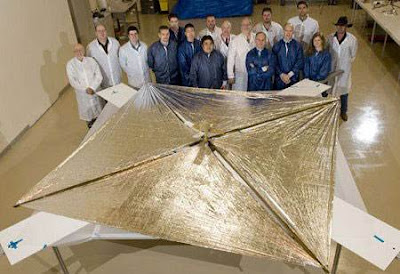
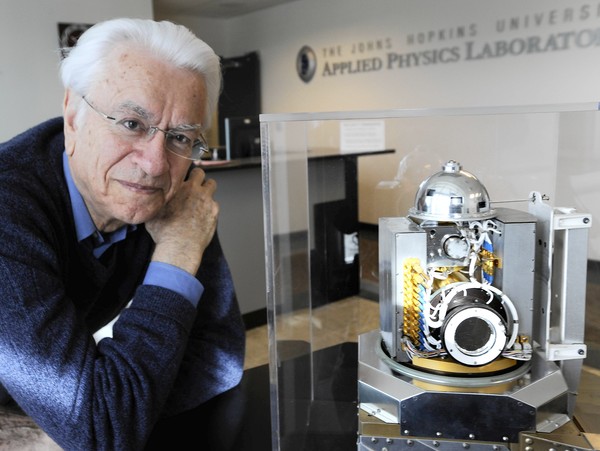
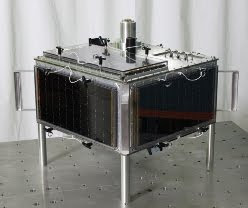
ARISSat-1 is a microsat developed as a follow-on to the SuitSat-1 project. The satellite was launched to the ISS on January 28th, 2011, with deployment during an EVA (spacewalk) on February 16, 2011.

The satellite will downlink live SSTV images from four onboard cameras, live telemetry and messages on the CW, FM voice, and BPSK downlinks, as well as provide a 16kHz wide transponder for two-way contacts. All the uplinks and downlinks are based on software defined radio systems.

Telemetry will include spacecraft subsystem information, as well as data from the Kursk State University experiment. This experiment will sample the change in vacuum as the satellite slowly re-enters the atmosphere.


Frequency Information

Mode V Digitalker (Voices Messages and Telemetry):
Downlink 145.9500 MHz FM
Mode V Imaging (Robot 36 SSTV from onboard cameras):
Downlink 145.9500 MHz FM
Mode V Telemetry (1000 baud (400 baud backup)):
Downlink 145.9200 MHz BPSK
Mode V TLM Beacon (CW-2, active with BPSK-1000):
Downlink 145.9190 MHz CW
Mode V TLM Beacon (CW-1, active with BPSK-400):
Downlink 145.9390 MHz CW
Mode U/V (B) Linear Transponder (Inverting):
Uplink: 435.7580 – 435.7420 MHz SSB/CW
Downlink 145.9220 – 145.9380 MHz SSB/CW

And for those of you looking for a bit of competition, there is a tech challenge:

AMSAT-UK has announced a ARISSat-1 reception challenge with a FUN reward. The different categories cover those with or without a FUNcube SDR dongle.

ARISSat-1 is scheduled for deployment from the ISS next Wednesday Feb 16 – it has a composite VHF downlink that will easily fit into the FUNcube Dongle receive spectrum.
The telemetry is 1 kbit BPSK and can, of course, also be received with a normal SSB 2-metre receiver.

The expected signal levels from ARISSat should be similar to those we expect from FUNcube itself (and also eventually from UKube) and the team are keen to discover what will be the minimum and best type of antennas for schools to use with a FCD. Therefore user experience with the ARISSat signals will be very valuable in making this determination.

To encourage everyone to receive ARISSat signals we are offering a FUN reward for listeners!

There are a number of categories for this challenge – they include:

1+ The first FCD user, from each continent, who can post a spectrum recording of the received signal together with evidence of decoding the data using the ARISSat software and of sending it to the ARISSat data warehouse .

2+ The first non-FCD user, from each continent, who can provide evidence of having decoded the signals and of sending it to the ARISSat data warehouse.

3+ The listener, using a FCD or not, who can demonstrate satisfactory reception of the telemetry in the same ways as described above, using the “smallest” possible receive antenna. The actual closing date for this part of the challenge will be announced later.

4+ All other entrants who can demonstrate that they have been having FUN!

Please submit your “entries”, including your location, station details (including FCD serial number where applicable), postal address and reports to g0auk@amsat.org

Good luck,

ARISSAT-1
http://www.arissat1.org/

You can join the FUNcube Yahoo Group at
http://groups.yahoo.com/group/FUNcube/

Twitter: http://www.twitter.com/FUNcubeUK
Facebook: http://www.facebook.com/ just lookup FUNcube

FUNcube SDR Dongle
http://www.FUNcubeDongle.com/
From The Guys Who Found the Nano-Sail Satellite Signal

Howdy Bill, and all the SolderSmokers listening in on the PodCast.

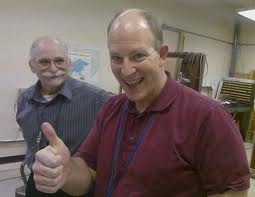
We appreciate the shoutout in #130 about the NanoSail-D excitement .!. Stan – N4PMF and I have been working over the last year or so to re-activate the Amateur Radio Club at NASA’s Marshall Space Flight Center. We both have day jobs in the Huntsville Operations Support Center (HOSC), and routinely interface with the scientists and developers involved with projects such as the International Space Station, Space Shuttle propulsion, and more recently the FastSat program.

The NanoSail project is actually a smaller satellite that was carried into orbit by the FastSat. This NanoSail vehicle is only about 18 inches long, and a few inches square. No room there for high powered S-Band telemetry transmitters, so it carried a ham licensed 1/2 watt FM transmitter in the 70cm band. Maybe later we can get into more detail about all that if you are interested.

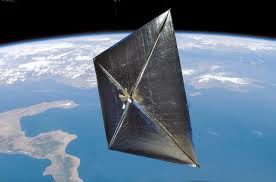
The NanoSail is the first successful deployment of a Solar Sail into earth orbit. The quicker story is that our club (WA4NZD) was started in the early-1970s, and operated Special Events commemmorating Apollo flights to the moon, Skylab missions, and early shuttle launches. Activity kinda dropped off in the mid-1990s, and the club is only now coming back to life. We still have VHF and UHF transcievers and beam antennas on a tower, that are ready to operate – and sometimes we listen in on ISS school contacts, or bounce APRS beacons thru the ARISS digipeater.

We of course got excited back in December when FastSat launched, and the NASA scientists asked if we could help them by listening for the NanoSail when it ejected. Unfortunately, Murphy had snuck on-board, and somehow prevented the smaller satellite from completely ejecting, and it looked like a loss….

Then in January the FastSat telemetry indicated that NanoSail-D may have ‘popped itself out’, and the Principal Investigator Dean Alhorn found Stan and asked if we could take him to the station “NOW” to listen for it. Sure enough, we had the right equipment, ready to go, and he got to hear it for the first time. We even had the AX25 TNC hooked up and it decoded a telemetry burst which allowed them to better estimate when the SolarSail should deploy. Dean was very very excited, and we all enjoyed a bit of the spotlight as Dean made obvious reference in numerous press releases to the role of the MSFC Amateur Radio Club in helping get the word out. The power of ‘crowd-sourced’ science became obvious as they received reports from all around the world. We are lucky to have been ready, willing and able to decode that early telemetry – it sure will help to validate and justify the existence of our little club station at NASA. You can easily find more on the internet, searching for NANOSAIL and WA4NZD.

Again we appreciate the publicity from your Podcast, and look forward to tuning in more often, and possibly sending you more info for your show. Thanks /;^) Alan Sieg – WB5RMG (http://wb5rmg.wordpress.com) Stan Sims – N4PMF MSFC ARC – WA4NZD (http://wa4nzd.wordpress.com)

Mark Twain, Tesla, and Edison

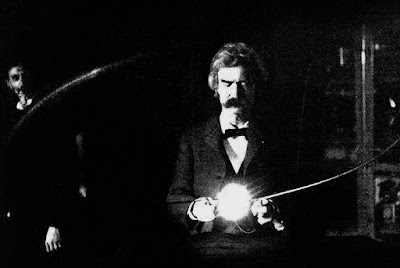
For Christmas my wife gave me Mark Twain’s recently released autobiography. This put me on the path to “The Adventures of Tom Sawyer” which I’m reading on the train these days. I was pleased to find out that Mark Twain was very interested in science and technology. He liked to note that he was born during an appearance of Haley’s comet, and that he would die when the comet returned (he did!) Wikipedia notes that there was a lot of tech talk in Twain’s “A Connecticut Yankee in King Arthur’s Court” (one of my favorite books from high school days). Twain was close to Nikola Tesla. The wonderful picture (above) shows him in Tesla’s lab. He was filmed by Thomas Edison (YouTube version below).

Our New Microphone!

Just kidding… That’s actually a mic from an old Heathkit Benton Harbor Lunchbox.

I continue to get good advice from listeners on the mic issue. I hope to put this to rest soon — then we’ll shift away from AF back to RF. Several listeners advised me to stick to SolderSmoke’s “homebrew or roadkill” ethos, and to avoid the temptation to solve problems with credit cards. Good advice! People REALLY like the audio with the old decrepit computer mic and the Linux Ubuntu Laptop. So here is what I’m going to do: I’ll go back to that combo, but I will attempt to fix up some of the mechanical problems (the old mic is falling apart and it has all kinds of weird things taped on to it) and the electrical problems (it seems to pick up more AC hum than then D-104). It won’t be pretty, but it will be a nice homebrew/roadkill device.

A question for those who expressed support for this mic and for the audio in #129: Didn’t you hear the AC hum?

Audio Blues

OK, so the SolderSmoke community wasn’t exactly Astatic about my use of the D-104. I was really kind of disappointed. After all, I’d risked my dental health (duct tape on my teeth!) in an effort to improve the audio quality. I found it especially galling that a new demon was added to my audio woes: AM broadcast band interference. QRM on the internet! I suppose it is somewhat fitting, especially for a podcast that occasionally dabbles in crystal radios.

Thanks for all the comments. Even for the bruising ones. They gave me some additional insights. Most of the problem is clearly at my end of the fiber optic cable. But I think part of this problem has to do with the fact that people are listening to the show with a wide variety of equipment: some are using car sound systems, some are at home using computer speakers (fed by all kinds of different sound cards). A very wide variety of headphones and earbuds are in use. Also, there are big differences in our ears! I, like many listeners, have some serious high frequency hearing loss.

But never fear, SolderFans! The quest for the perfect podcast audio continues. I have turned one corner of the radio shack into a roadkill sound studio. I have worked on several new (and several old) microphones. I have visited (and have actually read) several websites about podcast audio quality.

There may be a “name that mic” contest in our future…

SolderSmoke Podcast #130

SolderSmoke Podcast #130 is available at
http://soldersmoke.com/soldersmoke130.mp3

Some important trivia questions (answers will be given in the podcast):

— What is the connection between radio amateur (and pioneer radio astronomer) Grote Reber and world famous astronomer Edwin Hubble?

— In the world of radio-controlled helicopters, what is “TBE”?

— In Britain they have radio “rallies,” but at one time they had hamfests.” When did this happen?

— Only one terrain feature on Venus is named for a man. He is man of radio. Who is he?

— What music did Neil Armstrong listen to on his way to the moon?

Plus:
— The Air and Space Museums
— Our music
— The SolderSmoke D-104
— NASA asks for our help
— Telescope repairs
— A BFO for the Trans-O
— Back on Echolink
MAILBAG!

Please send reports on the D-104 audio!

HT-37 on AM

I was very pleased to find AM activity up around 7290 last Saturday.
And I was even more pleased to find that my old
Hallicrafters transmitter can do AM.
The panel switch says DSB, but it is really putting out AM in that position.
If Verizon restores our internet connection I will send out podcast
#130 tonight.

40!

In search of early morning contacts I converted my 20m dipole into a
40m inverted V.
Wow! 40 is wonderful! I’m running into lots of fellow boatanchor fans,
and am also talking to Italian and Spanish radio amateurs.
Internet should be fixed on Friday.

Great News! Internet outage!

Last week’s snow storm knocked out internet service here.
It may be out for a week.
This motivated me to get back on the air.
I fired up my OLD HT37 and Drake 2B combo and have been
Having a ball on 20 SSB.
Every dark cloud has a silver lining.
No hay mal que por bien no venga!
Podcast 130 is done (via D104) and
Will be uploaded as soon as they
fix the fiber optic cable.
I’m sending this via Blackberry.

Tech Details on SolderSmoke’s Theme Music

This will be discussed in the next podcast, so I thought I’d share some tech details on our theme music. From the artist, Maestro Moj:

Geeky details about the music:
In the homebrew spirit, I tried to make all the sounds with instruments which I had soldered
together myself. These were a Formant music synthesizer designed by C. Chapman from the Dutch/British “Elektor” magazine, circa 1977, and a FatMan synthesizer kit from PAiA Electronics. I play them through an ancient Kustom 200 guitar amplifier, which I’ve caused to smoke at least twice. The beginning is my K2 being powered on and tuned across 80 meters. I cheated and used a real gong at the end which a good friend went to the trouble of finding and buying in China, but I fed the sound through a PIC Polywhatsit designed by John Becker and described in Britain’s “Everyday Practical Electronics,” December 2001.
If anyone wants to sing along, it seems to me that the words are: ” – Sol-Der Smo-Oke, – Sol-Der
Smoke (repeat over and over) “
Music, like all home-brew, is never truly done. Next time I’ll try to get a theremin working
again – there’s a radio-circuitried musical instrument!
If my grandson has kept the site up, there may be garage band music of his and mine on MySpace
under Mikeandtheceiling.
Enjoy!
Mark “moj” Johnson
W8MOJ

NASA NANO-Sail Found by Hams!

All is well with the Nano-sail spacecraft, and hams apparently helped find it:

“This is tremendous news and the first time NASA has deployed a solar sail in low-Earth orbit,” said Dean Alhorn, NanoSail-D principal investigator. “To get to this point is an incredible accomplishment for our small team and I can’t thank the amateur ham operator community enough for their help in tracking NanoSail-D. Their assistance was invaluable. In particular, the Marshall Amateur Radio Club was the very first to hear the radio beacon. It was exciting!”

The Marshall Amateur Radio Club confirmed deployment of NanoSail-D late Wednesay EST with reception of the 1200bps AX.25 FM beacon on 437.275MHz +/-10kHz Doppler. News Release: 19 January 2011 Huntsville, AL USA The Marshall Amateur Radio Club (@ MSFC) – WA4NZD late Wednesday afternoon confirmed ejection of the NanoSail-D sub-satellite. This loaf-of-bread sized spacecraft was carried to orbit late last year on an Air Force rocket as part of NASA’s FastSat project. This is the first successful deployment of a satellite, launched from a satellite already in orbit .!. The only communication from the NanoSail-D vehicle is via ham radio with 1200 baud FM AX25 beacon packets. The WA4NZD team of N4PMF and WB5RMG, was listening on 437.275 MHz FM with the NanoSail-D Principal Investigator Dean Alhorn at the club station when the beacon was heard and susbequently decoded onto the screen. Please visit http://wa4nzd.wordpress.com/ for pictures and more links to the NanoSail-D project. They are asking for telemetry reception reports from all over the world to help fill in gaps. The battery is expected to last for only three days. Marshall Amateur Radio Club http://wa4nzd.wordpress.com/ NanoSail-D Dashboard http://nanosaild.engr.scu.edu/dashboard.htm NanoSail-D on Twitter http://twitter.com/NanoSailD

Voyager — Still on the air after 33 years

The Baltimore Sun has a really nice article on the Voyager spacecraft, and on the guys who have been keeping them going for the past 33 years. Here’s an excerpt:

You probably have more computing power in your pocket than what NASA’s venerable Voyager spacecraft are carrying to the edge of the solar system. They have working memories a million times smaller than your home computer. They record their scientific data on 8-track tape machines. And they communicate with their aging human inventors back home with a 23-watt whisper. Even so, the twin explorers, now 33 years into their mission, continue to explore new territory as far as 11 billion miles from Earth. And they still make global news. Scientists announced last month that Voyager 1 had outrun the solar wind, the first man-made object to reach the doorstep to interstellar space.
Here’s the link to the article:

http://www.baltimoresun.com/news/maryland/bs-md-voyager-20110117,0,278380,full.story

NASA Needs Our Help!

Kim Newton
256-544-0034
Marshall Space Flight Center, Huntsville, Ala.
Kimberly.D.Newton@nasa.gov
01.19.11

RELEASE
:
11-009


NanoSail-D Ejects: NASA Seeks Amateur Radio Operators’ Aid to Listen for Beacon Signal

HUNTSVILLE, Ala. — Wednesday, Jan. 19 at 11:30 a.m. EST, engineers at Marshall Space Flight Center in Huntsville, Ala., confirmed that the NanoSail-D nanosatellite ejected from Fast Affordable Scientific and Technology Satellite, FASTSAT. The ejection event occurred spontaneously and was identified this morning when engineers at the center analyzed onboard FASTSAT telemetry. The ejection of NanoSail-D also has been confirmed by ground-based satellite tracking assets.

Amateur ham operators are asked to listen for the signal to verify NanoSail-D is operating. This information should be sent to the NanoSail-D dashboard at: http://nanosaild.engr.scu.edu/dashboard.htm. The NanoSail-D beacon signal can be found at 437.270 MHz.

The NanoSail-D science team is hopeful the nanosatellite is healthy and can complete its solar sail mission. After ejection, a timer within NanoSail-D begins a three-day countdown as the satellite orbits the Earth. Once the timer reaches zero, four booms will quickly deploy and the NanoSail-D sail will start to unfold to a 100-square-foot polymer sail. Within five seconds the sail fully unfurls.

“This is great news for our team. We’re anxious to hear the beacon which tells us that NanoSail-D is healthy and operating as planned,” said Dean Alhorn, NanoSail-D principal investigator and aerospace engineer at the Marshall Center. “The science team is hopeful to see that NanoSail-D is operational and will be able to unfurl its solar sail.”

On Dec. 6,, 2010, NASA triggered the planned ejection of NanoSail-D from FASTSAT. At that time, the team confirmed that the door successfully opened and data indicated a successful ejection. Upon further analysis, no evidence of NanoSail-D was identified in low-Earth orbit, leading the team to believe NanoSail-D remained inside FASTSAT.

The FASTSAT mission has continued to operate as planned with the five other scientific experiments operating nominally.

“We knew that the door opened and it was possible that NanoSail-D could eject on its own,” said Mark Boudreaux, FASTSAT project manager at the Marshall Center. “What a pleasant surprise this morning when our flight operations team confirmed that NanoSail-D is now a free flyer.”

If the deployment is successful, NanoSail-D will stay in low-Earth orbit between 70 and 120 days, depending on atmospheric conditions. NanoSail-D is designed to demonstrate deployment of a compact solar sail boom system that could lead to further development of this alternative solar sail propulsion technology and FASTSAT’s ability to eject a nano-satellite from a micro-satellite — while avoiding re-contact with the FASTSAT satellite bus.

Follow the NanoSail-D mission operation on Twitter at:

http://twitter.com/nanosaild

For additional information on the timeline of the NanoSail-D deployment visit:

http://www.nasa.gov/pdf/501204main_NSD2_timeline_sequence.pdf

To learn more about FASTSAT and the NanoSail-D missions visit:

http://www.nasa.gov/mission_pages/smallsats

– end –


text-only version of this release

Rouges Gallery: Three Possible SolderSmoke mics

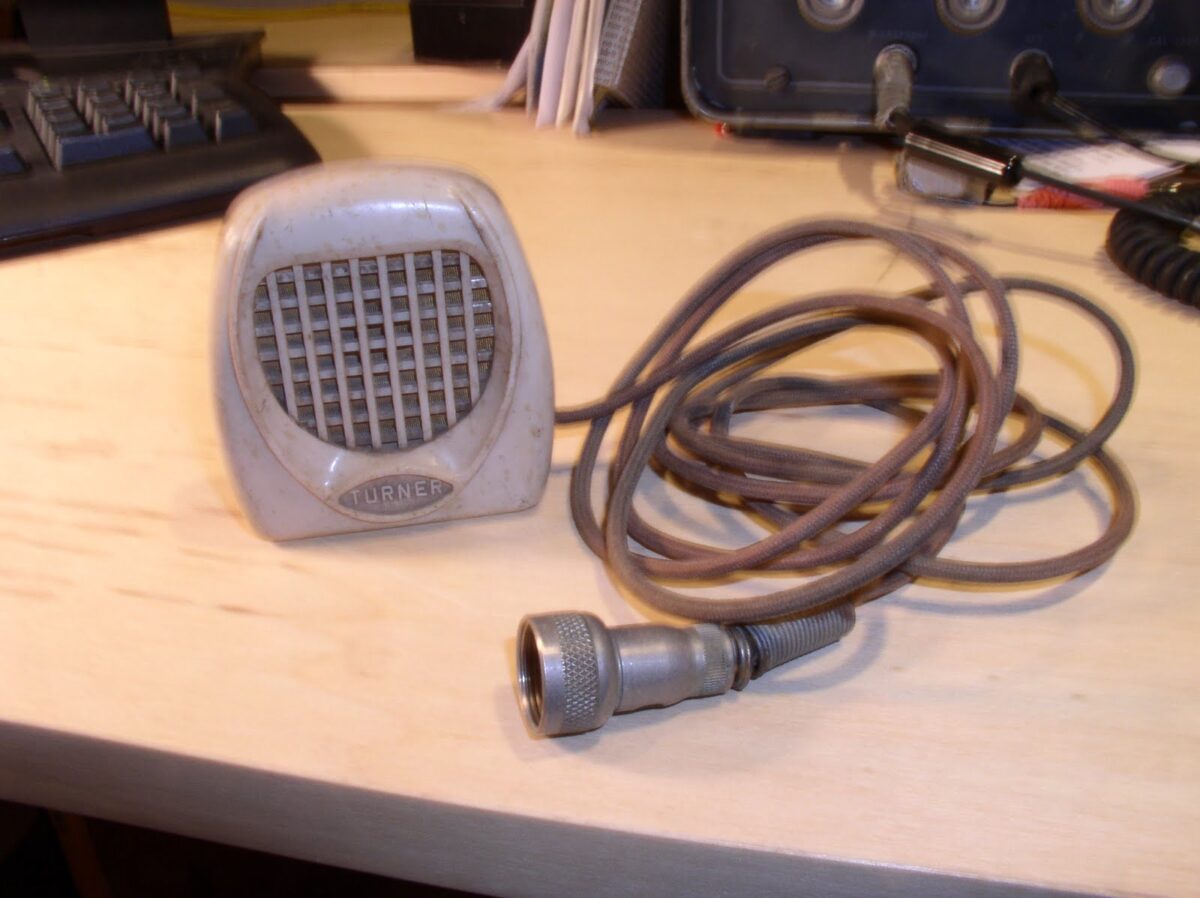
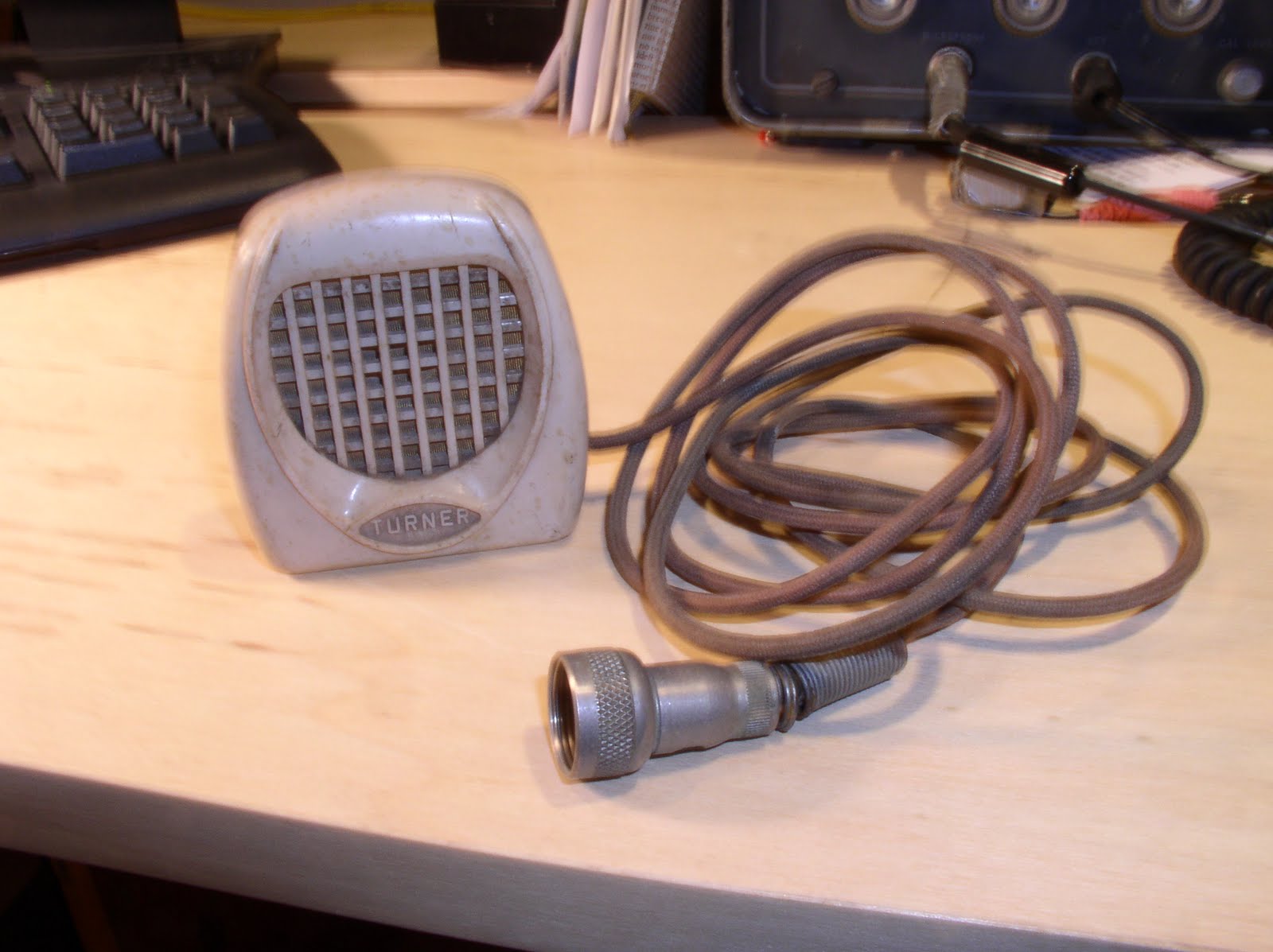
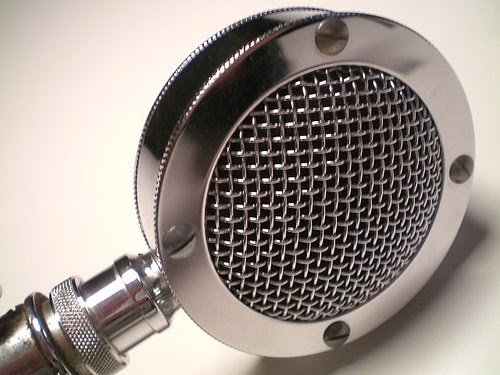
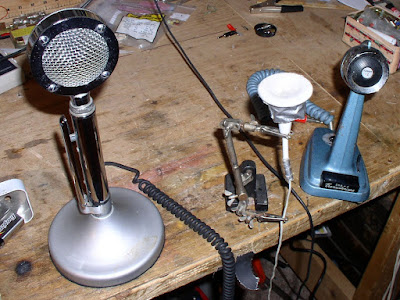
One of my New Year’s resolutions was to finally, seriously pay some attention to the audio quality of the SolderSmoke podcast. With its roots in the scratchy Echolink connections between Juneau and London, audio quality has long been neglected on our show. With some funds donated by kind listeners (thanks guys!) I was this weekend shopping the internet for a suitable SolderMic. I ran into a lot of audio-fool snake oil. Wait a second, I thought, let’s do some checks on the many mics I have around me here in the shack. I made comparison tests using three different mics (pictured above): my venerable D-104 chrome lollipop (with a transistor amplifier in the base), the dilapidated computer mic with improvised pop shield that I’ve been using for the last several years, and a Turner +2 mic that I gutted a while back (the original element was replaced by a cheap Radio Shack electret element, and the on-board amplifier was disconnected). (NOTE: It is a MYTH — an ugly myth — that the D-104 is CB gear. We debunked this hideous lie a while back. The D-104 is definitely ham gear! The Turner +2? Well, I don’t know about that one. It does look a bit good-buddyish.)

At first, I thought the re-done Turner would win out. Then I thought the computer mic would keep its job. But then — surprisingly — the D-104 started to sound REAL good. The D-104 was especially good at keeping AC hum out of the signal — that was a problem with the other two.

I found that I could get a very nice-sounding audio by running the D-104 audio through some EQ to knock down the little bit of hum that it did pick up, and to put about 30 db of attenuation on my now infamous SSSS whistles. I also used Audacity’s noise remover.

So, the next SolderSmoke may come to you via an Astatic D-104. Kind of appropriate, don’t you think? What do you guys think? Maybe I should post an audio sample to get some expert opinion before I chrome lollipop #130…

What should I do with this thing?

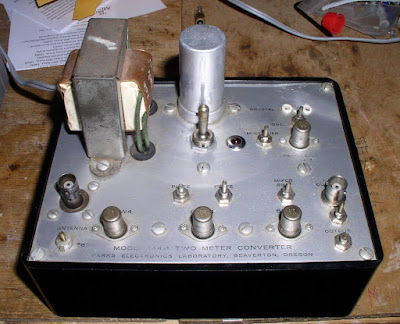
Pretty cool, don’t you think? I found this among the stuff that arrived from storage. I must have bought it at a hamfest sometime in the distant past. Note the miniature TUBES. Note the place of manufacture: BEAVERTON, OREGON. The internal construction is beautiful, with good shielding between each stage. It has a nice AC power supply. I have no real need for a 2 meter converter… So, what should I do with this? It seems to have the potential to become a QRP transmitter. Or maybe a DC receiver? Or maybe I should just turn it over to AA1TJ for conversion into something really surprising and marvelous.

Einstein and Lead-Acid Batteries

In “SolderSmoke — Global Adventures in Wireless Electronics” we discuss the way in which Einstein’s Special Relativity explains how and why transformers and coils work. I thought it was very cool to be able to see the role of Einstein’s theory in our little toroidal transformers. Yesterday The New Scientist (perhaps the best science weekly in the world) brought news that we need to consider relativistic effects if we want to understand how and why our car batteries (and, I suppose, our gel-cells) work:

Thank relativity every time your car starts. Lead-acid batteries get about 80 per cent of their voltage from special relativistic effects.

Check it out (the NS story is short and gets right to the point): http://www.newscientist.com/article/dn19978-car-batteries-run-on-relativity.html?DCMP=OTC-rss&nsref=online-news

Support independent publishing: Buy this book on Lulu.

Some Tech Humor

Ron Barrett


Apparently Pluto’s demotion from planet status might have been a bit unfair. Researchers say that the rival to Pluto that was discovered six years ago is actually smaller than Pluto.

And I thought this BBC skit on computer problems would yield a few chuckles from the SolderSmoke community. (For U.S. readers: Orange is a big ISP/mobile phone provider in the UK and elsewhere.):
http://www.youtube.com/watch?v=kAG39jKi0lI