
Thanks to Rogier PA1ZZ for sending this to me.
Month: April 2022
The Story of Television (Sarnoff’s Version) — 1956 Film
Of course, this has to be taken with a huge grain of salt. “General” Sarnoff sits there and claims that Vladimir Zworkyin “invented” electronic television. But Philo Farnsworth really did that. Zworykin’s claim to invention has about as much validity as Sarnoff’s claim to having been a General!
But still, there is a lot of interesting info amidst the RCA propaganda. Again, it is really striking how far they had come before WWII put things on hold for four years.
Level UP EE Lab Builds a Superhet Receiver
I was really glad to have stumbled across Darren’s YouTube channel:
Heck, he has an S-38E on the shelf above his bench. He is clearly one of us. What is his callsign?
This morning I watched the first and last of his 10 videos on his superhet receiver project. Very cool. Lots of good info in there. And there is something for everyone: Arduinos and Si5351s, along with a lot of standard analog circuitry. The first episode appears above.
The variable bandwidth filter looks very interesting. And there was a nice shout-out to Charlie Morris and one to Hans Summers.
I really like his effort in episode 10 to measure Minimum Discernible Signal using commonly available test gear. This helped me in my effort to get more rigorous and serious about receiver performance measurement.
Darren has many other excellent projects on his YouTube channel. My Hammarlund HQ-100 receiver started giving me trouble this week, and I was debating whether or not to fix the old thing. Darren’s channel provided the inspiration I needed. It will be fixed!
Please subscribe to Darren’s channel. And spread the word about his videos. We definitely want him to make a lot more.
Thanks Darren!
Words of Wisdom on Which Tools to Buy
Also interesting are Van Neistat’s thoughts on workshop design:
75/20 – 17/12 Two Homebrew Rigs in Scrap-Wood Boxes

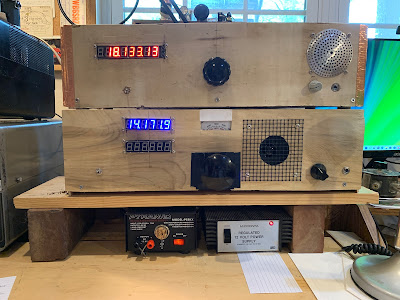
I moved the 17/12 Rig off the workbench and placed it (as planned) atop the Mythbuster rig. Now I have four bands easily accessible. In these pictures you can see all four bands being displayed on the San Jian Frequency Counters.
I found a kitchen drain screen that is an ideal cover for the 3 inch speaker in the 17/12 rig.
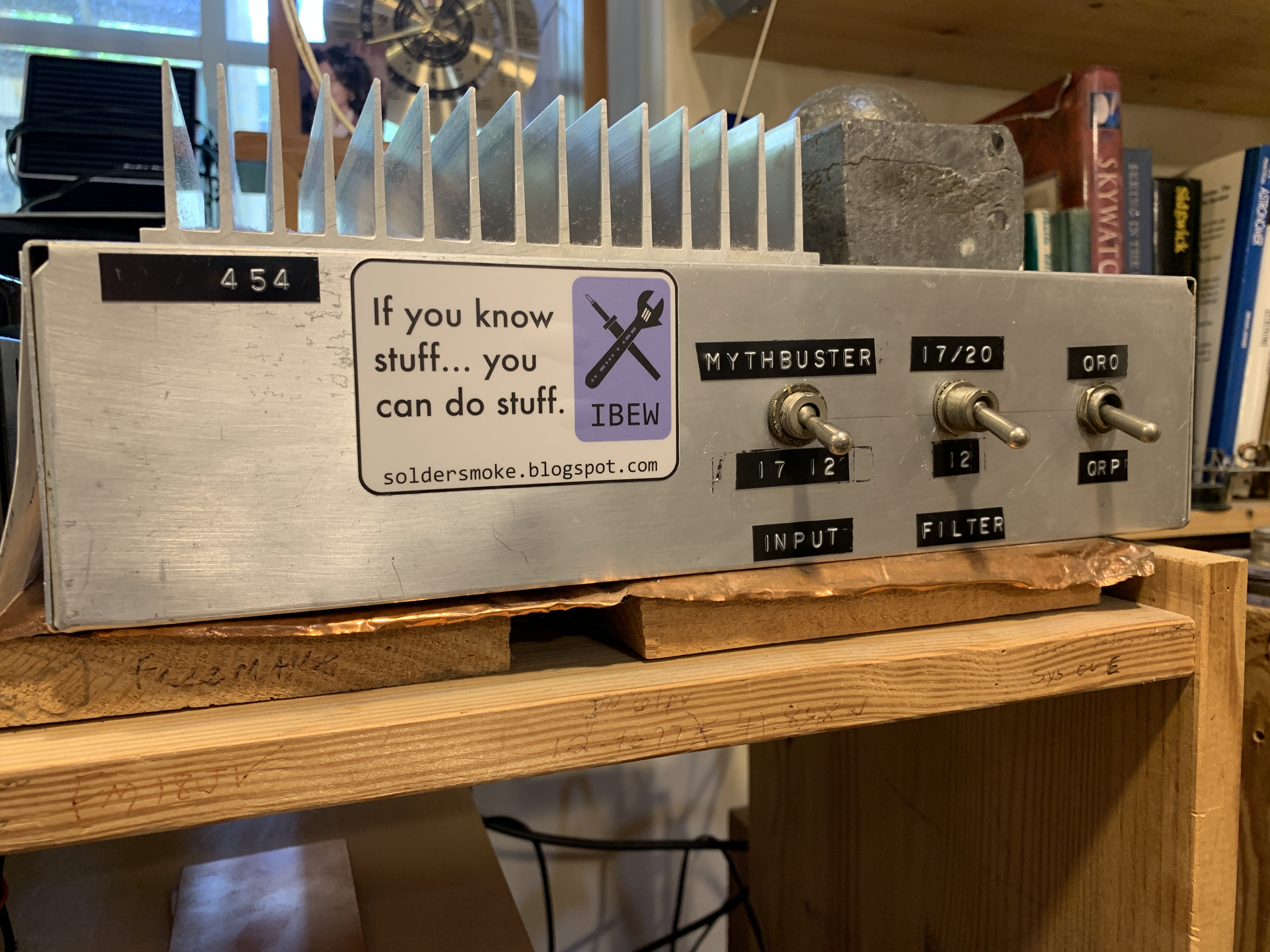
I reconfigured the Low Pass filters in the CCI .1 kilowatt amplifier. I put a 12 meter LP filter in there in place of the 40 meter LP filter (that I haven’t been using much).
I have been working a lot of DX on both 17 and 12.
Back to the 1970’s! Homebrew Keyboards! Don Lancaster’s TV Typewriter
Even though it is outside my normal analog comfort zone, I really liked this video. Farhan sent it to me, along with this note:
————–
As a kid, do you remember Don Lancaster’s books? I learnt most of my digital electronics from him. I still have the 7 dollar video generator book on my shelf. He predates the Homebrew Computer Club. In fact, he is probably the reason for the HCC, because he put in the pieces that were used by others like the two Steves to build their own computers.
His most brilliant hack was to build a “TV typewriter” out of standard TTL parts that were just coming out in the surplus market. For $120, you could, if you build etched your own PCBs and managed to pry parts of fellow builder’s dead fingers, build a circuit that, if you typed your name, it showed up on the TV screen! Never mind that dad wanted to get back to watching football or mom wanted the kitchen counter to be cleared out. Those days, parents had no appreciation for their kids being on TV, I guess.
In an earlier hack, he encouraged people through his articles in Radio Electronics to build their own Qwerty keyboard. With this in hand, you could, um .. um… well type something and sit back. There was nothing to connect it to. The fun thing was, there were no key switches available. You had to build those as well. Wind your own springs, make your own keytops, Once it was built, you could use a VOM to check that the ASCII bits corresponding to the key you held down would correctly show up on the 7 data lines. I guess the girls were surely impressed. You just needed to carry the power supply with +5, -5v, +12v, the keyboard itself, an ASCII chart and a VOM to school to show off.
Jokes apart, he kept building things and builds them to this day. His TTL cookbook and CMOS cookbooks were the goto books for almost all digital elecctronics hackers. It is a pity that no one acknowledges his knack. He has scanned in a few of his books on his 1990s www.tinaja.com. Check https://www.tinaja.com/ebooks/
Why does it concern us? He is K3BYG, that’s why.
Watch this https://www.youtube.com/
– f
———–
So many things from the video resonated with me:
— The importance of building and testing, stage by stage. The narrator admits “I might have screwed that up.”
— Homebrew keyboards! Make your own keyboard springs you pathetic appliance operators!
— Wood box.
— Origins of ASCI
— The scary 1970s. Indeed. I started High School in 1972.
— Schematic errors! Oh the humanity! Erratas.
— Appeals to the Digital Gods. (Not as powerful as The Radio Gods.)
— A Gimmick Twin Lead.
— “So many different disciplines went into building this thing…”
— A taste of the home computing revolution of the 1970s.
— Farhan is right — he was K3BYG. But that call now seems to belong to someone else.
Don Lancaster’s unofficial autobiography:
https://www.tinaja.com/glib/waywere.pdf
Clearly, Don Lancaster has The Knack!
Looking at the World Through a 1 inch Cathode Ray Tube (the RCA 913) (videos)
Joh DL6ID sent me the above video. We have been e-mailing each other about the W9YEI Television Receiver built in 1939 or so. We have kind of concluded that the builder used an RCA 913 tube as the CRT. This was an oscilloscope tube and was often described as looking like a metal 6L6 with a tiny screen on top. This is kind of neat — like using something from the old days to peer into the new world of video.
We wondered about the image persistence of this tube. Fortunately for us, we found several YouTube videos showing recent builds or repairs of oscilloscopes with RCA 913 tubes.
Of course, Mr. Carlson has a video on one of these devices (and — as expected — has another in his junk box. Mr. Carlson has at least two of everything.)
Here are a few other videos showing RCA 913 tubes in action.
https://www.youtube.com/watch?v=IfN2mmEIfTE (with Men at Work audio)
https://www.youtube.com/watch?v=TJF22Ra2kIM (Summertime…. And the Livin’ is Easy)
Here’s a nice video from Tektronix on CRTs:
1942 (?) RCA Film on Tubes, Radio, Research, and Television
Here is a very interesting video from RCA. It was released in 1942, but it looks to me as if it was produced BEFORE the Pearl Harbor attack and the U.S. entry into World War II. There is no mention of the war nor of RCA’s support for the war effort. All films like this that were produced during the war have a lot of material about how the company was contributing to the war effort. So I think this is really a pre-war film.
Early in the film they link the origins of RCA Labs to a decrepit “radio shack” at Riverhead, Long Island (NY) in 1919. Here is some background on this:
and
In this film we see Vladimir Zworykin (boo, hiss) of TV fame (no mention of poor Philo Farnsworth), and we also see Harold Beverage, the creator of the antenna that bears his name. There is what must have been one of the first “electronic clocks.”
At the end, the segment on television is really interesting. It is amazing how far they had gone with TV before the war.
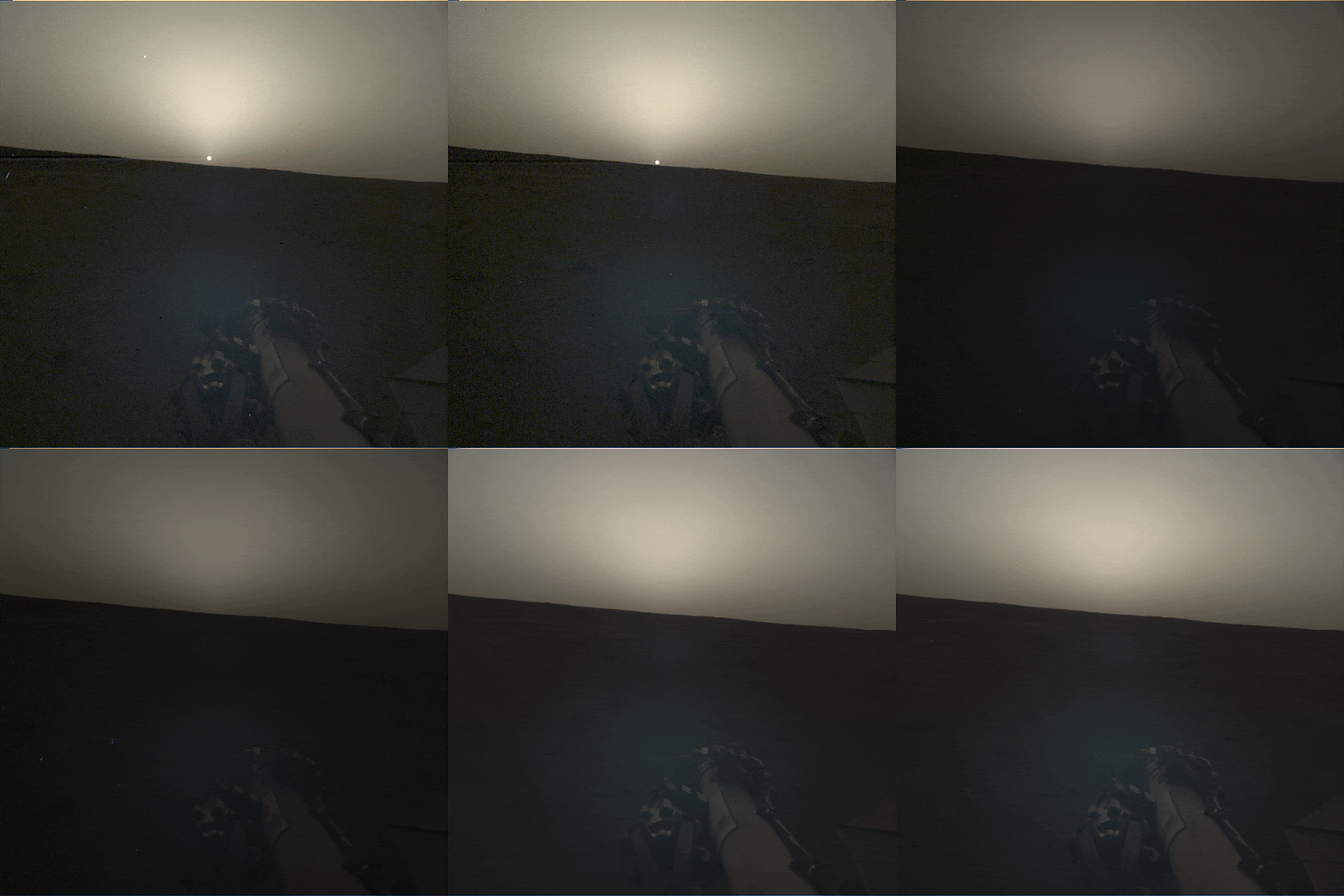
An Eclipse, a Sunset and a Sunrise, all on Mars

Conclusions About W9YEI’s Early (1940?) Homebrew Television Receiver
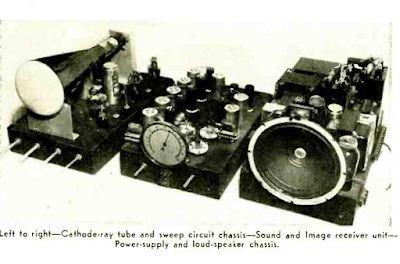
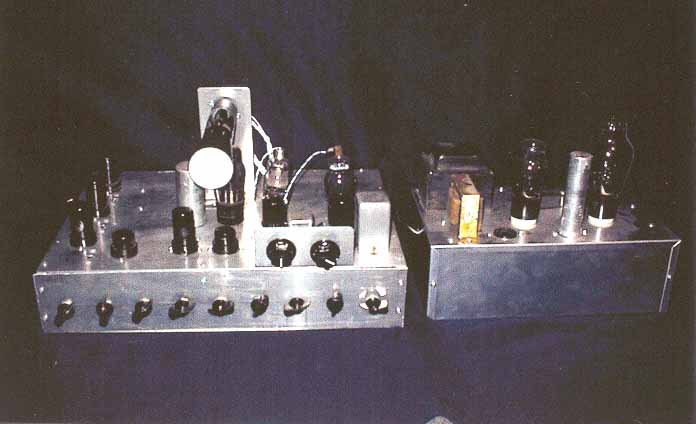
It may have looked something like this. Recent build of the Scozarri receiver by Jack Neitz
Joh DL6ID and I have been exchanging e-mails in which we compare notes on the early homebrew television receiver of Johnny Anderson W9YEI. In 1973 on WOR New York, Jean Shepherd described a very memorable demonstration of TV conducted some three decades earlier by Anderson for teenage friends in Hammond, Indiana. Shep provided a lot of detail, but some of his recollections seemed a bit off; Shep was known for exaggerating or changing details to make a story better.
We have arrived at some conclusions about this project (but if anyone has more info, please let us know):
DID ANDERSON ACTUALLY BUILD A TV RECEIVER?
Yes, he did. This was a homebrew project, not a kit build and not the use of a receiver built and loaned for test purposes by the transmitting station. Anderson was an accomplished homebrewer whose basement, according to Shep, was filled with devices he had built. A QSL card sent by him in 1938 shows him using a “9 tube superhet” as a receiver. Shep describes Johnny — over a period of perhaps six months — gathering components in Chicago’s electronics parts market, and building something in his basement. That sure sounds like a real homebrew project. A TV receiver kit was available, but it was very expensive, and Shep would have immediately denounced it as a non-homebrew project. Anderson homebrewed the receiver.
WHY DID HE DO THIS?
Why would a ham build a TV receiver at a time in which there were only a few experimental transmitters on the air, and no possibility of using the receiver to “work” other amateur stations? We tend to think of TV as a post-war commercial phenomenon. But in fact there was a lot of “buzz” about TV in the 1930s. Magazines were filled with TV articles, and with ads for courses that promised to prepare people for what seemed to many to be “the next big thing.” The World’s Fair in Chicago in 1933 and 1934 featured a demonstration of television — Anderson, who lived in a close-in Chicago suburb, may have seen this demonstration. Television must have seemed like a do-able but difficult technical challenge, and would have attracted the interest of an advanced homebrewer like Anderson.
WHEN DID ANDERSON BUILD THE RECEIVER?
Shepherd describes a demonstration of TV in which Anderson tuned into experimental transmissions of WBKB in Chicago. WBKB’s experimental transmitter W9XBK did not go on the air until August 1940. And Anderson told Shep that he had been calling in reception reports for a month or six weeks. That would push the date of the demonstration to September 1940 at the earliest. In September 1940 Anderson was 22 years old, and Shep was 19. (Here is one area in which Shep’s recall is questionable — he claims that the event took place when he — Shep — was 16 or 17. In fact he was older, but having the protagonists a bit younger made the story more intriguing.) If we assume that it took Anderson six months or so to build the receiver, that would push the start date of Anderson’s build to around March 1940.
There was another experimental station on the air in Chicago: Zenith Corporation had W9XZV doing experimental transmissions starting on February 2, 1939. If Anderson had built the receiver a bit earlier, he could have been tuning into W9XVZ before W9XBK went on the air. But I think it was more likely that he started building in early 1940. I get the feeling that the Scozzari articles of October/November 1939 influenced his build.
WHAT PUBLICATIONS GUIDED ANDERSON?
Shep, in extolling Anderson’s advanced, self-taught knowledge of electronics tells us that Anderson was at his young age already reading the IRE Journal, the monthly publication of the Institute of Radio Engineers. Joh DL6ID notes that Shep said that this publication was being sent to Anderson, indicating that he had some form of subscription. He may have also had access to back-issues in a Chicago library. Anderson was a serious consumer of technical material.
The IRE Journal had many articles about television, but they were highly theoretical. Typical of this was the December 1933 issue. Anderson probably also benefitted from more practical, build-related articles that appeared in publications like QST, Shortwave and Television, and Radio and Television.
In December 1937 QST began a series of articles on television my Marshall Wilder.
In March 1938 CW Palmer launched a series of build articles on TV receivers in the Gernsback magazine “Shortwave and Television.” See photo below.
In October 1938 QST started a series of practical build articles on TV by J.B. Sherman. This series provided circuit details on how to use three different sizes of RCA oscilloscope CRTs, including the small 1 inch 913 tube.
In December 1938 QST continued with the television theme, presenting the first in a series of build articles by C.C. Schumard.
In October 1939 Peter Scozzari launched a good series of build articles in Radio and Television magazine. See photo below.
WHAT CATHODE RAY TUBE DID HE USE?
Many of the publications of the era carried projects using 2 or 3 inch CRTs. But it appears that Anderson had a smaller, 1 inch oscilloscope CRT in his project. In his 1973 broadcast, Shep repeatedly called the CRT “tiny” and refers to it as a 1 inch tube. Shep said the image produced was green, indicating a tube built for oscilloscopes. He may have used a 1 inch RCA 913 CRT Tube. See the Sherman article in the October 1938 QST.
THE DEATH OF ROSS HULL
In the middle of all this, on September 13, 1938 radio pioneer Ross Hull was electrocuted while working on his homebrew television receiver.

The Palmer Receiver
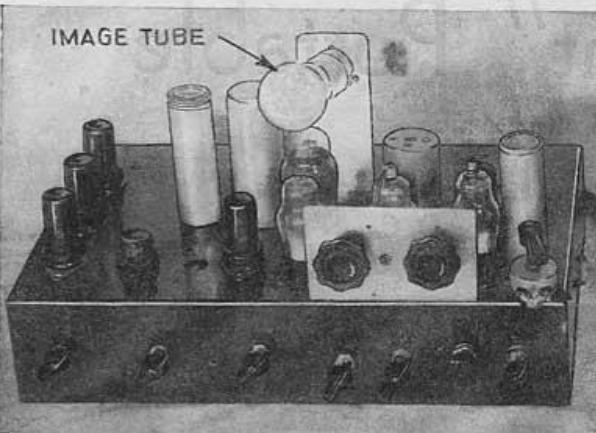
The Scozzari receiver — Power supply on separate chassis
Previous SolderSmoke Daily News posts about this project:
Hack-A-Day post on this topic:
Young Jean Shepherd Gets Hung-Up On Ham Radio
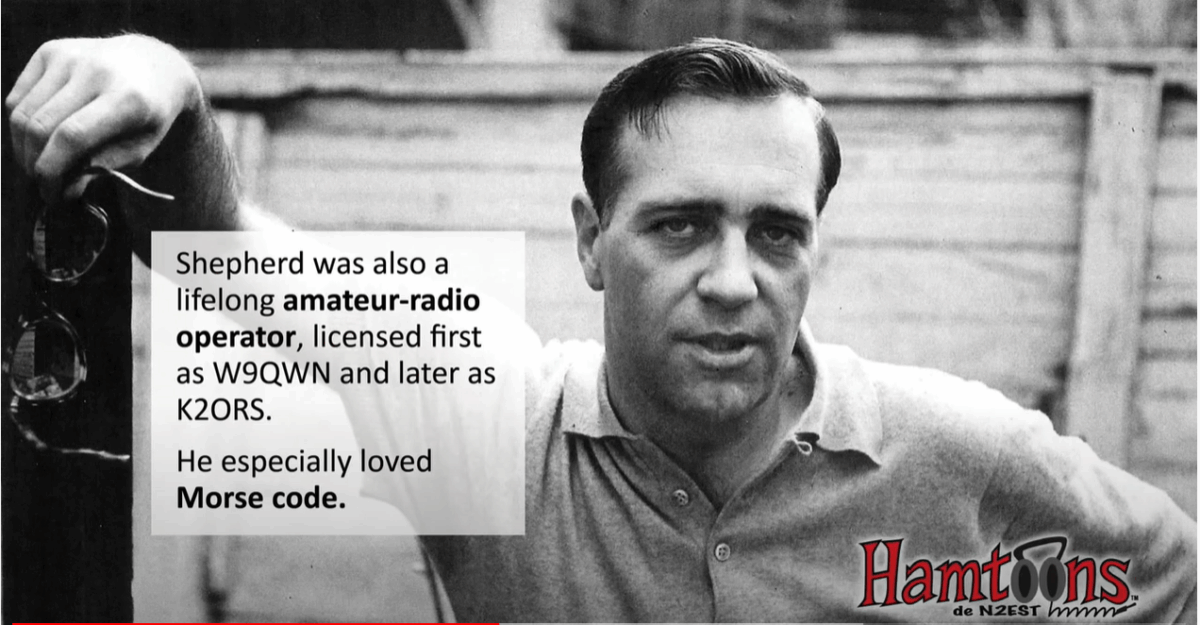
Oh man, we’ve all been there: OBSESSION with ham radio. Shep went over the top and didn’t sleep all weekend when his homebrew transmitter was finally neutralized and started to put out a decent signal on 40 meter CW.
One of my favorite lines in this episode is about how, before the neutralization, the transmitter had had so many parasitics that it would continue to transmit for two hours AFTER Shep turned it off, “and all on the wrong frequencies.”
I found this while searching for other Shep references to Johnny Anderson, the guy who built the TV receiver. Please let me know if you know of any other Shep references to Johnny.
Here is the program. Skip ahead to 20:50
EXCELSIOR!
Ruby Payne-Scott and Early Australian Radio Astronomy
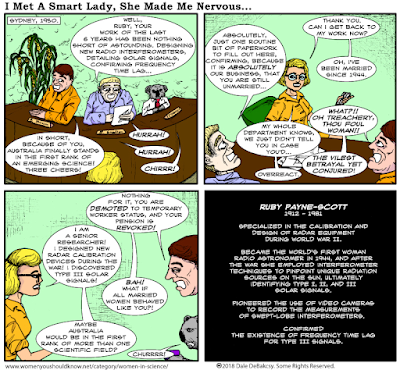
Click on the cartoon for a better view
Read the full article here:
Talking about “Electronics Archaeology” and Early TV with Joh DL6ID
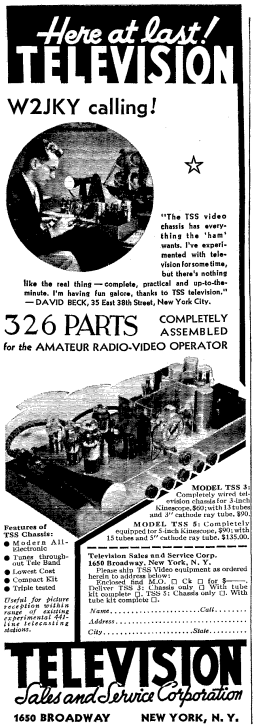
Joh: I agree. Radio archaeology is interesting and useful.
Yes, while he was reading the IRE Journal, Anderson probably needed more practical literature. The Scozzari articles would have been very useful, but the timing is a bit off for them to have been one of Anderson’s main sources of info: Scozzari’s articles appeared in October and November of 1939. But the experimental station that Shep described went on the air in February 1939. Also, Anderson was born in July 1918, Shep in July 1921. The earliest that Anderson’s TV demonstration could have taken place was February 1939 when Anderson was 20 years old and Shep was 17. Anderson probably started building this receiver sometime in 1938. There were in that year a lot of TV articles in QST and other ham magazines. For example, from December 1937 to May 1938, QST ran a series of articles on TV construction by Marshall Wilder. In October 1938 we see another article in QST by Sherman on “Building Television Receivers with Standard Cathode Ray Tubes.” My guess is that Anderson got useful info not only from the more theoretical articles in the IRE Journal, but also from the QST articles of 1937 and 1938. The 1939 articles by Scozzari may have been too late to have been useful to Anderson.
One of the hazards and problems with this kind of project was that you’d be building a receiver for which there was still no transmitter! But Anderson would have known that an on-the-air TV signal was on its way to the Chicago area. In March 1938 there was a press report that Zenith was preparing to transmit 400 line TV from an experimental station in the Chicago area. That may have been enough to push Anderson to melt solder. The first transmissions took place in early February 1939.
73 Bill
On Saturday, April 16, 2022, 02:14:13 PM EDT, Johannes wrote:
Hi Bill,
sometimes even radio-archeology is good fun 🙂
Initially I was hoping for something practical (ie “how-to”) from the pages of IRE in the time period in question: late 38/early 39. But nitty-gritty just didn´t show there – Instead it´s all quite particular, special or highly theoretical. Plus – there seems to be quite a gap in terms of reference in this particular journal for the five years between.
I don´t think IRE was Andersons sole source – You are probably on the right path searching the more “popular” journals for a clue:
Even Anderson would have been thankfull for proven layouts and circuits – Something a complex, high voltage multi-tube circuit might oppose, is being built “al fresco”.
Without any illustration (journal, book or actual existing rig to lay hands or eyes on…) I don´t quite understand, how such a project is even triggered: One was obviously strictly banned to just receiving/not transmitting, as such confined to an unforgiving reception mode unlikely to solve the complex frequency/modulation scheme just by trial and error. There was no abundance or variety in stations/programs, and obviously not much help from your peers. –> There isn´t just enough benefit or resource – but Anderson must have been a curious, enduring and devoted character. For that, too, Shep remebered him!
73 Joh
Gesendet: Samstag, 16. April 2022 um 17:25 Uhr
Von: “solder smoke”
An: “Johannes
Betreff: Re: Aw: Re: experimental TV in 1938
Von: “solder smoke”
An: “Johannes
Betreff: Re: Aw: Re: experimental TV in 1938
Joh: I listened to Shep’s description of Anderson’s receiver again. It is very clear to me that Anderson built this receiver himself from scratch.
For me, an number of things that Shep mentions seem to confirm this:
— Shep’s description Anderson’s search in the surplus electronics shops for strange esoteric parts. Sounded real.
— The fact that Anderson spent 3-6 months secretly working on something. It would take a skilled builder about that long.
— It fact that Anderson had already built “a basement full of electronic gear.” He had a lot of experience.
— Shep’s mention of how they all had to be careful with money, and that some parts were expensive.
— The fact that Anderson was reading the IRE Journal (my guess is that he got it from the library – he would not have spent the money on a subscription).
— Shep’s physical description of the receiver chassis. Sounds to me that he built it his way, with the power supply on the chassis.
Thanks for the IRE publication. The 1933 issue you sent would have been useful to Anderson, but I think the later articles by Scozzari in Radio and Television would have been even more useful. The IRE articles from 1933 seemed more theoretical. Have you found any other TV articles in IRE Journal close to 1938-1939 that might have been more practical?
Listening to Shep’s description again was very enlightening and inspirational.
73 Bill
On Saturday, April 16, 2022, 10:41:15 AM EDT, Johannes Aucktor wrote:
Hi Bill
I´m fond to believe the essentials of Shep´s story are correct 🙂
What I love probably most about it, it´s not alone the description of Anderson´s technical achievement, but the melange of his proud decency and secrecy he´s dealing with his fellow hams.
This way Shep´s impression and amazement is most comprehensible to his listeners – then and now!
Based on these early articles in QST or Radio&Television, its perfectly clear amateur TV reception was on-going and would be esp. interesting to the experiment-oriented ham – with probably not many stations were around to watch and listen to back then.
Professional/commercial TV sets would be out of question, pride- and penny-wise 😉
(Just the other day I was reading about an “unobtainable” TV IF-strip, used in early British Radar:
www.dos4ever.com/EF50/EF50.html – EG Bowen´s first hand account on it, “Radar Days” is in my mail by now!)
I was stumbling over the QST-advertisment in the backpages casually, looking for a reference list to Sherman´s publication. We are talking just five years of particular design after some seminal publications in the IRE Journal mentioned by Shep:
I´ve glanced through the 1936-39 volumes of Proc. IRE, hoping to find corroborate on Anderson´s membership status, but -alas- to no result so far.
Anyhow – it is a great story by Shep for sure! Along with these of the ill-modulated Heising transformer, the Indiana blizzard, or the Kentucky diner hold-up; to name a few I thoroughly enjoyed lately!
Thank you, Bill – and 73 de Joh
Gesendet: Samstag, 16. April 2022 um 12:23 Uhr
Von: “solder smoke”
An: “Johannes
Betreff: Re: experimental TV in 1938
Von: “solder smoke”
An: “Johannes
Betreff: Re: experimental TV in 1938
Thanks Joh. That is really interesting. I had not seen that ad.
While there is the possibility that Anderson did not in fact homebrew his receiver, and instead used a kit or something built commercially, I think he did homebrew his receiver. Here’s why:
— Shep said Anderson built it. Shep would have spotted a commercial piece of gear or a kit. He was quite scornful of even Heathkits!
— Anderson was an accomplished homebrewer. He was using a nine tube superhet on the ham bands.
— Shep and his friends regularly scrounged for parts on Chicago’s radio row. Anderson could probably gotten what he needed there.
— Those TSS kits were EXPENSIVE. In today’s dollars $1,223 to $2,752. Teenagers in the Great Depression could never have afforded this.
— The ad you mention talks about a larger CRT — Shep said it was a 1 inch tube.
— Shep described a very large chassis: 25 inches by 28 inches. The TSS kit chassis looks smaller and more rectagular.
— Shep described the power transformer as being on a back corner — The TSS chassis has it on a front corner.
— Shep desctibes a lot of wires coming off the chassis — the Scorzzi receiver has those kids of wires, including dangerous plate connectors. The TSS does not.
As for the WBKB callsign, I think it is likely that the presenter just went ahead and used the callsign that he was familiar with and not the experimental call that the BKB station had been issued. or maybe Shep just knew that they were watching the WBKB station and remembered it that way.
One other possibility occurred to me. One of the newspaper clips from the period indicates that WBKB built several receivers for us in their initial tests and distributed them to scientists and others for the purpose of evaluating the system. Shep said Anderson was calling in with reports. But Shep also said that the station was soliciting reports from anyone capable of receiving the signal. Anderson could possibly have been given one of the sets built by WBKB. But I don’t think they would have used a cheap 1 inch oscilloscope tube. And I don’ think they would have loaned a receiver to a kid working in his parents’ basement. So again, I think Anderson did in fact — as Shep said — build it.
What do you think? Any ideas on how to get more info?
73 Bill
On Friday, April 15, 2022, 10:18:47 PM EDT, Johannes wrote:
Hi Bill,
I just enjoyed Shep´s great story on early TV and your research and findings.
Did you spot the ad, printed on page 94 in QST Oct 1938 ?
The TV set pictured there features the triangular bracket for the CRT as Shep described for Anderson´s rig.
Both commercial types work the 441-line picture format, which in 1939 was used in the Chicago area by W9XZV; W9XBK –> WBKB (Shep´s QSL) came some time later: cf. “KeithE4” post on
All the best & 73 de Joh DL6ID
Windsor (England) Signal Generator (from Slough) with a Very Cool Dial

Kilo Cycles! Mega Cycles! Windsor – like in the castle! Made in Slough, Buckinghamshire, England, the town that was the fictional site of the original (UK) version of the TV series “The Office.” The dial and indicator turn nicely.
I would be willing to part with this piece of kit. Please let me know if you are interested, how much you would offer, and how we could arrange shipment.
Soldering School — 1958 (Video)
I went to a similar course at Ft. Gordon Ga. in 1977. But I think my instructors would pass out if they saw the way I REALLY solder in the shack today. But hey, I am building SSB transceivers, not spacecraft. If one of my joints is bad (they rarely are), I can fix it. So chill out Mr. Instructor — if we were to do every connection your way it would take us a lot longer to build a rig.
TV Homebrew 84 years ago — Tracking Down W9YEI’s 1939 Television Receiver — The CRT He Probably Used — Please Help Find More Info
by J.B. Sherman
A recent Hack-A-Day article about early television receivers got me thinking about the receiver built by young Johnny Anderson in 1939 and described by Jean Shepherd on WOR in 1973. In the 1973 program (skip to the 18 minute mark), Shep gives a good description of the device. It sounded a lot like the receiver from Peter Scozzari’s October 1939 “Radio and Television” article: Shep described a big chassis with angled pieces of aluminum one of which had a tube socket brazed onto it. Anderson may have bult the power supply on the same chassis as the receiver. Shep said that a 1 inch CRT was in this socket. Tellingly, he described the picture as being green in color.
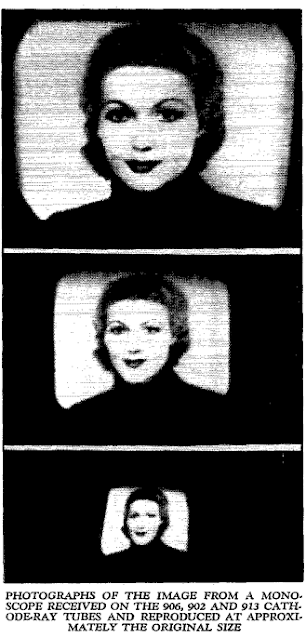
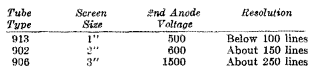
Peter Scozzari wrote that oscilloscope tubes produced a “greenish hue.” One month after his first article, in November 1939 Peter Scozzari published another article in which he changed the CRT to to a tube that would produce a black and white (not green) pictures. See below for the part of the article that describes the shift to the larger black and white tube. This supports the idea that Anderson was using a tube built for oscilloscopes. The picture above shows what images from the three sizes of RCA oscilloscope tubes would have looked like (absent the green hue — this was a black and white magazine). I find them kind of eerie, considering that the person in the picture was probably born more than 100 years ago. And in that bottom picture we see an image (absent the green hue) very similar to what Shep saw in 1939, and described so vividly in 1973.
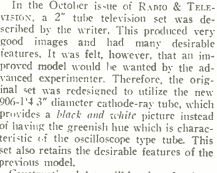
Scozzari’s receiver started out with a 2 inch tube, then a month later, he went with a 3 inch tube. But Johnny Anderson may have only had the 1 inch tube described by Shep. The Sherman QST article provided circuit details for all three sizes of RCA tubes. This information would have been very useful to Johnny Anderson. So my guess is that when Shep saw TV for the first time in 1939 in Johnny Anderson’s basement workshop, he was looking into an RCA 1 inch 913 CRT.
Here’s a great EDN article on the 1 inch CRTs available in the 1930s:
Here’s a fellow who recently built a TV receiver using an RCA 902:
Here’s the YouTube video of his 902-based receiver in action:
Previous SolderSmoke blog posts on this topic:
This is all pretty amazing: We are gathering details on a television receiver built some 84 years ago by a teenager in a basement in Hammond, Indiana.
Does anyone out there have more information on what Anderson built? Can anyone dig up more information on this? Any more info on Peter Scozzari? Anyone have info on Jack Neitz of California (he recently built the Scozzari TV receiver)?
W9YEI’s Homebrew 1939 TV?
I’ve been thinking about Jean Shepherd’s 1973 description of the homebrew TV receiver built by his friend Johnny Anderson W9YEI in (probably) 1939. Shep said Johnny got the info on this receiver from the IRE Journal. But I was thinking that there had to have been “how to build” articles in circulation around that time, and — if located — these articles might provide some insight on what Johnny Anderson built.
Asked for info on early TV’s Google will send you to lots of sites about early commercial sets. But you have to dig a bit and refine your search to find articles about the kind of receiver that Shep described as having been built by Johnny Anderson.
The picture above shows one such possibility. It comes from an article in the October 1939 issue of Radio and Television magazine. The author was Peter Scozzari.
The picture tube seems to be about the size that Shep described; Shep said it was a 1 inch tube, and this schematic shows a 2 inch tube, but the image must have been smaller, so this seems consistent with Shep’s recollection. The article presents this as a “Low Cost” project — that would have been what Shep’s teenage friends were looking for. And we KNOW that Anderson was capable of building something like this: we have a QSL card from him from the same time period in which he notes that he was using a “9 tube superhet.” Someone who could build a 9 tube superhet in 1938 could certainly build this TV receiver.
Can anyone find more of these kind of articles from the late 1930’s?
Three cheers for Johnny Anderson and for Peter Scozzari.
More Googling revealed that a Californian named Jack Neitz more recently built the receiver described in Scozzari’s 1939 article. Here is Neitz’s build:
This is really amazing. We need more info on Jack Neitz! The only info I have is from:
“Patrolling the Ether” WWII Video on Radio Direction Finding Efforts
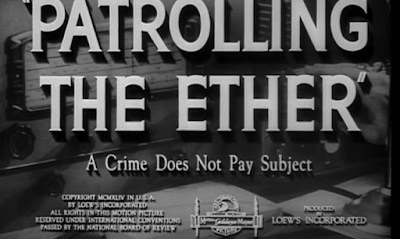
I heard about this video while trying to track down information on John Stanley Anderson’s 1939 television receiver. “Patrolling the Ether” is kind of hard to find. It is not really on YouTube. But there is a good BARC Vimeo video about WWII RDF efforts that includes at the end the full “Patrolling the Ether” video.
Here it is:
Thanks to BARC and to Brian Harrison for putting this together.
In the video, they discuss the invention of the Panadaptor by Dr. Marcel Wallace F3HM during World War II. I set up a very crude Panadaptor using Wallace’s principals:
https://soldersmoke.blogspot.com/2019/05/diy-waterfall-quick-and-easy-panadaptor.html
The 17 & 12 SSB Transceiver — Circuit and Build Info — Video #4
I REALLY LIKE THIS RIG. IT IS LIKE A MAGIC CARPET THAT CARRIES MY VOICE ACROSS THE SEAS.
Cutting Display Hole sets off smoke alarm. Reverse Polarity Protection. IF and Crystal Filter at 21.470 MHz 50 ohms! TRGHS! Amp for VXO Carrier Oscillator/BFO. Mic Amp from uBITX. Transmit/Receive switching from mic connector. VFO: NO DIE CAST BOXES! HT-37 Variable Cap, Frequency Shift. BP filters from QRP LABS designs (G0UPL). TIA amp boards from K7TFC. Needed RF amp to hear band noise. BITX40 PA design, but RD006HHF1 instead of IRF510. Should I run receiver input through LP filter? Frequency Readout Story: How to use one San Jian counter on two bands.
John Stanley Anderson W9YEI — Shep’s Friend Who Homebrewed a TV Receiver in 1938
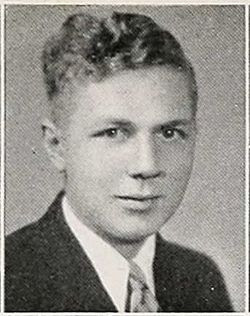
John Stanley “Johnny” Anderson — son of John E. and Beda Klarin Anderson, natives of Sweden — was born on July 19, 1918, in East Chicago, Indiana. He grew up at 6813 (formerly 1439) Arizona Avenue in Hammond, and graduated from Hammond High School a couple of years ahead of American humorist and writer Jean Shepherd. In his WOR radio broadcast of January 24, 1973, Shepherd told of how Johnny was an expert ham who was way ahead of the other kids in town, and how he first saw television demonstrated by Johnny in his basement. Johnny in fact held amateur radio license W9YEI at the time.
After graduation from Hammond High, Johnny went to work as a chemist at the local steel mill. On April 11, 1941, Johnny enlisted at Fort Benjamin Harrison in the U.S. Army, serving through WWII until November 27, 1945. On June 4, 1955, he married Jane H. Vanstone.
Johnny later moved to Munster, Indiana, and continued working at Inland Steel, where he held a variety of technical positions. He passed away on January 29, 1984, at the emergency room of Hammond’s St. Margaret Hospital after suffering from neurogenic shock. At the time of his death, Johnny was an electrical technician at Inland Steel’s quality control center. He was buried at Elmwood Cemetery in Hammond. From: https://www.findagrave.com/memorial/173124396/john-stanley-anderson
After graduation from Hammond High, Johnny went to work as a chemist at the local steel mill. On April 11, 1941, Johnny enlisted at Fort Benjamin Harrison in the U.S. Army, serving through WWII until November 27, 1945. On June 4, 1955, he married Jane H. Vanstone.
Johnny later moved to Munster, Indiana, and continued working at Inland Steel, where he held a variety of technical positions. He passed away on January 29, 1984, at the emergency room of Hammond’s St. Margaret Hospital after suffering from neurogenic shock. At the time of his death, Johnny was an electrical technician at Inland Steel’s quality control center. He was buried at Elmwood Cemetery in Hammond. From: https://www.findagrave.com/memorial/173124396/john-stanley-anderson
The Flick Lives web site has an interesting letter that Johnny wrote to his friend Paul Schwartz (W9KPY) in mid 1941. Schwartz is frequently referred to by Jean Shepherd. Schwartz was killed in World War II.
In the letter, Johnny also references another mutual friend who Shep often mentions: Boles (W9QWK).
Dorothy Anderson was Johnny’s sister and was for a time Shep’s girlfriend.
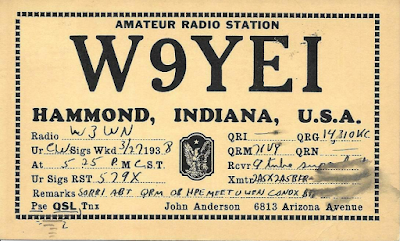
Rcvr: “9 tube Superhet” FB OM