I first saw the link to Onno’s site on Peter VK2TPM’s blog. And at first I confused it with the site of another great homebrewer Miguel PY2OHH. This is all very IBEW: On the website of an Australian ham, I spot the web site of a Dutch ham living in Spain and briefly confuse him with a Brazilian homebrewer with a very similar callsign. TRGHS.
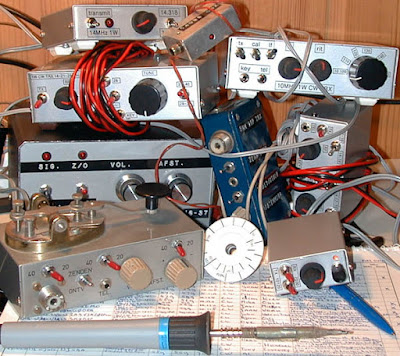
Onno PA2OHH has an inspirational approach to the hobby that he presents in a really wonderful website. Here is his intro to Barefoot Radio:
Barefoot technology and Barefoot power!
Barefoot technology or simple, non-professional radio technology and real Barefoot power or harmless QRP power, that is what you will find here. There are some complex designs but many designs are simple radio amateur circuits. They will never be used professionally! These simple circuits and rigs can give you much fun: home brewing, portable activities during holidays, etc. Batteries and inverted V dipole antenna’s with a fishing rod as the center support are all you need to make many QSO’s.
Much fun! Barefoot technology and Barefoot power can give you much fun, but is not perfect… There are disadvantages like VXO control instead of a VFO, direct conversion receivers that receive both sidebands and simple frequency displays that are not so easy to read. But working with such simple equipment is often more exciting than working with a much better commercial transceiver. Perhaps that you cannot believe that you can make many QSO’s with QRP power of only 1 watt. Indeed, some practice is needed in the beginning so do not give up too soon. Every boring standard QSO becomes an exciting experience with QRP power!
I spent most of January in the tropics, away from my workbench. This seems to have had a good effect on my 17 meter split TX/RX project. As I was leaving, heading south, I was thinking about several difficult options to deal with my spur problem (see previous blog posts). I thought about turning the transmitter into a transceiver by building a receiver board. I thought about putting San Jian frequency counters on both the transmitter and the receiver, then doing a visual numerical “netting” by just putting the two devices on the same frequency (I actually ordered 3 San Jian counters). The counter option was even more complicated than it at first seemed — I would have to build a converter to shift the RX VFO frequency up. VK2EMU suggested a tube type “Magic Eye” (interesting idea, but also complicated). This was getting out of hand.
When I got back home, I took a new look at the problem. I decided to take one more shot at suppressing the 8th harmonic of the carrier oscillator. I had already built a new oscillator and buffer using the circuit from Farhan’s BITX20. And I had put it in a metal box. Now I decided to do three things:
1) Tighten up the low pass filter at the output of the buffer by moving the cutoff frequency lower (to around 7 MHz) thereby getting a bit more suppression at 41 MHz
2) Try putting a series LC shunt circuit tuned to 41 MHz at the output of the carrier oscillator (between the oscillator and the buffer).
3) Reduce the voltage to the oscillator/buffer. I have this on a pot, so I can adjust it down to the point where the remnant of the harmonic is no longer audible, while keeping the main carrier osc signal sufficiently strong.
It seemed to work. I could now hear the desired frequency for spotting, without the confusing tone from the spur.
Why had I been able to do this back in 2002 in the Azores using a simple trimmer cap to ground? My guess is that I was using my Drake 2-B as the receiver. The trimmer cap to ground may have reduced harmonic output. And I was probably cranking back the RF gain on the 2-B to the point where I could hear the desired signal but not the remnants of the spur. I have no RF gain control on the Barebones Barbados receiver that I am using in this project.
So, what’s the lesson from all this? Well, if you are faced with a serious technical problem, and you find yourself considering complicated and difficult solutions, go to the Dominican Republic for about a month (especially if it is January or February), and then take another look at the problem when you return. If you are unable to travel this far or for this long, taking a walk or taking a weekend break from a troublesome problem will likely have a similar mind-clearing effect.
The video above shows part of a February 1, 2022 QSO with Gar WA5FWC using the split TX/RX 17 meter rig. Gar is an amazing long-time SSB homebrewer who got his start with phasing rigs back in the day.
So there I was, innocently checking the lower end of the tuning range on my now 17 meter SSB Barebones Barbados W4OP receiver. I had it tuned to the bottom of the 17 meter phone band. All of a sudden I hear YV5B in CW. It was obviously a beacon transmission.
I had forgotten about these beacons. Some quick Googling brought me to a very up-dated web site:
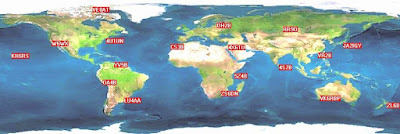
The site shows exactly which station is transmitting at any given moment. There is also a very handy map display giving beam headings and distance from your location.
So far, I’m only hearing YV5B and VE8AT. I hope to hear more once the Coronal Mass Ejection is behind us.
Check it out. Leave your receiver on 18.110 MHz. Let us know what you are hearing.
In several of the articles that I have seen about the homebrewing of VFOs the authors seem to throw up their hands when the subject of temperature compensation comes up. They seem to just say, “This is hard. Not for the faint of heart. Good luck with that!” But in this great video Mike WU2D shows us in very practical terms how to do temperature compensation of VFOs. This is really great news for those of us who prefer old style coils and caps to Si5351 chips. Thanks Mike!