The Importance of Keeping the Noise FLAT

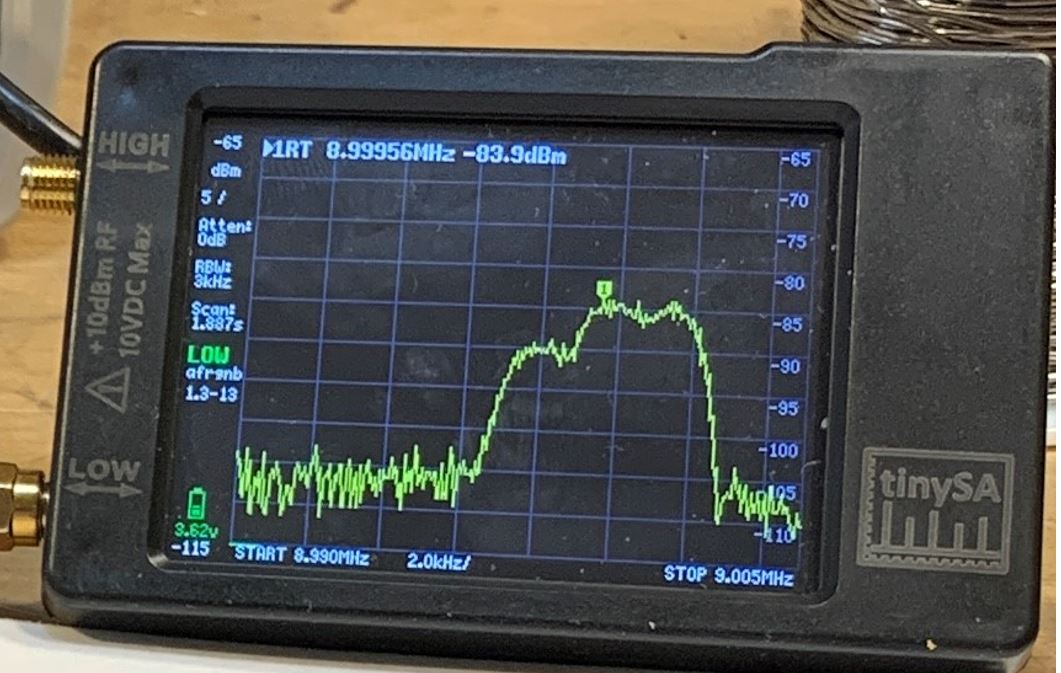
A few days ago I put up a blog post about using a noise generator (in my case my cheap FeelTech sig generator) and my TinySA spectrum analyzer to look at the passband of a crystal filter. I was using the 9 MHz filter used by Dean KK4DAS and the Vienna Wireless Makers Group. The idea is simple: insert broadband noise into the input. The filter should pass more of the noise that falls within its passband. The TinySA should let you see this. At first, I was pleased that I could clearly see the passband. I thought I had succeeded. See above.

But I was bothered by something. Look at that bump in the passband. It should be close to flat across the top.

I decided to take a look at the same filter with my NanoVNA. Here I was not using a noise generator. The NanoVNA sweeps the filter using and looks at output in the Log-Mag mode. Here is what it looked like (below):
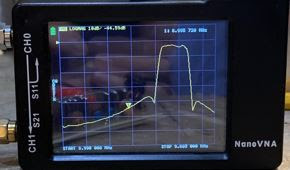
That was much better. But why the difference? Tony Fishpool G4WIF suggested that my noise source might not be putting out noise at the same level on all frequencies. I took at look at the noise output of the FeelTech sig gen in the range of the filter passband (with some above and below frequencies for reference) and I found that the flatness of this noise depended a lot on what frequency I had the sig gen set to. I tuned it around a bit until I found a setting that produced a flat noise output in the desired frequency range. Then I went back and swept the filter with the noise and the TinySA again. Here is what it looked like with the “flat” noise:
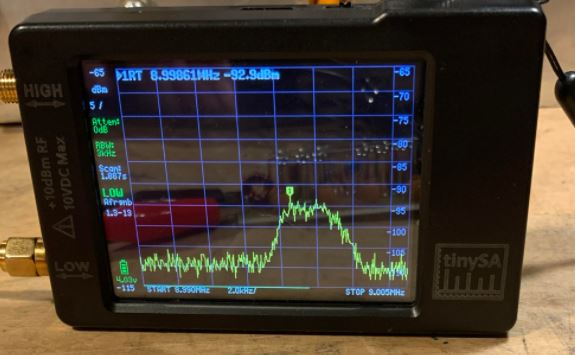

Better, I think. Closer to the passband displayed by the NanoVNA.
Tony points out that these Chinese sig gens don’t really put out random noise — they give us predictable noise. Dean said “Predictable Noise” would be a good name for a rock group. I said they could open for my favorite: “The Ceramic Spurs.”

Farhan’s Amazing Knack Story: From a Boyhood SW Receiver to the Design of the sBITX SDR

The presentation starts at about the 4 minute point.

I think if I were only allowed to watch one YouTube video in the next year, I’d make it this one.

In this amazing RSGB video, Ashhar Farhan VU2ESE takes us back to his earliest days as a radio amateur. He tells us about his very early desire to build radios, his early projects, and his personal evolution as a designer and builder, from a simple DC receiver, to the BITX, the Minima, the uBITX and now the hybrid HDR/SDR sBITX.

There is a lot of homebrew wisdom and tribal knowledge in this video. And we learn so many hitherto unknown details about the rigs that have become so important to us:

— Farhan had the EMRFD book with him on the famous flight from Sweden to India during which the BITX was designed.

— We learn about the origins of the BITX oscillator circuits, and that the VFO and BFO are essentially the same.

— I was really pleased that Farhan included a picture of my HB BITX17 rig in his presentation.

— Farhan discusses the difficulties he faced in obtaining needed parts in India.

— We actually see the nylon washers that Farhan used in the original BITX.

— Farhan discusses his early system for measuring coil inductance.

— In addition the huge contribution of EMRFD, Farhan talks about how he was helped by Pat Hawker G3VA’s writing, and the ARRL’s SSB Handbook.

— Farhkan talks about his Tex 465 ‘scope and his building of a Spectrum Analyzer.

— We see his evolution to dual conversion. We see the conceptual birth of the Minima and the birth (thanks Wes!) of the TIA amps. I didn’t know about the HF-1. Then Farhan designed the uBITX and now the sBITX.

— Farhan talks about his practice of taking the pictures of new rigs with the new rig sitting atop the book that was most important in its design and construction. FB.

— I was really blown away by Farhan’s presentation of how the uBITX advertisement was inspired by and in many ways based on the Heathkit ad for an HW-101. Amazing.

— I learned a lot from Farhan’s discussion of SDR theory. I pledge to spend more time with this. I really like Farhan’s hybrid HDR/SDR approach.

— But I have a question: Farhan seems to say that we’d need a big expensive GOOGL computer to do the direct sampling HF SDR. But doesn’t the little RTL-SDR do just that? Without a GOOGL?

— Great to see Wes’s AFTIA being used in the sBITX.

— Really cool that Farhan has his mind on VHF transverters when designing the sBITX. I liked use of the TCXO module to free up one of the Si5351 clock outputs. FB. And great to include an idea from Hans in this rig.

Thanks very much to Farhan (who stayed up until 3 am to do this!) and to the RSGB for hosting.