QRP – QRP Contact from Dominican Republic

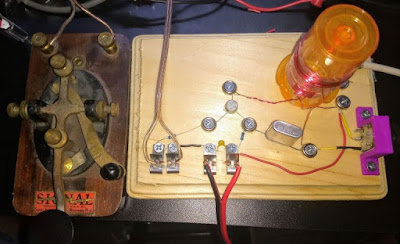
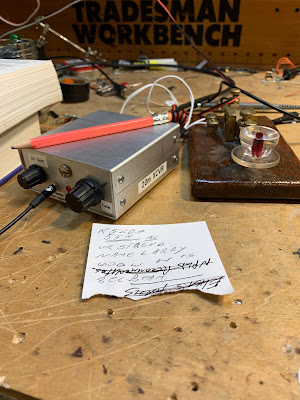
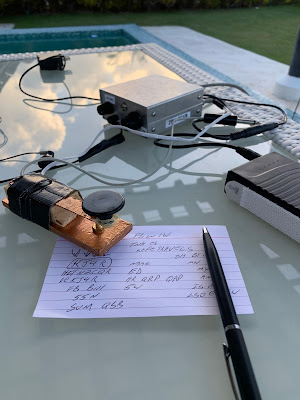
It took some brass pounding on my homebrew key, but on May 28, 2021 I made a real QSO from the eastern tip of the island of Hispaniola. KJ4R came back to my CQ near 14.060 MHz. I was running just 1-2 watts from my SST transceiver to an end-fed half wave antenna. Ed KJ4R was in South Carolina running 5 watts, also to an EFHW antenna. TRGHS. Thanks Ed. And thanks to Bob Scott KD4EBM and Wayne Burdick N6KR.

Farhan’s sBITX — Combining SDR with the Traditional Superhet

Here is Farhan’s amazing presentation to the virtual 2021 FDIM event. There is a lot of tribal knowledge in this video. Lots of old and new technology. I was especially intrigued by Chris Trask’s Kiss mixer. Farhan’s discussion of simple Arduino-based speech equalization and compression made me think that I have work to do in this area. And of course, Farhan’s whole discussion of how to bring SDR into — literally into — the circuitry of a uBITX is really cool and very educational.

TRGHS: K3ZO heard from the Dominican Republic

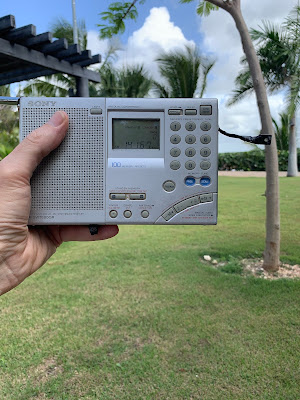
We arrived in the DR just yesterday, and this morning was my first chance to do some ham radio stuff. I fired up my old Sony SW receiver (the one with the busted BFO fine tuning control) and tuned to 20 meters. The very first station I tuned in (after adjusting the BFO with my Swiss army knife) was talking about the Cicadas. He described weather similar to that which we had just left in Northern Virginia. Then I heard the call: K3ZO. It was Fred Laun up in Maryland! When I first came to the DR in 1992, the locals were talking about Fred as if he had just recently past through. I learned, however, that he had been there during the 1960s! He had left quite an impression. He had saved one of the local hams during the 1965 political violence. I gave that same local ham some Vibroplex parts so that he could fix up an old bug that Fred had left him.

Wow, it was really cool to have Fred Laun be the very first ham I hear during this trip. The Radio Gods Have Spoken. We need to spend more time (especially winter time!) in the DR!

I have a video of this listening session that I will post when we get back to Virginia.

Parasets, Parachutes, and Tubes in “A French Village” Season 3

https://en.wikipedia.org/wiki/Un_village_fran%C3%A7ais

In season 3, Episodes 7 and 8, resistance members parachute in from London. They are equipped with what looks a lot like a paraset. One of their tubes develops an open filament. The Germans engage in radio direction finding. The Morse code is fairly good (but not great). All in all, there is quite a bit of radio-related material.

“A French Village” is a very well-done series. But it is (of course) quite dark.

Michigan Mighty Mite, Joy of Oscillation, and the Color-Burst Liberation Army in Washington State

Perhaps its the result of a vaccine-induced relaxation of COVID tensions, but for whatever reason we are seeing a resurgence of interest in the Michigan Mighty Mite and the Color Burst Liberation Army.

Dan AF7O describes his excellent MMM CBLA adventure here: https://af7o.campclan.net/?p=144 Extra points for the use of George Dobbs’ Ladybird book technique, and for the 3D printed variable cap holder (made by Dan’s son).

Yes Dan, rebuild that antenna, build an LP filter, and get that MMM on the air. At the very least you can get some reports from the Reverse Beacon Network. And, as Jack NG2E recently demonstrated, it is possible to make contacts with a simple rig like this:
LONG LIVE THE COLOR-BURST LIBERATION ARMY!

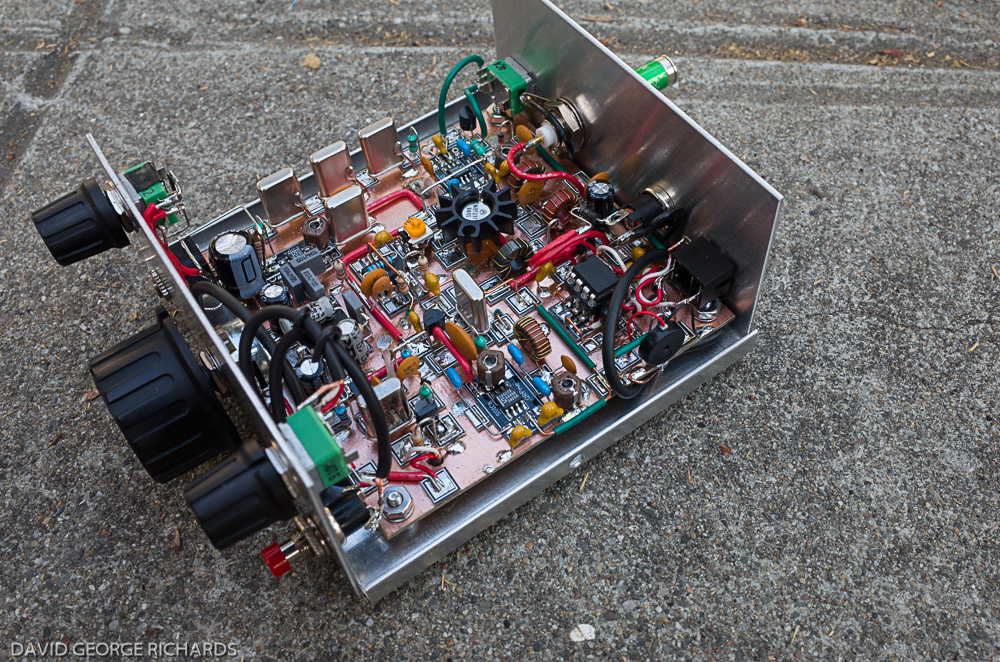
AA7EE’s Amazing Homebrew SST QRP Transceiver

Look at that rig. It is truly a thing of beauty.

I was very pleased to see Dave AA7EE’s comment on my SST rig. This caused me to search his site for his SST article. And wow, it is an SST treasure trove. Lots of discussion of the circuit and mods. And Dave’s usual wonderful photography and videography.

Check it out.

https://aa7ee.wordpress.com/2016/09/09/a-scratch-build-of-n6kr-and-wilderness-radios-sst-for-20m/

Thanks Dave!


Cicadas Arrive in Northern Virginia

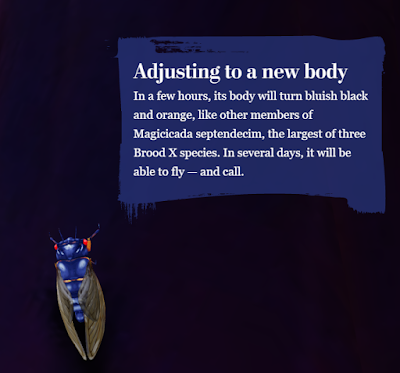
Usually the only bugs we talk about here are dead bugs (components with their leads up on circuit boards) or perhaps CW keying devices. But in the last podcast I mentioned the arrival in Northern Virginia of Brood X Cicadas. They are coming to the surface after 17 years underground. This morning I found this amazing animation that explains the lifecycle of these fascinating creatures.

This morning Elisa mercifully took the time to take several dozen of them off the tires of her car.

Here is the animation. Just scroll down to follow the life cycle.

Be sure to turn on the audio!

https://www.washingtonpost.com/science/interactive/2021/cicadas-lifecycle-brood-x/?fbclid=IwAR39n951RzQfNPvr3iurHjCDcnDEj2ues0c1UmJFiYV8k5vwO2NZoekKN18

The SST QRP Transceiver

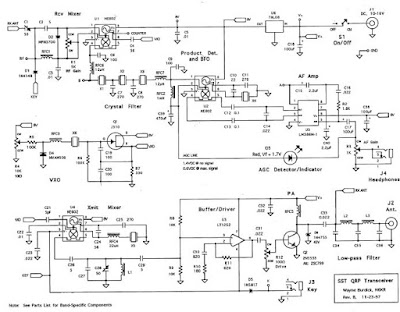
Click on the schematic for a better view
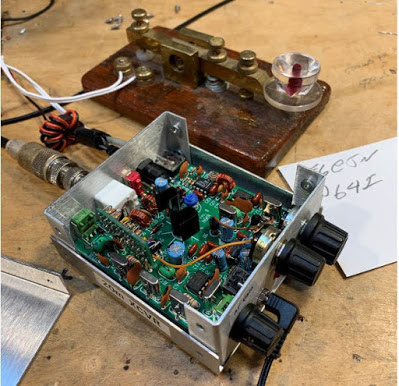
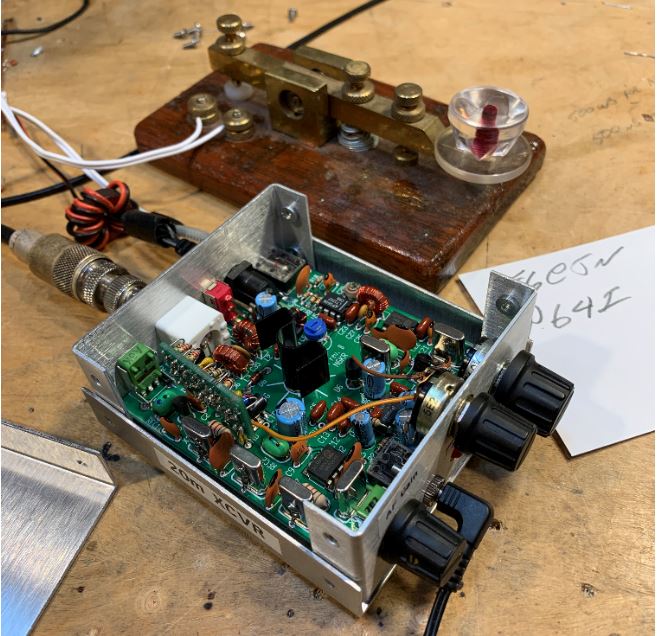
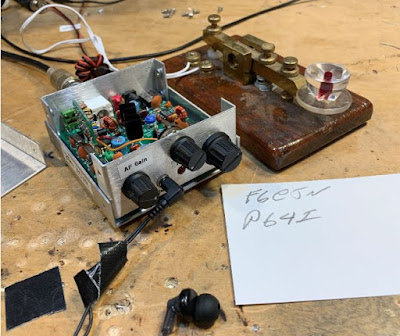
Bob KD4EBM recently sent me an amazing package of radio goodies. Included was a little metal box not much larger than a deck of cards. It is a 20 meter SST transceiver designed by Wayne Burdick N6KR during the late 1990s. This transceiver is built around three NE602 Gilbert Cell mixer chips. It arrived in my shack as I was struggling to understand the Gilbert Cell. TRGHS. It also put me back on the path of QRP CW righteousness. Thanks Bob. Thanks Wayne.

I e-mailed Wayne Burdick (now of Elecraft fame) to tell him I was now using the rig he had designed so long ago. Wayne e-mailed back, saying that the SST was the smallest “real” radio that he had ever designed. SST stands for Simple Superhet Transceiver.

I’ve been using the SST every day for the last week or so. It is a pleasure to operate. I’m using it with the key from India that Farhan brought for me. It is truly QSK — the receiver stays on when I transmit. I’ve never used a QSK rig before and I can now see the big advantage that this provides: When I am responding to a CQ, I can immediately hear if the other guy put out another CQ or respond to someone else — I can stop calling at that point. My first contact with it was with F6EJN. Again, TRGHS.

I made two small mods to the SST: I added 1 uH to the RFC in the VXO; it now tunes 14.053 — 14.063. And I took out a noise blanker that had been installed. Removing the noise blanker left an ugly hole in the front panel which I promptly filled with a completely cosmetic machine screw.

Here’s the manual:

https://qrpbuilder.com/wp-content/uploads/2017/04/sst_manual_042217.pdf

HRDX Interviews Paul Taylor VK3HN

Wow, Paul Taylor, VK3HN is working on homebrew rig #11. FB.

This interview was quite thought-provoking.

— I agree with Paul about the importance of not being dogmatic about
always staying under 5 watts. It sounds like Paul is having fun with his
100 watt SOTA project.

— It was great to hear that Leon VK2DOB is still active in ham radio and running a QRP company in VK. FB. An article by Leon on CMOS mixers in the summer 1999 issue of SPRAT played a key role in my understanding how switching mixers really work. I put Leon’s diagram in my book SolderSmoke — Global Adventures in Wireless Electronics.

— On blowing up the finals in simple HB gear. The first real transmitter that I built was the VXO-controlled 6 watter from QRP Classics by the ARRL. It had a 36 volt Zener diode across the collectors of the final. This was to prevent the kind of final destruction Paul suffered up on that summit: “D2 is used to clamp the collector voltage waveform to protect the output transistors if the transmitter is operated into an open circuit or high SWR antenna system.” Maybe we should revive the use of that simple SWR protection circuit, especially for SOTA rigs.

Bill N2CQR Talks to Dean KK4DAS about the Simple SSB Group Build

Dean KK4DAS visited the N2CQR SolderSmoke shack. We talked about a lot things including chess, Mars, and AI. Dean is an amazing guy — he used to work at NASA’s Jet Propulsion Laboratory and a couple of times actually spoke with Richard Feynman. We also shot a video about the Vienna Wireless Society’s group build of Pete Juliano’s Simple SSB transceiver (video above).

This group build all started with Dean’s build of Pete’s rig. He built his early in the pandemic, while on furlough from work, thus the name “The Furlough 40.” That makes all of this very much a quarantine effort. As we have learned, dark clouds often do have silver linings.

For more details on the group build, check out Dean’s blog:
https://kk4das.blogspot.com/
And here is the Vienna Wireless Society’s Group Build page:
Thanks Dean! And three cheers for all the Vienna Wireless builders!

SolderSmoke Podcast #230 is available! Apr 1, Mars, Group Build, SDR, SSB, Mich Mighty Mites, Mailbag

SolderSmoke Podcast #230 is available for download

http://soldersmoke.com/soldersmoke230.mp3

N2CQR was down for maintenance
A few words about April 1
China lands on Mars
Brood X Cicadas arriving in NOVA

Pete’s Bench
The Dentron Project
The Spillsbury Tindall SBX-11A
KK4DAS and the Simple SSB Group Build
TenTec mods
Shack Mystery solved. Maybe
Changing the channels at age 9

Bill’s Bench
Why LSB below 10 MHz? The “SSB Legend” Rig
WU2D RTL-Dongle Up converter
Understanding the Gilbert (Jones) Cell
SDRSmart RTL-SDR.com V3 Dongle
VK3HN and 2 meter SSB
Jack NG2E, MMM and the 10 minute transmitter
KD4EBM sends me SST by Wayne Burdick. DX!
A new computer

Mailbag:
MM0ACN
VK2EMU
N5VZH
VE3KZJ
HS0ZLQ
AD0JJ
VK8MC
KK0S
VE3VVH
KB3SII
WA9WFA
M0NTV
W2DAB


60 Minutes Story on Mars Ingenuity Helicopter:

The Homebrew Spirit of the Radio Amateur

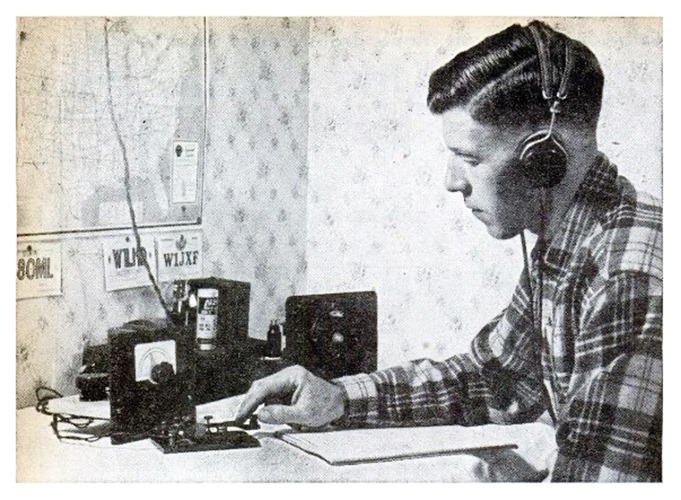
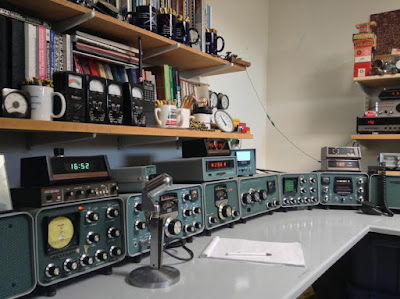
I just liked this picture. It seems to capture the pride and satisfaction that comes from getting on the air with homebrew gear. It’s obviously a simple QRP station, but it is all homebrew. And — from the QSL cards on the wall — we can see that he has had some success with it. The map on the wall is of the United States and the QSLs are from the east coast and the mid-west, so my guess is that he’s probably on 80 or 40. FB OM.

The Joy of Fixing Broken Things (a really amazing video)

This amazing 10 minute video captures very well the joy of fixing broken things. It comes to us through a recommendation from Paul VK3HN in Melbourne, Australia. Thanks Paul.

I hope we will see more from Van Neistat. He already has a bunch of videos on his YouTube channel: https://www.youtube.com/channel/UC5mPJA4y5G8Z6aNkY6AxgAw

I often tell the story of the OT (probably now an SK) who at hamfests would ask if a piece of old gear was working. If the vendor answered honestly and said no, OT would reply, “Good, I pay extra for that.” He too liked to fix things.

Help India’s Makers Build Oxygen Concentrators for COVID Victims– The M-19 Oxikit Initiative

Why building oxygen concentrators is NOT rocket science.

To make a donation:

Understanding the Gilbert Cell

I’ve been using the Gilbert Cell (in its NE-602 form) for many years. It was in the G-QRP Sudden Receiver. It was in the Neophyte receiver, it was in that little 20 meter DSB rig that I used in Rome and the Dominican Republic. But truth-be-told, every time I used one I heard Jean Shepherd’s voice in my head, razzing me about the fact that I didn’t really understand how the Gilbert Cell works.

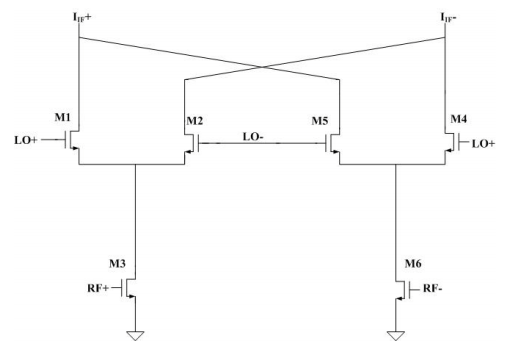
My ignorance was kind of understandable, the Gilbert Cell was built around a circuit rarely used in ham radio: the differential pair. And Gilbert used three of them.

My most recent use of the G Cell came after I watched Mike WU2D’s videos on upconverters for the RTL-SDR Dongle. I had an NE-602 all boarded, boxed and socketed, so I used it in my version of the upconverter. But as I did so, I pledged — this time — to really learn how it works.

So I started cracking the books (and the internet) on the Gilbert Cell. It is a very interesting circuit. Gilbert was working to come up with a double balanced mixer that could be built on a chip without the use of the big toroids that we have in our diode ring mixers.

From my study of other mixers I knew what was needed to get two signals to really mix: You needed a non-linearity. You needed the gain or loss experienced through this non-linearity by one of the signals to be determined by the level of the other signal. If you had this, you’d have at the output a complex repeating wave form. Fourier told us that this kind of waveform has within it a number of sine waves and that among them will be one at the sum frequency of the two waves and one at the difference frequency. That’s mixing in a very small nutshell.

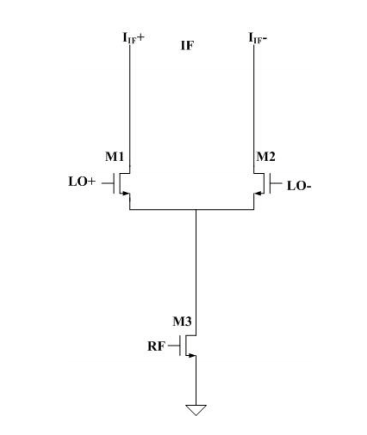
Descriptions of the Gilbert Cell usually begin with single differential pair with a current source controlled by another amplifier connected to the emitters in the two transistors in the differential pair:

The gain of the M1 M2 differential pair will be determined by how much current current is flowing into their emitters. The signal coming into the RF port will control this current. So, assuming there is some nonlinearity in these circuits, RF will mix with LO and at the IF you will have sum and difference frequencies.

The problem is that you will also have the LO signal there. A singly balanced mixer balances out one of the inputs. A doubly balanced mixer balances out both. Gilbert came up with a way of eliminating both input signals without having to use the big inductors that are used in diode mixers.
Chuck Penson WA7ZZE, Heathkits, and the Titan Missile Museum

WA7ZZE Shack

The video above popped up in my Facebook feed today and reminded me of Chuck Penson WA7ZZE. Chuck is the author of a wonderful book on Heathkits (and several other books).

The Titan missile explosion (not of the warhead) in Arkansas is described in an excellent but horrifying book entitled “Command and Control” by Eric Schlosser.

PBS made a video out of the book. You can watch it here:

Here’s an interesting article on nuclear weapons tourism. It has a great title.
https://www.nytimes.com/2007/01/05/travel/escapes/05atomic.html


It is easy to see how an interest in ln old technology would lead someone to both Heathkits and Titans. I get that. But on the other hand the Heathkits and the Titans are at completely opposite ends of the humanity spectrum: Heath made friendly technology that ultimately brought people together on the ham bands. We know that the Titans were supposed to do.

In any case it was great to be reminded of Chuck WA7ZZE. We last posted about Chuck more than 10 years ago:
In a comment to that post, Steve “Snort Rosin” Smith WB6TNL noted that Chuck had spoken at the 2009 CactusCon hamfest, and that the club pledged to put his presentation on-line. But Google and I can’t seem to find it. Do any of the Scorpions or anyone else out there know where Chuck’s hamfest talk is?

Bob KD4EBM has been out there. He reports that hams can bring their rigs and make use of the Titan site’s large Discone antenna:

“Adventures in Electromagnetism” Video by Julius Sumner Miller

This guy is quite a character, with a real knack for describing physics. At the start of this video he says that these kinds of adventures are “good for the spirit and the soul.” Right you are Professor Miller. I am currently recovering from a minor back injury. It is nothing serious, but it has delayed the production of the SolderSmoke Podcast #230. These videos are, for me, just what the doctor should have ordered.

I liked Miller’s references to Michael Faraday.

There are many videos on the Julius Sumner Miller YouTube Channel. They are indeed “good for the spirit and the soul.” Thanks to Hack-A-Day for alerting us to this treasure trove.