I know what you are thinking: Software Defined radio with the TOTAL elimination of hardware? WHERE IS BILL AND WHAT HAVE THEY DONE WITH HIM?
Relax my friends. All is well at SolderSmoke’s East Coast HQ. In fact, just yesterday I was making use of one of the systems described in this video. Here’s how:
I was on 20 meters with my BITX 20 Hardware Defined (HDR) homebrew transceiver. Everything was going smoothly. We have some sunspots now, so DX is once again possible. I heard a loud U.S. station (that will remain anonymous) calling CQ, so I gave him a call.
The trouble started right after he looked at my QRZ page. You see, I have pictures of my homebrew rigs there. These images sometimes trigger hostile reactions, especially from guys who have almost their entire stations INSIDE their computer boxes. I also admit to occasionally making things worse by pointing out that it is possible to build a BITX20 for about five dollars U.S. Some guys apparently don’t like hearing about this.
Anyway, the fellow I was talking to proceeded to give me a very blunt and harsh signal report: “Well, I suppose your signal is strong enough, but your audio is TERRIBLE!” Interpersonal relations pointer: This is NOT a good way to alert a fellow ham to possible technical problems in the rig that he has built by hand, from scratch, in his home workshop. Especially when the person delivering the harsh signal report is using a “rig” that was built by credit card in a robotic factory on the other side of the planet.
So that QSO ended rather quickly. But I did want to follow-up in the comment about the audio. And here is where I turned to Web SDR. Mehmet NA5B has a really nice WEB SDR receive system in Washington DC, just about 8 miles east of me. Before 20 meters opened, I called up Mehmet’s SDR on my computer, tuned it to the frequency of my transceiver and watched the screen as I asked if the frequency was in use. I then issued a couple of hopeless CQs, again watching the screen. I could see in NA5B’s waterfall that my signal was indeed seriously lacking in low frequency audio.
Now it was time to turn to hardware. Rig on the bench, ‘scope and sig generators fired up, I quickly determined that the problem most likely resulted from my placement of the carrier oscillator frequency in relation to the homebrew USB crystal filter. I had placed it about 300 Hz too low. This resulted in a low AF frequency roll off not at the desired 300 HZ, but instead at around 600 Hz. That would make the audio sound “tinny.” So I moved the carrier oscillator up 300 Hz and went back to Mehmet’s SDR receiver. I could see that the lows were now at the right level. Thanks Mehmet.
One note about the audio coming out of the many SDR radios on the air: When you look at the passbands in the Web SDR receivers you can see audio going almost all the way down to the frequency of the suppressed carrier. With non-SDR rigs you usually see a gap of around 300 Hz between the carrier freq and the start of the SSB signal. This is often the result of our filter rigs having IF filter skirts — you would place the carrier oscillator frequency a bit down the skirt — this would help with opposite sideband suppression and all you would be losing would be the lows below 300 cycles, which weren’t really necessary anyway. I had placed the carrier oscillator too far down on the skirt.
Of course, sometimes SDR rigs will also have a gap between the carrier freq an the start of the audio if the operator has set the passband this way, or if the microphone attenuates below 300 Hz. But you see a lot of signals with audio filling almost the entire passband –some of the “Enhanced SSB” guys are running audio passbands that go as low as 50 Hz.
Has anyone else noticed this “full passband” effect when looking at the waterfalls?
Any other tips for using Web SDR for troubleshooting?
Month: August 2020
Presence (Absence?) and Direct Conversion Receivers (with wise comments from Farhan)
Hello Bill,
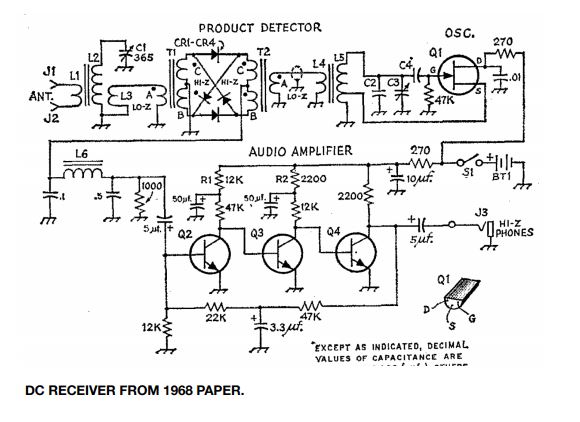
I was reading an online article by Wes Hayward, W7ZO from 1968 about the history of direct conversion receivers (http://w7zoi.net/dcrx68a.pdf) . It was linked in an email in qrptech. It recounts how he had first build a dc receiver with a single diode for the detector, and how microphonic it was, and dissatisfying an experience. This was in the early days of solid state devices, and so they were hard to come by. He describes meeting another ham engineer at work Dick Bingham, W7WKR who immediately recognized that what he needed was a diode ring mixer. The story goes on to describe their experiments, and success at this design.
They decided to write up the design for QST. I won’t bore you with the details…the article is well worth reading about how Wes mailed the radio and the design to ARRL, and how it ended up in the hands of a new person on their staff there, Doug DeMaw, W1CER (later W1FB.). Here is an excerpt from the article describing Doug’s reaction to the receiver:
“This was the epiphany, the moment when Doug realized that solid-state technology had produce a new way to build a simple receiver. Doug tuned the receiver higher in the band and found some SSB. Again it was like nothing he had ever heard. It was as if the voice came from the same room. Doug used the term presence in his description.”
Here I present the earliest use, that I know of, of presence being used to describe a receiver. I have to say when I read it, I immediately thought of you guys, and decided to share.
Thanks for all you guys do.
dave /nt1u
———————————————————-
Bill replied:
Thanks Dave. Yea, that’s the 1968 article that launched the use of DC receivers. I had forgotten about DeMaw’s early use of “presence.”
Just to cause trouble, perhaps we should start commenting on “absence” i.e. “I dunno OM, I think your rig lacks a bit of absence in the mid-range… turn menu item 63b to ELEVEN!”
🙂
73 Bill
———————————————————-
Farhan wrote:
Mon, Aug 3 at 3:22 PM
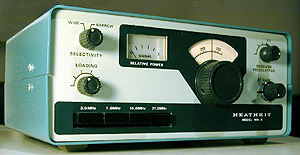
When I got my license, my friend Anil SM0MFC was living in Hyderabad. He lent me his HW-8. I stringed up a 40 meter dipole with a lamp cord and worked with it. Somehow, the combination of the lamp cord length and the 40 meter inverted V made it resonate on 20 m as well. The HW-8 had a nominal antenna tuner and I worked pretty good DX.
Till date, it remains the best receiver that I have used for regular contacts. The only trouble it had was the the MC1496 was a nominal detector, it overloaded heavily with shortwave broadcast stations. There was an unnecessary RF amplifier in the front-end that they could have done without.
I made several direct conversion receivers, but never managed to hang on to any. This makes me want to build one, one of these evenings. I even have a KK7B R1 kit. but real men solder on without any PCBs or even circuit diagram!
A 7/14/21 direct conversion radio that puts out 3 watts of power is what my ideal setup would be. I am not too bothered with the images on CW. I just tune them out in my head. Real soon now, at the moment, i am trying to finish a radio that has been in the works for years. Finally, I am making some headway.
-f
———————————————
Farhan of course is no slouch in the DC receiver area. Years ago he wrote a wonderful post about building a DC receiver with his cousin for her class project:
Included in this post was a passage that I included in my book SolderSmoke — Global Adventures in Wireless Electonics:
————————–
Why build a receiver?
Why do you want to build it? These are available at the Dubai Duty Free asked Harish, an old friend, when he spotted us struggling over the DC40 one evening. I didn’t have an answer to this question and considering the amount of work piled this quarter, it appeared to be a sensible thing to ask.
I think this question is answered by us all in different ways. My personal answer would be because we human beings are fundamentally tool builders. We have an opposable thumb that allows us to grip the soldering iron.
For an engineer (by the word ‘engineer’, I don’t just mean those who have a degree, but anyone who applies technical knowledge to build things) the act of building a receiver is a fundamental proof of her competence and capability. It is much easier to put out 1 watt signal than it is to receive a 1 watt signal.
A simple definition of a good receiver is that a good receiver consistently, clearly receives only the intended signal, such a definition hides a wide range of requirements. The receiver has to be sensitive enough to pick up the weakest signal imaginable (note: clearly), it has to be selective enough to eliminate other signals (only), it has to be stable enough (consistently).
For a ham or an engineer, building a usable receiver is a personal landmark. It establishes a personal competency to be able to understand the very fundamental operation of the radio and mastery over it.
——————–
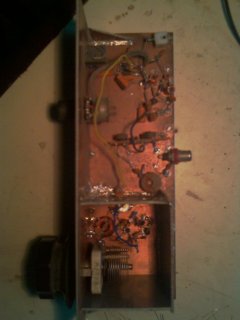
Bill: OM Ryan Flowers did a 5 part series on building the DC40. If you are want to build one, I suggest you use the schematics on Ryan’s site. There was an error in Farhan’s original schematic — Farhan corrected it but some of the incorrect schematics are still floating around the internet. Here is part one of Ryan’s series:
 |
| Farhan’s DC40 |
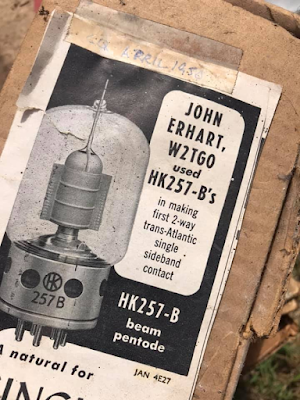
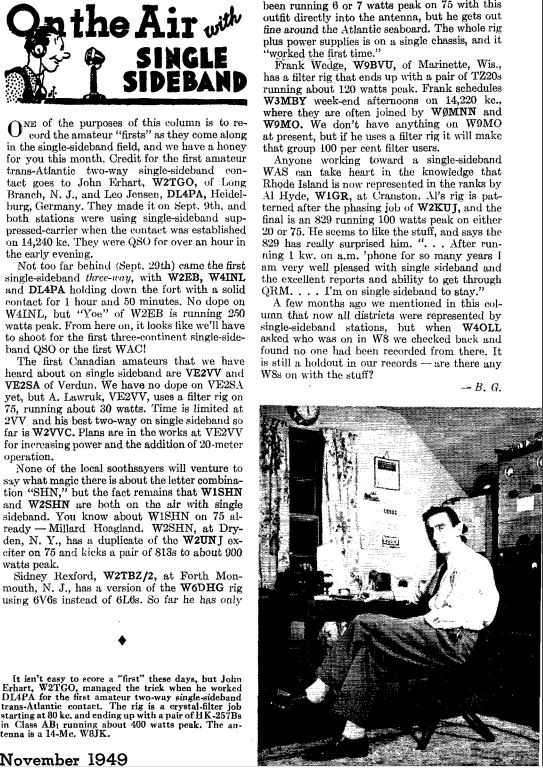
First Amateur Transatlantic SSB Contact W2TGO–DL4PA September 9, 1949
Mars: Book Review, Martian Propagation, Martian Moons as VHF Repeater Sites

In SolderSmoke #224 I mentioned the Mars Trilogy by Kim Stanley Robinson. I found a book review in The New Yorker (see below). In Red Mars they mention that there is no ionospheric propagation on Mars. W1PJE and K1RID point out that this is incorrect — there is ionospheric propagation on Mars. K1RID provides a link to a really detailed NASA study of this question (it includes discussion of the effect on propagation of Martian dust storms — good to know!). Finally, 2E0CHK suggests placing VHF repeaters on the two moons of Mars. I found a good article about the overhead passes of these moons. See below for all.
AND REMEMBER: THE ELSER-MATHES CUP REMAINS UNCLAIMED!
Here’s a review from The New Yorker:
https://www.newyorker.com/books/page-turner/our-greatest-political-novelist
———————————-
Hello Pete and Bill,
Listened to your latest SolderSmoke podcast. Enjoyable as always. But you should correct the record: Mars does have an ionosphere!
The peak daytime electron density (“M2 layer”) is low in altitude – perhaps 130+ km, about our E region – and density is like our E region too (5-10x lower than our F region). So for the Mark Watneys carrying their Homebrew rig and inverted V, probably only a few hundred km to the first skip zone. More NVIS flavor than anything else.
Fun to think about. You should go and test it out!
73
Phil W1PJE
————————————————-
BTW, this made the rounds in our club last year:
dit dit
73 de Ed, K1RID
Newburyport Electronics & Radio Society
www.K1YRD.org
Newburyport Electronics & Radio Society
www.K1YRD.org
——————————————
2E0CHKAugust 1, 2020 at 4:04 PM
Hey Bill,
No skip on Mars ?
No ionosphere ?
Every cloud has a silver lining, even if Mars doesn’t have any clouds 😉
Mars has two moons.
Could be paradise for Moon Bounce aficionados. No ionosphere or F layer to get in the way. VHF can get around corners after all.
No skip on Mars ?
No ionosphere ?
Every cloud has a silver lining, even if Mars doesn’t have any clouds 😉
Mars has two moons.
Could be paradise for Moon Bounce aficionados. No ionosphere or F layer to get in the way. VHF can get around corners after all.
———————————–
Here is an article describing the overhead passes of the two Martian moons:
How to Sweep, Plot, and Measure Filter Output in LTSpice
The other day Pete N6QW posted a very nice graph of a bandpass filter’s passband. He was using LTSpice. I realized I had a serious gap in my LTSpice knowledge — I wasn’t sure how to do this.
The charming video from India explains how. Really useful.
OSCAR 100 Geosynchronous Satellite Video
I guess the title for this post could also be “How the Other Half Lives.” I’m sure at least a few of you will be thinking about building an OSCAR 100 station after watching this video. But if you are in North or South America (with the exception of the Eastern tip of Brazil), forget about it. OSCAR 100 is geostationary over the other side of the planet. And amateurs have no equivalent on this side of the world. But we can listen in using the Web SDRs.
A couple of interesting bits from this recording. You can hear G7BTP’s coming back from the satellite with a bit of a delay — he is obviously monitoring the downlink when he is transmitting. DL8FBH says that he doesn’t have a receive system of his own — he is using a WEB SDR station (as I was) for the receiver.
Homebrew Resistor Kit — Drew’s Mouser BOM
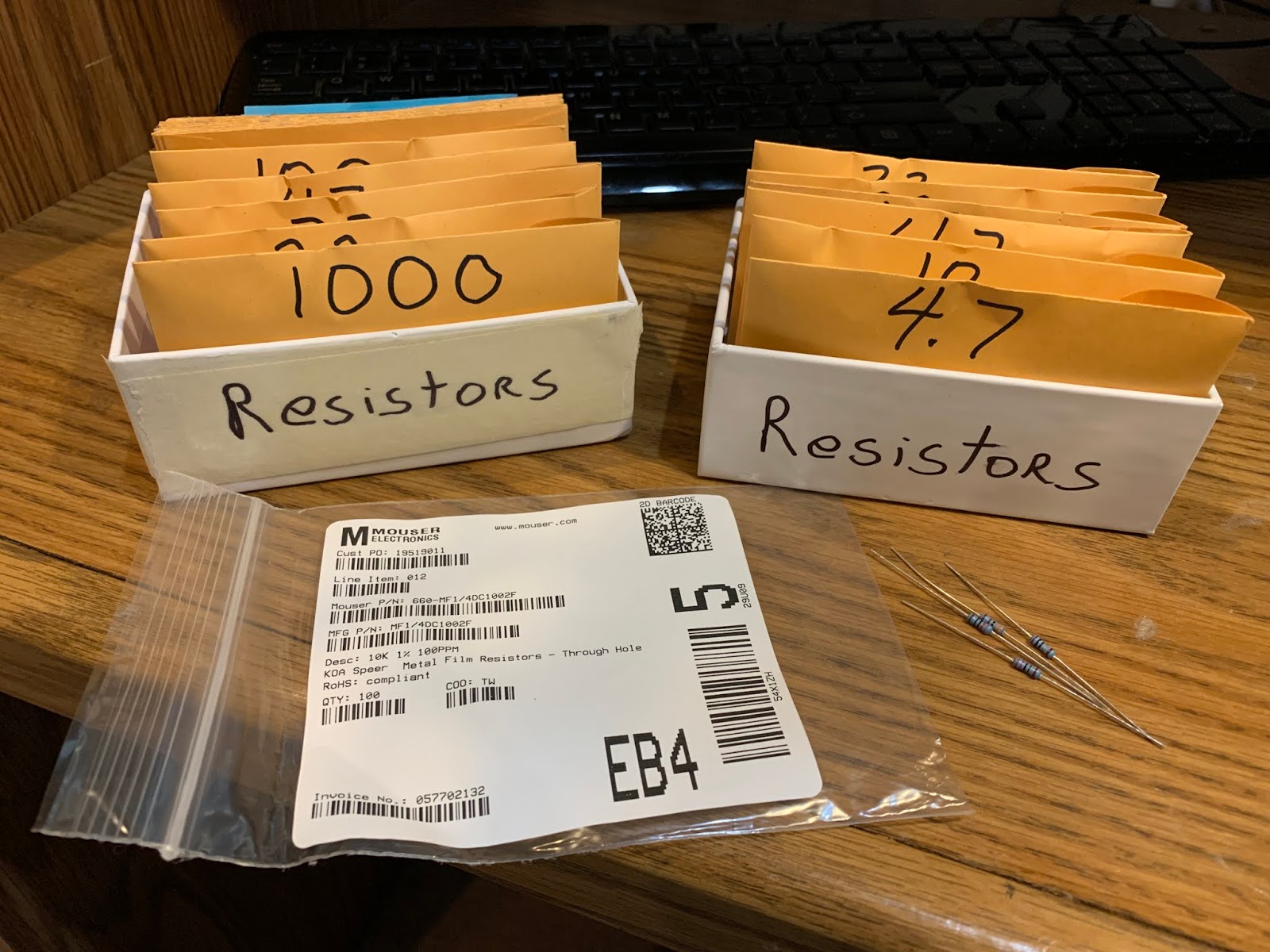 |
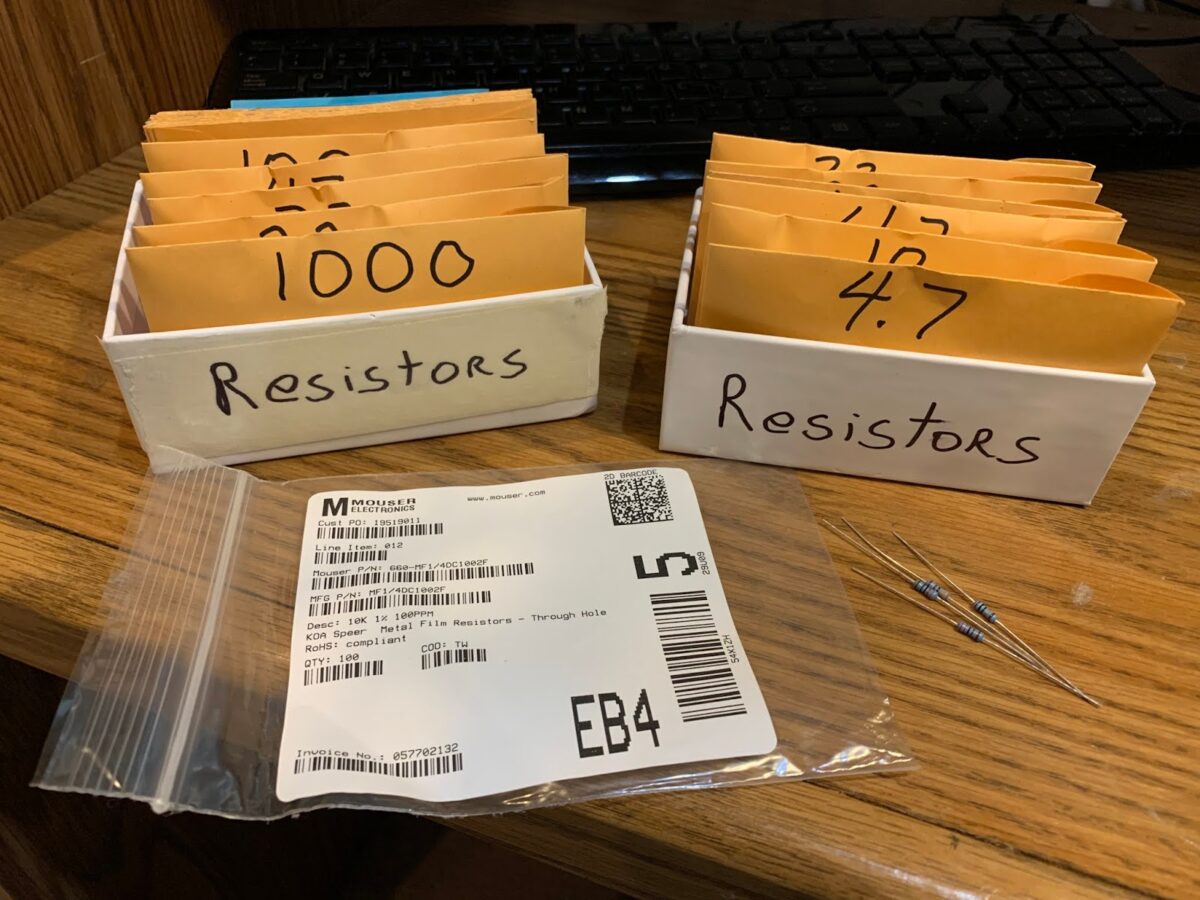
| I put the resistors in parts envelopes and cardboard boxes |
Hi Bill,
You mentioned wanting to get a resistor kit. If you’d like, I can
help you do what I did.
First, I looked at: https://en.wikipedia.org/wiki/E-series_of_preferred_numbers
Then I noodled about it a bit. And looked at mouser.
A tiny bit of code put together a copy and paste list of part numbers
that I pasted onto mouser’s BOM order form. And bob’s your uncle.
In my case, a particular manufacturer’s 1/4 W metal film 100 ppm as
they were 1.9c @ 100 pieces. I created a copy and paste BOM for E6
over 4 decades plus E3 for a 5th and 1M and 49.9 ohms. Less than $2
per value for 29 values. Not a bad price for the size of the resistor
kit. I also figured if the value gap was too large, I could fill it
in with the other half of the E12 series. (E6 series is every other
E12 series value.)
This could be tweaked. Perhaps fewer resistors in each value. Or add
some more special values or whatever.
Mouser was kind enough to cut tape and put each value in a flat
plastic baggy with a label as to what was inside. Sorted in a file
box, it’s a snap to grab a resistor.
Perhaps this is something I should post online to share? Maybe
someone else already has?
On my todo list is to construct my self a homebrew BOM of capacitors.
If you’re interested, I could update this and let you know what Mouser
can do for you. It may not be your preference, but it is an
interesting option.
Best regards,
Drew
n7da
——————————–
Drew: Your message caused me to think about what I really need in a resistor kit. I have been using some other resistor kits, but I end up using ALL of certain values and NONE of others. Your message made me realize that there is valuable data in those old kit packages.
I took a look a them this morning. It seems I use the following values: 4.7, 10, 47, 100, 220, 330, 470, 1k, 2,2k, 3,3k, 4,7k, and 10k. That’s about it. So maybe I just need to go to mouser and order, 50 of each. I’m thinking 1/4 or maybe 1/2 watt?
The packaging you describe sounds great. How can I get Mouser to do that for me?
I don’t think I need the more sophisticated approach you used, but I’m sure we have listeners who could benefit from it.
Any further suggestions?
Thanks again,
73 Bill
—————————–
Hi Bill,
Sounds very good. It turned out to be simple for me to order a
ridiculously well stocked resistor kit, but doing something custom is
actually a great idea. If you want both 1/4 and 1/2, get both. (I
figured I could always make a 1/2 W resistor out of 2 1/4 watt
resistors.)
The packaging is just what they do. No extra charge other than their
regular shipping and handling.
So, I did this in late 2018. When ordered, two values were
backordered, but they shipped them out a month or 6 weeks later or
something. Checking now, 660-MF1/4DC1000F (a 1% 100 ohm metal film
1/4 watt), I see it is out of stock with an ETA of June 1st for 10K
they are ordering. The other P/N that was backordered was
660-MF1/4DC1503F. Who knew 100 and 150K ohms were extra popular?
150K is in stock right now BTW. Maybe it’s random what they run out
of?
Best thing is you copy and paste your list of P/Ns and quantity for
each and bam Mouser will tell you pricing and if anything is
backordered, etc. If you don’t like what you see, change your list
and try again.
I actually thought about what I wanted, then looked at Mouser to see
what they had and what the pricing was on it.
So, from this particular resistor family, I see the pricing is what it
was a couple of years ago.
if you order 50 pieces of that 150 or 100 ohm resistor, that is:
50*$0.055 = $2.75 for 50 resistors.
If you order 100 pieces of that 150 or 100 ohm resistor, that is:
100*$0.019 = $1.90
IT”S CHEAPER TO ORDER 100! Well, at least for this resistor family
and for Mouser’s price breaks. You have to look at the price breaks
versus volume. And of course, understand the minimum you need and the
maximum you can store in your lab. 🙂 Don’t be ordering 10,000.
🙂
So, price breaks for these they show:
Qty. Unit Price
1 $0.23
10 $0.055
100 $0.019
1,000 $0.014
2,000 $0.009
10,000 $0.008
25,000 $0.007
You can see that there’s a good break at 10, 100, and 2,000. The
quantity with a good break really depends, so you would have to look
at different vendor product families to see. I don’t think I looked
very long. I probably knew I wanted 1/4 W (may have considered 1/8 or
1/2, don’t remember). I also think I knew I wanted metal film. When
I saw the pricing on these at 100 pc and with 1% tolerance (so I could
double out to E12 series and have it make sense if it turned out to be
useful for me), I stopped shopping.
Here’s the full BOM I ordered. The top part is some extra parts I
wanted and those couple of special resistor values. The lower part
was generated by just a few lines of python:
—–
G6K-2F-Y-DC12|8
1N4007FFG|100
1N4448|100
2N3904TAR|100
2N3906TAR|100
2643000101|100
2643002402|25
2673002402|25
2661000101|25
1C10X7R104K100B|50
1C10X7R103K100B|50
ECA-1HM101|25
ECA-1HM100|25
TIP29CG|5
TIP30CG|5
1N5355BG|10
PR01000104700JR500|10
PR01000102200JR500|6
MF1/4DC1800F|20
MF1/4DC2400F|20
MF1/4DC36R5F|10
FC2053-440-A|100
MF1/4DC16R5F|20
MF1/4DC10R0F|100
MF1/4DC15R0F|100
MF1/4DC22R0F|100
MF1/4DC33R0F|100
MF1/4DC47R0F|100
MF1/4DC68R0F|100
MF1/4DC1000F|100
MF1/4DC1500F|100
MF1/4DC2200F|100
MF1/4DC3300F|100
MF1/4DC4700F|100
MF1/4DC6800F|100
MF1/4DC1001F|100
MF1/4DC1501F|100
MF1/4DC2201F|100
MF1/4DC3301F|100
MF1/4DC4701F|100
MF1/4DC6801F|100
MF1/4DC1002F|100
MF1/4DC1502F|100
MF1/4DC2202F|100
MF1/4DC3302F|100
MF1/4DC4702F|100
MF1/4DC6802F|100
MF1/4DC1003F|100
MF1/4DC1503F|100
MF1/4DC2203F|100
MF1/4DC3303F|100
MF1/4DC4703F|100
MF1/4DC6803F|100
MF1/4DC49R9F|100
MF1/4DC1004F|100
—–
So, your BOM (4.7, 10, 47, 100, 220, 330, 470, 1k, 2,2k, 3,3k, 4,7k,
and 10k) would be the following. Added the 4.7 by hand and deleted
the other values by hand. Qty 100 each.
—–
MF1/4DC4R700F|100
MF1/4DC10R0F|100
MF1/4DC47R0F|100
MF1/4DC1000F|100
MF1/4DC2200F|100
MF1/4DC3300F|100
MF1/4DC4700F|100
MF1/4DC1001F|100
MF1/4DC2201F|100
MF1/4DC3301F|100
MF1/4DC4701F|100
MF1/4DC1002F|100
—–
Mouser.com. Services & Tools button. BOM Tool button. Login (they
want account for the tools. I can’t complain.) Upload spreadsheet or
copy and paste. In this case, copy and paste. In fact, copy right
out of this draft email and into their tool. Next. Then they ask me
for a name for the BOM and if I only want RoHS. (RoHS is up to you.
I picked only RoHS, because I know all these parts are RoHS and it
won’t warn me about lead poisoning or anything.) Process BOM.
Blammo.
I had the 4.7 wrong, but they figure it out. Ouch. Pricey. Maybe
you don’t need so many, but $4.6 for 100. Parallel a couple of 10
ohm, you’ll have less parasitic L in your emitter circuit. Change the
BOM before you click the add all to cart. No problem. Or maybe 4.7
is worth the extra money to a high roller such as yourself. 🙂
2 parts are at 0 inventory. The 100 we knew about. 470 as well with
6K arriving 15June. Yes, those ETAs are perhaps questionable. Dunno.
They will ship you what they have and ship the rest later AT NO EXTRA
CHARGE. 🙂
A third part is at 123 pc inventory. Act now before they are all out!
🙂 220 ohms. 6K due end of June.
The above would be $25.50 plus less than $10 for their cheapest
shipping option. Not a bad price for a well stocked CUSTOM kit and
it’s really easy to do. And these are good parts with specifications
and tempcos etc. all in the data sheet. Sure, you don’t need it 99%
of the time, but if you wanted it, because you were doing something
fussy, you have it.
You could cut that price down quite a bit if you went carbon or wider
tolerance. (Who needs 1%? This is electrical engineering, not
mechanical engineering!) Or maybe another manufacturer. It’s easy to
browse on Mouser and figure out those other options quickly and what
it may do to help you out. Of course, when you get to a price of
$0.00, you still have the flat rate cheapest Mouser shipping as the
floor on what price you can achieve.
Mouser will also give you a print and email with price, part number,
description of everything in your custom kit. And each pouch is
labelled. Crazy! 🙂
Another crazy thing is with these BOMs is that you can easily share
them with others.
Best regards,
Drew
n7da
Sounds very good. It turned out to be simple for me to order a
ridiculously well stocked resistor kit, but doing something custom is
actually a great idea. If you want both 1/4 and 1/2, get both. (I
figured I could always make a 1/2 W resistor out of 2 1/4 watt
resistors.)
The packaging is just what they do. No extra charge other than their
regular shipping and handling.
So, I did this in late 2018. When ordered, two values were
backordered, but they shipped them out a month or 6 weeks later or
something. Checking now, 660-MF1/4DC1000F (a 1% 100 ohm metal film
1/4 watt), I see it is out of stock with an ETA of June 1st for 10K
they are ordering. The other P/N that was backordered was
660-MF1/4DC1503F. Who knew 100 and 150K ohms were extra popular?
150K is in stock right now BTW. Maybe it’s random what they run out
of?
Best thing is you copy and paste your list of P/Ns and quantity for
each and bam Mouser will tell you pricing and if anything is
backordered, etc. If you don’t like what you see, change your list
and try again.
I actually thought about what I wanted, then looked at Mouser to see
what they had and what the pricing was on it.
So, from this particular resistor family, I see the pricing is what it
was a couple of years ago.
if you order 50 pieces of that 150 or 100 ohm resistor, that is:
50*$0.055 = $2.75 for 50 resistors.
If you order 100 pieces of that 150 or 100 ohm resistor, that is:
100*$0.019 = $1.90
IT”S CHEAPER TO ORDER 100! Well, at least for this resistor family
and for Mouser’s price breaks. You have to look at the price breaks
versus volume. And of course, understand the minimum you need and the
maximum you can store in your lab. 🙂 Don’t be ordering 10,000.
🙂
So, price breaks for these they show:
Qty. Unit Price
1 $0.23
10 $0.055
100 $0.019
1,000 $0.014
2,000 $0.009
10,000 $0.008
25,000 $0.007
You can see that there’s a good break at 10, 100, and 2,000. The
quantity with a good break really depends, so you would have to look
at different vendor product families to see. I don’t think I looked
very long. I probably knew I wanted 1/4 W (may have considered 1/8 or
1/2, don’t remember). I also think I knew I wanted metal film. When
I saw the pricing on these at 100 pc and with 1% tolerance (so I could
double out to E12 series and have it make sense if it turned out to be
useful for me), I stopped shopping.
Here’s the full BOM I ordered. The top part is some extra parts I
wanted and those couple of special resistor values. The lower part
was generated by just a few lines of python:
—–
G6K-2F-Y-DC12|8
1N4007FFG|100
1N4448|100
2N3904TAR|100
2N3906TAR|100
2643000101|100
2643002402|25
2673002402|25
2661000101|25
1C10X7R104K100B|50
1C10X7R103K100B|50
ECA-1HM101|25
ECA-1HM100|25
TIP29CG|5
TIP30CG|5
1N5355BG|10
PR01000104700JR500|10
PR01000102200JR500|6
MF1/4DC1800F|20
MF1/4DC2400F|20
MF1/4DC36R5F|10
FC2053-440-A|100
MF1/4DC16R5F|20
MF1/4DC10R0F|100
MF1/4DC15R0F|100
MF1/4DC22R0F|100
MF1/4DC33R0F|100
MF1/4DC47R0F|100
MF1/4DC68R0F|100
MF1/4DC1000F|100
MF1/4DC1500F|100
MF1/4DC2200F|100
MF1/4DC3300F|100
MF1/4DC4700F|100
MF1/4DC6800F|100
MF1/4DC1001F|100
MF1/4DC1501F|100
MF1/4DC2201F|100
MF1/4DC3301F|100
MF1/4DC4701F|100
MF1/4DC6801F|100
MF1/4DC1002F|100
MF1/4DC1502F|100
MF1/4DC2202F|100
MF1/4DC3302F|100
MF1/4DC4702F|100
MF1/4DC6802F|100
MF1/4DC1003F|100
MF1/4DC1503F|100
MF1/4DC2203F|100
MF1/4DC3303F|100
MF1/4DC4703F|100
MF1/4DC6803F|100
MF1/4DC49R9F|100
MF1/4DC1004F|100
—–
So, your BOM (4.7, 10, 47, 100, 220, 330, 470, 1k, 2,2k, 3,3k, 4,7k,
and 10k) would be the following. Added the 4.7 by hand and deleted
the other values by hand. Qty 100 each.
—–
MF1/4DC4R700F|100
MF1/4DC10R0F|100
MF1/4DC47R0F|100
MF1/4DC1000F|100
MF1/4DC2200F|100
MF1/4DC3300F|100
MF1/4DC4700F|100
MF1/4DC1001F|100
MF1/4DC2201F|100
MF1/4DC3301F|100
MF1/4DC4701F|100
MF1/4DC1002F|100
—–
Mouser.com. Services & Tools button. BOM Tool button. Login (they
want account for the tools. I can’t complain.) Upload spreadsheet or
copy and paste. In this case, copy and paste. In fact, copy right
out of this draft email and into their tool. Next. Then they ask me
for a name for the BOM and if I only want RoHS. (RoHS is up to you.
I picked only RoHS, because I know all these parts are RoHS and it
won’t warn me about lead poisoning or anything.) Process BOM.
Blammo.
I had the 4.7 wrong, but they figure it out. Ouch. Pricey. Maybe
you don’t need so many, but $4.6 for 100. Parallel a couple of 10
ohm, you’ll have less parasitic L in your emitter circuit. Change the
BOM before you click the add all to cart. No problem. Or maybe 4.7
is worth the extra money to a high roller such as yourself. 🙂
2 parts are at 0 inventory. The 100 we knew about. 470 as well with
6K arriving 15June. Yes, those ETAs are perhaps questionable. Dunno.
They will ship you what they have and ship the rest later AT NO EXTRA
CHARGE. 🙂
A third part is at 123 pc inventory. Act now before they are all out!
🙂 220 ohms. 6K due end of June.
The above would be $25.50 plus less than $10 for their cheapest
shipping option. Not a bad price for a well stocked CUSTOM kit and
it’s really easy to do. And these are good parts with specifications
and tempcos etc. all in the data sheet. Sure, you don’t need it 99%
of the time, but if you wanted it, because you were doing something
fussy, you have it.
You could cut that price down quite a bit if you went carbon or wider
tolerance. (Who needs 1%? This is electrical engineering, not
mechanical engineering!) Or maybe another manufacturer. It’s easy to
browse on Mouser and figure out those other options quickly and what
it may do to help you out. Of course, when you get to a price of
$0.00, you still have the flat rate cheapest Mouser shipping as the
floor on what price you can achieve.
Mouser will also give you a print and email with price, part number,
description of everything in your custom kit. And each pouch is
labelled. Crazy! 🙂
Another crazy thing is with these BOMs is that you can easily share
them with others.
Best regards,
Drew
n7da
SolderSmoke Podcast #224: Mars. Spurs. Bikes. SDR. NanoVNA. Antuino. MAILBAG
SolderSmoke Podcast #224 is available:
1 August 2020
–The launch of Perseverance Mars probe with Ingenuity helicopter.
–China’s Tian Wen 1 on its way – radio amateur Daniel Estevez EA4GPZ is listening to it!
–Sci Fi Books: Mars Trilogy by Kim Stanley Robinson. No skip on Mars 🙁
–We have some sunspots! SFI now 72 and the Sunspot number is 23.
Bill’s bench:
–Conquering Ceramic Spurs in Q-31 Roofing filter — sort of
–NE602 for a Q-75 converter – Gilbert Cell.
–Measuring low power levels out of NE602. Antuino better than ‘scope .
–NanoVNA Really cool stuff. SDR in there.
–Building a 455 kc LC filter from QF-1 rubble. Using LTSPICE, Elsie…
–Reviving my bicycle AM radio – The “All Japanese 6”
–Understanding L Network impedance matching.
–Bill’s new resistor kit from Mouser. Thanks to Drew N7DA.
SHAMELESS COMMERCE: PATREON, AMAZON SEARCH. THANKS
Pete’s Bench:
–Lockdown Special
–BPF work on SDR Rig
–I U W I H
Mailbag:
VK3HN Summit Prowler 7
VK2EMU “The Stranger”
SM0P HB uBITX in Dubai
AE7KI Worked him in VK from London
ON6UU EA3GCY’s 4020 rig
KA4KXX A Simpler Mighty Mite
W9KKQ M19 DMR
KD4PBJ Radio Schenectady
W3BBO 12AU7 Regen
KE5HPY Another 12AU7 regen
N5VZH Ne602 Converter
KY3R Wall Art
G4WIF Spectrum Analyzer in your pocket
W2AEW Talks to UK Club
KK0S Sent 455 Kc IF cans
KL0S Making 9Mhz filters
VU2ESE Diving into simple SDR schemes
Dean KK4DAS Amateur Radio Astronomy