Month: March 2016
Elser-Mathes Cup Opportunity!
I’m sure he’ll be on the air. With a homebrew rig.
Stay thirsty my friends!
A Knack Victim’s Midlife Crisis
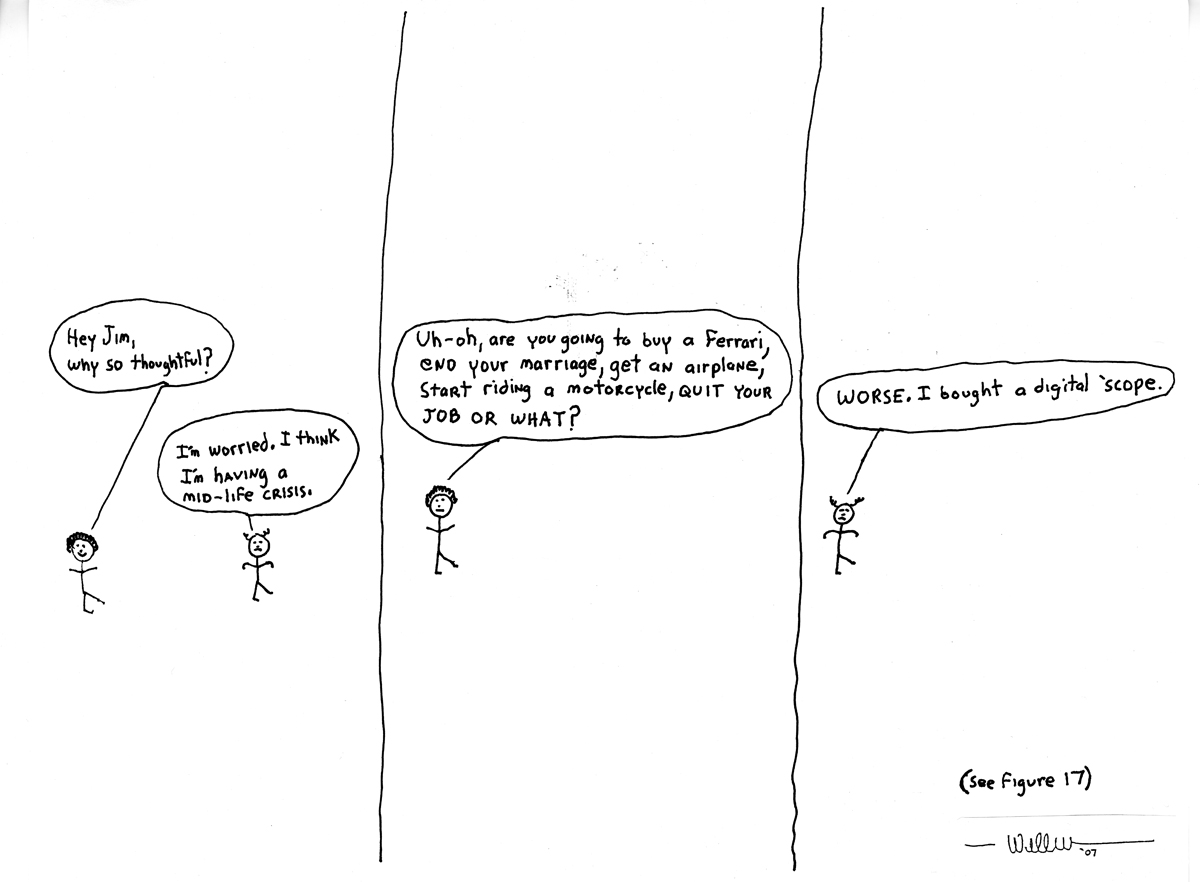
Thanks to Steve WA0PWK for sending us this Jim Williams cartoon.
Been there, done that. It doesn’t mean you are a bad person.
German Mighty Mite works Venice on 40 (video)
In spite of being a bit off frequency, sTef, DL1FDF (aka VY1QRP) has been inducted into the Color Burst Liberation Army. Congratulations sTef! Normally we would requite operation on 3.579 MHz, but sTef has been granted special dispensation because 1) he doesn’t have a 3.579 MHz rock, 2) our stock of this crystal has been depleted, and 3) he actually made a contact with this rig, working II3ICZ in Venice. FB sTef. If anyone has a color burst crystal for sTef, please let us know.
sTef writes:
I would like to say „Thanks” to both of you for your ongoing inspirations in soldering and homebrewing. After 15 years out of ham radio it were you two guys who got me back into the world of -> SOLDERSMOKE. Thanks for that.And belive me been away for 15 years and now getting back into it feels a sometimes a little bit too “digital“ …. ARDUINO or NOT TO ARDUINO ? This is the question….
Anyway…
So what could be more sophisticating than having a MMM ready on the work bench and answering a CQ call on 40m with that thing and be heard.
Yes, the first QSO today with my MMM was for you both.
I worked the Italian Radio Station II3ICZ. I was 559 into Venice with 0.5 watts from the MMM into my full-size triple leg for 40m.
Adafruit Profiled in “The New Yorker”

Congratulations to Limor Fried. Her company got a very nice write up in “The New Yorker.”
http://www.newyorker.com/tech/elements/limor-frieds-artful-electronics
“My Favorite Programming Language is Solder” — Boldport Kits
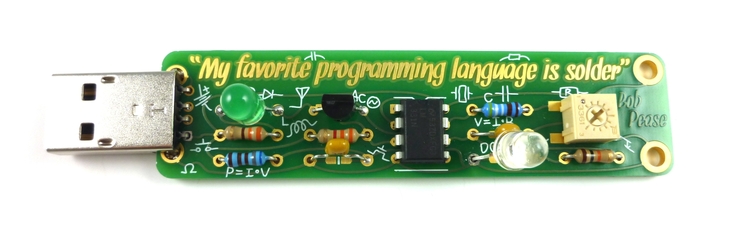
Look closely at the inscription on that USB stick. Obviously I sympathize. The folks at Boldport have some very interesting ideas and projects. And they operate from a very cool location, just south of the river Thames, not far from my old home in London.
Here is their main site: http://www.boldport.com/blog/2016/2/21/boldport-club-project-1
Here is where you can subscribe to receive a monthly project (with parts!) from them:
https://boldport.cratejoy.com/
As for the solder quote from Bob Pease, this was discussed before on this blog, back in 2011. We were talking about an intereview that had been done with Alan Wolke W2AEW:
I also liked Alan’s response to the question about his favorite software tool: “Gee, solder is soft, can we consider that software? I use a lot of that!” This is very reminiscent of a quote from the legendary Bob Pease (colleague of Jim Williams): “My favorite programming language is solder.” (That quote was sent to me by Steve WA0PWK. Thanks Steve.)
AA1TJ — On the Air with a Tuning Fork Transmitter using the 2,212th Harmonic and Olive Oil Cooling
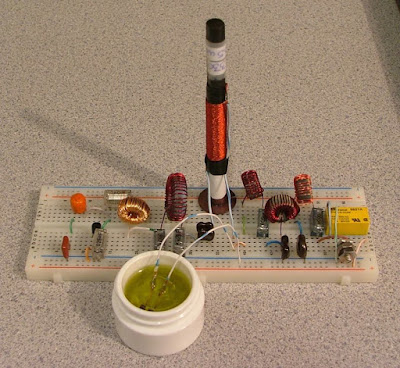
The saturable magnetic frequency septupler. The tiny computer memory core is submerged in olive oil (Italian…naturalmente).
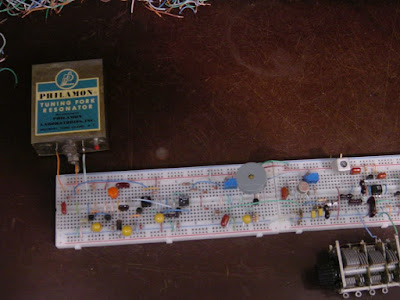
Not a very good picture, but here’s the 1600Hz tuning-fork, fork oscillator, SRD pulse generator, PLL S/H phase-detector (diode gate), differential amplifier D.C. amplifier, and part of the 500kHz VCO.
The Wizard (AA1TJ) reports from the Hobbit Hole:
I was pleased to have made the first contact with my tuning-fork transmitter this evening. My contact, N1QLL, runs a pretty B&B on the Maine seacoast, midway between Bar Harbor and Cutler. Jerry was operating a solar-powered QRP station. I found a follow-up email from him when I came up to the house for dinner. He’s asking for a better explanation of my set-up. I can’t wait to tell him about the passive frequency septupler made from an East German computer memory core, heat-sinked in a thimble of olive oil.
My signal was also logged by a number of automated “Reverse Beacon Network” receivers (image attached) located in Ohio, North and South Carolina, Virginia and Pennsylvania…not bad for 90mW on 80m. Please note that my operating frequencies, 3,528.0 and 3,539.2kHz, are the 2,205 and 2,212th harmonics, respectively, of my 1,600Hz tuning-fork frequency reference.
FYI: the third attached image illustrates the block-diagram and tuning-fork reference oscillator circuitry for three common-wavelength AM broadcast transmitters operating in Berlin, Stettin and Magdeburg, Germany from 1928 through the mid 30’s. A central 2,000Hz tuning-fork generated reference carrier was transmitted by landline to transmitters in the aforementioned cities whereupon the 529th harmonic was generated, amplified and broadcast at 1,058kHz. The equipment was designed by the Berlin-based firm, C. Lorenz A.G.. The fourth image details Lorenz’ technique of frequency multiplication via saturable magnetic iron-core inductors. My septupler operates in an identical fashion.
A very pleasant day… 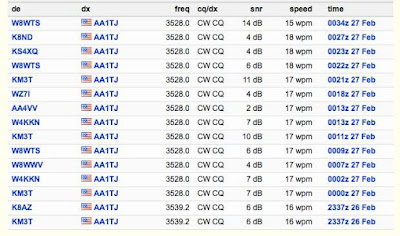
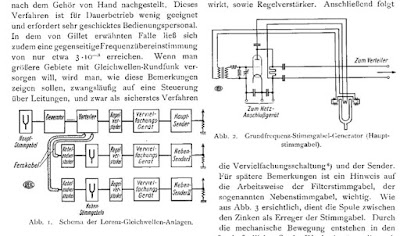
FYI: the third attached image illustrates the block-diagram and tuning-fork reference oscillator circuitry for three common-wavelength AM broadcast transmitters operating in Berlin, Stettin and Magdeburg, Germany from 1928 through the mid 30’s. A central 2,000Hz tuning-fork generated reference carrier was transmitted by landline to transmitters in the aforementioned cities whereupon the 529th harmonic was generated, amplified and broadcast at 1,058kHz. The equipment was designed by the Berlin-based firm, C. Lorenz A.G.. The fourth image details Lorenz’ technique of frequency multiplication via saturable magnetic iron-core inductors. My septupler operates in an identical fashion.
A very pleasant day…
Mike points out that this is a work in progress. He hopes to cross the pond (the Atlantic!) soon. Here is a update from Mike:
A nasty cold has delayed work on the 20 meter implementation, although some of the time I’ve spent crashed on the sofa was put to use redesigning the loop filter network. I think yesterday might have been my “hump” day so I’m looking forward to getting in some quality bench-time over the weekend.
By the way, my PLL-based transmitter frequency stabilizing circuit has much in common with a garden-variety frequency-synthesizer. Obviously, the tuning-fork frequency reference is the main point of departure. My sampling phase detector, for example, was old hat by the mid-1960’s. Nevertheless, this has been a fun project.
That Time We Were Re-Transmitted on 487 THz On a Red Light over Salt Lake City….
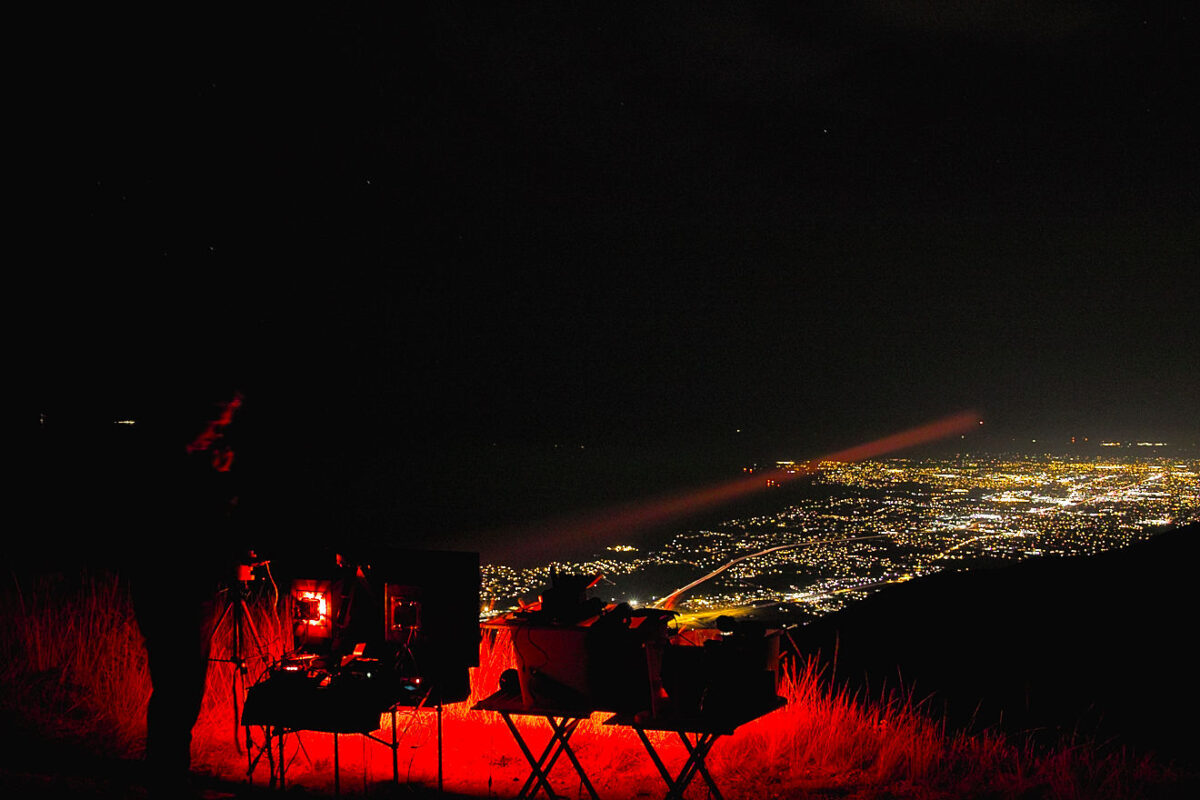
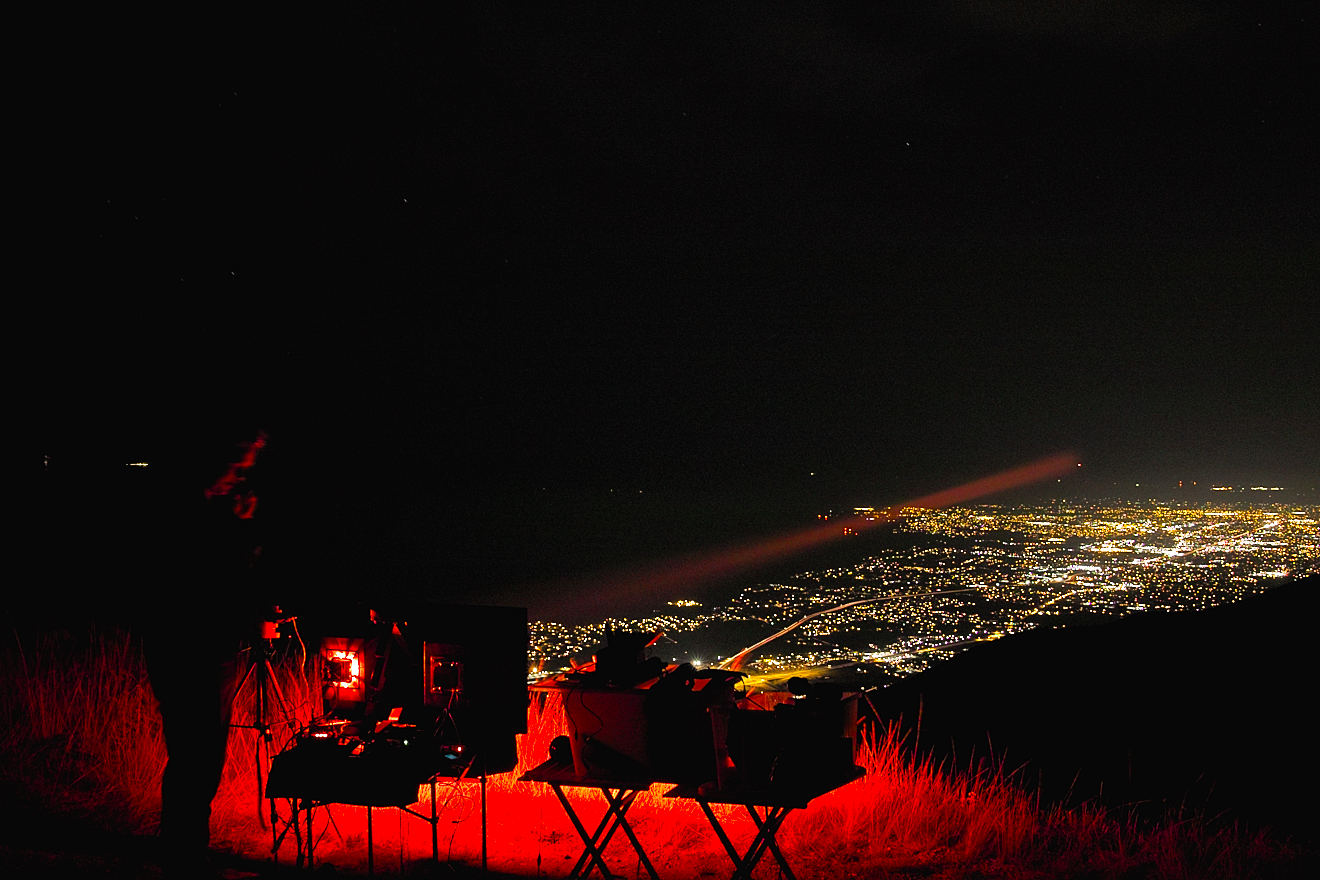
Some of you may remember this from back in 2012:
http://soldersmoke.blogspot.com/2012/09/soldersmoke-in-red-light-zone.html
Fast forward to November of last year. By this time I’d forgotten about the Utah light beams. Ron Jones, K7RJ, was kind enough to send me a wonder-filled bag of electronic parts. I have been slowly sorting them. All kinds of great stuff is in there, but I noticed a lot of stuff that you don’t normally find in ham shacks — lots of optical stuff, lots of LEDs and photo transistors, little transistors with lenses on the top. Cool stuff all, but not the kind of parts you’d use for a 40 meter CW rig. What the heck was Ron building? I wrote and asked. Here is his reply.
I’m like you, Bill, I’m a jack of all trades and master of none. I dabble in this and that. I always have a hand full of half finished projects on the bench.
The optical stuff probably fell on the floor when Clint (KA7OEI) and I were experimenting with “through the air light communication” a few years back. Clint in the real guru in that particular project. We made optical contacts over what we think is a world record – 173 miles! That meant packing in optical gear to the top of remote Utah mountains, but what a great time we had! We used a high power LED – NOT a laser. Lasers really suck for super long range communications. They are great for wide band across a parking lot, but not for voice communication over tens of miles (in our cast 173 miles) over the air. We did over 100 miles with a laser pointer – can you believe that? A $3.00 laser that you torture your dog with… 100 miles! But, that is a different topic. If you do say anything about the optical stuff, be sure to mention Clint, he really engineered the optical communication project.
By far, most important thing that we did with optical communication was on one of our short tests (only about 50 miles) when we broadcast one of the Solder Smoke episodes for anyone who cared to “look in” on our red beacon. I think Clint sent you a picture from his side of the path a few years ago.
If there are any parts in that pile of junk that you are particularly interested in, I may be able to find more data and/or circuit ideas I had. But, honestly, a lot of that is stuff that is as strange and wonderful to me as it is to you. Fun as heck to look at, but needs to be put in the “YAFP” pile (Yet another .. project).
Thanks for doing the podcast. It is always an inspiration for me to keep my soldering hot.
73
Ron K7RJ
Very cool. So Ron had been at the other end of Clint’s Red Light beam, the light beam that was carrying a SolderSmoke podcast across Salt Lake City. And it appears that some of the parts involved in that amazing project have ended up in my junk box. The Radio Gods like this sort of thing and may have been at work here. Thanks Ron.
DD4WH’s Fantastic Teensy SDR Receiver (Videos)
This is almost enough to make me abandon my analog, discrete component, HDR fundamentalism. Check out that display. And that StereoAM mode in which the upper and lower sidebands go to the left and right headphones “useful for CW”… Wow, that’s seems like a step beyond binaural.
Don’t miss Parts 2-4 –They are all on YouTube and will appear in the right hand column when you are watching Frank’s videos. But I couldn’t resist embedding the video that shows the hardware. Note: the oscillator is an Si5351! Yea! And the LP filter board comes from Hans Summers.
Beautiful work Franz! Thanks for making the videos. 73 Bill
From Paul Darlington M0XPD: A Book!

Our friend Paul Darlington M0XPD is a member in good standing of the International Brotherhood of Electronic Wizards. His AD9850 Arduino shield propelled me into the world of I and Q. His “Shack Nasties” blog is a valuable resource for all of us. And now he has written a book. Paul was kind enough to let me read it before it was published — I enjoyed it very much. It is the story of a very personal journey. At one level it is about Paul’s trip to the Dayton Hamvention. But the trip goes much further than Dayton, both geographically and personally. I especially enjoyed Paul’s observations on the United States — our British cousins often see things we ourselves overlook. I’m really pleased that George Dobbs wrote the foreword — he is the ideal person to do this for Paul’s very philosophical book.
We give “Getting There” our highest review: the coveted FIVE SOLDERING IRONS. And we are nominating Paul for a Brass Figlagee with Bronze Oak Leaf Palm.
Read Paul’s description of the book here:
Buy the book here:
Congratulations Paul!
