Speaking of Breadboards…

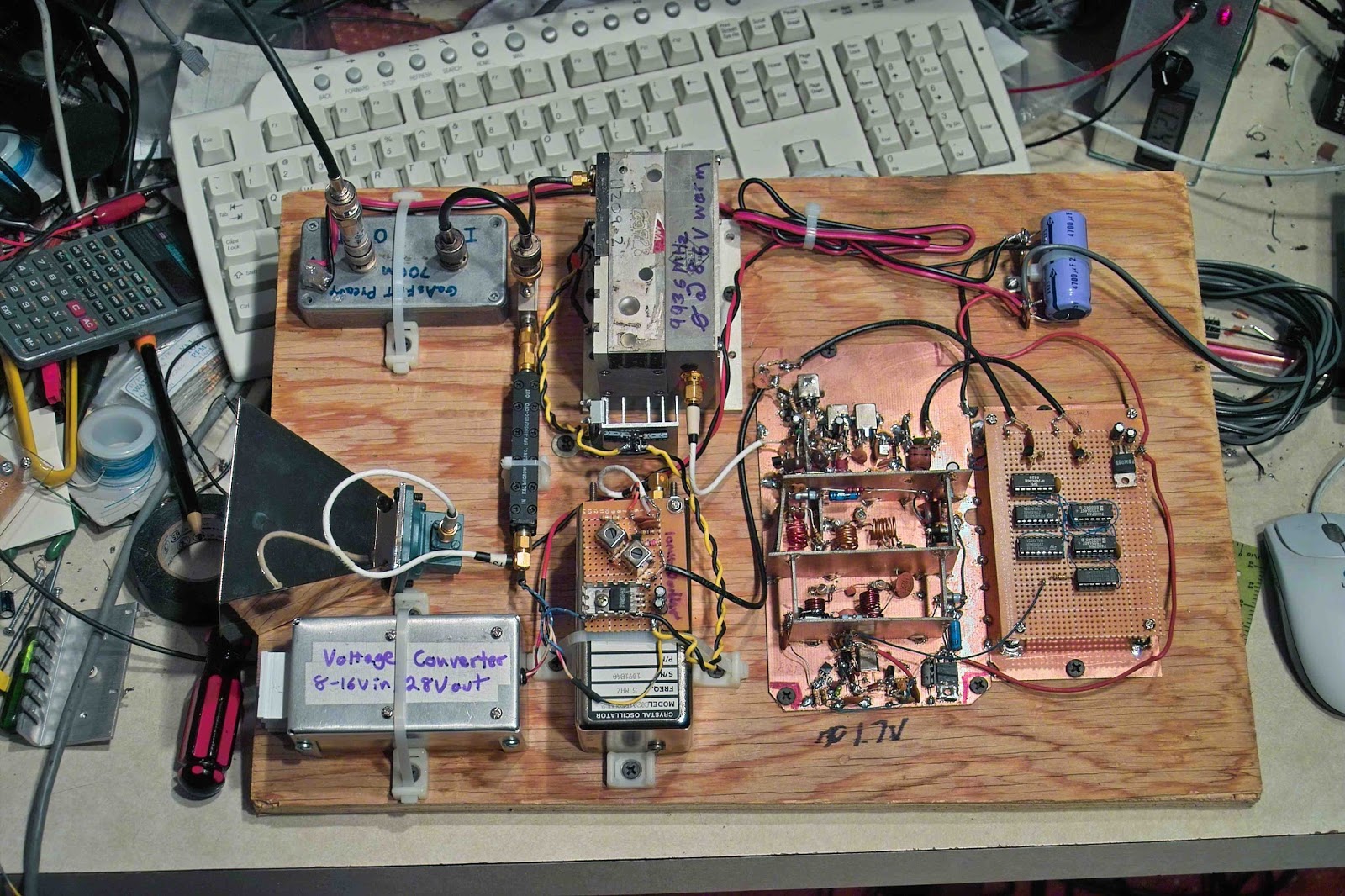
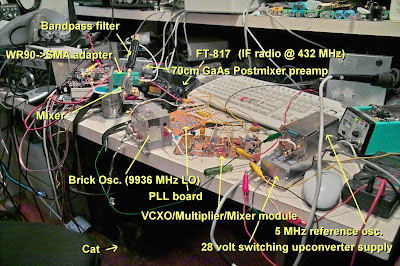
Clint KA7OEI sent us these inspiring photos of his 10 GHz transverters. FB Clint! The one on the top was built in 2005 and STILL looks like this. Note “CAT” component in the version pictured in the second photo.

Our book: “SolderSmoke — Global Adventures in Wireless Electronics” http://soldersmoke.com/book.htm Our coffee mugs, T-Shirts, bumper stickers: http://www.cafepress.com/SolderSmoke Our Book Store: http://astore.amazon.com/contracross-20

Si5351 and the Spectral Purity Mask

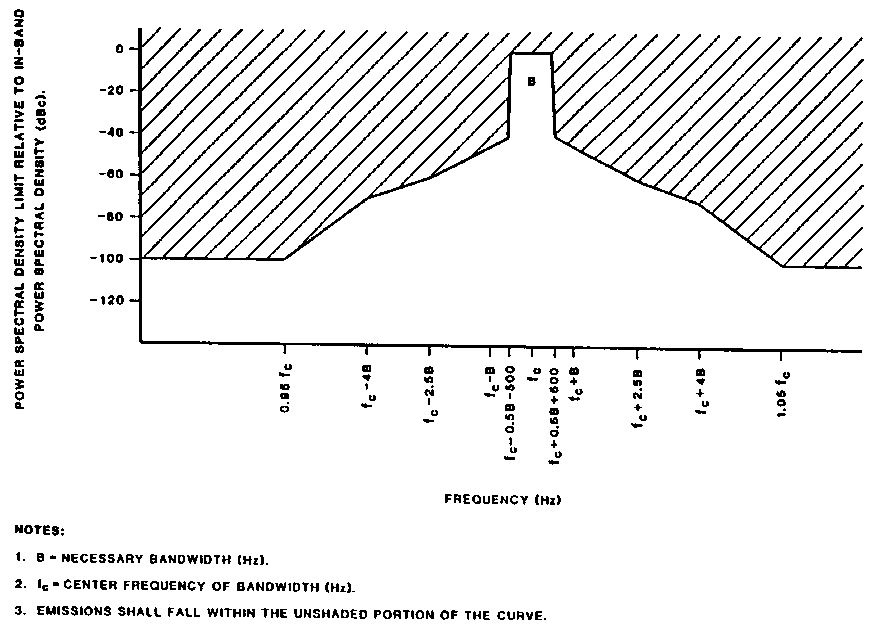
I was thinking about spectral purity standards and the Si5351 chip. I realized that I didn’t even know what the FCC standards for “close in” noise are. The standards for spurious emissions ARE well known, but these are for harmonics and parasitic emissions relatively far from the desired signal. What about unwanted signals CLOSE to the desired signal?

My old 2002 ARRL handbook indicates that the FCC has not established firm standards for this “close in” noise. (They call it “out of band” noise, but are clearly referring to noise that is close to the desired signal but spreading out beyond the desired bandwidth. Phase noise would be in their category.)

In the course of my Googling, I found the above spectral purity mask. I don’t know where it comes from, but I think it is the kind of graph that would be very useful to us as we evaluate the merits and shortcomings of various frequency synthesizers. Would our DDS or PLL rigs fit in this mask? I think an Si5351 rig WOULD. According to KE5FX’s measurements, at a mere 100 Hz from the center frequency, the Si5351 phase noise is already -90 db.

Does anyone have a similar mask showing current standards?

I still don’t understand why so many folks believe that the Si570 is a useful part for homebrew rigs, but the Si5351 is not. Look at the numbers:

Si570
Clifton Labs measuring at 30 MHz carrier. At 10kHz from carrier: -109.6 dbc/Hz
Silicon Labs web site (carrier freq not specified) At 10 kHz from carrier: -116 dbc/Hz

Si5351
KE5FX measuring at 19.99 MHz. At 10kHz from carrier: -127 dbc/Hz
Silicon Labs measuring at 156.2 MHz. At 10 kHz from carrier -112 dbc/Hz.

Can anyone out there explain the technical basis for the belief that the Si570 is a useful part while the Si5351 is not?

It is important to keep things in perspective. ALL of these noise numbers represent VERY small noise levels. Let’s keep is simple and assume a 100 watt carrier signal and a phase noise of -100 dbc/Hz. That means the phase noise per hertz would be .00000001 watts. That’s watts/hertz. How much “noise power” would that represent in a typical SSB passband? Multiply by 2500 Hz and you get 25 microwatts. That’s really low noise levels. Not enough to worry about. And as we’ve noted, we’ve happily used rigs with LC VFOs and crystal oscillators for all these years without every once measuring their phase noise.

Our book: “SolderSmoke — Global Adventures in Wireless Electronics” http://soldersmoke.com/book.htm Our coffee mugs, T-Shirts, bumper stickers: http://www.cafepress.com/SolderSmoke Our Book Store: http://astore.amazon.com/contracross-20
Noodling on Phase Noise — Si570 vs. Si5351

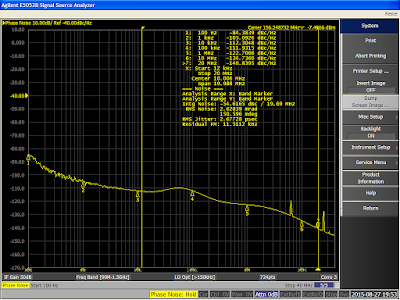
Pete and I were very recently talking about phase noise in the Si5351 as compared to the Si570. Pete e-mailed Si labs and got their phase noise data on the Si5351. See above.


I did some googling and found a similar graph for the Si570. Here it is:


Sure, the Si570 has a bit less phase noise. But with both devices, this noise is so low that it doesn’t cause trouble in our rigs. No trouble on receive and no trouble on transmit.

At 10 kHz from the carrier, the Si570 phase noise is -132dbc/Hz. At 10kHz the Si5351 is -112 dbc/Hz at 1kHz from the desired freq, the 570 is at -122 dbc/Hz and the Si5351 is at -105 dbc/Hz

I have the Si5351 in my BITX 40 DIGI-TIA and I have tried very hard to hear the “noise around a strong signal” that people warn about. I can’t hear it. If a tree falls in the woods and no one hears it…. I’m sure my neighbor is making some noise in his basement right now. But I can’t hear it, so, should I complain?

As for the transmit signal, I get no complaints, even from the most cranky and gleefully critical SDR-equipped appliance ops on 40 meters (believe me, they don’t hold back!). EMRFD notes that on transmit, in the output from the final, the phase noise output will have the same relationship to the desired signal as it has to the desired oscillator signal. If we are talking about noise that is 100 db down, with a 100 watt rig, the phase noise would be at .00000001 watt/Hz. I realize that is noise PER HERTZ. But even if we assume a 2500 Hz bandwidth, how much TOTAL noise power is that? Multiply by 2500: .000025 watts right? (Check my math — I majored in International Studies!) 25 microwatts! Even my critics on 40 can’t hear that. And the phase noise figures for both the Si570 and the Si5351 are a lot better than -100 db.

The Si5351 offers us a BIG advantage: That second oscillator for the BFO. This is huge. And the thing is so cheap. Cheap is good!

How about some side by side comparisons? Maybe someone in the BITX or Minima community could try a rig with an SI570, then substitute an Si5351. See if they notice a difference on transmit or receive. I don’t think they will.

What do you think of my logic and math?

Our book: “SolderSmoke — Global Adventures in Wireless Electronics” http://soldersmoke.com/book.htm Our coffee mugs, T-Shirts, bumper stickers: http://www.cafepress.com/SolderSmoke Our Book Store: http://astore.amazon.com/contracross-20
Alan Wolke’s Drake 2-B (video)

Alan’s video inspired me to do a little work with my Drake 2-B. Nothing major — I was just making sure that the passband knob is in the right setting. I’ve complained that the Drake 2-B doesn’t sound great on AM. I recently noticed that my BITX40 DIGI-TIA sounds surprisingly good with AM signals — I just treat them as SSB signals and zero-beat the carrier with my Si5351 VFO. I wanted to try doing the same thing with the 2-B, and then make some comparisons. I only heard a few AM signals this morning, so I will try again later today and will report results here.

Our book: “SolderSmoke — Global Adventures in Wireless Electronics” http://soldersmoke.com/book.htm Our coffee mugs, T-Shirts, bumper stickers: http://www.cafepress.com/SolderSmoke Our Book Store: http://astore.amazon.com/contracross-20
SolderSmoke Book Now Free on Amazon Kindle

http://www.amazon.com/SolderSmoke-Global-Adventures-Wireless-Electronics-ebook/dp/B004V9FIVW/ref=la_B001JOYVM4_1_1_title_1_kin?s=books&ie=UTF8&qid=1441406675&sr=1-1

Our book: “SolderSmoke — Global Adventures in Wireless Electronics” http://soldersmoke.com/book.htm Our coffee mugs, T-Shirts, bumper stickers: http://www.cafepress.com/SolderSmoke Our Book Store: http://astore.amazon.com/contracross-20
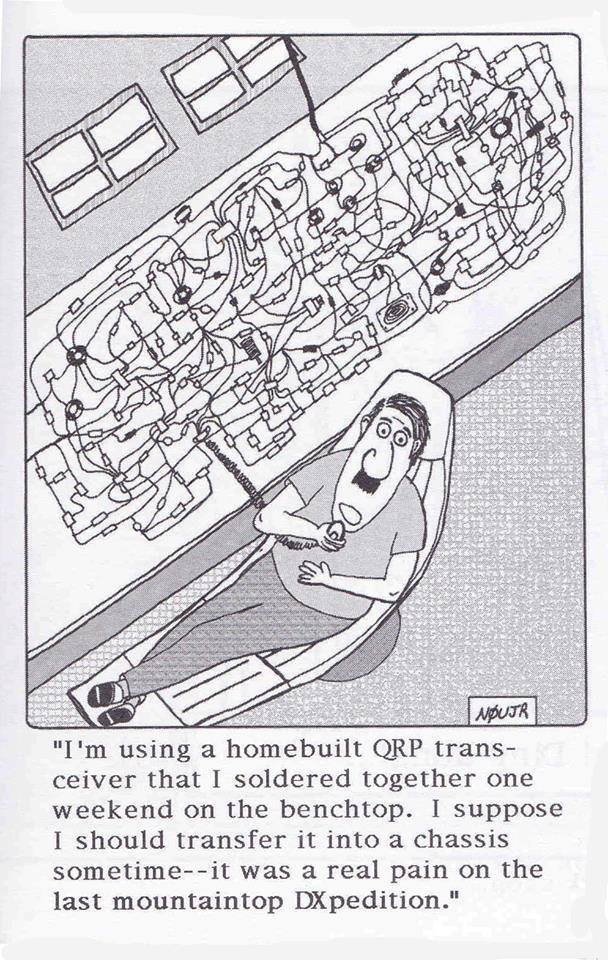
Breadboarding and Mountaintopping


We needed an illustration today. I was having trouble finding something suitable. Then the Radio Gods (along with Joe Peltola and the artist N0UJR) provided this. Obviously I can relate to the breadboard operation. I’m sure Pete can too. As for the mountain topping, that made me think of Colin, M1BUU. And of Wes, W7ZOI.

Our book: “SolderSmoke — Global Adventures in Wireless Electronics” http://soldersmoke.com/book.htm Our coffee mugs, T-Shirts, bumper stickers: http://www.cafepress.com/SolderSmoke Our Book Store: http://astore.amazon.com/contracross-20

Five Lessons from Pluto for Homebrewers

http://www.edn.com/electronics-blogs/embedded-basics/4440230/5-Engineering-Lessons-from-Pluto?_mc=NL_EDN_EDT_EDN_today_20150901&cid=NL_EDN_EDT_EDN_today_20150901&elq=3e27f3c4018844db9381c8a508867555&elqCampaignId=24586&elqaid=27842&elqat=1&elqTrackId=06ba9f8cc21140c1ae477df75c36dd65

Thanks to Bob Crane, W8SX, for the link to this article. Those of us who are reading “The Martian” will find the mention of RTG power interesting (but hey, let’s not try to put any plutonium in our rigs, OK?)

Our book: “SolderSmoke — Global Adventures in Wireless Electronics” http://soldersmoke.com/book.htm Our coffee mugs, T-Shirts, bumper stickers: http://www.cafepress.com/SolderSmoke Our Book Store: http://astore.amazon.com/contracross-20

Interview with Paul Horowitz (W1HFA) — A Giant In Radio Electronics (Video)

I’ve been hearing about this book for years, but until I watched this interview, I knew nothing about the author. Thanks Lady Ada. (And thanks to Farhan for the alert.)

As a native New Yorker, I’m pleased to include in the blog yet another reminder that the Big Apple is not all fashion and finance — a lot of solder has been melted in my home town.

Paul Horowitz has a truly awesome bio. He got his ham license at age eight. QST tells us that lots of little kids do this, but unlike some of the youngsters we see in the magazine I suspect young Paul really mastered the theory. Paul Horowitz has “The Knack.” Big time.

PhD from Harvard. Author of “The Art of Electronics.” Pioneer in the Search for Extraterrestrial Intelligence. Carl Sagan is believed to have modeled the main character in “Contact” partly on Paul. Check out the wiki page:

https://en.wikipedia.org/wiki/Paul_Horowitz

Our book: “SolderSmoke — Global Adventures in Wireless Electronics” http://soldersmoke.com/book.htm Our coffee mugs, T-Shirts, bumper stickers: http://www.cafepress.com/SolderSmoke Our Book Store: http://astore.amazon.com/contracross-20

“The Soul of a New Machine”

We talk a lot about putting soul in our new machines. The phrase comes from a book by Tracy Kidder. Ira Flatow of NPR’s Science Friday recently took a new look at this book. There are TWO recordings in this link. Both are worth listening to. The second is an interview with the author, conducted at Google HQ in New York City. Woz chimes in.
At about 6:43 in the second interview, Ira Flatow and Tracy Kidder get into a little argument about how to pronounce the word “kludge.” I’m with Ira — the fact that he pronounces it this way makes me think that we are using a New York, or at least and East Coast pronunciation.
I am a big fan of Tracy Kidder. His “Mountains Beyond Mountains” is about Dr. Paul Farmer, a heroic physician who has dedicated his life to treating the poor people of Haiti. “My Detachment” is about Kidder’s stint as an army officer in Vietnam. Kidder and his editor wrote a nice book about the crafts of writing and editing: “Good Prose.” “Strength in What Remains” is about the genocide in Burundi.

Our book: “SolderSmoke — Global Adventures in Wireless Electronics” http://soldersmoke.com/book.htm Our coffee mugs, T-Shirts, bumper stickers: http://www.cafepress.com/SolderSmoke Our Book Store: http://astore.amazon.com/contracross-20