I had a great time at the Vienna Wireless Winterfest. The weather was very nice, so I moved my sales operation out to the tailgate area. I managed to sell the Heathkit Twoer that I was trying to get rid of (the receiver is a REGEN). Also sold a bunch of old books, an old o’scope, and some other odds and ends. I picked up a few things I needed, including some solder wick, a replacement rubber band for my wrist rocket antenna launching sling shot and a backup mic for the podcast (just like the one you guys are so find of).
I met many podcast listeners. Bert, WF7I, and Mark, KJ7IEA, from the University of Virginia (the guys with the rhombic) were there and it was great to meet them. N3UMW, the designer of the SolderSmoke logo, was there at my sales table, but I didn’t realize until after the hamfest that he’d been there – -I would have liked to have talked to him! Oh well, more ‘fests in the DC area are coming up, and I still have some junk to sell.
I’ll be at the Vienna Wireless Society’s Winterfest hamfest tomorrow morning. I’ve gathered up all the unnecessary junk in the shack, and hope to replace it all with new and better junk tomorrow. I’ll also have a few copies of “SolderSmoke — The Book” for sale. I’ll be at table D4 inside the facility. Hope to see many of you there!
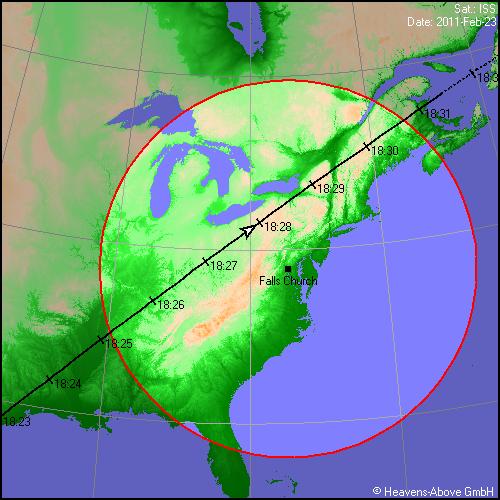
Thanks to a tip from spaceweather.com, Billy, Maria and I were in position to watch the International Space Station fly over the Washington area on the evening of 23 February. The map above (from heavensabove.com) shows the pass we saw. All times are local. Maria spotted it first. She seems to have a talent for this — she last spotted the ISS six years ago (at age 4!) from the streets of Central London.
This was a very nice pass to watch. We were in twilight. We first saw the spacecraft as it flew past Jupiter’s position in the sky. It was red at first, then turned bright white. This time we felt a special connection to the ISS because the twin brother of Astronaut Mark Kelly is currently on board. We all met Mark (and his wife Gabrielle) when they came to London. Mark will be heading up to ISS himself in April. Godspeed to Mark and to his brother. And we’re all hoping for the best for Gabrielle. They are very nice people.
Here is a really well-done video on the new EU radio telescope. Very interesting. They are listening as low as 10 MHz. (I hope my little QRSS shark fins don’t cause any ET confusion!) The antenna elements pictured looked a lot like the devices that Paul, NA5N, has been working on out at the Very Large Array. One thing I didn’t quite get in the video: the shot of Arecibo.
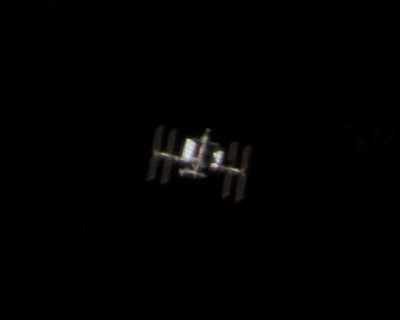
The folks at spaceweather.com report that the International Space Station AND the Nano-Sail D satellite will be visible from North America this week. They provide a very handy on-line tool that lets you know when and where to look: http://spaceweather.com/flybys/?PHPSESSID=iem8ec1ep115mnga8hjhh5p8p0 Here is an amazing image taken by an amateur astronomer in Florida:
“I love to revel in philosophical matters – especially astronomy. I study astronomy more than any other foolishness there is. I am a perfect slave to it. I am at it all the time. I have got more smoked glass than clothes. I am as familiar with the stars as the comets are. I know all the facts and figures and I have all the knowledge there is concerning them. I yelp astronomy like a sun-dog, and paw the constellations like Ursa Major. ~ Mark Twain
OK, so he hung out with Tesla and Edison. Now this… Could Mark Twain have had a pre-radio case of The Knack?
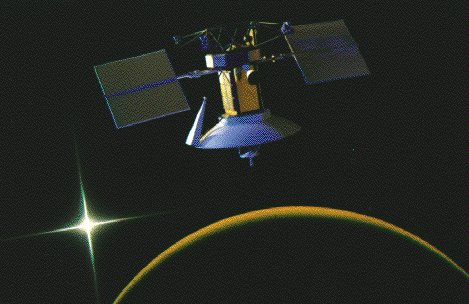
On SolderSmoke Podcast #130 I mentioned that in the book “The Evening Star” by Henry S.F. Cooper, the author mentioned that during the Magellan mission to Venus, some of the chips on the spacecraft could somehow “heal themselves” after developing problems. Wow! Rigs that fix themselves. I don’t know about that. That would kind of take us out of the troubleshooting game, right? Anyway, I was wondering how this “self healing” thing works. Hamilton, KD0FNR has some ideas:
Hi!
I just caught up on SolderSmoke and finished listening to episode 130. FB and great fun! Thanks! You asked a quesiton about logic circuits that had healed themselves on the Venus mission. I can’t find an exact reference to it now, but when I interned at a particle accelerator during my MSEE work, engineers frequently talked about using gallium arsenide transistors because they were rad-hard and self-healing. Here’s the idea as it was recounted to me in the early ’90s:
Radiation can damage transistors by breaking the crystalline lattice inside the semiconductor. Self-healing transistors run very hot so that when a lattice site in the semiconductor crystal is broken by radiation it is ‘fixed’ by the crystal effectively melting around the broken site. It’s similar to your halogen bulb/heat gun fix but on a transistor level and automatically.
Thanks for the mention of my QSO mapper on your show a few years ago! The mapper and my practice exams have continued to evolve and grow, and the latest of each can now be seen at:
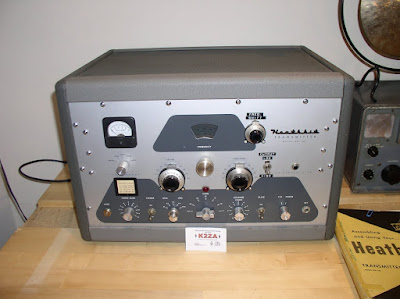
Today was big day here at SolderSmoke HQ. John, K2ZA, and his lovely wife Erika drove down from New Jersey bringing with them the Heathkit DX-100 that John’s dad (now a silent key) had built years ago. John heard me mention my long yearning to once again own a DX-100 (I’d had one as a kid); he very generously decided to give me his dad’s.
It’s beautiful. And BIG: Shipping weight: Over 100 pounds. This, gentlemen, is the rig that they were talking about when they first started to refer to certain transmitters as “boatanchors.”
After some time on a Variac, I plan on pairing this magnificent transmitter up with a suitable thermionic-based receiver. Maybe the HQ-100. Then I will put it on 75 meter AM and will attempt to establish myself as one of the plate-modulated, big signal anointed, perhaps even attaining “tall ship” status. We can dream…
Getting the DX-100 was great, but even nicer was meeting John and Erica. What nice people they are!
John and I recorded (in both video and audio) a short segment about the DX-100. I will plug the audio into SolderSmoke #131, and will upload the video to the SolderSmoke YouTube page.
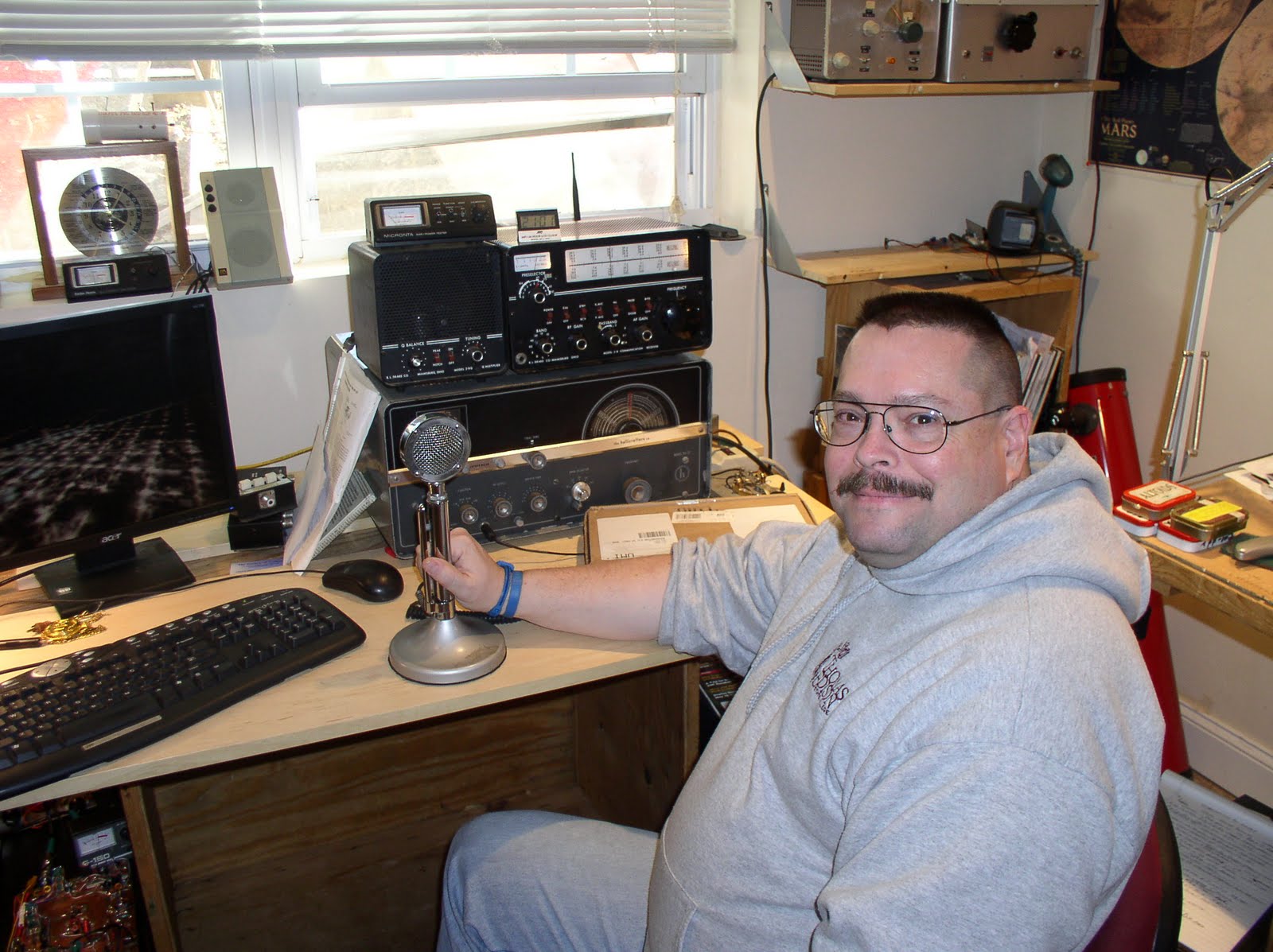
Here’s John with the Drake 2-B, the HT-37, and the INFAMOUS Astatic D-104:
Lulu is running a President’s Day sale on SolderSmoke The Book (and everything else they are selling!). Through Feb 21 use the coupon code Happy 305 at checkout and save 20%. http://soldersmoke.com/book.htm
Speaking of sales… We will soon be in T-shirt weather in the Northern Hemisphere. And hamfest season is approaching. Now is a good time to stock up on SolderSmoke T-shirts. CafePress is offering 35% off on all T-shirts now through Sunday. It’s 15% off site-wide and you get another 20% off with the coupon code PREZ http://www.cafepress.com/SolderSmoke
Bill, I immensely enjoyed Solder Smoke — The Book, and have given it as gifts to several friends. It has rekindled the homebrewing spark, and I have been operating only homebrew gear this year as a result. My transmitter is a rockbound 40 meter rig, and I am using a HF regen receiver.
Tiring of QRM on 7.030 MHz, I decided to cobble up a VFO. Well, you know how that can take on a life of its’ own. I decided to build a Hartley oscillator at 3.5 MHz, and then double it to 7.030. The initial stages of the oscillator and buffer went well, but then I ran into a brick wall with the doubler, which performed admirably as an attenuator, but nothing else. The circuit was simple enough, but it just wouldn’t work. For a week I tweaked and tuned, to no avail. (as a result of all this effort, my wife said VFO must mean Very Frustrating Object). Then this morning I was going over the circuit again, and discovered that one side of the doubler tank circuit capacitor was grounded, and not supposed to be. It seems the knob shaft of the variable cap was in contact with the metal front panel, and being grounded out. I corrected the problem, and almost shouted EUREKA! when the doubler sprang to life and generated a big and perfect sine wave exactly at 7030!
I just wanted you to know that the story of your doggedness in tracking down the cause of harmonics on one of your homebrew rigs provided moral support to help keep me coming back again and again.
So, thanks again for the inspiration Bill.
Hey, I hope you are going to FDIM this year. If so, you should bring a good supply of SSTB. I bet you would go home with new junk, but no books.
Phil, KD4IDH, sent me links to these two very interesting organizations. We sometimes joke about being “The International Brotherhood of Electronic Wizards.” These folks seem to be taking that idea to a whole new level.
Geeks Without Borders +) GWOBorg is an international coalition of passionate problem solvers working together to assist people whose survival is threatened by lack of access to technology or communications due to violence, neglect, or catastrophe.
One of the things that GWOB does is called The Digital Mountaintop: This is a free, open communications hub, accessible via voice, text (SMS), plain old telephone (POTS), Skype, SIP, Google Voice, Twitter, Facebook, Email, Instant Messaging (IM)…and as many other networks we can connect to. In crisis situations, neighbors can ask for help simply by sending sending a message to the DMT, as long as they (or someone they know) can connect via any of the messaging or real-time communication methods it supports.
Random Hacks of Kindness (RHoK) is all about using technology to make the world a better place by building a community of innovation. RHoK brings software engineers together with disaster risk management experts to identify critical global challenges, and develop software to respond to them. A RHoK Hackathon event brings together the best and the brightest hackers from around the world, who volunteer their time to solve real-world problems.
Peter Parker, VK3YE, is one of the real DSB Gurus. When I got started in the world of double-wide RF, I would frequently turn to his web site for ideas and inspiration. So you can imagine my delight in getting this e-mail from him (his DSB WSPR video is embedded above):
Hi Bill, Discovered SolderSmoke a few weeks back and love the show. You might be interested that another DSB WSPR station is on air. A video demo appears at http://www.youtube.com/watch?v=2aUHNRgV7kwIt’s still very crude (eg manual T/R switching) and the receiver is getting false spots. However the transmitter is working very well, with some long distance spots. 73, Peter VK3YE
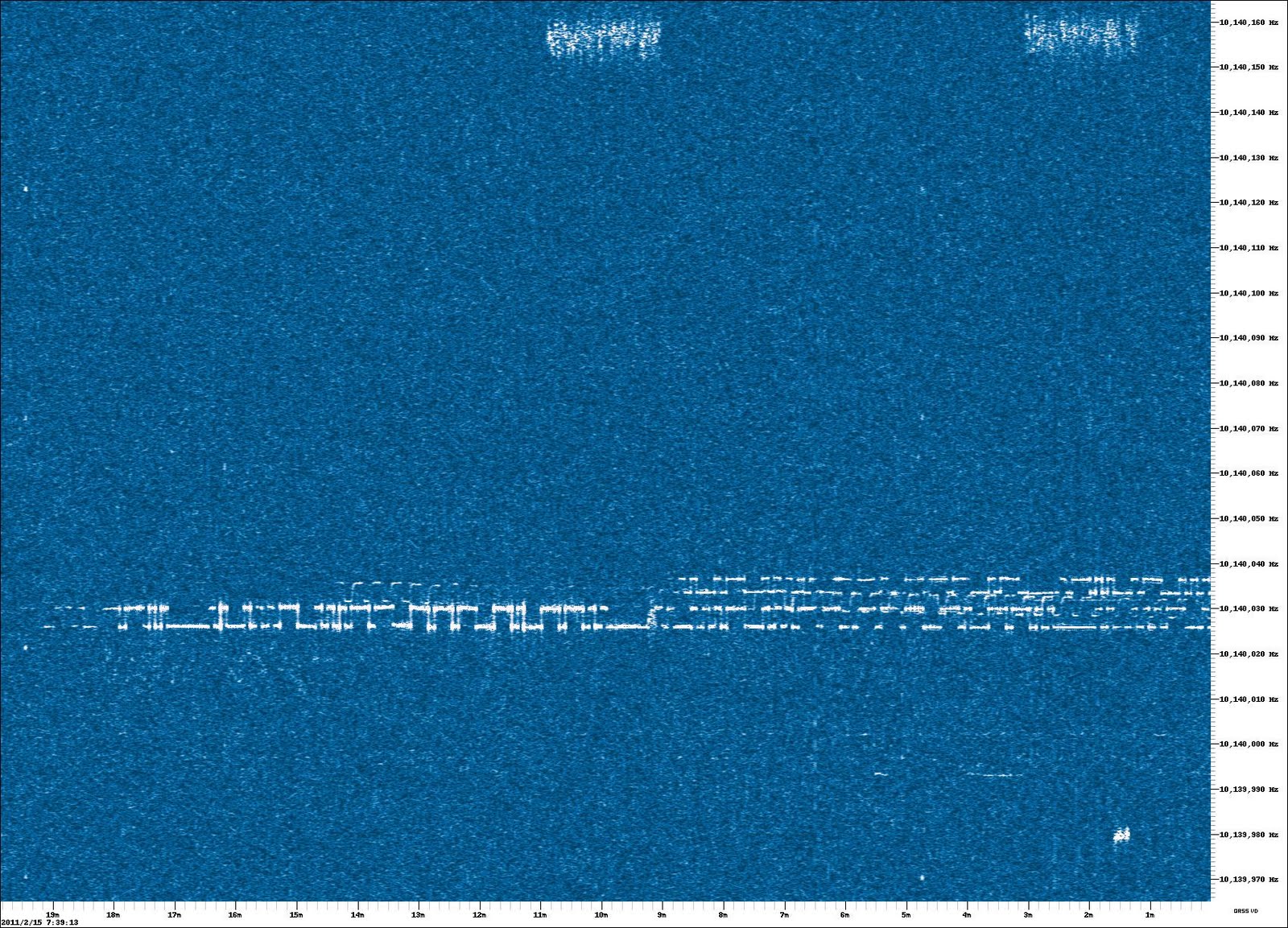
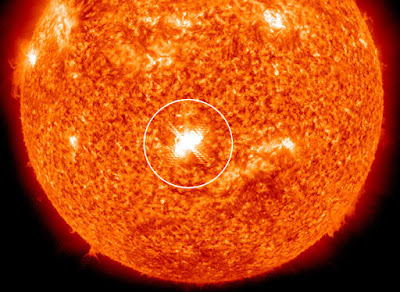
Yesterday I predicted that solar activity would affect my little DaVinci code QRSS beacon. Sure enough, Pablo, EA4FUK, reports seeing my shark fin this morning on EA1FAQ’s grabber. He sent this image: A big X-Class flare took place at 0200Z, which was probably just a few hours before Pablo was looking at the FAQ grabber. This pond crossing probably also coincided with gray line time at his location.
Paul, NA5N, puts it all in context (in a message to QRP-L):
Gang, There was an X2 flare about 0200Z 15 FEB (about 2100 EST). This has caused HF radio blackouts on the sunlit side of the sun (not us!). As this subsides, the E/F layers will be highly ionized for good reflection. This event has already elevated the solar flux to about 113 (average lately about 80-85). While this doesn’t do much for us right now in North America, it could create some very interesting morning gray line propagation if you’re one of those morning people.
The X2 event didn’t have much density to it, only creating a shock wave of about 550 km/sec. However, the M6 two days ago had a shock wave of about 1200 km/sec. – enough to cause a geomagnetic storm when it is expected to arrive Tuesday morning.
These active regions are near the center of the sun, meaning any further flares will send shock waves directly at us. The active regions are highly magnetized, meaning they are capable of generating further M or X class flares. If another flare or two happens tomorrow (Tuesday) during daylight hours, it will raise the solar flux and the higher bands will be open for the duration of daylight.
Therefore, the upper bands may be open, but may be interfered with for a few hours if a geomagnetic storm is triggered. It’s a matter of dodging the bad stuff (geomagnetic storms) to get to the good stuff (enhanced E/F propagation).
The only question left … is this a hiccup on the sun, or is it finally waking up from hibernation?
I finally got around to something I have been meaning to do for our fellow Soldersmoke and Gadgeteer blog friends. As soon as we moved to Tennessee last summer I knew I had to do it.
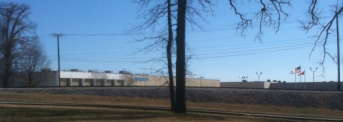
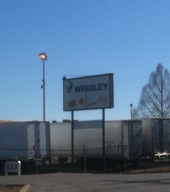
I had to go to town (Chattanooga) today to the Honda dealership to get a warranty repair done on my wife’s car. The Wrigley plant that manufactures all our Altoids is right across the highway from the car dealership!! So guess what I did after getting the car fixed?? I got pictures of the plant for your blog.
Now they were with my iphone camera so they weren’t the clearest, and I made sure that no one was behind me when I snapped them after stopping for a quick shot.
In the one marked Altoids Sign, you can see the tin on the sign under the Y in Wrigley.
For anyone who wants to find this on Google Earth, it is at the corner of Jersey Pike and Shallowford Road in Chattanooga Tennessee, near the intersection with the TN 153 freeway.
Part of the plant has a for sale sign on it, mainly an unused huge loading dock building that fronts to Shallowford Rd. The building next to Wrigley’s is Sathers Candy, and it appears that Chattanooga must be known for food as both Little Debbies and Moon Pies are made in metro Chattanooga too.
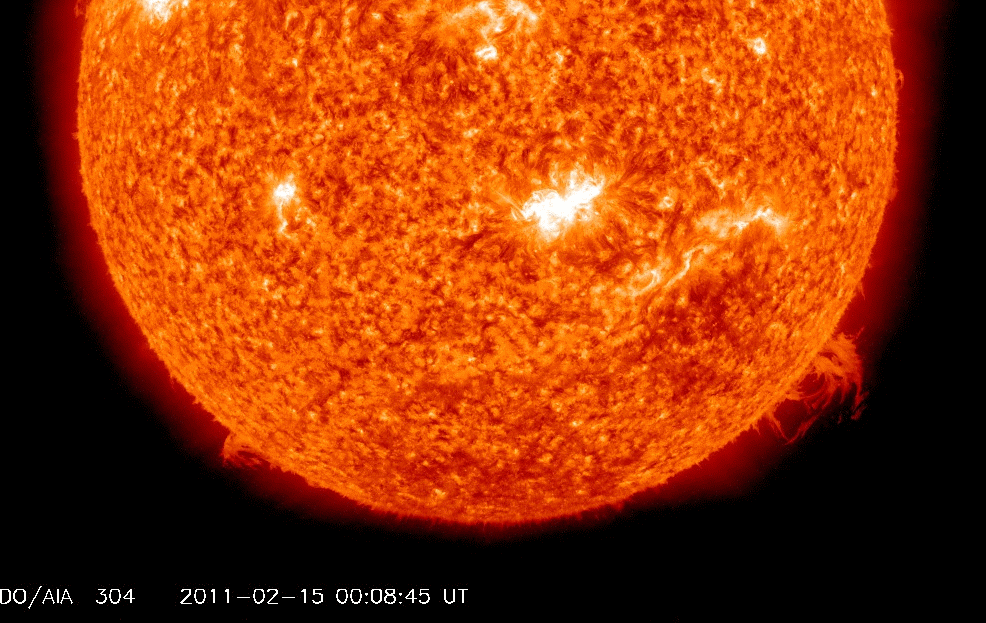
The fellows over at spaceweather.com report a big solar flare yesterday at 1738 UTC (pictured above). This may, of course, have some impact on my 20 mW QRSS signal. I put the little Da Vinci code beacon back on the air yesterday. You can try to spot my Italian shark fins swimming past Pensacola, Florida: I put a miniature version of Bill, W4HBK’s QRSS grabber in the right hand column of this blog. Just look to the right and scroll down a bit. Johan’s Belgian Grabber is also there.
This project has me digging through the boxes, looking for my 2 meter gear. This looks like fun! From AMSAT:
ARISSat-1 is a microsat developed as a follow-on to the SuitSat-1 project. The satellite was launched to the ISS on January 28th, 2011, with deployment during an EVA (spacewalk) on February 16, 2011.
The satellite will downlink live SSTV images from four onboard cameras, live telemetry and messages on the CW, FM voice, and BPSK downlinks, as well as provide a 16kHz wide transponder for two-way contacts. All the uplinks and downlinks are based on software defined radio systems.
Telemetry will include spacecraft subsystem information, as well as data from the Kursk State University experiment. This experiment will sample the change in vacuum as the satellite slowly re-enters the atmosphere.
Frequency Information
Mode V Digitalker (Voices Messages and Telemetry):
Downlink
145.9500 MHz FM
Mode V Imaging (Robot 36 SSTV from onboard cameras):
Downlink
145.9500 MHz FM
Mode V Telemetry (1000 baud (400 baud backup)):
Downlink
145.9200 MHz BPSK
Mode V TLM Beacon (CW-2, active with BPSK-1000):
Downlink
145.9190 MHz CW
Mode V TLM Beacon (CW-1, active with BPSK-400):
Downlink
145.9390 MHz CW
Mode U/V (B) Linear Transponder (Inverting):
Uplink:
435.7580 – 435.7420 MHz SSB/CW
Downlink
145.9220 – 145.9380 MHz SSB/CW
And for those of you looking for a bit of competition, there is a tech challenge:
AMSAT-UK has announced a ARISSat-1 reception challenge with a FUN reward. The different categories cover those with or without a FUNcube SDR dongle.
ARISSat-1 is scheduled for deployment from the ISS next Wednesday Feb 16 – it has a composite VHF downlink that will easily fit into the FUNcube Dongle receive spectrum. The telemetry is 1 kbit BPSK and can, of course, also be received with a normal SSB 2-metre receiver.
The expected signal levels from ARISSat should be similar to those we expect from FUNcube itself (and also eventually from UKube) and the team are keen to discover what will be the minimum and best type of antennas for schools to use with a FCD. Therefore user experience with the ARISSat signals will be very valuable in making this determination.
To encourage everyone to receive ARISSat signals we are offering a FUN reward for listeners!
There are a number of categories for this challenge – they include:
1+ The first FCD user, from each continent, who can post a spectrum recording of the received signal together with evidence of decoding the data using the ARISSat software and of sending it to the ARISSat data warehouse .
2+ The first non-FCD user, from each continent, who can provide evidence of having decoded the signals and of sending it to the ARISSat data warehouse.
3+ The listener, using a FCD or not, who can demonstrate satisfactory reception of the telemetry in the same ways as described above, using the “smallest” possible receive antenna. The actual closing date for this part of the challenge will be announced later.
4+ All other entrants who can demonstrate that they have been having FUN!
Please submit your “entries”, including your location, station details (including FCD serial number where applicable), postal address and reports to g0auk@amsat.org
Good luck,
ARISSAT-1 http://www.arissat1.org/
You can join the FUNcube Yahoo Group at http://groups.yahoo.com/group/FUNcube/
Twitter: http://www.twitter.com/FUNcubeUK Facebook: http://www.facebook.com/ just lookup FUNcube
Howdy Bill, and all the SolderSmokers listening in on the PodCast.
We appreciate the shoutout in #130 about the NanoSail-D excitement .!.Stan – N4PMF and I have been working over the last year or so tore-activate the Amateur Radio Club at NASA’s Marshall Space Flight Center.We both have day jobs in the Huntsville Operations Support Center (HOSC),and routinely interface with the scientists and developers involvedwith projects such as the International Space Station, Space Shuttlepropulsion, and more recently the FastSat program.
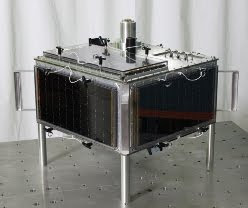
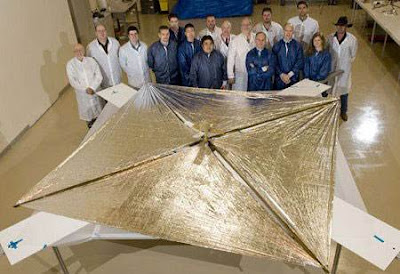
The NanoSail projectis actually a smaller satellite that was carried into orbit by the FastSat.This NanoSail vehicle is only about 18 inches long, and a few inches square.No room there for high powered S-Band telemetry transmitters, so it carrieda ham licensed 1/2 watt FM transmitter in the 70cm band. Maybe later wecan get into more detail about all that if you are interested.
The NanoSail is the first successful deployment of a Solar Sail into earth orbit.The quicker story is that our club (WA4NZD) was started in the early-1970s,and operated Special Events commemmorating Apollo flights to the moon,Skylab missions, and early shuttle launches. Activity kinda dropped offin the mid-1990s, and the club is only now coming back to life. We stillhave VHF and UHF transcievers and beam antennas on a tower, that areready to operate – and sometimes we listen in on ISS school contacts,or bounce APRS beacons thru the ARISS digipeater.
We of course got excited back in December when FastSat launched, and the NASA scientists asked ifwe could help them by listening for the NanoSail when it ejected.Unfortunately, Murphy had snuck on-board, and somehow prevented the smallersatellite from completely ejecting, and it looked like a loss….
Then in January the FastSat telemetry indicated that NanoSail-D may have‘popped itself out’, and the Principal Investigator Dean Alhorn foundStan and asked if we could take him to the station “NOW” to listen for it.Sure enough, we had the right equipment, ready to go, and he got to hearit for the first time. We even had the AX25 TNC hooked up and it decodeda telemetry burst which allowed them to better estimate when the SolarSailshould deploy. Dean was very very excited, and we all enjoyed a bit ofthe spotlight as Dean made obvious reference in numerous press releases tothe role of the MSFC Amateur Radio Club in helping get the word out.The power of ‘crowd-sourced’ science became obvious as they receivedreports from all around the world. We are lucky to have been ready,willing and able to decode that early telemetry – it sure will help tovalidate and justify the existence of our little club station at NASA.You can easily find more on the internet, searching for NANOSAIL and WA4NZD.
Again we appreciate the publicity from your Podcast, and look forward totuning in more often, and possibly sending you more info for your show.Thanks /;^)Alan Sieg – WB5RMG (http://wb5rmg.wordpress.com)Stan Sims – N4PMFMSFC ARC – WA4NZD (http://wa4nzd.wordpress.com)
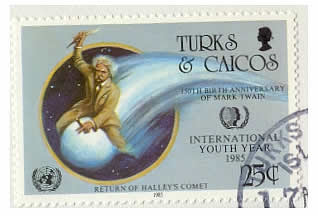
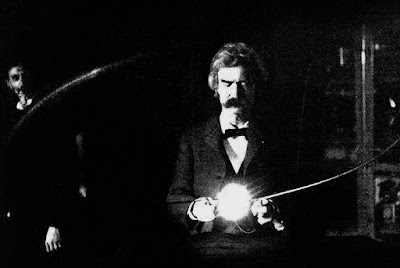
For Christmas my wife gave me Mark Twain’s recently released autobiography. This put me on the path to “The Adventures of Tom Sawyer” which I’m reading on the train these days. I was pleased to find out that Mark Twain was very interested in science and technology. He liked to note that he was born during an appearance of Haley’s comet, and that he would die when the comet returned (he did!) Wikipedia notes that there was a lot of tech talk in Twain’s “A Connecticut Yankee in King Arthur’s Court” (one of my favorite books from high school days). Twain was close to Nikola Tesla. The wonderful picture (above) shows him in Tesla’s lab. He was filmed by Thomas Edison (YouTube version below).
Frank, VK2AKG sent me this link to a good article about, solder, smoke and a simple homebrew way of keeping the fumes out of our lungs. (Steve “Snort Rosin” Smith take note!)
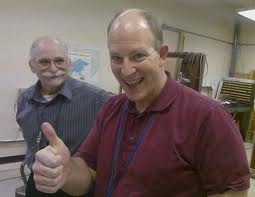
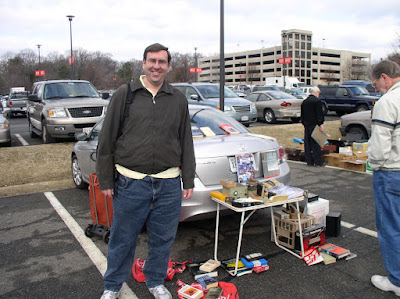 Bert, WF7I, at Winterfest
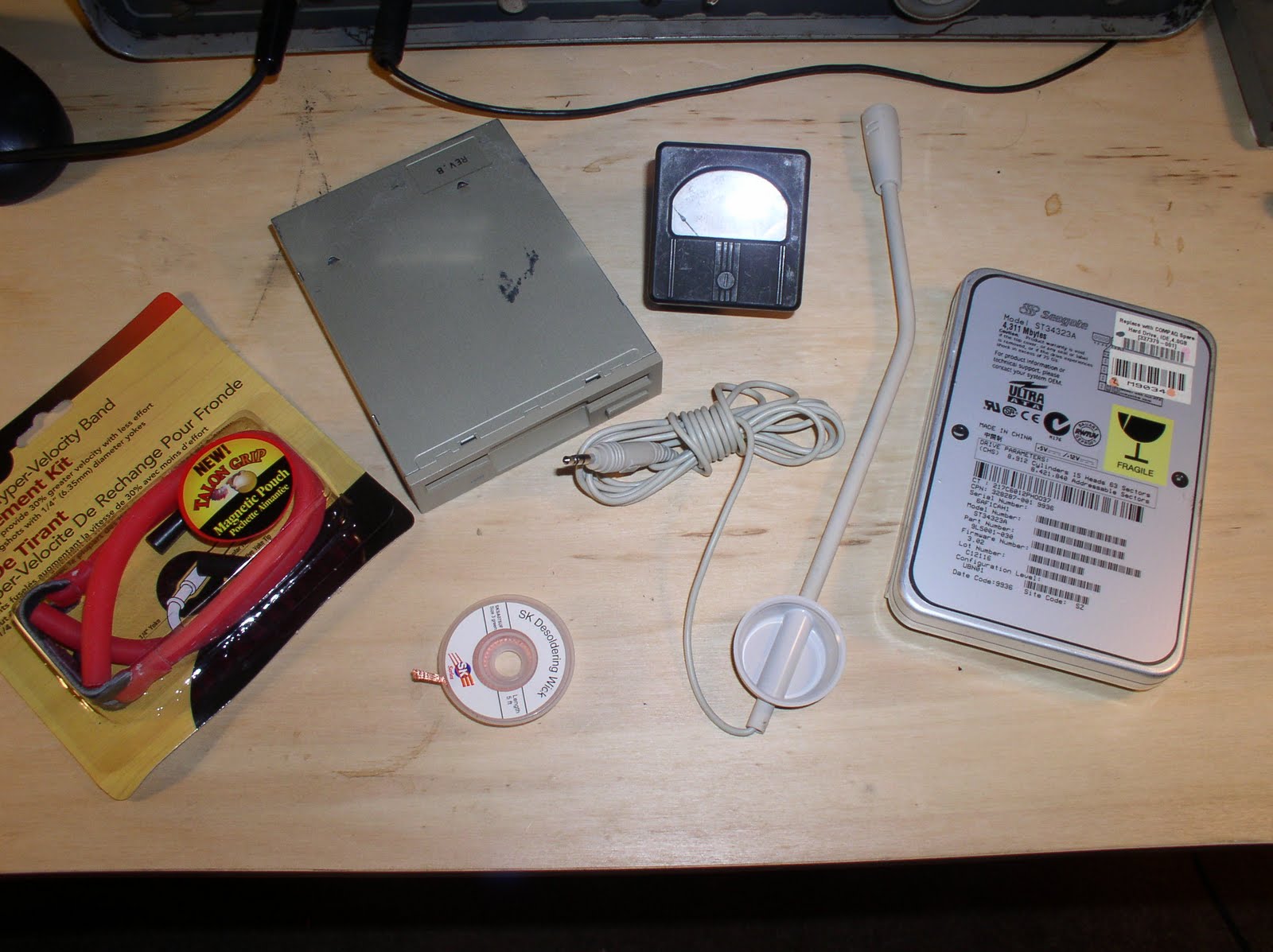 I met many podcast listeners. Bert, WF7I, and Mark, KJ7IEA, from the University of Virginia (the guys with the rhombic) were there and it was great to meet them. N3UMW, the designer of the SolderSmoke logo, was there at my sales table, but I didn’t realize until after the hamfest that he’d been there – -I would have liked to have talked to him! Oh well, more ‘fests in the DC area are coming up, and I still have some junk to sell.