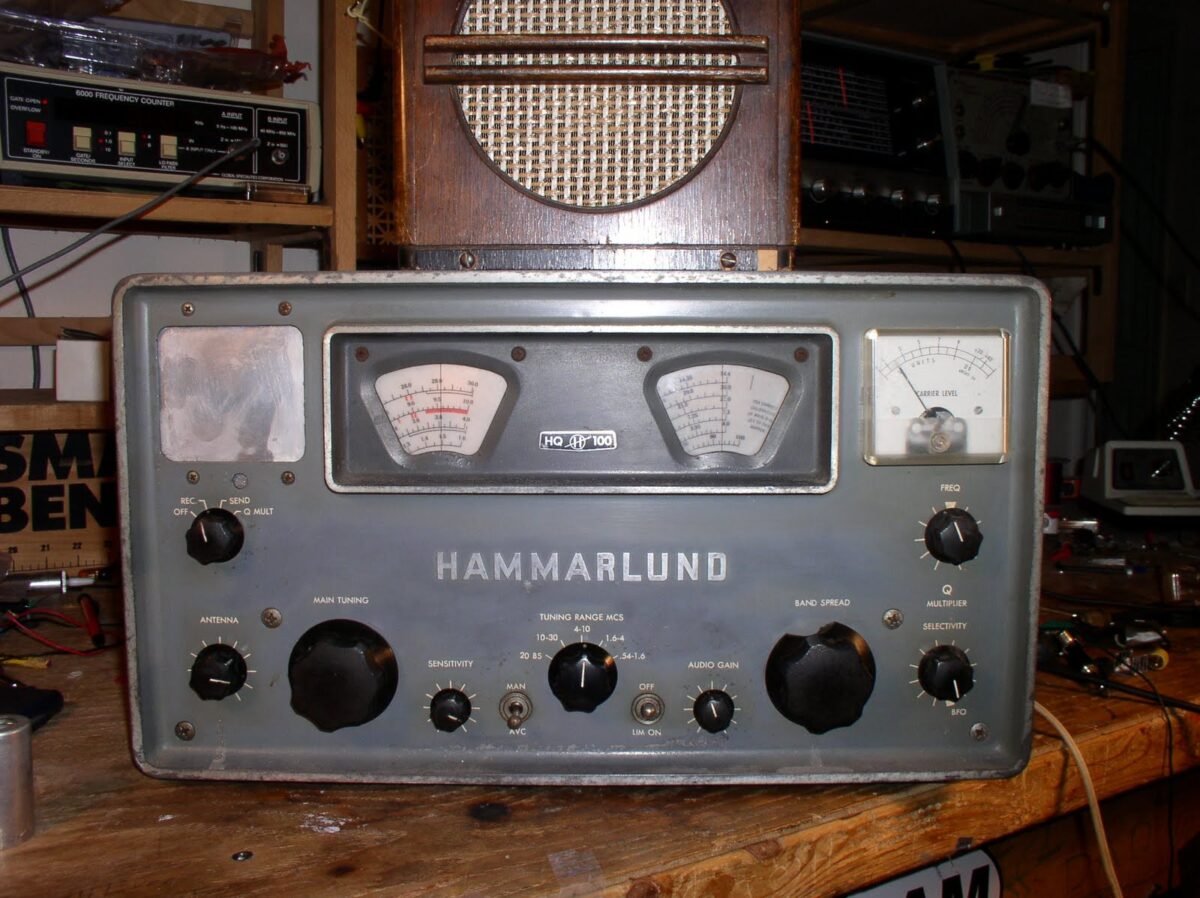
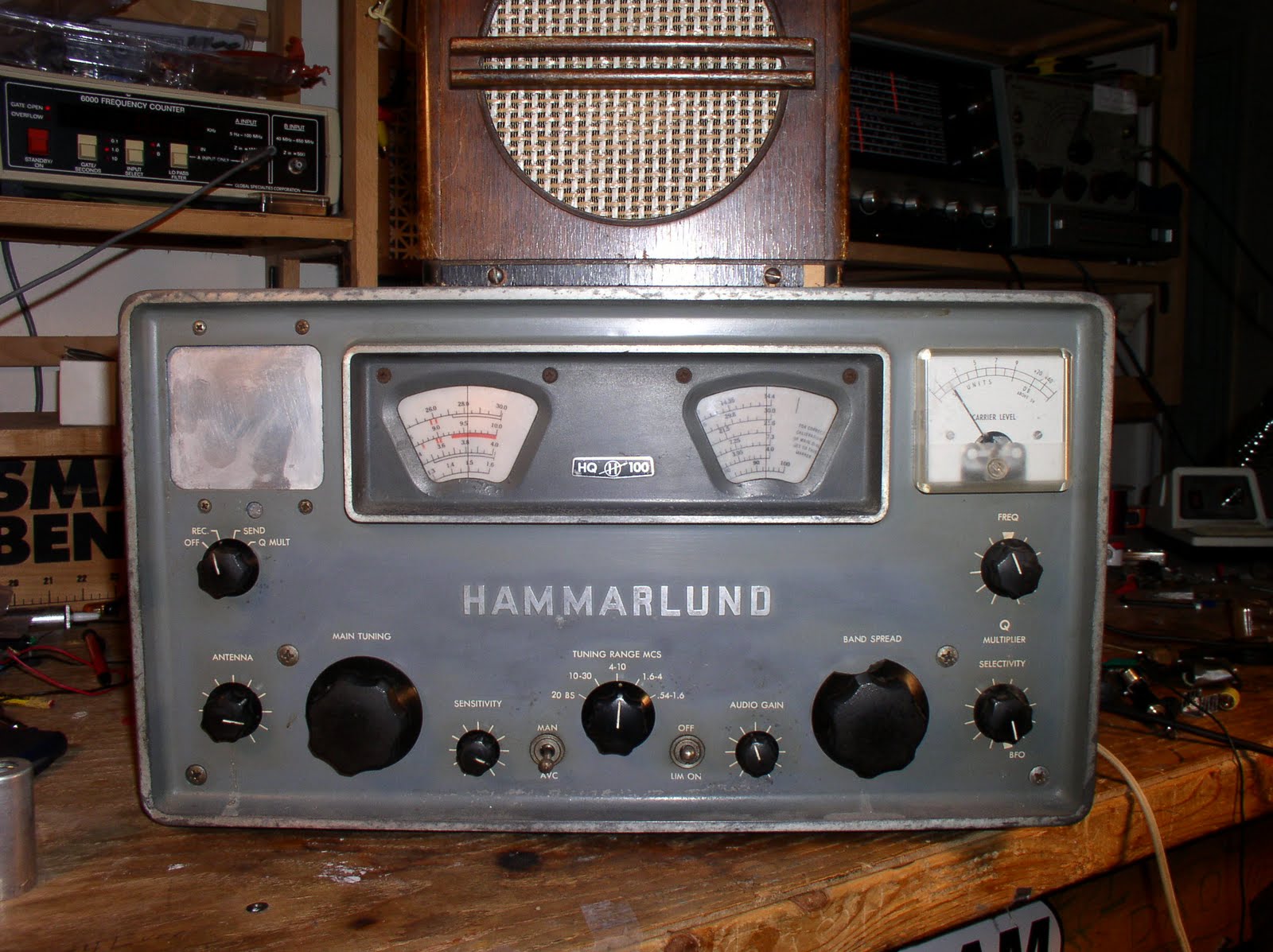
 I’m sitting here in the shack at 0645 EST on the first Sunday morning in 2011. Coffee is on. And so is my OLD Hammarlund HQ-100. I have it tuned to a friendly AM roundtable on 75 meters. And it sounds GREAT. Nothing like a receiver that is as broad as a barn door to let you appreciate that great AM sound.
This receiver and I have some history. I bought it in the Dominican Republic, probably in 1993, probably from my friend (now SK) Pericles Perdomo. It had suffered the ravages of the Dominican radio environment from both ends: I think I found signs of a lightning surge at the front end, and of a power surge at the AC input. The audio output transformer was bad also. This was one of my first tube-type renovation project. I had a lot of fun with it.
There are no crystal filters in this receiver. If you want to narrow it down, there is a Q-multiplier (so –yikes!– this receiver is at least in part a regen). In its original configuration the Q multiplier doubled at the BFO, but I guess my anti-regen feelings were at work even then: I took the 100 kc crystal calibrator and put a 453.5 kc crystal in there — so that calibrator now serves as the BFO. This seems much more civilized.
You can see in the picture that the clock is gone. Mine was in pretty sad shape when I got it. Plus I thought it looked kind of goofy in that otherwise very beautiful front panel. So I took the clock out, patched the hole, and gave the clock to a very grateful Hammarlund collector.
The AM really sounds great. I can see that I’m going to need a 75 meter dipole so I can match this receiver up with my DX-60 VF-1 combo.