Drake 2-B Goes Digital with WSPR

7 spots:

Timestamp Call MHz SNR Drift Grid Pwr Reporter RGrid km az
2010-02-06 16:04 DK9MS 10.140210 -11 -1 JO40tm 2 I0/N2CQR JN61fv 983 166
2010-02-06 16:04 PA3BTI 10.140271 -8 0 JO22og 5 I0/N2CQR JN61fv 1276 152
2010-02-06 16:04 DL9DAC 10.140246 -4 0 JO31qi 20 I0/N2CQR JN61fv 1120 158
2010-02-06 16:02 DL6NL 10.140262 -20 2 JO50cb 0.1 I0/N2CQR JN61fv 924 168
2010-02-06 16:00 DF6DBF 10.140279 +1 -1 JO31si 10 I0/N2CQR JN61fv 1116 159
2010-02-06 16:00 M5LMY 10.140248 -14 1 IO91oi 5 I0/N2CQR JN61fv 1455 131
2010-02-06 16:00 DL1EEZ 10.140201 0 0 JO31qi 20 I0/N2CQR JN61fv 1120 158

Query time: 0.002 sec

Until this weekend have been “transmit only” on the WSPR system, running the world’s only homebrew double sideband WSPR rig (please correct me if I’m wrong). I’m also running one of the most low-powered of WSPR stations (20 mW).

I’ve been feeling a bit guilty about my “transmit only” status. I felt like I wasn’t doing my fair share in the WSPR effort. I was sort of a digital free-loader.

So Saturday I decided to do some receiving. I fired up the old Drake 2-B. I ran a lead from the headphone jack of the receiver into the audio in of my old Tecra 8100 (running Linux Ubuntu Jaunty Jackalope). Antenna was a pathetic little end-fed wire. The only tricky part was getting the Drake on the precise freq. I just put my WSPR transmitter on 10140200 Hz and then put the bandpass in USB 2.1 kHz. I found the computer clock was off a bit (I had neglected to run the ntp program), but once that was taken care of signals started pouring in. And reports were automatically uploaded to WSPR HQ, and appeared on-line (see above).

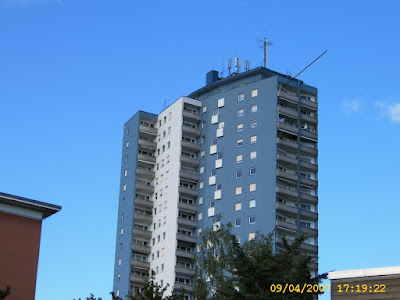
I was very pleased to receive DL6NL’s 100 milliwatt signal. OM NL is well known in the QRSS/WSPR world. A picture of one of his more QRO rigs appears above. A shot of his balcony Microvert antenna (the white thing at the end of the dark indicator line) appears below.
Haiti: Dominican Hams Help

The video (from a phone patch the day after the quake) gives you a real sense of how bad it is. It was good to see that hams from the Dominican Republic were going over to help out. See below.

From: http://spectrum.ieee.org/telecom/wireless/hams-in-haiti/1
BY Anne-Marie Corley // January 2010

… Which leads to the other difference in Haiti: The country is home to very few amateur operators in the first place. Though there are around 100 to 120 ham licenses active for Haiti, according to Pitts, only about seven or eight operators were actually in Haiti as far as the ARRL can determine. According to Bill Pasternak, the president and cofounder of the Amateur Radio Newsline, which broadcast audio from one ham operator outside Port-au-Prince soon after the earthquake hit, most of the operators who have Haitian licenses aren’t even Haitian but rather missionaries and aid workers who travel in and out of the country.
Pitts says that the ARRL has heard from only a few operators, most from outside Port-au-Prince, though one operator did radio in from the city just to let the organization know he was alive. ”The ones that were there did all they could,” Pitts says, ”but we haven’t heard from all of them.” It is likely that some were killed, Pitts speculates. Others may have been concerned with safety, McPherson suggests, so hams in Haiti have been ”on and off the air,” he says.
To help out, hams from the neighboring Dominican Republic have traveled into Haiti several times to set up equipment, despite being attacked by looters last week. They set up a 2-meter analog repeater high on a mountain close to the Haiti–Dominican Republic border. The repeater takes in weak signals—even one from a clip-on radio putting out just 5 watts—and rebroadcasts those signals on a different frequency and at a higher power.
Dominican operators installed a second repeater near the airport in Port-au-Prince and were expecting a third to arrive from ARRL Tuesday, which they will likely put in the region southeast of the capital.

”They’re doing really good work,” Pitts says of the Dominican helpers, ”getting things where they need to be and coordinating with other teams.”
Pitts adds that the international nature of ham radio is well suited to emergency missions like this one. Hams in Argentina, Brazil, Cuba, Florida, and Puerto Rico, among others, were on the air and listening for any signals soon after the earthquake. ”Nobody was going to hiccup without being noticed,” Pitts says. And because they talk in radio code, language barriers don’t matter as much. ”We all have the same language,” Pitts says. ”We’re used to talking with each other.”
The embedded hams in Salvation Army recovery teams work, too, McPherson says, because they can tap into the entire amateur radio community. Nonofficial operators, for example, who may hear an embed trying to reach Haiti or to call out, may help relay a signal. ”It’s like [all the] amateur community is listening, standing by to help,” McPherson says.
The lesson to be learned, according to Pitts, is that ”in a situation or population where amateur radio is encouraged and present,” hams can provide better and faster information during a major disaster, which allows a faster response. ”That golden 48 hours is where the hams really can shine, if they’re there.”
So while cellular and Internet communication return ever so slowly to normal (or better than normal), what Haiti might also want to invest in is a few more homegrown radio operators.

PA1ZZ Gets Ticket in Southern California

A while back we reported on the Californian travails of long-time listener Rogier, PA1ZZ. We are happy to report that OM Rogier has joined the ranks or U.S.-licensed radio amateurs and is preparing to wiggle the ether with the FB rig pictured above.

Hey Bill,
Since the FCC doesn’t like it if you use the foreign license as a Permanent resident. I took the plunge and passed the technician and general exams in one day.
So here I am KJ6ETL QRV from San Mateo, CA.
One day I will do the Extra class but that’s for later. First I have to study for my career, hobby comes 2nd…

I still had my DSW-II build from a kit when I was living on Bonaire. But never managed to get in the air due to the lack of a dummy load to tune the final stage and a very strong HF signal from a local US religious broadcast station (50KW) aiming at South America and the Radio Netherlands relay station. Both put so much HF in the air that my SWR meter needle was pushed in the corner without my transmitter hooked up…

Now, years later, I polished the March R3A paddle and finally tuned the DSW-II. Next step will be to hang an invisible 20mtr band dipole on our balcony (hoa’s….) and see what happens.
Since my morse skills are very rusty and antenna and power are rather limited I might want to jump ahead and start with the digital modes…


Smiles across the wires,

Rogier