Nick, KA1BQ, alerted me to this one. I don’t think Herman really had The Knack ( he seems more like an appliance operator to me), but he did work Italy, so it merits mention here.
Month: August 2008
SolderSmoke in Australia in 1944: Listen in!
Well, not exactly SolderSmoke, but these VK3 hams were obviously melting a lot of solder. One of them recorded some of their 1944 QSOs. (I may have mentioned this recording before, but it is good enough to mention again!)
Have a listen: http://www.crossbandradio.com/xbands/ehams.mp3
Cheerio and 73 Old Boy!
Kits and Parts dot com
For some nice offers on parts of interest to QRPers and Knack victims in general, check out the website of Diz, W8DIZ.
Google to the Moon! $30 Million in Prizes!
Extra prizes for finding artifacts! Will there be a SolderSmoke team in the competition?
QRSS e-mail from VK6DI
Hi Bill,
OK on your podcast. I had a quick listen to the first portion. Yes, QRSS3 bandwidth is indeed 0.34 Hz. ON7YD has an excellent CW bandwidth reference, see –
http://www.qsl.net/on7yd/136narro.htm#Bandwidth
Clearly ‘hard keying’ of any CW (or FSK) TX will increase the transmitted bandwidth. In a practical sense QRSS transmissions key the carrier at such infrequent intervals that an odd key click every 3 (dot) or 9 (dash) seconds will be of little consequence, and especially with QRPp. Ideally however it would be best to control the carrier rise and fall times during keying. A ‘raised cosine’ / ‘Gaussian’ rise / fall time is optimal. It also seems to make ‘intuitive sense’ for those like me that do not understand the underlying math’s.
Another way to get more familiar with QRSS bandwidth requirements is to open Spectran –
http://www.weaksignals.com … Select a Mode (eg – QRSS3), then observe the “Show Controls” menu –
(22050 / 65536 = 0.34 Hz)
For QRSS10 you will see –
(11025 / 131072 = 0.084 Hz)
QRSS10 not considered unusable on HF for RX purposes, as it is impossible to keep even the most stable TX within a few FFT bins due to continually varying ionospheric conditions. RX s/n is dependent upon capturing as much energy in as few a bins as is possible.
Following some 100’s of tests over several years between DL6NL and myself, we eventually concluded that QRSS6 TX with a 5 Hz CW_FSK shift was “pretty much optimal” over long paths if you want accurate callsign ID’s. Slower obviously gives more time to “integrate” the signal, and make a ‘decision’ as to whether the portion you have just seen was a dot or a dash. The trade off (as always), is rate of information transfer. When TX’ing QRSS6 FSK_CW, the HF reception should remain as QRSS3 – use Slow Mode. QRSS6 transmissions will look fine on most grabbers.
Another factor not generally appreciated by newcomers to QRSS is that the visual ‘gain advantage’ of QRSS comes not from the RX’ers filter bandwidth, but rather from the FFT bin size (Resolution) within Argo / Spectran – namely 0.34 Hz. Narrow roofing filters can be useful to exclude strong QRM that otherwise might impact the RX AGC, but make no difference to the observed s/n ratio otherwise. (All else being equal.)
Unfortunately I think that is fairly unlikely that I will see many EU signals until conditions improve. I have caught only one EU signal so far this year. Conditions have been really poor these past 12 months or so, and the worst I’ve encountered since I started QRSS activities back in 2004, or was it 2005? When the sunspots return I’m sure I will see many new EU signals. DL6JAN has previously made it down here with 5 mW + many other stations that were running 50 mW to 200 mW or so with minimal TX antennas.
Good luck with your QRSS experiments!
Regards,
David, VK6DI.
SolderSmoke #89
 http://www.soldersmoke.com

August 3, 2008
Positano on the Amalfi Coast
QRSS: An Idea for More N. American Activity
Argo's bandwidth: .34 Hz
The New SolderSmoke Audio Filter
Knackered? Translating American to British
Kanga USA helps in Lake Michigan rescue
Google's "Back to the Moon" contest
Russia's Mars sample return mission
Apollo 11
Lasers from San Diego to the Moon
N0TU's slideshow (with Tuna Tin Two)
MAILBAG: K4QO on clubs without rules.
G0WAT names me "Hodeghog #4"
VE7SL ID's Mystery Military Radio
ZL2GX finishing Ph.D.
KC0PET gets EMRFD
N5XL reports Tantalum shortage
G3WOE on Shep and 20 new BITX20s
W8OAJ is now N8WQ, building MEPT
Italy Travel Report: Positano
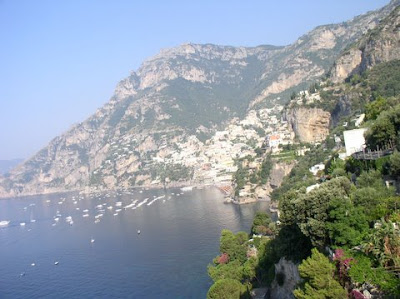 We were down on the Amalfi coast this week, near Positano. This is on the southern coast of a beautiful peninsula that juts out into the Med, a bit South of Naples. I brought a SW receiver with me, but didn’t hear too much. We did some fishing, down near the boats you see in the picture. This was the view from our window. I’ll mention this in SolderSmoke 89 (probably tomorrow), so I thought I’d put a picture on the blog.